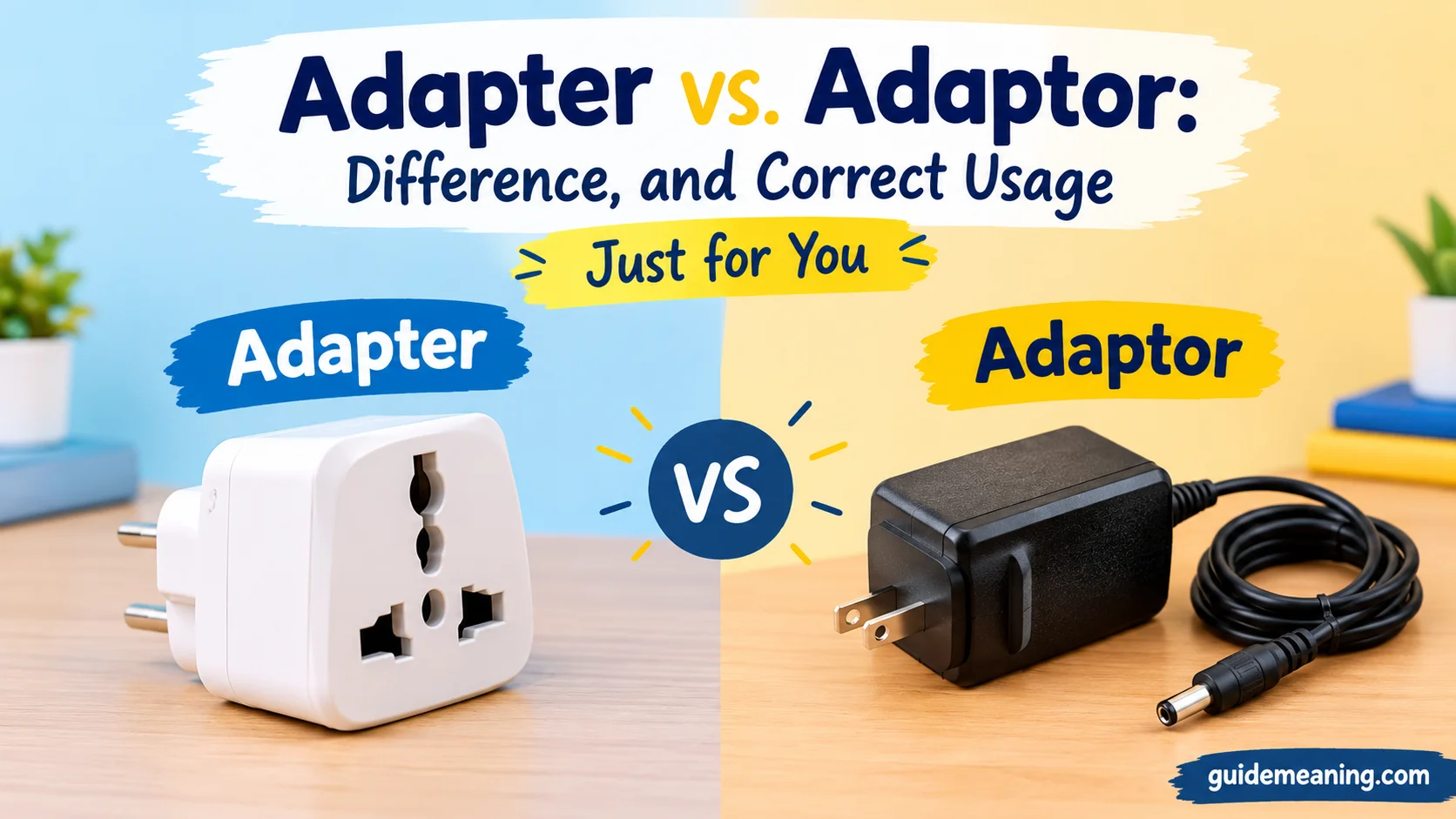

Adapter vs. Adaptor can seem confusing, but both spellings usually describe the same thing, including a device, tool, or person. The main difference is English spelling and regional preference. American English commonly uses adapter, while British English often uses adaptor, although both are accepted in modern English and can appear interchangeably across different varieties. In written English, product boxes, and online stores, adapter is often more visible because of its connection with modern usage, technology, and electronics. From my experience, this common spelling confusion becomes easier once you understand that spelling does not usually change the meaning.
The word can describe something that connects different systems, devices, or components so they can work together and work properly. A phone charger adapter connects a plug with a different socket type, while a USB adapter can connect incompatible devices. A software adapter helps different systems communicate, showing how the word works in technical contexts. The full meaning can also include one who adapts to new conditions or someone who changes a work of art for a different style or medium. These examples make the function and real-world usage easier to understand.
The language behind these spellings is an evolving living river, shaped by society and technology as they move forward. Older books and historical writing style may contain adaptor, while software manuals, tech products. Regional preference, regional English, historical usage, style, a style guide, and industry context can influence choosing one spelling. Web claims about a strict distinction should be considered carefully because writers’ preferences may differ from an examination of how words are actually used. In edited news publications, both forms can refer to people and electric devices, so the main idea is to understand the usage preference, compatibility, and context of your article before choosing the right one with easy, confident judgment.
Quick Answer: Adapter vs. Adaptor
Adapter and adaptor are both correct English spellings. In most contexts, they have the same meaning.
- Adapter is generally preferred in American English.
- Adaptor is especially associated with British English, although adapter is also used in Britain.
- Both words can describe a device that connects or modifies equipment.
- Both can also describe a person who adapts written material for another form.
- Neither spelling is inherently wrong.
- In American English, adapter is usually the safer and more familiar choice.
- In technical writing, follow the terminology used by the relevant manufacturer, standard, or organization.
| Word | Correct? | Main meaning | Typical preference |
| Adapter | Yes | A person or device that adapts something | Common in American English |
| Adaptor | Yes | A person or device that adapts something | Particularly common in British English |
Cambridge explicitly defines adapter as a device used to connect equipment and also as someone who changes a book, play, or similar work for performance. It lists adaptor as an alternative spelling.
What Does “Adapter” Mean?
An adapter is a person or thing that adapts something for a different purpose, condition, connection, or use.
Today, the word most often brings electronics to mind. You might picture a power adapter sitting beside a laptop, a USB adapter connecting two ports, or a travel adapter helping a plug fit a foreign socket.
However, the word has a broader meaning.
Adapter as a Device
An adapter can connect two pieces of equipment that weren’t originally designed to connect directly.
For example, imagine you have a device with one type of connector and a cable with another. An adapter can bridge that physical mismatch.
Common examples include:
- Power adapter
- USB adapter
- HDMI adapter
- Network adapter
- Travel adapter
- Audio adapter
- Lens adapter
- Cable adapter
- Socket adapter
Oxford defines an adapter as a device for connecting electrical equipment that wasn’t designed to fit together.
The exact function varies from one adapter to another. Some simply change the physical connection. Others may also alter electrical characteristics or allow different systems to communicate.
That distinction matters.
A connector adapter might simply solve a shape or port mismatch. A power adapter, on the other hand, can be part of the system that changes electrical power into a form suitable for a particular device.
Adapter as a Person
Adapter can also refer to a person who adapts something.
This meaning appears frequently in literature and entertainment. For instance, an adapter might take a novel and change it into a screenplay.
Oxford gives this meaning as a person who changes a book or play so that it can become a film, television drama, or another form.
For example:
The adapter turned the novel into a two-hour screenplay.
Here, adapter has nothing to do with electricity. The person adapts existing material for a new medium.
Examples of “Adapter” in Sentences
- I need a new power adapter for my laptop.
- This USB adapter connects the older device to a newer port.
- She bought a travel adapter before visiting Europe.
- The photographer uses a lens adapter with older lenses.
- The film’s adapter made several changes to the original novel.
The spelling remains the same even though the context changes dramatically.
What Does “Adaptor” Mean?
Adaptor has essentially the same core meaning as adapter.
It can refer to a device that connects or modifies equipment. It can also refer to a person who adapts material for another purpose.
Dictionary.com labels adaptor as a variation of adapter and gives meanings involving both people and connecting devices.
Adaptor as a Device
An adaptor can connect components that don’t otherwise fit together.
For example:
The engineer installed an adaptor between the two components.
You could generally replace adaptor with adapter without changing the meaning:
The engineer installed an adapter between the two components.
The important point is that the spelling changed. The underlying concept did not.
Adaptor as a Person
The same applies when the word describes someone who adapts written material.
For example:
The adaptor changed several scenes for the stage production.
In American English, adapter would usually feel more familiar:
The adapter changed several scenes for the stage production.
Neither sentence becomes grammatically wrong merely because of the spelling.
Adapter vs. Adaptor: What’s the Difference?
The biggest mistake is assuming that adapter and adaptor describe different objects.
In general, they don’t.
Difference in Meaning
Both words can mean:
- A person who adapts something.
- A device that makes different equipment or components work together.
- A component that modifies a connection or makes an existing system suitable for another use.
Cambridge lists adaptor as an alternative form under its entry for adapter. Oxford likewise lists adaptor as an alternative.
That makes the central distinction surprisingly simple:
Adapter and adaptor are usually spelling variants, not different words with different meanings.
Difference in Spelling
The only obvious visual difference is the ending:
- adapt + er = adapter
- adapt + or = adaptor
English uses both -er and -or endings in nouns. However, you shouldn’t assume that every pair ending in these suffixes works exactly the same way.
For adapter/adaptor, dictionaries recognize the two forms as variants.
Collins traces adapter to adapt + -er and dates its first recorded use to the late eighteenth or early nineteenth century. It also lists adaptor as an alternative.
Difference in Regional Usage
Regional preference provides the most useful practical distinction.
Adapter is strongly established in American English. Cambridge’s American English dictionary gives adapter as the headword and defines it as a device for connecting electrical equipment.
British English uses both forms. Adaptor has a long-established presence in British usage, particularly in contexts involving electrical equipment.
Interestingly, modern British English doesn’t restrict itself to adaptor. Cambridge’s British dictionary also uses adapter as the main entry and identifies adaptor as an alternative.
So the regional picture isn’t a rigid American-versus-British split.
It’s better described as a usage preference with considerable overlap.
Adapter vs. Adaptor in American English
If you’re writing for an American audience, adapter is usually the most natural choice.
You’ll commonly encounter phrases such as:
- power adapter
- AC adapter
- USB adapter
- wireless adapter
- network adapter
- travel adapter
- audio adapter
- display adapter
For example:
My laptop’s power adapter stopped working.
That’s the spelling most American readers would expect.
This doesn’t mean adaptor is impossible in American English. It simply isn’t usually the first choice for general American writing.
If a particular manufacturer, technical document, or established product name uses adaptor, preserving that terminology can make sense.
Adapter vs. Adaptor in British English
British English provides a more interesting picture.
Adaptor has traditionally been common in British usage, particularly for electrical equipment. Dictionary.com labels the word British and gives several device-related meanings.
For example, a British writer might encounter:
- power adaptor
- travel adaptor
- plug adaptor
- mains adaptor
However, adapter is also firmly established in British English. Cambridge’s British entry uses adapter as its main headword and explicitly notes adaptor as an alternative.
That detail matters because saying “British English always uses adaptor” would be too simplistic.
It doesn’t.
Modern English usage overlaps considerably across regions.
Adapter vs. Adaptor in Different Contexts
The context can influence which spelling you encounter.
Electronics
Electronics is probably where most people meet these words.
You might see:
- AC adapter
- power adapter
- USB adapter
- plug adaptor
- travel adaptor
The device itself doesn’t determine which spelling is grammatically correct. Regional terminology, product labeling, and established usage can influence the choice.
Computers and Networking
Computer terminology frequently uses adapter.
For example:
The computer’s wireless adapter connects it to the network.
A network adapter is hardware or an interface that enables network connectivity.
You might also see terms such as display adapter, Bluetooth adapter, and USB network adapter.
Here, technical vocabulary often develops its own established naming conventions. If you’re documenting a specific technology, consistency with that technology’s official terminology matters more than trying to force a general spelling rule.
Travel
Travel products provide an easy example of regional variation.
A traveler might buy a travel adapter or travel adaptor to connect a plug to a socket with a different physical configuration.
However, there’s an important technical issue hiding beneath the spelling question.
A plug adapter doesn’t necessarily change electrical voltage. A traveler must distinguish between physical plug compatibility and voltage compatibility.
For example, if a device isn’t designed for the local voltage, simply using a travel adapter may not solve the problem.
The spelling is linguistic. The electrical specifications are practical.
Don’t confuse the two.
Photography
Photography offers another useful example.
A lens adapter allows a lens and camera body with different mounting systems to work together.
For example:
The photographer used a lens adapter to mount an older lens on a newer camera.
You could also write lens adaptor. The meaning remains essentially unchanged.
The important question in photography isn’t the spelling. It’s whether the particular adapter supports the relevant lens mount, electronic communication, autofocus features, or other requirements.
Literature and Film
The word also has a completely different-looking application.
An adapter can be someone who transforms an existing work into another medium.
For example:
The adapter converted the novel into a screenplay.
The same person could be called an adaptor.
Cambridge specifically includes this meaning in its definition, describing someone who makes changes to a book, play, or other text so it can be performed.
This usage demonstrates why adapter doesn’t inherently mean an electronic device.
The underlying concept is adaptation.
Adapter vs. Adaptor: Practical Case Studies
Case Study: American Technical Article
Suppose you’re writing an American-English article about laptop accessories.
A sentence such as this fits standard usage naturally:
The laptop requires a 65-watt power adapter.
Using adaptor wouldn’t necessarily make the sentence incorrect. However, adapter fits the expected American spelling more naturally.
Case Study: British Product Description
Now imagine a British retailer describing an electrical accessory.
The product might be labeled:
Universal travel adaptor
That spelling is perfectly legitimate.
Changing it automatically to adapter could actually make the description less consistent with the retailer’s established terminology.
Case Study: Film Adaptation
Consider a film based on a novel:
The adapter made several structural changes to the original story.
Here, the word refers to a person rather than a physical component.
The same sentence could use adaptor without creating a fundamentally different meaning.
Case Study: Technical Documentation
Suppose a manufacturer consistently calls a particular component an adaptor throughout its documentation.
Even if adapter is more familiar to your audience, changing every occurrence can create unnecessary terminology problems.
In technical writing, consistency matters.
Follow the manufacturer’s official terminology when you’re describing its product or system.
Adapter vs. Adaptor: Common Mistakes
Mistake: Calling “Adaptor” Incorrect
This is the most common misunderstanding.
Adaptor is not simply a misspelling of adapter.
Major dictionaries recognize it as a valid variant. Cambridge and Oxford both list the alternative form.
Mistake: Assuming They Have Different Meanings
There’s usually no reliable semantic distinction between the two spellings.
If someone says:
I need a power adaptor.
They’re generally talking about the same kind of device as someone who says:
I need a power adapter.
The spelling doesn’t magically change the hardware.
Mistake: Treating British Usage as One Fixed Rule
It’s tempting to memorize a simple rule:
American = adapter; British = adaptor.
That shortcut is useful but incomplete.
British dictionaries themselves demonstrate that adapter is established British usage too.
Think of regional usage as a preference rather than an absolute boundary.
Mistake: Ignoring Established Technical Terminology
Technical writing sometimes follows product-specific terminology.
If a manufacturer calls a component an adaptor, changing the term throughout a manual can make the documentation inconsistent.
When technical accuracy matters, check the relevant documentation or terminology standard.
Adapter vs. Adaptor vs. Adaptation
These related words can easily become tangled.
| Word | Part of speech | Meaning | Example |
| Adapt | Verb | To change something to suit a new purpose | We need to adapt the design. |
| Adapting | Verb/gerund | Changing something to suit another purpose | She is adapting the novel. |
| Adaptation | Noun | The process or result of adapting | The film is an adaptation of the book. |
| Adapter | Noun | A person or thing that adapts | The adapter changed the screenplay. |
| Adaptor | Noun | Variant spelling of adapter | The adaptor changed the screenplay. |
The key relationship is easy to remember:
Adapt → adaptation → adapter/adaptor
The suffix changes the grammatical role. The basic idea of adjustment remains connected.
Which One Should You Use: Adapter or Adaptor?
For most American-English writing, adapter is the straightforward choice.
Use adapter when:
- You’re writing for an American audience.
- You’re writing general web content in US English.
- You’re discussing common electronics.
- You’re describing computer equipment.
- The established product terminology uses adapter.
- You want the spelling most American readers expect.
Use adaptor when:
- You’re following an established British usage.
- A British publication or organization prefers it.
- A manufacturer specifically uses adaptor.
- You’re maintaining terminology from an existing technical document.
- Consistency with surrounding text requires it.
The Best Rule for Professional Writing
Match your audience and stay consistent.
There’s rarely a good reason to alternate between adapter and adaptor randomly.
For example, this looks unnecessarily inconsistent:
The power adapter connects to the travel adaptor. The second adapter has a USB port.
If the context doesn’t require different terminology, choose one spelling and use it consistently.
For American English, adapter is usually the cleanest default.
Adapter vs. Adaptor: Quick Comparison
| Feature | Adapter | Adaptor |
| Correct spelling | Yes | Yes |
| Core meaning | Person or thing that adapts | Person or thing that adapts |
| Electronic device | Yes | Yes |
| Connecting equipment | Yes | Yes |
| Person adapting a work | Yes | Yes |
| American English | Common | Less common |
| British English | Common | Also established |
| Technical contexts | Very common | Used in some contexts |
| Can replace the other? | Usually | Usually |
| Best default for US English | Yes | Usually no |
The dictionary evidence supports the central point: these aren’t two completely separate words. Cambridge identifies adaptor as an alternative spelling of adapter, while Oxford does the same.
FAQs:
Is adapter or adaptor correct?
Both adapter and adaptor are correct spellings. They generally have the same meaning and can refer to a device, person, or someone who adapts something.
Is adapter more common than adaptor?
Yes. Adapter is generally more common in modern English, especially in American English and technical contexts. Adaptor is also widely used, particularly in British English.
Is adapter American English?
Adapter is the more common spelling in American English. However, it is not exclusive to American English, and you can find it in British and other varieties of English as well.
Is adaptor British English?
Adaptor is traditionally associated more closely with British English. However, British writers and publications also use adapter, especially in technical and modern contexts.
Do adapter and adaptor have different meanings?
Usually, no. Adapter and adaptor generally have the same meanings. Both can describe something that connects different systems or devices, as well as a person who adapts something.
Should I use adapter in technical writing?
Adapter is a common choice for technical writing, particularly when discussing electronics, software, computers, and other technology. However, your style guide or industry convention may recommend a particular spelling.
Which spelling should I use in SEO content?
For content, consistency is more important than switching between spellings unnecessarily. Adapter is a widely recognized modern spelling, but you should consider your target audience, region, and the terminology commonly used in your industry.
Conclusion
Adapter and adaptor are two accepted spellings with essentially the same meaning. Adapter appears frequently in American English, modern technology, and online content, while adaptor remains common in British English and some traditional writing. The choice often depends on regional preference, style, and context. When writing, choose the spelling that fits your audience and use it consistently throughout your content.