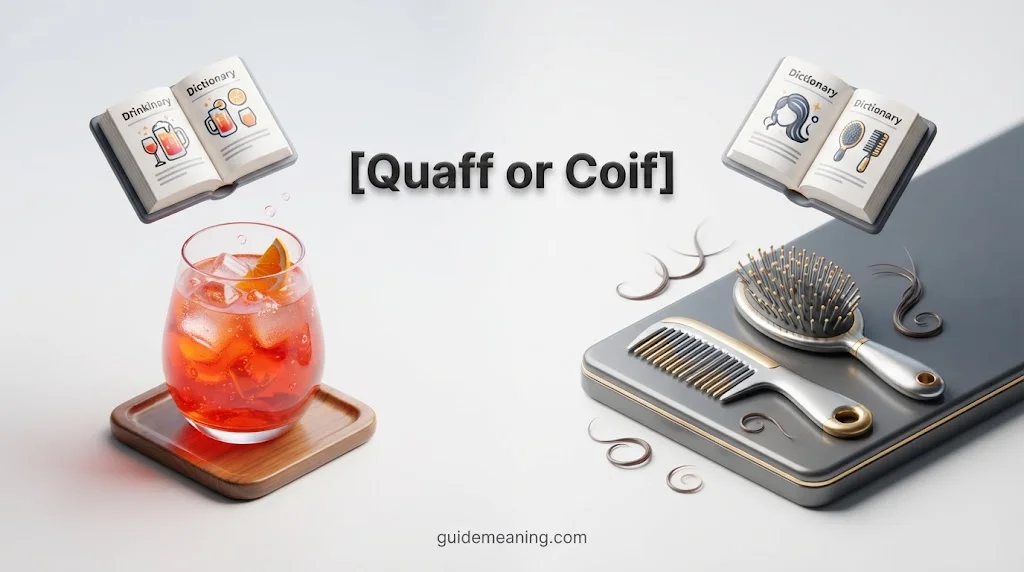

Quaff or Coif can confuse learners because these homophones share a sound but have different spellings and meanings. English can feel like a tricky maze when words are pronounced the same way but look nothing alike. That confusion may sneak in like a quiet thief when you come across them in real sentences. You may have seen or used one, then paused mid-sentence and thought about which spelling to choose. To understand the difference, focus on meaning, pronunciation, language, and word choice. This makes it easier to speak and write with confidence and clarity.
A useful way to remember the pair is to connect each word with its context and usage. Quaff is linked to drinking and can work as a noun meaning a drink, especially an alcoholic drink that is consumed heartily or all at once. It can also work as a transitive verb, meaning to drink something heartily. Its related forms are quaffs, quaffed, and quaffing. The word is derived from the German quassen, associated with overindulge and something consumable. Its word origin and etymology add an interesting history lesson. Coif, on the other hand, connects with hair, the head, headwear, and clothing, not a beverage. Their meanings, grammar roles, and different situations separate them, even though their sound is identical.
If you still confuse them, try using a simple mental picture instead of trying to memorize a dry rule. When you see quaff, imagine someone taking a big drink; when you see coif, picture styled hair or headwear. This small association can help you avoid awkward mistakes and common vocabulary mistakes. The difference becomes clearer when you connect each spelling with its meaning. Today, you can learn the real meaning of both words, see how they came from different histories, and use real-world examples to improve your writing, speaking, and language skills. This guide is the right place to understand the pair once and for all without adding unnecessary things that make the topic harder.
Let’s dive in!
Quick Answer:
The simplest distinction is:
Quaff = drink heartily or in large amounts.
Coif = style or arrange hair, or refer to a hairstyle/head covering.
Here’s a quick comparison:
| Word | Main Meaning | Part of Speech | Typical Context | Example |
| Quaff | To drink quickly or in large amounts | Verb | Drinks and drinking | They quaffed the cider. |
| Coif | To style hair; a hairstyle or head covering | Noun, Verb | Hair, grooming, historical clothing | She coifed her hair. |
So, if you’re talking about someone drinking a beverage, use quaff. If you’re talking about someone’s carefully arranged hair, coif is the relevant word.
They aren’t interchangeable.
What Does “Quaff” Mean?
Quaff means to drink something quickly or in a large amount. Cambridge lists it as a verb and marks it as old-fashioned in contemporary English.
The word often creates a stronger image than the ordinary verb drink. Imagine someone lifting a large mug after a long journey and taking several hearty swallows. Quaff captures that vigorous action better than the plain word drink.
For example:
The travelers quaffed cool water after crossing the desert.
The sentence doesn’t merely tell you that they drank. It suggests eagerness and quantity.
Quaff as a Verb
The most important grammatical fact is that quaff is primarily a verb.
You can use it in several forms:
- quaff
- quaffs
- quaffed
- quaffing
Examples include:
He likes to quaff cold ale after work.
She quaffed the lemonade in seconds.
The guests were quaffing wine throughout the evening.
He quaffs his coffee as though he’s racing the clock.
The word can take a direct object, as in quaff the wine, or appear without one when the context already makes the beverage clear.
What Kind of Drinking Does “Quaff” Suggest?
The word doesn’t usually describe a tiny sip.
Compare these sentences:
She sipped her tea.
She quaffed her tea.
The first sentence suggests small, careful amounts. The second creates an image of substantial or rapid drinking.
Cambridge places quaff alongside words such as gulp and swig, although those words aren’t perfect synonyms.
The difference can be understood like this:
| Word | Drinking Style |
| Sip | Small, controlled amounts |
| Drink | Neutral and general |
| Gulp | Swallow quickly |
| Swig | Take a large drink, often directly from a container |
| Quaff | Drink quickly or in a large amount |
That makes quaff particularly useful when you want vivid description rather than plain everyday wording.
Is “Quaff” Used for Alcohol Only?
No.
Alcoholic beverages frequently appear with quaff, especially in literary or historical writing. However, the word itself isn’t restricted to alcohol.
You can technically quaff:
- water
- lemonade
- tea
- coffee
- juice
- wine
- beer
- cider
- another beverage
For example:
After the hike, the children quaffed cold water.
The sentence is grammatically possible because quaff describes how much or how eagerly someone drinks, not the specific type of beverage.
Still, context matters. In ordinary conversation, drink will usually sound more natural.
I drank some water after my run.
That sounds completely normal.
I quaffed some water after my run.
That’s grammatically understandable, but it sounds more dramatic and deliberately colorful.
What Does “Coif” Mean?
Coif has a completely different meaning from quaff. In modern English, it is associated mainly with hair styling. It can also refer to a hairstyle or, in historical usage, a close-fitting head covering.
Cambridge gives the pronunciation of the word as /kɔɪf/ in both its UK and US pronunciation entries.
The hair-related meaning is the one you’re most likely to encounter when discussing appearance.
For example:
The stylist carefully coifed her hair before the ceremony.
Here, coifed means that the hair was carefully arranged or styled.
Coif as a Verb
When coif functions as a verb, it relates to styling or arranging hair.
Common forms include:
- coif
- coifs
- coifed
- coifing
Examples:
The stylist coifed the actress’s hair.
She carefully coifed her hair before the interview.
The salon specializes in elaborate hairstyles and professional coifing.
The verb has a somewhat polished or formal flavor. In everyday conversation, people are much more likely to say style, arrange, or do someone’s hair.
For example:
She styled her hair for the wedding.
sounds much more ordinary than:
She coifed her hair for the wedding.
Both communicate the general idea, but their tones differ.
Coif as a Noun
Coif can also work as a noun.
In this use, it can refer to a hairstyle or an arrangement of hair. That meaning connects naturally with the verb.
For example:
Her elaborate coif attracted everyone’s attention.
Here, coif refers to the hairstyle itself rather than the act of styling it.
This is one reason coif can feel slightly unusual to modern readers. Everyday English normally uses words such as hairstyle, hairdo, or simply hair.
Still, coif remains a legitimate English word.
The Historical Meaning of “Coif”
There’s another meaning worth knowing.
Historically, a coif could refer to a close-fitting cap or head covering. The word therefore has a genuine connection with clothing and headwear as well as hair.
That historical meaning can appear in discussions of medieval clothing, historical costumes, legal dress, or old illustrations.
Consider:
The medieval woman wore a linen coif beneath her outer headdress.
Here, coif doesn’t mean a modern hairstyle. It refers to a type of head covering.
That distinction matters because readers sometimes assume coif always means hairstyle. It doesn’t.
The word has a broader historical life.
Quaff vs. Coif: The Main Difference
The biggest difference is semantic. Quaff concerns drinking, while coif concerns hair or headwear.
| Feature | Quaff | Coif |
| Core idea | Drinking | Hair styling or head covering |
| Main modern use | Verb | Noun and verb |
| Common object/context | Beverage | Hair |
| Typical tone | Literary, playful, old-fashioned | Formal, stylish, historical |
| Example | He quaffed the wine. | She coifed her hair. |
| Everyday alternative | Drink | Style or arrange |
| Historical association | Drinking | Headwear |
A useful way to think about the difference is to picture two scenes.
In the first, someone raises a mug and takes a hearty drink. That’s quaff.
In the second, someone sits before a mirror while a stylist carefully arranges their hair. That’s coif.
Two scenes. Two words.
Quaff vs. Coif Pronunciation
Pronunciation makes the distinction even clearer.
Cambridge gives the US pronunciation of quaff as /kwæf/. The initial sound begins with /kw/, followed by the vowel found in words such as cat.
For coif, Cambridge gives the US pronunciation /kɔɪf/. The middle sound is the same diphthong heard in words such as boy.
So they aren’t pronounced the same way.
| Word | US IPA | Main Sound Feature |
| Quaff | /kwæf/ | Starts with kw |
| Coif | /kɔɪf/ | Contains the oy sound |
This is useful when you’re listening rather than reading. The spellings may look similar, but their vowel sounds clearly separate them.
Quaff or Coif: Example Sentences
Seeing both words in realistic sentences makes the distinction much easier to remember.
Examples With “Quaff”
The sailors quaffed their drinks after reaching shore.
He quaffed a glass of cold cider after the long walk.
The guests sat around the table and quaffed wine.
After the race, she quaffed a bottle of water.
The characters in the novel often quaff ale at the village inn.
Notice the common thread: every example involves drinking.
Examples With “Coif”
The stylist coifed her hair before the photo shoot.
Her carefully arranged coif completed the formal look.
The actress arrived with her hair perfectly coifed.
The historical costume included a linen coif.
The salon gave her an elegant coif for the ceremony.
Here, the context points toward hair or headwear.
Paired Examples
Consider these two sentences:
The guests quaffed champagne during the celebration.
The stylist coifed the bride’s hair before the celebration.
Changing the word changes the entire subject matter.
You don’t coif champagne. You quaff it.
You don’t quaff someone’s hairstyle. You coif it.
That’s the easiest distinction to keep in mind.
Common Mistakes With Quaff and Coif
These words don’t cause trouble because either spelling is incorrect. They cause trouble because their spellings look related even though their meanings are separate.
Using “Coif” When You Mean “Drink”
Incorrect:
We coifed our drinks after dinner.
Correct:
We quaffed our drinks after dinner.
The first sentence places a hair-related word where a drinking verb belongs.
Using “Quaff” When You Mean “Style Hair”
Incorrect:
The stylist quaffed her hair.
Correct:
The stylist coifed her hair.
If the action involves arranging hair, coif is the appropriate word.
Assuming “Coif” Only Means Hair
That’s too narrow.
A coif can also refer to a historical close-fitting head covering. Therefore, the surrounding context matters.
She wore a medieval coif.
This sentence concerns headwear rather than a modern salon hairstyle.
Assuming “Quaff” Means Any Ordinary Drinking
Technically, quaff relates to drinking. However, it carries a stronger flavor than ordinary drink.
If you simply want to tell someone what happened, drink is usually the natural choice.
If you want a more vivid or literary description, quaff may fit.
When Should You Use “Quaff” Instead of “Drink”?
The choice depends largely on tone.
Use “Quaff” for Hearty Drinking
Choose quaff when the action involves substantial or enthusiastic drinking.
The travelers quaffed cool water after their journey.
The verb gives the action more energy.
Use “Drink” for Everyday Communication
In ordinary conversation, drink is far more natural.
I need to drink some water.
Nobody needs a more colorful verb there.
Use “Quaff” for Literary or Playful Writing
Because dictionaries identify quaff as old-fashioned, it can give prose a deliberately traditional or humorous feel.
For example:
The knights quaffed ale around the roaring fire.
That sentence feels at home in a historical fantasy setting.
By contrast:
The students quaffed water during lunch.
The second sentence sounds intentionally playful because the word is much grander than the situation requires.
That’s not necessarily a problem. Writers sometimes choose unusual vocabulary precisely to create that effect.
When Should You Use “Coif” Instead of “Style”?
The same principle applies to coif.
Use “Coif” for a More Formal or Descriptive Tone
The actress appeared with an elaborate coif.
The word draws attention to the hairstyle as a carefully arranged feature.
Use “Style” in Everyday Speech
She styled her hair before the party.
This is simpler and more natural in casual conversation.
Use “Coif” When the Hairstyle Itself Matters
When you’re describing appearance, fashion, historical dress, or a deliberately polished look, coif can add useful precision and character.
Cambridge’s related word coiffed describes hair that has been carefully arranged in an attractive style.
For example:
He arrived with perfectly coiffed hair.
The related noun coiffure means the style in which someone’s hair is cut and arranged. Cambridge labels coiffure as formal.
Read More: Shown vs. Showed: Which Is Correct? 2026
Quaff and Coif in Different Contexts
Context often solves the problem before you even consciously think about the definition.
At a Restaurant or Party
If people are consuming beverages, quaff can work:
The guests quaffed wine while waiting for dinner.
For ordinary writing, however, drank would usually be more neutral.
At a Hair Salon
If someone is arranging hair, coif fits:
The stylist coifed the model’s hair before the show.
You could also simply say styled.
In Historical Writing
Both words can appear in historical or literary contexts, but they describe completely different things.
The soldiers quaffed ale after the battle.
The noblewoman wore a linen coif beneath her veil.
The first concerns drinking. The second concerns historical clothing.
In Fiction
These words can add atmosphere.
A fantasy writer might choose quaff to make a tavern scene feel old-fashioned:
The weary travelers quaffed ale beside the fire.
A historical novelist might use coif to describe clothing:
Her linen coif framed her face beneath the hood.
In both cases, the unusual vocabulary helps establish the setting.
In Academic or Professional Writing
Use caution.
Neither word is inherently incorrect in formal writing. However, a more familiar word may communicate the idea more efficiently.
Instead of:
The participants quaffed water.
you might write:
The participants drank water.
Instead of:
The stylist coifed the client’s hair.
you might write:
The stylist arranged the client’s hair.
Clear writing doesn’t always require the fanciest word on the shelf.
Quaff vs. Coif: Word Forms and Grammar
Knowing the basic forms helps prevent grammatical mistakes.
Forms of “Quaff”
| Form | Example |
| Base form | They quaff the drink. |
| Third-person singular | He quaffs the wine. |
| Past tense | She quaffed the cider. |
| Past participle | They have quaffed several drinks. |
| Present participle | He is quaffing water. |
Cambridge confirms quaffed as the past simple and past participle of quaff, while quaffing is its present participle.
Forms of “Coif”
| Form | Example |
| Base form | The stylist coifed her hair. |
| Third-person singular | She coifs the model’s hair. |
| Past tense | The stylist coifed her hair. |
| Past participle | Her hair was carefully coifed. |
| Present participle | The stylist is coifing her hair. |
You’ll also encounter the related form coiffed, particularly as an adjective.
She arrived with perfectly coiffed hair.
Cambridge defines coiffed as hair that has been carefully arranged in an attractive style.
Quaff, Coif, Coiffed, and Coiffure
The coif family deserves a closer look because several related words appear in English.
Coif can function as a noun or verb.
Coiffed commonly functions as an adjective describing carefully arranged hair.
Coiffure is a formal noun meaning a particular style in which someone’s hair is cut and arranged.
Here’s the relationship:
| Word | Meaning |
| Coif | Style hair; a hairstyle or historical head covering |
| Coiffed | Carefully arranged or styled |
| Coiffure | A hairstyle or arrangement of hair |
For example:
The stylist coifed her hair.
Her elegant coif attracted attention.
Her elaborate coiffure matched the period costume.
These words belong to the same semantic neighborhood. Quaff doesn’t.
A Simple Way to Remember Quaff vs. Coif
You don’t need a complicated mnemonic.
Remember:
Quaff = drink.
Coif = hair.
You can make the distinction even stronger with a simple visual association.
Quaff → cup
Think of someone lifting a cup and taking a hearty drink.
Coif → comb
Think of someone arranging hair with a comb before looking in the mirror.
The Context Test
When you’re unsure, ask yourself one question:
Is this sentence about drinking?
If yes, consider quaff.
Is it about hair or a head covering?
If yes, consider coif.
This works because the two words occupy very different semantic fields.
Quaff or Coif Practice Quiz
Choose quaff or coif in each sentence.
Sentence A
The thirsty hikers ___ cold water after reaching the campsite.
Answer: quaffed
The action involves drinking a large amount of water.
Sentence B
The stylist ___ her hair before the wedding.
Answer: coifed
The action involves arranging hair.
Sentence C
The medieval woman wore a linen ___ beneath her hood.
Answer: coif
Here, the word refers to historical headwear.
Sentence D
The sailors ___ ale after returning to the harbor.
Answer: quaffed
The sentence describes hearty drinking.
Sentence E
Her carefully arranged ___ gave her a polished appearance.
Answer: coif
Here, coif refers to the hairstyle.
Sentence F
He ___ the lemonade after finishing the race.
Answer: quaffed
The context clearly involves drinking.
Sentence G
The actress appeared with perfectly ___ hair.
Answer: coiffed
The related adjective describes carefully arranged hair.
A Real-World Usage Case Study
Imagine you’re writing a scene about a wedding.
You might write:
Before the ceremony, the stylist coifed the bride’s hair. Later, the guests quaffed sparkling wine during the reception.
Both words work naturally because each describes a different action.
The stylist coifed the hair.
The guests quaffed the drinks.
Now imagine reversing them:
The stylist quaffed the bride’s hair.
The sentence becomes nonsensical because quaff belongs to drinking.
Likewise:
The guests coifed their wine.
That doesn’t work because coif doesn’t describe drinking.
This simple contrast shows why memorizing isolated definitions isn’t enough. Context is the fastest way to choose the correct word.
FAQs:
What is the difference between quaff and coif?
Quaff and coif are homophones, so they sound the same but have different spellings and meanings. Quaff relates to drinking something heartily, while coif relates to hair, hairstyling, or a type of head covering.
Is quaff a noun or a verb?
Quaff can be both a noun and a verb. As a verb, it means to drink something heartily or in a large amount. As a noun, it can refer to a drink that is consumed heartily, often an alcoholic drink.
What does coif mean?
Coif can refer to a hairstyle or the act of styling someone’s hair. It can also describe a type of close-fitting cap or head covering. The meaning depends on the context in which the word appears.
Are quaff and coif pronounced the same way?
Yes. Quaff and coif are generally pronounced the same way in standard English. However, their spellings and meanings are completely different. This makes them easy to confuse when you hear them rather than see them written.
How can I remember the difference between quaff and coif?
Use a simple mental association. Think of quaff when you imagine someone taking a hearty drink. Think of coif when you picture someone’s hair or a head covering. Connecting each word with a clear image can make the difference easier to remember.
What are the forms of the verb quaff?
The common forms are quaff, quaffs, quaffed, and quaffing. For example, you can say, “He quaffed the drink quickly” or “They were quaffing their beverages.”
Which spelling should I use for drinking: quaff or coif?
Use quaff when you are talking about drinking. Coif does not mean to drink. If the sentence involves hair, hairstyling, or headwear, coif may be the correct choice.
Conclusion:
Quaff and coif may sound alike, but their meanings take them in completely different directions. Quaff is connected with drinking, while coif is associated with hair, hairstyling, or headwear. Once you connect each spelling with its meaning, this confusing pair becomes much easier to remember. When in doubt, think quaff = drink and coif = hair or headwear.