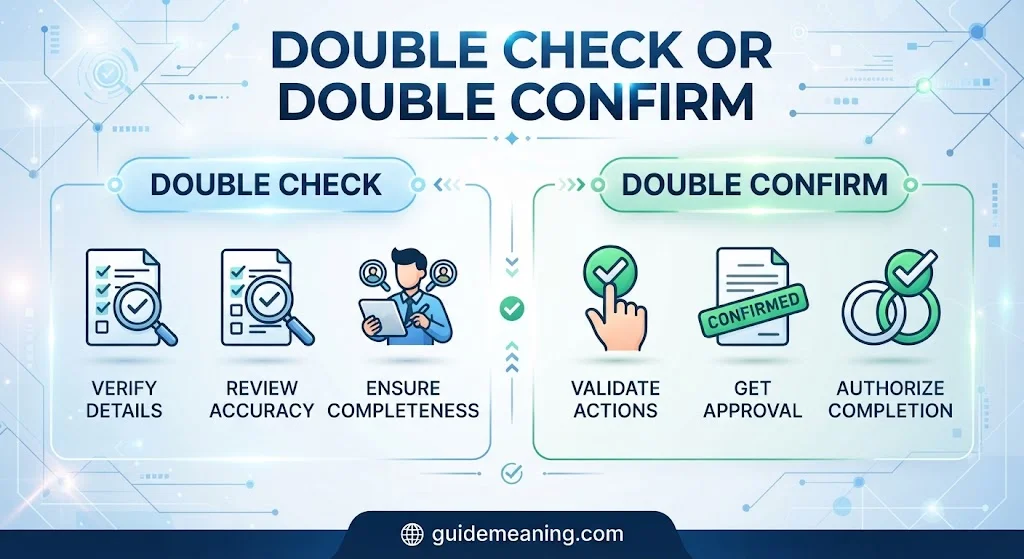

Double Check or Double Confirm can change the way your language shapes perception, especially when a phrase can signal competence instead of confusion. When you write, choosing between double check and double confirm can affect your words, tone, clarity, and credibility. Many professionals use these phrases interchangeably because the difference seems harmless, yet subtle differences can affect how a message lands in business emails, travel communication, academic writing, and cross-cultural settings. To break this down clearly, double check means reviewing something to make sure it is correct, while double confirm means confirming information again for reassurance, accuracy, and certainty. Both expressions are used to prevent mistakes, but they work differently in everyday English.
In simple terms, double check focuses on a review or careful examination, with correctness as its main aim. Double confirm puts more focus on confirmation and certainty. The difference may look small, but one word shifts the meaning, and that tiny choice can change how fluent, professional, and confident you sound. In 2026, global English is everywhere. Teams work across continents, while emails move through different time zones within seconds. Because of this, subtle phrasing matters. A sentence that sounds natural in one region may feel slightly off in another, so it helps to know exactly when to use each expression and when to avoid overcomplicating your business communication.
In English writing, I often perform a careful examination of important work before submitting it. For example, I may double-check a report, an email, or my to-do list each morning, just as I might double-check my kid’s lunches before they leave the house. Grammatically, double-check is a hyphenated compound word and an intransitive verb that can mean check twice or perform a careful examination. Looking at its meaning, usage, and origin can help you investigate why this form is common in the English language. By the end, the right wording should give your message a natural balance of clarity and precision rather than making the phrase sound forced.
Let’s dive in!
Quick Answer:
Double-check is the standard and natural expression when you mean checking something again to make sure it is correct, accurate, or safe.
For example:
Please double-check the address before sending the package.
If you mean that something has already been confirmed and you want to confirm it again, reconfirm is usually the more precise choice.
Please reconfirm your appointment before Friday.
Double confirm is understandable, but it isn’t the usual choice in standard American English. You may encounter it in regional varieties of English and international workplace communication.
Here’s the simplest rule:
| What you mean | Best expression | Example |
| Examine something again | Double-check | Double-check the figures. |
| Establish certainty | Confirm | Please confirm your attendance. |
| Confirm something again | Reconfirm | Please reconfirm the booking. |
| Confirm twice / regional usage | Double confirm | Understandable, but less natural in US English |
So when you’re unsure, ask yourself one question:
Am I reviewing something, or am I confirming something?
That question usually gives you the answer.
What Does “Double-Check” Mean?
Double-check means to examine or verify something again. The second check helps you catch an error, confirm accuracy, or make sure something is safe.
Cambridge Dictionary specifically defines double-check as making certain that something is correct or safe, usually by examining it again. Oxford’s American English dictionary similarly describes it as checking something a second time or with great care.
Think of it as taking a second look.
You might read an email once and notice nothing unusual. Before sending it to 500 customers, however, you read it again. You catch a wrong date in the second review.
You double-checked the email.
The important idea is review.
Double-Check Focuses on Verification
When you double-check something, you’re usually looking for mistakes or confirming information against what you already know.
For example:
- Double-check the spelling of her name.
- I need to double-check the meeting time.
- Please double-check these calculations.
- She double-checked the address before ordering.
- Let’s double-check the figures before publishing the report.
In each sentence, someone examines information again.
The purpose isn’t necessarily to obtain a new agreement from another person. Instead, the speaker wants to make sure the existing information is accurate.
Double-Check Works in Many Situations
You’ll find double-check in everyday conversation, professional communication, education, technical instructions, and business writing.
For example, a student might say:
“I’ll double-check my answers before submitting the test.”
An employee might write:
“Please double-check the figures in the final report.”
A traveler might say:
“Let me double-check the departure time.”
The situations differ, but the basic action remains the same: check again.
What Does “Double Confirm” Mean?
The phrase double confirm usually attempts to express the idea of confirming something again.
For example:
“Can you double confirm the meeting time?”
A reader can normally understand the intended meaning. The problem isn’t that the words are impossible to interpret. The issue is natural usage.
In standard American English, double confirm isn’t the established expression that speakers normally reach for. Current English usage discussions also describe it as understandable but less natural than alternatives such as reconfirm, confirm again, or double-check.
That’s an important distinction.
A phrase can be understandable without being the most idiomatic choice.
Why Does “Double Confirm” Sound Awkward?
The answer becomes easier when you separate the two verbs.
Check can mean examining information.
Confirm involves establishing or verifying that something is true, settled, or certain.
When you add double to confirm, you create the idea of confirming something again. English already has a concise way to express that idea:
reconfirm
So instead of:
“Please double confirm your reservation.”
you can write:
“Please reconfirm your reservation.”
Or, depending on what you mean:
“Please confirm your reservation again.”
The second version is longer, but it is perfectly clear.
Double Check vs. Double Confirm: The Key Difference
The easiest way to understand double check or double confirm is to focus on the action involved.
Double-check usually means inspect again.
Reconfirm usually means confirm again.
Confirm means establish certainty or agreement.
Consider this simple example.
You have a flight tomorrow. You open your email and look at the departure time again.
You double-check the flight time.
Then you contact the airline because you want to make sure your reservation still stands.
You confirm or reconfirm the reservation.
Those actions are related, but they’re not identical.
| Expression | Core idea | Typical purpose |
| Check | Examine | Find or verify information |
| Double-check | Examine again | Catch mistakes or verify accuracy |
| Confirm | Establish certainty | Make sure something is settled or true |
| Reconfirm | Confirm again | Verify something that was already confirmed |
| Double confirm | Confirm again | Understandable, but less natural in standard US English |
This distinction gives you a much better rule than simply memorizing that one phrase is “right” and another is “wrong.”
When Should You Use “Double-Check”?
Use double-check when you want to review information, work, details, or instructions one more time.
Checking Information for Accuracy
Suppose someone gives you a phone number. You want to make sure you copied it correctly.
Let me double-check the phone number.
You aren’t necessarily asking the person to confirm anything. You’re reviewing the information.
The same principle works with:
- Names
- Addresses
- Dates
- Times
- Prices
- Numbers
- Calculations
- Password requirements
- Instructions
- Documents
Reviewing Work Before Submission
Double-checking becomes especially useful when a small mistake could cause trouble.
For example:
Double-check the figures before sending the financial report.
The writer wants another review. Perhaps the numbers were already calculated. The second look provides an opportunity to catch an error.
That makes double-check a natural choice for:
- Reports
- Essays
- Applications
- Contracts
- Presentations
- Spreadsheets
- Emails
- Forms
Checking Plans and Arrangements
You can also double-check schedules and plans.
I’ll double-check the meeting time.
Can you double-check whether the store closes at 9 p.m.?
I need to double-check our hotel address.
Again, the central idea is looking at information again.
When Should You Use “Confirm”?
Sometimes you don’t need double-check or reconfirm at all.
If you simply want someone to establish that something is correct, agreed upon, or scheduled, use confirm.
For example:
Please confirm your attendance.
Can you confirm the delivery date?
I’d like to confirm our appointment.
Please confirm that you received the document.
These sentences don’t necessarily suggest that someone has already confirmed the information.
That’s why confirm is often the cleanest choice.
Confirm Is Not Always the Same as Double-Check
Compare these two sentences:
I’ll double-check the meeting time.
I’ll confirm the meeting time with Sarah.
The first sentence emphasizes reviewing information.
The second emphasizes obtaining confirmation, perhaps from another person.
Here’s another example:
I double-checked the address.
This suggests that you looked at the address again.
I confirmed the address with the customer.
This suggests that you established the address through communication with the customer.
The difference may seem tiny. In real communication, however, that tiny difference can sharpen your meaning.
When Is “Reconfirm” Better Than “Double Confirm”?
If something has already been confirmed and you need another confirmation, reconfirm is usually the natural choice.
Consider a restaurant reservation.
You received confirmation last week. The reservation is tomorrow. You contact the restaurant again to make sure everything remains scheduled.
You can say:
I’d like to reconfirm my reservation.
That sentence clearly tells the reader that a confirmation already happened.
Reconfirm Means Confirm Again
Here are some natural examples:
- Please reconfirm your appointment.
- I’ll reconfirm the booking tomorrow.
- We need to reconfirm the delivery date.
- The customer called to reconfirm the order.
- Please reconfirm your attendance by Friday.
These examples involve an earlier confirmation.
That’s the key.
Double Confirm vs. Reconfirm
Compare:
“Please double confirm the booking.”
with:
“Please reconfirm the booking.”
The second sentence is more natural for standard American English when you specifically mean another confirmation.
You can also say:
“Please confirm the booking again.”
That version is completely transparent because it spells out the repeated action.
Double-Check vs. Reconfirm: Are They Interchangeable?
Not always.
This is one of the most important points in the double check or double confirm discussion.
Imagine you’re preparing a wedding invitation.
You look at the venue address again because you’re worried that one digit might be wrong.
You double-check the address.
Now imagine the venue has already agreed to host the wedding. You contact the venue again to make sure the reservation still stands.
You reconfirm the booking.
The difference looks like this:
| Situation | Natural phrase |
| Review an address | Double-check the address |
| Review a calculation | Double-check the calculation |
| Review a spelling | Double-check the spelling |
| Confirm an appointment again | Reconfirm the appointment |
| Confirm a reservation again | Reconfirm the reservation |
| Confirm attendance again | Reconfirm attendance |
| Establish something for the first time | Confirm |
A useful memory trick is:
Double-check = look again.
Reconfirm = confirm again.
That distinction will solve most usage questions.
Is “Double Check” Hyphenated?
Yes, double-check is commonly written with a hyphen when it functions as a verb.
Examples:
Please double-check the report.
I’ll double-check the address.
She double-checked the figures.
We are double-checking the details.
Oxford lists the verb as double-check and gives forms such as double-checked and double-checking.
You’ll also encounter double-check as a noun.
For example:
I gave the document a double-check before sending it.
Oxford defines the noun as an act of checking something for a second time or with great care.
The spelling matters less than using the expression naturally in context. When you’re writing a normal sentence with the verb, double-check is the safest standard form.
Read More: Quaff or Coif? Master These Confusing Words in English for 2026
Common Mistakes With Double Check and Double Confirm
A few patterns cause most of the confusion.
Mistake: Using “Double Confirm” for Every Situation
Not every second look is a confirmation.
Less precise: I need to double confirm the spelling.
Better: I need to double-check the spelling.
Spelling is something you inspect. You aren’t necessarily asking another person to confirm it.
Mistake: Using “Double-Check” When You Mean Reconfirm
The opposite problem can also occur.
I need to double-check my reservation with the hotel.
This sentence can work if you’re reviewing the reservation details.
However, if you specifically mean that the reservation was already confirmed and you want another confirmation, this is clearer:
I need to reconfirm my reservation with the hotel.
The difference depends on your intended action.
Mistake: Assuming “Double” Automatically Makes a Phrase Natural
English isn’t a mathematical equation where adding double to a verb always creates a standard expression.
Some combinations are firmly established:
- Double-check
- Double-checking
- Double-booked
- Double-check the facts
Other combinations may be understandable without being conventional.
That’s why double confirm can make sense logically while still sounding unusual to many American English speakers.
Double Check or Double Confirm in Professional Emails
Professional writing rewards precision.
If you’re sending an email to an American English audience, choose the expression that tells the reader exactly what you plan to do.
| Less natural wording | Better wording |
| Please double confirm the schedule. | Please confirm the schedule. |
| Please double confirm the booking. | Please reconfirm the booking. |
| I will double confirm the details. | I will double-check the details. |
| Can you double confirm the numbers? | Can you double-check the numbers? |
| Please double confirm your attendance. | Please reconfirm your attendance. |
Notice something important: there isn’t one replacement for every occurrence of double confirm.
The right replacement depends on the meaning.
That’s why simply memorizing “never use double confirm” doesn’t teach the whole lesson.
A Better Business Writing Rule
Use:
Double-check for information, accuracy, and details.
Confirm for certainty, agreement, or arrangements.
Reconfirm when something already confirmed needs confirmation again.
This three-way distinction produces cleaner business writing.
Double Check or Double Confirm in Different Situations
The context often makes the correct choice obvious.
At Work
Double-check the spreadsheet before the meeting.
You’re reviewing information.
Please confirm your attendance.
You’re asking someone to establish whether they will attend.
Please reconfirm your attendance by Thursday.
The attendance was already established earlier.
In Emails
A professional email might say:
Could you please double-check the attached figures?
Or:
Could you please confirm the delivery date?
Or:
Could you please reconfirm the delivery date before we finalize the order?
Each sentence performs a slightly different job.
At School
A teacher might say:
Double-check your answers before submitting the test.
The student needs to review the work.
A teacher might instead say:
Please confirm that you have completed all sections.
Now the student needs to acknowledge completion.
While Traveling
You might say:
I’ll double-check the departure time.
You might also say:
I’ll reconfirm the hotel reservation.
The first action involves reviewing information. The second involves obtaining another confirmation.
When Making Appointments
Use:
I’d like to confirm my appointment for Tuesday.
If the appointment was already confirmed:
I’d like to reconfirm my appointment for Tuesday.
Avoid forcing double confirm into either sentence when writing standard American English.
Why Does “Double Confirm” Appear in English?
Language doesn’t develop in a perfectly uniform way.
English exists in many varieties around the world. Expressions can become common in particular regions, industries, communities, or multilingual environments even when speakers in another variety rarely use them.
Current usage discussions note that double confirm appears in some regional forms of English and international workplace communication. It is particularly associated with usage in parts of Southeast Asia.
That doesn’t mean every speaker in those regions uses it. It also doesn’t mean the phrase is meaningless.
In fact, most readers can understand it immediately.
The important point is that regional familiarity and standard American usage aren’t necessarily identical.
If your audience uses the expression naturally, communication may be effortless. If you’re writing for a broad US audience, however, confirm, reconfirm, or double-check will usually sound more conventional.
A Simple Memory Trick for Double Check or Double Confirm
You don’t need to memorize a complicated grammar rule.
Remember these four words:
Check → Double-check → Confirm → Reconfirm
Think of them as four different actions.
Check
You examine something.
Check the address.
Double-Check
You examine it again.
Double-check the address.
Confirm
You establish that something is true, settled, or agreed.
Confirm the address with the customer.
Reconfirm
You establish that something is still confirmed.
Reconfirm the address with the customer.
Here’s the simplest mental shortcut:
If you’re looking again, double-check. If you’re confirming again, reconfirm.
That distinction is much easier to apply than memorizing isolated examples.
Double Check or Double Confirm: Real-Life Case Studies
Case Study: A Business Report
Imagine an employee prepares a quarterly sales report.
Before sending it to the manager, the employee reviews the calculations.
The natural sentence is:
I need to double-check the figures before sending the report.
Why?
Because the employee is examining the information for accuracy.
Reconfirm wouldn’t express that exact action as clearly.
Case Study: A Hotel Reservation
Now imagine a traveler booked a hotel two weeks ago.
The hotel sent a confirmation email. One day before the trip, the traveler wants to make sure the reservation remains active.
A natural sentence is:
I’d like to reconfirm my reservation for tomorrow.
Here, the reservation already exists. The traveler wants another confirmation.
Case Study: A Meeting
A manager asks an employee whether the employee will attend tomorrow’s meeting.
The employee hasn’t responded yet.
The manager can write:
Please confirm whether you’ll attend the meeting.
There is no need for reconfirm because the manager isn’t necessarily referring to an earlier confirmation.
These examples show why context matters more than the words double and confirm alone.
Double Check or Double Confirm: Example Sentences
Examples With “Double-Check”
- Please double-check the spelling before publishing the article.
- I’ll double-check the address before placing the order.
- She double-checked the calculations twice.
- We should double-check the meeting time.
- Always double-check important information before sharing it.
- He double-checked the attachment before sending the email.
- Can you double-check these figures?
- I want to double-check that everything is ready.
Examples With “Confirm”
- Please confirm your attendance by Friday.
- Can you confirm the delivery date?
- I’d like to confirm our appointment.
- Please confirm that you received my email.
- The company confirmed the order this morning.
- Can you confirm whether the meeting is still scheduled?
- Please confirm your preferred payment method.
Examples With “Reconfirm”
- Please reconfirm your reservation before arrival.
- I’ll reconfirm the appointment tomorrow.
- We need to reconfirm the delivery schedule.
- She called to reconfirm the booking.
- Please reconfirm your attendance before the event.
- The airline asked passengers to reconfirm their travel details.
Replacing “Double Confirm”
Instead of:
Please double confirm your booking.
write:
Please reconfirm your booking.
Instead of:
I’ll double confirm the meeting time.
write:
I’ll confirm the meeting time again.
If you’re actually reviewing the time rather than obtaining another confirmation, write:
I’ll double-check the meeting time.
The intended action determines the best wording.
Double Check or Double Confirm: Quick Comparison
| Feature | Double-check | Confirm | Reconfirm | Double confirm |
| Main meaning | Check again | Establish certainty | Confirm again | Usually means confirm again |
| Focus | Accuracy | Certainty/agreement | Repeated certainty | Emphasis or repeated confirmation |
| Standard US usage | Common | Common | Common | Less common |
| Useful in business writing | Yes | Yes | Yes | Usually avoid |
| Useful for checking numbers | Yes | Sometimes | No | No |
| Useful for appointments | Sometimes | Yes | Yes | Less natural |
| Means “again” | Yes | No | Yes | Intended to |
| Best alternative to double confirm | — | — | Reconfirm | — |
The table highlights an important point: double-check and reconfirm aren’t interchangeable synonyms.
They overlap because both can involve certainty. Their actual actions differ.
Is “Double Confirm” Wrong?
It’s better to be precise here.
Calling double confirm simply “wrong English” can oversimplify how language actually works.
The phrase is understandable and does occur in real-world English, especially in some regional varieties and multilingual workplace settings. Current sources discussing the expression generally describe it as less common or less natural in standard American English rather than unintelligible.
For standard US English, however, there are more established choices.
Use double-check when you mean check again.
Use confirm when you mean establish certainty.
Use reconfirm when you mean confirm again.
That approach gives you a clear, natural sentence without pretending that regional usage doesn’t exist.
Final Rule to Remember
The double check or double confirm question becomes easy once you separate checking from confirming.
Double-check means to examine something again.
Double-check the address.
Confirm means to establish that something is correct, agreed, or settled.
Confirm the appointment.
Reconfirm means to confirm something again after an earlier confirmation.
Reconfirm the appointment.
Double confirm can be understood as meaning “confirm again,” but it isn’t the usual expression in standard American English.
So, before you write double confirm, stop for a second and ask what you actually mean.
If you mean “look at it again,” choose double-check.
If you mean “make sure,” choose confirm.
If you mean “make sure again,” choose reconfirm.
That tiny distinction can make your English sound much more precise and natural.
FAQs:
Is “double check” or “double confirm” correct?
Both expressions can be understood, but double-check is the more established and natural expression in standard English. It means checking something again to make sure it is correct.
What does “double-check” mean?
Double-check means to check, review, or examine something a second time. For example, you might double-check an email before sending it to make sure there are no mistakes.
What does “double confirm” mean?
Double confirm means to confirm information again, usually to make sure there is no uncertainty. It is understandable, especially in some varieties of international English, but it can sound less natural in many contexts.
Is “double check” one word or two words?
As a verb, double-check is commonly written with a hyphen. For example, “Please double-check the address.” You may also see double check in informal usage, but the hyphenated form is useful for the verb.
Can I use “double-check” in a professional email?
Yes. Double-check works well in professional emails when you want someone to review information for accuracy. For example, “Please double-check the attached figures before the meeting.”
What is the difference between “double-check” and “confirm”?
Double-check focuses mainly on accuracy. You review something to see whether it is correct. Confirm focuses more on establishing or verifying that information is certain. The best choice depends on what you want the reader to understand.
Should I avoid “double confirm”?
You don’t necessarily have to avoid it, but double-check, confirm again, or reconfirm will often sound more natural in standard English. If your goal is clear, professional communication, choose the expression that matches the exact meaning you intend.
Conclusion:
Double-check and double confirm may seem almost identical, but they emphasize slightly different ideas. Double-check is mainly about reviewing something for accuracy and correctness, while double confirm emphasizes confirming information again for certainty. In most everyday and professional English, double-check is the more familiar choice. When you understand this small distinction, you can choose your words more precisely and make your writing sound clear and natural.




1 thought on “Double Check or Double Confirm: Which One Is Correct?”