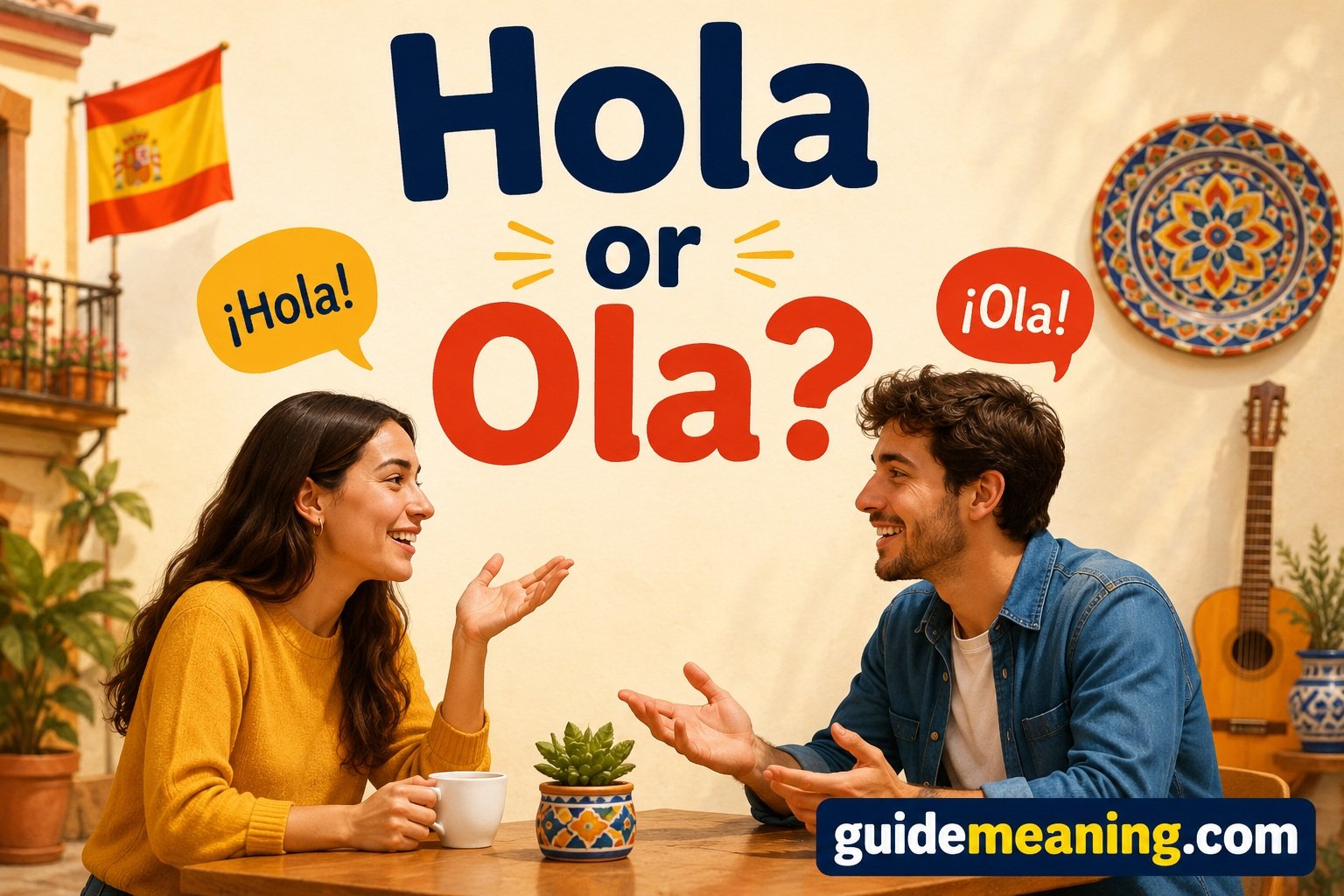

Hola or Ola can confuse anyone learning Spanish because both words look alike, yet their meaning, spelling, and usage are different in context.
In Spanish, Hola is a friendly greeting, while ola means a wave; clear context, pronunciation, and spelling help you choose the correct form.
For writing, use Hola in a text, caption, or email; use ola for the ocean, and avoid common mistakes by checking the correct spelling in context.
Let’s dive in!
Quick Answer:
Hola or Ola? Use hola when you mean “hello” in Spanish. Use ola when you mean “wave.” Both are pronounced essentially the same in Spanish because the h in hola is silent.
TL;DR:
- Hola means “hello” or “hi” in Spanish.
- Ola means “wave,” especially a water or ocean wave.
- Both words are pronounced approximately “OH-lah.”
- The Spanish h is silent in hola.
- Writing ola as a greeting is a spelling mistake.
- Portuguese uses olá as a greeting, adding another source of confusion.
What Does Hola Mean?
The word hola is a Spanish greeting. It’s similar to “hello,” “hi,” or sometimes “hey” in English.
Hola as a Greeting
People use hola when starting a conversation or acknowledging another person. It works in casual conversations and many everyday situations.
For example:
- ¡Hola! — Hello!
- Hola, Ana. — Hi, Ana.
- Hola, ¿cómo estás? — Hello, how are you?
- Hola, buenos días. — Hello, good morning.
Because it’s simple and widely understood, hola is one of the first Spanish words many English speakers learn.
Why Hola Sounds Like Ola
The main source of confusion is pronunciation. Spanish does not pronounce the initial h in hola.
Therefore, hola and ola sound alike. Their meanings, however, remain completely different.
What Does Ola Mean?
Ola is a Spanish noun meaning “wave.” It commonly describes a wave of water.
Literal Meaning
You might use ola while talking about the ocean, a beach, surfing, or a large body of water.
For example:
La ola es grande.
“The wave is big.”
The plural is olas, meaning “waves.”
Figurative Meaning
The word can also describe a wave in a broader sense. Like English, Spanish can use the idea of a “wave” for something that rises or spreads.
So ola isn’t an incorrect word. It’s simply the wrong word when you’re trying to say hello.
Hola vs. Ola: The Main Difference
For American English speakers, the easiest way to remember the difference is to connect each word with its purpose.
| Word | Meaning | Main Use | Example |
| Hola | Hello / Hi | Greeting someone | ¡Hola, María! |
| Ola | Wave | Describing a wave | La ola es enorme. |
| Hola | Greeting | Starting a conversation | Hola, ¿cómo estás? |
| Ola | Wave | Talking about nature | La ola llegó a la playa. |
The important point is simple: hola and ola are not interchangeable. Their pronunciation may match, but their written meanings do not.
A Simple Memory Trick
Think of the h in hola as helping you remember hello.
H + ola = hola = hello
Without the h, ola means wave.
That small memory trick can prevent a surprisingly common spelling mistake.
Why Is the H Silent in Hola?
The silent h is one reason English speakers often spell hola incorrectly.
Spanish Pronunciation
In standard Spanish pronunciation, the h at the beginning of hola is silent. As a result, the word sounds approximately like OH-lah, rather than “HO-lah.”
This creates a classic sound-versus-spelling problem. You hear “ola,” but you need to remember that the greeting is written hola.
Why This Matters
English learners often depend heavily on sound when writing unfamiliar words. However, pronunciation alone cannot tell you whether the written word needs an h.
That’s exactly what happens with hola and ola. They sound alike, but context tells you which spelling makes sense.
Is Hola Formal or Informal?
Hola is flexible enough for many everyday situations.
Everyday Conversations
You can use hola with friends, classmates, neighbors, coworkers, and other people you meet. It doesn’t automatically sound childish or overly casual.
You can also combine it with another greeting to make the interaction more specific.
Examples include:
- Hola, buenos días.
- Hola, buenas tardes.
- Hola, ¿cómo está?
- Hola, mucho gusto.
The exact greeting can depend on the relationship and situation.
Professional Situations
In the United States, Spanish speakers may use hola in workplaces, emails, meetings, and customer interactions. Still, more formal situations may call for a greeting such as buenos días or buenas tardes.
So hola is best understood as a flexible everyday greeting rather than a word limited to close friends.
Read More: Family & Friends or Friends & Family: Which One Sounds Better? 2026
How Hola Is Used in the United States
Spanish has a major presence in American life. Consequently, hola can appear in schools, workplaces, homes, restaurants, travel situations, and online conversations.
Everyday American Use
In multilingual communities, switching between English and Spanish is common. Someone might naturally say:
“Hola, how are you?”
That kind of language mixing can happen in casual conversation, especially among bilingual speakers.
Social and Cultural Familiarity
Even people who don’t speak Spanish often recognize hola. It appears in language classes, travel materials, entertainment, restaurants, greeting cards, and social media.
Because of this familiarity, the word has become recognizable far beyond Spanish-speaking households.
Hola in Texting and Social Media
Digital communication creates another reason for the hola vs. ola confusion.
Fast Typing
When people type quickly, they may leave out letters. A person who knows that hola means hello might still accidentally type ola.
However, that doesn’t make ola an accepted spelling of the greeting. It remains a different Spanish word.
Playful Online Spelling
Social media also encourages informal spelling. Someone might write holaaa to make a greeting feel warmer, excited, or playful.
That extra lettering changes the tone, not the basic meaning. The word still comes from hola.
What Does Ola Mean in Everyday Spanish?
The most familiar meaning of ola is a wave.
Ocean and Beach Contexts
You’ll commonly see ola when people talk about beaches, surfing, storms, swimming, or the sea.
For example:
La ola fue enorme.
“The wave was huge.”
The surrounding words make the meaning obvious.
Figurative Uses
Spanish can also use ola in figurative expressions. A “wave” can describe something that spreads, grows, or arrives in large numbers.
This is similar to English expressions such as “a wave of excitement” or “a wave of change.”
Are Hola and Ola Homophones?
Yes. In Spanish, hola and ola are homophones because they have the same pronunciation but different meanings and spellings.
Same Sound, Different Meaning
This distinction is important for learners.
Hola → hello
Ola → wave
The same pronunciation doesn’t make the words interchangeable.
Context Solves the Confusion
If someone says the word aloud, you need the surrounding sentence to understand which meaning they intend.
For example, a sentence about meeting a friend points toward hola. A sentence about the ocean points toward ola.
Hola or Ola in Portuguese?
Portuguese creates an additional wrinkle for English speakers.
The Portuguese Greeting
In Portuguese, olá means “hello.” Notice the accent mark.
That means learners may encounter:
- Hola — hello in Spanish
- Ola — wave in Spanish
- Olá — hello in Portuguese
- Ola — wave in Portuguese
The accent in Portuguese is important because it distinguishes the greeting from the word for “wave.”
Why This Causes Confusion
Spanish and Portuguese share many words and patterns. However, similar-looking words don’t always have identical meanings.
Therefore, always consider the language before choosing the spelling.
Common Mistakes With Hola and Ola
Most mistakes happen because the two words sound identical.
Mistakes to Avoid
- Writing ola when you mean “hello”
- Pronouncing the h in hola
- Assuming identical sounds mean identical meanings
- Confusing Spanish hola with Portuguese olá
- Treating ola as a casual spelling of hola
These errors are easy to fix once you connect each spelling with its meaning.
Correct Examples
Correct: ¡Hola, Carlos!
Incorrect: ¡Ola, Carlos!
Correct: La ola es enorme.
Incorrect: La hola es enorme.
The first pair concerns a greeting. The second pair concerns a wave.
Why Do People Write Ola Instead of Hola?
There isn’t one single reason. Usually, the mistake comes from pronunciation, unfamiliarity, or fast digital communication.
The Silent-Letter Problem
English speakers may hear OH-lah and naturally spell what they hear. Since the h isn’t pronounced, ola can seem logical.
However, Spanish spelling requires the h for the greeting.
Texting and Autocorrect
Fast typing can also cause accidental omissions. Social media makes these mistakes more visible because short messages are written quickly.
Still, an accidental spelling does not create a new standard meaning. In Spanish, ola remains “wave.”
The Cultural Meaning of Hola
Although hola isn’t a symbol in the traditional sense, greetings carry social meaning.
A Sign of Welcome
A greeting opens communication. Saying hola can signal friendliness, recognition, or willingness to interact.
In American multicultural settings, using a greeting from another language can also reflect familiarity with another culture.
Respect and Context
However, cultural awareness matters. A Spanish greeting should be used naturally rather than as a stereotype or joke.
Learning the correct spelling is a small but meaningful part of using another language respectfully.
How the Meaning Changes With Context
Context is especially important when two words sound identical.
Greeting Context
If you see:
Hola, ¿cómo estás?
the meaning is clearly a greeting.
Wave Context
If you see:
La ola golpeó la costa.
the meaning is clearly “wave.”
The surrounding words tell you which word is intended. This is why listening alone isn’t always enough when learning Spanish.
Hola or Ola: Which One Should You Use?
If your goal is to say hello in Spanish, choose hola.
Use Hola When You Mean
- Hello
- Hi
- A friendly greeting
- The beginning of a conversation
- An everyday Spanish salutation
Use Ola When You Mean
- A wave
- An ocean wave
- A water movement
- A figurative wave
- A spreading movement described as a wave
The rule is straightforward. Hello has an H: hola. A wave does not: ola.
FAQs:
1. Is Hola or Ola correct for saying hello?
Hola is the correct Spanish word for saying “hello” or “hi.” Ola means “wave.”
2. What does Hola mean?
Hola is a common Spanish greeting used when you want to say “hello” or “hi” to someone.
3. What does Ola mean in Spanish?
Ola is a Spanish noun that means “wave,” usually referring to a wave in the ocean or another body of water.
4. Are Hola and Ola pronounced the same?
Yes. In standard Spanish pronunciation, Hola and ola are pronounced the same. Their spelling and meaning tell them apart.
5. Why do people confuse Hola and Ola?
They’re easy to confuse because they sound identical and differ by only one letter. This is especially common among new learners and English speakers learning Spanish.
6. Does Ola mean hello in Portuguese?
Not exactly. In Portuguese, olá with an accent mark means “hello.” In Spanish, ola means “wave.”
7. How can I remember the difference between Hola and Ola?
A simple trick is to remember that Hola starts with H and is the greeting. Ola without the H refers to a wave. Checking the context can also help.
Conclusion:
Knowing the difference between Hola and Ola is simple once you connect each word with its meaning. Use Hola when greeting someone in Spanish, and use ola when talking about a wave.
Although they sound the same, their spelling and meaning are completely different. If you’re learning Spanish, paying attention to context will help you avoid mistakes and feel more confident when speaking or writing.