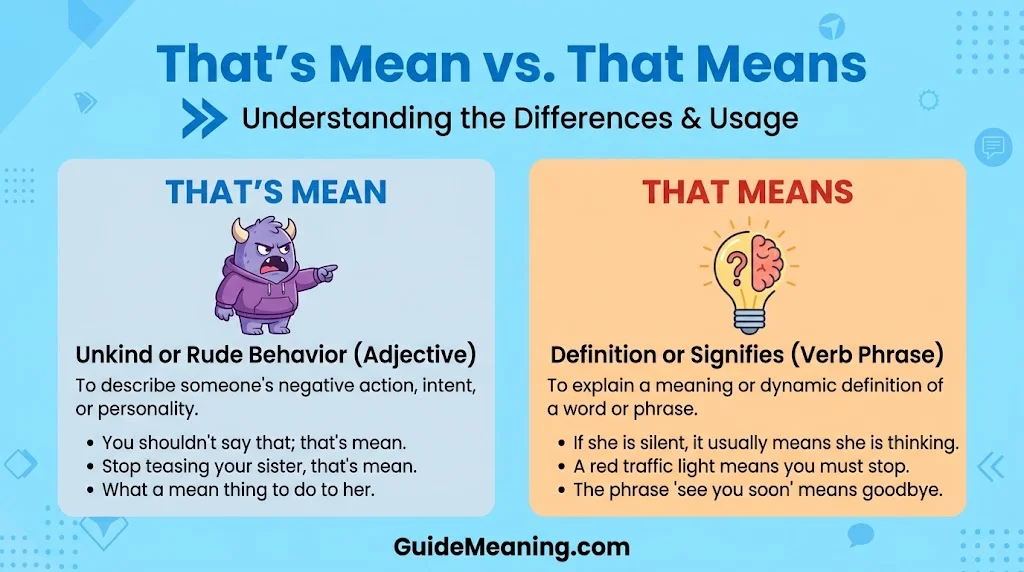

In That’s Mean vs. That Means, tricky phrases can look similar, yet their grammar and meaning differ when you use them correctly in English. “That’s mean” and “That means” can confuse advanced learners because they sound almost identical, but they have different jobs. “That’s mean” is a contraction of “that is mean,” where mean is an adjective that describes something unkind, rude, hurtful, or cruel. It gives an emotional judgment about an action or comment. “That means”, on the other hand, uses mean as a verb phrase to explain, clarify, indicate, signify, or imply something logically. In plain English, one expression gives an emotional comment, while the other gives an explanation or result.
A quick rule makes the difference easier to understand: swap the phrase with “that is unkind.” If it works, “That’s mean” is the right expression; otherwise, “That means” usually fits. For example, “That’s mean” is used when you’re calling an action unkind, while “That means” explains what something indicates or what “that leads to” as a result. These two little expressions can create a big mix-up when the wrong one is chosen accidentally. The whole message may then sound unclear or awkward. I’ve found that remembering the purpose of each expression is a simple guide: “That’s mean” expresses emotion, while “That means” provides an explanation.
The correct usage becomes clearer through context, subject-verb agreement, and sentence structure. These grammar clues help you determine which expression fits correctly. Clear examples, practical examples, simple rules, and useful grammar tips can help you recognize the grammatical difference and avoid common mistakes. When you know whether mean is working as an adjective or a verb, it becomes easier to write and speak natural English confidently. A perfect example is the contrast between “That’s mean” and “That means”: they sound alike, but they do completely different jobs. A quick test can help you choose the right expression instead of picking the wrong one or mixing them up.
Let’s dive in!
Quick Answer:
- That’s mean means “That is unkind, hurtful, or cruel.”
- That means means “That indicates,” “That explains,” or “That leads to.”
Compare these examples:
- That’s mean. You shouldn’t make fun of someone’s mistake.
- The store is closed. That means we need to come back tomorrow.
In the first sentence, the speaker criticizes someone’s behavior. In the second, the speaker explains the consequence of a closed store.
| Expression | Full grammatical meaning | Main purpose | Example |
| That’s mean | That is unkind | Describes hurtful or unfair behavior | That’s mean of you. |
| That means | That indicates or results in | Explains information or a consequence | That means we’re late. |
A simple way to remember the difference is:
That’s mean = That is unkind. That means = That explains something.
What Does “That’s Mean” Mean?
“That’s mean” is a contraction of “that is mean.” In this expression, mean is an adjective. It describes a person, action, comment, joke, or behavior as unkind, hurtful, harsh, or cruel.
For example:
You told her that her presentation was terrible. That’s mean.
The speaker is not explaining the meaning of the presentation. Instead, the speaker is judging the comment as hurtful.
Grammar Structure of “That’s Mean”
The basic structure is:
That + is + adjective
The word that’s contains two parts:
- That is the subject.
- ’s is the contraction of is.
- Mean is a predicate adjective describing the subject.
The expanded form is:
That is mean.
The sentence may refer to an action, statement, situation, or behavior that was just mentioned.
For example:
- You laughed at his pronunciation. That’s mean.
- She refused to help her friend. That’s mean.
- Making fun of someone’s appearance is unkind. That’s mean.
- You shared his private message with everyone. That’s mean.
The subject that often points to something that happened immediately before the sentence.
When Should You Use “That’s Mean”?
Use “that’s mean” when you want to criticize or comment on behavior that seems unkind or insensitive.
Reacting to a Hurtful Comment
“He said your idea was foolish.” “Wow, that’s mean.”
The expression shows that the speaker considers the comment unnecessarily hurtful.
Criticizing an Unfair Action
You promised to help her, but then you left without saying anything. That’s mean.
Here, the speaker is judging the action rather than explaining it.
Responding to a Cruel Joke
They laughed when he made a mistake in front of the class. That’s mean.
The phrase expresses disapproval of the way someone was treated.
Showing Sympathy
“Nobody invited Maya to the party.” “That’s mean. She was looking forward to it.”
In this context, “that’s mean” communicates sympathy for Maya and criticism of the people who excluded her.
“Mean” as an Adjective
In “that’s mean,” the adjective mean usually means:
- Unkind
- Cruel
- Hurtful
- Harsh
- Insensitive
- Unfair
- Ungenerous
Consider these examples:
| Sentence | Meaning of mean |
| That’s a mean thing to say. | Hurtful or unkind |
| He made a mean joke about her accent. | Insensitive or cruel |
| She was mean to her little brother. | Unkind in her behavior |
| That was a mean trick. | Unfair or unpleasant |
| Don’t be mean to him. | Don’t treat him unkindly |
The word mean has other meanings in English, but the meaning “unkind” is the one used in “that’s mean.”
Common Forms of “That’s Mean”
The phrase can appear in several forms depending on the situation and the speaker’s tone.
- That’s mean.
- That’s so mean.
- That’s really mean.
- That was mean.
- That’s mean of you.
- That’s a mean thing to say.
- It’s mean to treat someone that way.
Compare the following:
That’s mean.
This is a short reaction to something unkind.
That’s mean of you.
This directly identifies the person whose behavior is being criticized.
That was mean.
This refers to something that happened in the past.
That’s a mean thing to say.
This focuses specifically on a spoken comment.
Can “That’s Mean” Be Playful?
Yes. The phrase does not always express serious anger. Its meaning can depend on tone, facial expression, context, and the relationship between speakers.
For example:
“I ate the last slice of pizza.” “That’s so mean!”
Among close friends, this may be playful exaggeration. The speaker may be pretending to be offended.
In another situation, the same phrase may express genuine hurt:
“You told everyone about my private problem?” “That’s mean.”
The words are identical, but the emotional force is different.
What Does “That Means” Mean?
“That means” is a subject-and-verb construction. In this phrase, means is the third-person singular present form of the verb mean.
It usually introduces:
- An explanation
- A definition
- A result
- A consequence
- An implication
- An interpretation
- A conclusion
For example:
The train has already left. That means we need another way to get home.
The phrase explains the consequence of the train leaving.
Grammar Structure of “That Means”
The structure is:
That + means + explanation, result, or interpretation
Here is the grammatical breakdown:
- That = singular subject
- Means = present-tense verb
- The rest of the sentence = information being explained or inferred
Examples include:
- That means we are late.
- That means she already knows.
- That means the answer is incorrect.
- That means you need to try again.
- That means the road is closed.
The verb means agrees with the singular subject that.
Compare:
- That means trouble.
- It means trouble.
- She means what she says.
- He means well.
However:
- They mean well.
- These signs mean different things.
- Those results mean that the plan failed.
When Should You Use “That Means”?
Use “that means” when one fact helps explain another fact or leads to a conclusion.
Explaining a Result
We missed the last bus. That means we’ll have to take a taxi.
The second sentence explains the result of missing the bus.
Explaining Information
The sign says “Employees Only.” That means customers cannot enter this area.
The phrase interprets the information on the sign.
Showing a Consequence
The meeting has been moved to Friday. That means we have another day to prepare.
The new meeting date creates a consequence.
Making a Reasonable Inference
She hasn’t replied to any messages today. That means she may be busy.
The speaker is making an interpretation based on available information. The conclusion is not necessarily certain.
Clarifying a Statement
“I’m leaving the company.” “Does that mean you’re moving to another city?”
Here, “does that mean” asks for clarification about the implication of a statement.
That’s Mean vs. That Means: Grammar Comparison
The most important difference is the grammatical role of mean.
In “that’s mean,” the word mean is an adjective. In “that means,” the word means is a verb.
| Feature | That’s mean | That means |
| Expanded form | That is mean | That means |
| Main word | Mean | Means |
| Part of speech | Adjective | Verb |
| Main function | Describes something as unkind | Explains or indicates something |
| Typical meaning | That is cruel or hurtful | That indicates or leads to |
| Common tone | Emotional or judgmental | Explanatory or logical |
| Apostrophe | Yes, in that’s | No |
| Example | That’s mean of you. | That means we need to leave. |
The Most Important Question to Ask
When deciding between the two expressions, ask yourself:
Am I judging someone’s behavior, or am I explaining something?
Use “that’s mean” if you are judging behavior:
You ignored her when she needed help. That’s mean.
Use “that means” if you are explaining a result:
She didn’t receive your message. That means she may not know about the meeting.
That’s Mean vs. That Means in Similar Situations
Looking at the expressions side by side can make the difference easier to understand.
Example: Someone Makes Fun of Another Person
He laughed at her mistake. That’s mean.
This sentence criticizes his behavior.
He laughed at her mistake. That means he may not understand how embarrassed she feels.
This sentence interprets what his behavior may suggest.
Example: Someone Leaves Early
She left without saying goodbye. That’s mean.
The speaker considers the action rude or hurtful.
She left without saying goodbye. That means she probably had to leave quickly.
The speaker offers an explanation or possible conclusion.
Example: A Store Is Closed
The store is closed. That means we need to shop somewhere else.
This is the natural use because the phrase explains a consequence.
“That’s mean” would not normally describe a store being closed. It could describe a person who refuses to let someone enter:
The manager refused to let the child use the restroom. That’s mean.
Example: Someone Refuses to Help
You knew she was struggling, but you refused to help. That’s mean.
This expresses disapproval.
You refused to help her. That means she’ll have to complete the task alone.
This explains the likely result of the refusal.
Why Do People Confuse “That’s Mean” and “That Means”?
The expressions are easy to mix up because they look and sound similar. However, several grammatical details separate them.
They Begin With the Same Word
Both expressions begin with that:
- That’s mean.
- That means.
When people read or hear them quickly, the difference may not stand out.
They Contain the Same Base Word
Both expressions include mean, but the word performs a different job:
- Mean is an adjective in “that’s mean.”
- Means is a verb in “that means.”
The additional s changes the grammatical form and the meaning of the sentence.
Contractions Can Cause Confusion
English uses contractions frequently in everyday speech:
- That is → That’s
- It is → It’s
- She is → She’s
- They are → They’re
Some learners may see that’s and mistakenly treat it as a form of the verb mean. It is not. The apostrophe shows that that’s means that is.
Spoken English Can Hide the Difference
In fast conversation, the final sound in “that’s mean” and the s in “that means” may be difficult to hear clearly.
Writing makes the distinction easier:
- That’s mean.
- That means.
The apostrophe and the final s provide important clues.
Read More: Correct vs. Correctly: Which Form Is Correct ? 2026
Common Mistakes With That’s Mean vs. That Means
Mistake: Writing “That’s Means”
Incorrect:
That’s means we are late.
Correct:
That means we are late.
Why? That’s already means that is. Adding means after it creates an incorrect structure:
That is means we are late. ❌
The correct sentence uses that as the subject and means as the verb:
That means we are late. ✔
Mistake: Writing “That Mean” for a Singular Subject
Incorrect:
That mean we have a problem.
Correct:
That means we have a problem.
The subject that is singular in this construction, so the present-tense verb needs the -s ending.
Compare:
- That means something.
- It means something.
- They mean something.
- Those facts mean something.
Mistake: Using “That’s Mean” to Explain a Result
Incorrect for the intended meaning:
The bus has left. That’s mean we must walk.
Correct:
The bus has left. That means we must walk.
The speaker is explaining a consequence, not criticizing behavior.
Mistake: Using “That Means” to Criticize Behavior
Unnatural for the intended meaning:
You made fun of her. That means.
Better:
You made fun of her. That’s mean.
The expression “that means” normally needs information after it, unless the rest of the sentence is understood from context.
For example:
“You’re not coming to my party?” “That means a lot.”
This is a different expression with a special emotional meaning, discussed below.
Mistake: Leaving Out the Apostrophe
Incorrect:
Thats mean.
Correct:
That’s mean.
The apostrophe is required because that’s is a contraction of that is.
In informal texting, people sometimes omit apostrophes. However, standard written English uses the apostrophe.
Related Expressions You Should Know
“What Does That Mean?”
“What does that mean?” is used to ask for an explanation, definition, or interpretation.
Examples:
- What does this word mean?
- What does that message mean?
- What does your answer mean?
- What does that expression mean in English?
Notice that the question uses does:
What does that mean?
It does not use means because the auxiliary verb does already carries the tense and grammatical agreement.
Incorrect:
What does that means? ❌
Correct:
What does that mean? ✔
“That Means a Lot”
The expression “that means a lot” has a special emotional meaning. It usually means:
- That is very meaningful to me.
- I really appreciate that.
- That makes me feel valued.
- I’m genuinely touched.
Example:
“I stayed up late to help you finish your project.” “Thanks. That means a lot.”
Here, the phrase does not simply describe a logical result. It communicates gratitude or emotional appreciation.
Other related expressions include:
- That means so much to me.
- That means the world to me.
- Your support means a lot.
- Your kindness means everything to me.
“It Means” vs. “That Means”
Both expressions can explain meaning, but they often point to different things.
It means commonly refers to a word, phrase, object, or previously mentioned subject.
What does “generous” mean? It means willing to give or share.
That means often refers to a specific fact, event, statement, or situation.
The road is blocked. That means we need another route.
Compare:
| Expression | Common reference | Example |
| It means | A word, phrase, object, or previously mentioned subject | “What does this word mean?” “It means ‘quick.’” |
| That means | A fact, situation, statement, or consequence | The lights are off. That means nobody is home. |
“That Is Mean” vs. “That’s Mean”
These two forms have the same grammatical meaning.
- That is mean.
- That’s mean.
The contracted form “that’s mean” is more natural in casual conversation. The expanded form may be used for emphasis or when teaching grammar.
For example:
That is mean of you.
That’s mean of you.
Both are grammatically correct.
A Simple Way to Remember the Difference
Use the “that is” test.
Step One: Expand “That’s”
Replace that’s with that is.
That’s mean. That is mean.
The sentence still works. Therefore, “that’s mean” is correct.
Now try the same test with this sentence:
That’s means we’re late.
It becomes:
That is means we’re late.
That does not work. The correct form is:
That means we’re late.
Step Two: Replace “Mean” With “Unkind”
If you can replace mean with unkind, you probably need “that’s mean.”
- That’s mean. → That’s unkind. ✔
- That’s mean of you. → That’s unkind of you. ✔
If unkind does not fit, you may be explaining a meaning or consequence instead.
Step Three: Replace “That Means” With “That Indicates”
If the sentence still makes sense after replacing that means with that indicates, use “that means.”
- That means we’re late.
- That indicates we’re late.
- That means the answer is wrong.
- That indicates the answer is wrong.
This test is not perfect in every context, but it works well for ordinary sentences.
Case Studies: How Context Changes the Meaning
Case Study: A Hurtful Joke
Situation: A student makes fun of another student’s reading mistake.
“Did you hear what he said about Alex?” “Yes. That’s mean.”
The speaker is judging the comment as unkind.
Now consider a different response:
“He made fun of Alex’s reading mistake. That means he may not understand how much the comment hurt Alex.”
This version interprets the behavior. It does not directly label the behavior as cruel.
Case Study: A Changed Schedule
Situation: A meeting is moved from Monday to Wednesday.
“The meeting was moved to Wednesday.” “Oh, that means we have two extra days to prepare.”
The second speaker explains the practical result of the schedule change.
The phrase “that’s mean” would not fit unless the speaker were criticizing someone’s behavior:
“The manager moved the meeting without telling anyone. That’s mean.”
The first example explains a result. The second criticizes an action.
Case Study: A Missed Message
Situation: A friend does not answer a text message.
“She hasn’t replied all day.” “That means she may be busy.”
This is an interpretation, not a confirmed fact. The speaker is drawing a possible conclusion.
However:
“She read your message and laughed at your problem. That’s mean.”
This sentence criticizes her reaction.
Practice: Choose “That’s Mean” or “That Means”
Complete each sentence with the correct expression.
Practice Sentences
- You made fun of his new haircut. ______.
- The restaurant is fully booked. ______ we need another place.
- She ignored her friend when he needed help. ______.
- The deadline has changed. ______ we have more time.
- You told everyone her private secret. ______ of you.
- The lights are off. ______ nobody is home.
- He laughed at her pronunciation. ______.
- The road is closed. ______ we must take a different route.
Answers and Explanations
| Sentence | Correct answer | Reason |
| You made fun of his new haircut. | That’s mean. | It criticizes hurtful behavior. |
| The restaurant is fully booked. | That means | It explains a consequence. |
| She ignored her friend when he needed help. | That’s mean. | It expresses disapproval. |
| The deadline has changed. | That means | It explains the result of the change. |
| You told everyone her private secret. | That’s mean of you. | It judges someone’s action. |
| The lights are off. | That means | It offers an interpretation. |
| He laughed at her pronunciation. | That’s mean. | It criticizes an unkind reaction. |
| The road is closed. | That means | It explains what follows from the closure. |
FAQs:
What does “That’s mean” mean?
“That’s mean” means “that is mean.” Here, mean is an adjective used to describe something unkind, rude, cruel, or hurtful.
What does “That means” mean?
“That means” uses mean as a verb. It explains what something indicates, signifies, implies, or leads to.
Is “That’s mean” grammatically correct?
Yes. “That’s” is the contraction of “that is,” so “That’s mean” is grammatically correct when you’re describing something as unkind.
Is “That means” grammatically correct?
Yes. “That means” is correct when you’re explaining the meaning or result of something. For example, “The store is closed. That means we need another plan.”
What’s the easiest way to remember the difference?
Use a simple test. If you can replace the phrase with “that is unkind,” use “That’s mean.” If you’re explaining what something indicates or implies, use “That means.”
Can “That’s mean” and “That means” be used interchangeably?
No. Although they look and sound similar, they have different grammatical roles and meanings. “That’s mean” describes behavior or an action, while “That means” explains information or a result.
Why do English learners confuse “That’s mean” and “That means”?
The confusion comes from their similar spelling and pronunciation. The key is to focus on context and identify whether mean is acting as an adjective or a verb.
Conclusion:
Understanding “That’s mean” vs. “That means” becomes much easier once you focus on the job of mean in the sentence. “That’s mean” describes something unkind or hurtful, while “That means” explains what something indicates or implies. With this simple distinction and a little practice, you can use both expressions naturally and avoid a common English grammar mistake.

1 thought on “That’s Mean vs. That Means: Meaning, Grammar, and Correct Usage 2026”