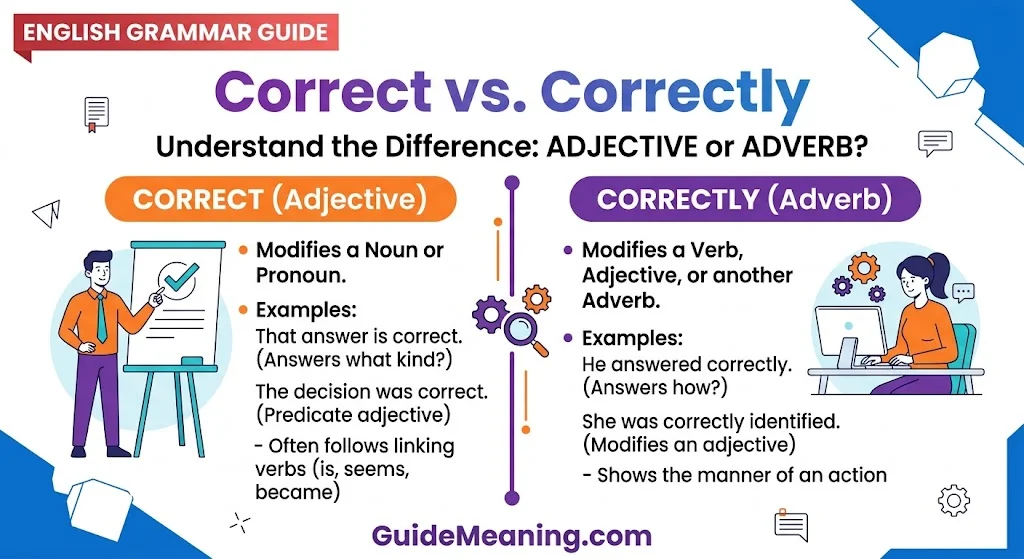

Correct vs. Correctly can confuse English learners, students, writers, and professionals because these words look similar but work differently in grammar. The key to understanding their difference is knowing the parts of speech. Correct is an adjective that describes a noun, while correctly is an adverb that describes a verb, action, or process. In everyday communication, choosing the correct word helps your sentence sound clear, accurate, and professional. Use correct when describing things as right or accurate, and use correctly when explaining how an action is done.
This difference plays a big role in English grammar, especially in speaking, writing, emails, assignments, social media posts, workplace writing, and professional communication. Many common mistakes happen when learners use the wrong form, making a message sound awkward, unclear, or grammatically incorrect. Learning the usage and rules of these words can help you avoid confusion and communicate more effectively.
This complete guide will help you learn the full meaning of correct and correctly, understand their differences, and know exactly when to use each word. Pay attention to the adjectives and adverbs in real-life examples, and use practical tips and memory tricks to remember the rules. When you start practicing today, you can improve your grammar, avoid mistakes, and use both words properly in daily communication. The article also covers choosing the right word, understanding the root word “correct,” and recognizing how actions and nouns work in sentences.
Let’s jump in!
Quick Answer:
Correct is most often an adjective that describes a noun or pronoun. It can also be a verb meaning to fix or point out an error.
Correctly is an adverb that describes how an action is performed.
| Word | Part of speech | Main function | Example |
| correct | Adjective | Describes something as right or accurate | “That is the correct answer.” |
| correct | Verb | Means to fix an error | “Please correct the mistake.” |
| correctly | Adverb | Describes an action performed accurately | “She answered correctly.” |
A useful rule is:
Use “correct” to describe what is right. Use “correctly” to describe how something is done.
For example:
- The answer is correct.
- You answered correctly.
- He used the correct spelling.
- He spelled the word correctly.
This rule handles most everyday situations. Still, it isn’t the whole story. Sentence structure matters too.
What Does “Correct” Mean?
The word correct has more than one grammatical role. It commonly works as an adjective and a verb.
Cambridge defines the adjective correct as being in agreement with true facts or an accepted standard. It also lists correct as a verb meaning to show or fix what is wrong.
Correct as an adjective
As an adjective, correct describes a person, thing, answer, statement, result, choice, or condition.
Consider these examples:
- “That is the correct answer.”
- “She entered the correct address.”
- “We have the correct information.”
- “Your calculation is correct.”
- “He chose the correct option.”
- “Is this the correct spelling?”
In each case, correct describes something.
The word doesn’t tell us how someone performed an action. Instead, it tells us that a particular thing meets the relevant standard of accuracy.
Correct as a verb
Correct can also be a transitive verb. In this use, it means to fix something that is wrong or to point out an error. Merriam-Webster includes meanings such as “to make or set right” and “to point out” errors for correction.
Examples include:
- “Please correct this sentence.”
- “The teacher corrected my spelling.”
- “The editor corrected the error.”
- “We need to correct the information.”
- “She corrected his pronunciation.”
Here, correct isn’t describing something. It represents an action.
That distinction is important because it shows why simply memorizing “correct = adjective” isn’t enough.
What Does “Correctly” Mean?
Correctly is an adverb.
Merriam-Webster defines it as meaning “in a correct manner.” Cambridge likewise identifies correctly as the adverbial form of correct.
An adverb can modify a verb by explaining how an action happens.
For example:
- “She answered correctly.”
- “He spelled the name correctly.”
- “You completed the form correctly.”
- “They followed the instructions correctly.”
- “I remembered the date correctly.”
- “The machine is working correctly.”
In each sentence, correctly tells us something about the action.
What does “correctly” modify?
Look closely at the verbs:
- answered correctly
- spelled correctly
- completed correctly
- followed correctly
- remembered correctly
- working correctly
The adverb tells the reader that the action happened without an error or in the appropriate way.
That is why the sentence:
She answered correctly.
works naturally.
The word correctly describes the manner or accuracy of her answering.
The Main Difference Between Correct and Correctly
The easiest way to understand correct vs. correctly is to ask what the word is describing.
If you’re describing a thing, person, answer, result, or state, use correct.
If you’re describing an action, use correctly.
Compare:
That is the correct answer.
Here, correct describes answer.
Now compare:
She answered correctly.
Here, correctly describes answered.
The meaning is closely related, but the grammar is different.
Correct describes a noun
Examples:
- the correct answer
- the correct spelling
- the correct address
- the correct method
- the correct information
- the correct pronunciation
Correctly describes an action
Examples:
- answer correctly
- spell correctly
- enter information correctly
- pronounce a word correctly
- follow instructions correctly
- calculate something correctly
This distinction is one of the most reliable ways to choose between the two.
Correct vs. Correctly Examples
Seeing the words in matched sentences makes the difference much clearer.
Answer
- That is the correct answer.
- You answered the question correctly.
In the first sentence, correct describes the answer.
In the second, correctly describes the answering.
Spelling
- That is the correct spelling.
- You spelled the word correctly.
Again, the adjective describes the noun spelling. The adverb describes the action spelled.
Pronunciation
- That is the correct pronunciation.
- You pronounced the word correctly.
The first sentence identifies the right pronunciation. The second evaluates how someone pronounced the word.
Information
- We have the correct information.
- You entered the information correctly.
The information itself can be correct. The act of entering it can also be performed correctly.
Instructions
- These are the correct instructions.
- You followed the instructions correctly.
The first sentence describes the instructions. The second describes the action of following them.
Is “You Did It Correct” or “You Did It Correctly” Correct?
This is one of the most common questions surrounding correct vs. correctly.
In standard edited English, the usual form is:
You did it correctly.
Here, correctly modifies the verb phrase did it. It tells us that the action was performed in the right way.
For example:
“You assembled the device correctly.”
“You filled out the form correctly.”
“You solved the problem correctly.”
“You did it correctly.”
The same pattern appears in all four sentences.
Why do people sometimes say “You did it correct”?
You may hear “You did it correct” in informal speech. That doesn’t mean every speaker treats the sentence as formal standard English.
English has many conversational constructions that don’t always follow the patterns expected in carefully edited writing.
For formal writing, academic work, professional communication, and situations where standard grammar matters, “You did it correctly” is the safer choice.
However, there is an important grammatical detail that shouldn’t be overlooked.
Can “Correct” Come After a Verb?
Yes.
This is where the simple rule “verbs take adverbs” can become misleading.
Consider:
She got the answer correct.
This sentence is grammatical in standard English.
You might wonder why correct appears after the verb instead of correctly.
The answer lies in the sentence structure.
Here:
- She = subject
- got = verb
- the answer = object
- correct = complement describing the object
The word correct describes the state of the answer.
Now compare:
She answered the question correctly.
Here, correctly describes the action of answering.
The two sentences communicate closely related ideas, but their grammatical structures differ.
Compare the two patterns
| Sentence | What “correct/correctly” describes |
| “She got the answer correct.” | The answer |
| “She answered the question correctly.” | The action of answering |
| “The answer is correct.” | The answer |
| “She answered correctly.” | The action |
This is why a good explanation of correct vs. correctly shouldn’t simply say that correct can never follow a verb.
The actual sentence structure matters.
Read More: On Tuesday Morning vs. In the Tuesday Morning: Which Is Correct? 2026
Correct vs. Correctly After Linking Verbs
Another important pattern appears with linking verbs.
Consider:
You are correct.
This is completely standard.
You wouldn’t normally say:
You are correctly.
Why?
Because are is functioning as a linking verb. The adjective correct describes the subject you.
The same pattern appears in:
- “She is correct.”
- “They are correct.”
- “His answer was correct.”
- “Your information is correct.”
- “That statement is correct.”
In each sentence, correct describes the subject.
Compare “You are correct” with “You answered correctly”
These sentences look similar, but they perform different grammatical jobs:
You are correct.
Here, correct describes you.
You answered correctly.
Here, correctly describes answered.
This distinction is especially useful when you’re learning how adjectives and adverbs work.
Correct vs. Correctly in Different Contexts
The difference becomes easier to remember when you see it in everyday situations.
In school and academic writing
You might write:
- “The student gave the correct answer.”
- “The student solved the equation correctly.”
- “She selected the correct option.”
- “He interpreted the passage correctly.”
The adjective identifies the right answer or option. The adverb describes the student’s performance.
At work
Consider a form or report:
- “Please use the correct form.”
- “Please complete the form correctly.”
- “Make sure you enter the correct account number.”
- “Enter the account number correctly.”
This distinction is practical because workplace instructions often involve both the correct item and the correct way to use it.
In everyday conversation
You might say:
- “That’s correct.”
- “You remembered correctly.”
- “Your information is correct.”
- “You understood the instructions correctly.”
These are natural examples of the adjective/adverb distinction.
Common Mistakes With Correct and Correctly
Understanding the rules is useful. Recognizing mistakes in real sentences is even more useful.
Mistake: “She answered the question correct”
In standard edited English, write:
She answered the question correctly.
The adverb correctly describes the action answered.
Mistake: “He gave the correctly answer”
Write:
He gave the correct answer.
Here, answer is a noun. The adjective correct describes it.
The sentence doesn’t need an adverb.
Mistake: “You are correctly”
Write:
You are correct.
The word after the linking verb are describes the subject you.
Mistake: Assuming every “-ly” word is automatically the right choice
The ending -ly is a useful clue, but grammar isn’t simply a matter of adding -ly whenever a verb appears.
What matters is the word’s function in the sentence.
Compare:
- “The answer is correct.”
- “She answered correctly.”
- “She got the answer correct.”
All three are possible because the words occupy different grammatical roles.
Correct vs. Correctly: A Simple Decision Test
When you’re unsure, ask one question:
Am I describing something as right, or am I describing how an action was performed?
If you’re describing something as right or accurate, choose correct.
If you’re describing how someone performs an action, choose correctly.
Use “correct” when:
- describing an answer
- describing information
- describing a spelling
- describing a result
- describing a choice
- describing a state
- fixing an error as a verb
Examples:
- “The answer is correct.”
- “That is the correct spelling.”
- “Please correct the error.”
Use “correctly” when:
- describing an action
- explaining how something was done
- showing that something happened without error
Examples:
- “She answered correctly.”
- “He spelled it correctly.”
- “They followed the instructions correctly.”
Correct vs. Correctly in Questions
Questions make the distinction especially easy to see.
“Which answer is correct?”
Use correct because it describes answer.
“Did I answer correctly?”
Use correctly because it describes answering.
“Did I do it correctly?”
Use correctly because it describes doing.
“Is this correct?”
Use correct because it describes this, whatever this refers to.
“Did I remember correctly?”
Use correctly because it describes the action of remembering.
These patterns occur constantly in everyday English.
Correct vs. Correctly: A Practical Case Study
Imagine you’re learning a new software program.
You complete a setup form and enter all the required details.
A colleague checks your work and says:
“You entered all the correct information.”
Here, correct describes information.
Then the colleague explains that you followed the setup process without errors:
“You configured everything correctly.”
Here, correctly describes configured.
Finally, they notice a typo and say:
“Please correct this field.”
Now correct is a verb meaning to fix the error.
One short workplace situation uses all three structures:
| Sentence | Role of the word |
| “You entered the correct information.” | Adjective |
| “You entered everything correctly.” | Adverb |
| “Please correct this field.” | Verb |
That’s the central concept in action.
Correct vs. Correctly vs. Properly
Correctly and properly can overlap, but they aren’t always interchangeable.
Correctly generally focuses on accuracy or correctness.
Properly can mean correctly, but it can also mean appropriately, suitably, or in an acceptable manner. Merriam-Webster lists correctly among the synonyms associated with one sense of properly.
Compare:
- “She answered the question correctly.”
- “She completed the procedure properly.”
The first strongly emphasizes accuracy. The second can emphasize whether the procedure was carried out in the appropriate or required way.
The context determines whether the meanings genuinely overlap.
A Quick Comparison Table
| Situation | Correct | Correctly |
| Describing an answer | “The answer is correct.” | — |
| Describing an action | — | “She answered correctly.” |
| Describing spelling | “The correct spelling” | “Spelled correctly” |
| Describing pronunciation | “The correct pronunciation” | “Pronounced correctly” |
| Describing information | “The correct information” | “Entered correctly” |
| After “be” | “You are correct.” | — |
| Fixing an error | “Please correct it.” | — |
Correct vs. Correctly Mini Quiz
Test yourself before looking at the answers.
- That is the ___ answer.
- She answered the question ___.
- Please ___ the spelling mistake.
- He entered the information ___.
- Are these the ___ instructions?
- Did I remember the date ___?
- You are ___.
- She got the answer ___.
Answers
- correct — describes answer
- correctly — describes answered
- correct — functions as a verb
- correctly — describes entered
- correct — describes instructions
- correctly — describes remembered
- correct — describes you after the linking verb are
- correct — describes the answer as its resulting state
The last example is especially important:
She got the answer correct.
This is different from:
She answered correctly.
The first uses correct as a complement associated with the object answer. The second uses correctly as an adverb modifying the action.
FAQs:
What is the main difference between correct and correctly?
Correct is an adjective that describes a noun, while correctly is an adverb that describes a verb, action, or process.
When should I use correct in a sentence?
Use correct when describing something as accurate or right.
Example: She gave the correct answer.
When should I use correctly in a sentence?
Use correctly when explaining how an action is performed.
Example: He answered the question correctly.
Can correct and correctly be used interchangeably?
No. They have different grammatical roles. Using the wrong word can make a sentence sound awkward or grammatically incorrect.
Why do English learners confuse correct and correctly?
Both words come from the same root word and have similar meanings. However, they belong to different parts of speech and work differently in sentences.
Is “She speaks English correct” grammatically correct?
No. The correct sentence is: She speaks English correctly. The adverb correctly describes how she speaks.
How can I remember when to use correct and correctly?
Remember this simple trick: correct describes a thing, while correctly describes an action. Practice with real-life examples to build your English grammar skills.
Conclusion:
Understanding correct vs. correctly can help you write clearer and more professional sentences. Use correct to describe nouns and correctly to describe actions. With regular practice, practical memory tricks, and attention to grammar rules, you can avoid common mistakes and use both words properly in everyday communication.



1 thought on “Correct vs. Correctly: Which Form Is Correct ? 2026”