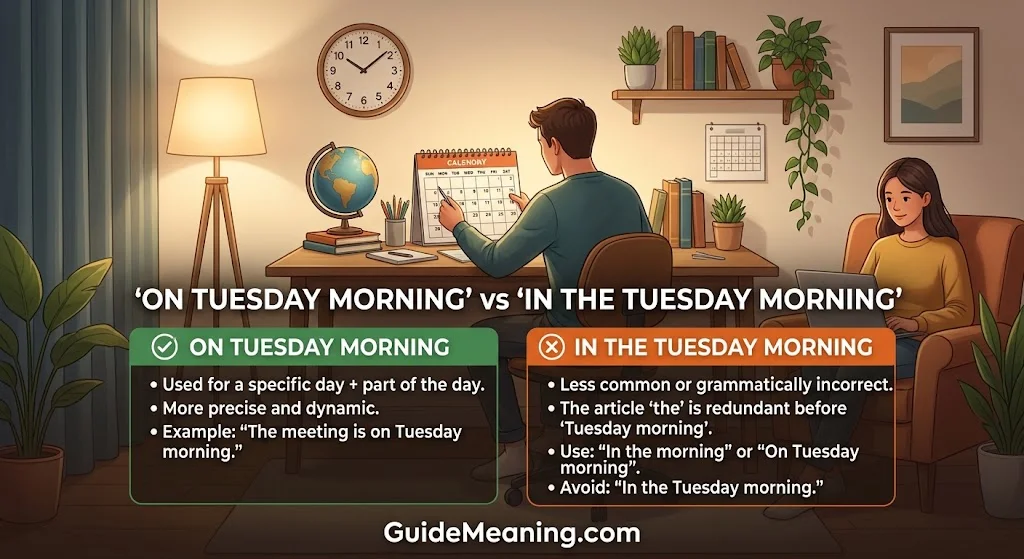

On Tuesday Morning vs. In the Tuesday Morning helps English learners understand which preposition fits a specific morning or general time. Many learners struggle with phrases such as in the morning vs on the morning because, at first glance, they look similar. In English grammar, on, in, and at can change the meaning of a sentence and serve different purposes. In the morning usually describes a general time period, while on the morning can refer to a specific date, event, or particular morning. This difference makes sense grammatically when you understand the pattern. Native speakers normally use these expressions naturally in conversation, spoken English, and written English.
The good news is that the correct use is simple, although people sometimes get confused because both forms talk about morning time and may seem to have the same meaning. The important idea is to figure out whether you mean a general period or one specific morning. Practical examples can help learners understand this difference. For instance, an everyday habit normally takes in the morning, while a particular occasion can take on the morning of an event. In my own writing, I find that this small distinction helps communicate clearly and avoids common mistakes. Clear rules, tables, and sentence examples can also help learners use the forms more confidently.
If you have wondered which form is correct, the answer depends on the context and the time you want to describe. This guide can help you understand the difference, answer common questions, and use the right prepositions without confused thinking. There are some exceptions, but the basic rules are clear. A small amount of practice can completely change how natural these phrases sound in everyday English. The tricky part is noticing whether the expression points to a general period or something specific. Once that idea becomes familiar, you can use the correct form in the same way that native speakers do and communicate your meaning more naturally.
Let’s jump in!
Quick Answer:
“On Tuesday morning” is correct and natural.
“In the Tuesday morning” is not the standard expression for a specific Tuesday morning.
Here’s the basic comparison:
| Expression | Correct? | Meaning |
| on Tuesday morning | ✅ Yes | A specific Tuesday morning |
| in the morning | ✅ Yes | A general morning |
| in Tuesday morning | ❌ No | Not standard English |
| in the Tuesday morning | ❌ No | Not the normal construction |
| at Tuesday morning | ❌ No | Wrong time preposition |
| on the Tuesday morning after the storm | ✅ Possible | A specifically identified Tuesday morning |
| Tuesday morning | ✅ Yes | Can appear without a preposition in some sentences |
For example:
- I have a meeting on Tuesday morning. ✅
- I usually exercise in the morning. ✅
- I have a meeting in Tuesday morning. ❌
- I have a meeting in the Tuesday morning. ❌
The key distinction is specific versus general. When Tuesday identifies the day, on naturally introduces the time expression.
Why Do We Say “On Tuesday Morning”?
The answer becomes clearer when you look at what Tuesday morning actually means.
Tuesday names a particular day on the calendar. Morning identifies the part of that day you mean. Together, Tuesday morning points to a specific period within a specific day.
That’s why English normally uses on:
- on Tuesday
- on Tuesday morning
- on Tuesday afternoon
- on Tuesday evening
- on Tuesday night
The same pattern works with other weekdays:
- on Monday morning
- on Wednesday afternoon
- on Thursday evening
- on Friday night
- on Saturday morning
This isn’t limited to Tuesday. The same grammar applies whenever a named day combines with a part of that day.
The Pattern Behind “On Tuesday Morning”
A useful structure to remember is:
on + weekday + part of the day
For example:
- on Monday morning
- on Tuesday afternoon
- on Wednesday evening
- on Thursday night
So:
on + Tuesday + morning = on Tuesday morning
This pattern also works with dates:
- on July 4
- on December 25
- on August 25, 2026
The important point is that on connects an event to a particular day or date.
Why “Morning” Doesn’t Always Take “In”
This is where many English learners get caught.
You may learn:
in the morning
Then you see:
Tuesday morning
It can be tempting to combine the two and create:
❌ in the Tuesday morning
But the entire expression matters. English doesn’t choose a preposition for morning in isolation.
Compare these sentences:
I exercise in the morning.
This refers to mornings generally.
I exercised on Tuesday morning.
This refers to one particular Tuesday morning.
The addition of Tuesday changes the structure.
“In the Morning” vs. “On Tuesday Morning”
Both expressions are correct. They simply provide different levels of information.
When to Use “In the Morning”
Use in the morning when you mean mornings generally or when you don’t need to identify a particular day.
For example:
- I drink coffee in the morning.
- She usually studies in the morning.
- The store opens in the morning.
- Birds often become active in the morning.
- I feel more productive in the morning.
None of these sentences identifies a particular Tuesday, Wednesday, or Friday.
The focus is simply the morning as a general part of the day.
When to Use “On Tuesday Morning”
Use on Tuesday morning when you identify a particular Tuesday.
For example:
- I’ll send the report on Tuesday morning.
- We have an appointment on Tuesday morning.
- She arrived on Tuesday morning.
- The exam begins on Tuesday morning.
- The package should arrive on Tuesday morning.
Here, the listener knows exactly which morning you mean.
The difference becomes even clearer in a pair of sentences:
I study in the morning.
This could mean any morning.
I studied on Tuesday morning.
This points to a particular morning.
One small preposition changes the time reference considerably.
Why “In the Tuesday Morning” Sounds Wrong
The phrase in the Tuesday morning often comes from combining two correct structures incorrectly.
The first structure is:
in + the morning
The second is:
on + Tuesday morning
A learner may see these patterns and create:
in + the + Tuesday + morning
But English doesn’t build the expression that way.
Compare:
- in the morning ✅
- on Tuesday morning ✅
- in Tuesday morning ❌
- in the Tuesday morning ❌
The issue isn’t simply the word the. The main problem is the entire construction in the Tuesday morning.
English normally uses on when a named weekday forms the anchor of the time expression.
Why Adding “The” Doesn’t Fix It
Some learners think the problem is that Tuesday morning needs an article.
It doesn’t.
We normally say:
on Tuesday morning
not:
❌ on the Tuesday morning
when we’re simply referring to Tuesday morning in ordinary American English.
Compare:
- I’ll call you on Tuesday morning. ✅
- I’ll call you in the Tuesday morning. ❌
Adding the doesn’t repair the incorrect preposition.
Can You Say “In Tuesday Morning”?
No. In Tuesday morning isn’t the standard form for referring to a particular Tuesday morning.
The natural choice is:
on Tuesday morning
For example:
❌ The meeting starts in Tuesday morning.
✅ The meeting starts on Tuesday morning.
Another example:
❌ I’ll visit the office in Tuesday morning.
✅ I’ll visit the office on Tuesday morning.
The same rule applies to other weekdays:
❌ in Monday morning
✅ on Monday morning
❌ in Friday afternoon
✅ on Friday afternoon
❌ in Sunday evening
✅ on Sunday evening
The pattern is consistent.
Read More: Segway vs. Segue: Which Is Correct? Meaning, Difference, and Examples 2026
Can You Say “On the Tuesday Morning”?
This question needs a little more care.
In ordinary American English, if you’re simply telling someone when something will happen, on Tuesday morning is the natural choice:
The meeting is on Tuesday morning.
However, the Tuesday morning can appear when additional context identifies a particular Tuesday morning.
For example:
On the Tuesday morning after the storm, the roads were still covered with snow.
Here, the Tuesday morning after the storm identifies one particular morning through the information that follows.
Another example:
On the Tuesday morning of the conference, everyone arrived early.
The phrase doesn’t simply mean any Tuesday morning. The surrounding context identifies which Tuesday morning you mean.
This distinction matters because saying that the can never appear with Tuesday morning would be too broad.
When “The” Has a Specific Job
Think about these two sentences:
We met on Tuesday morning.
The speaker identifies the day directly.
Now compare:
On the Tuesday morning after the announcement, the office was unusually quiet.
The second sentence gives additional identifying information.
The word the helps point to a particular morning that the context has made identifiable.
So the practical rule is:
Ordinary reference:
on Tuesday morning
Contextually identified reference:
on the Tuesday morning after…
The first is by far the more common choice for everyday scheduling.
“On Tuesday Morning” vs. “Tuesday Morning”
Another useful distinction involves dropping the preposition entirely.
In American English, Tuesday morning can sometimes appear without on.
For example:
I’ll call you Tuesday morning.
That sounds natural in American conversation.
You can also say:
I’ll call you on Tuesday morning.
Both forms can work. The difference comes partly from sentence structure and conversational style.
The version with on is especially clear when the time phrase functions as a conventional prepositional time expression:
The appointment is on Tuesday morning.
But American English often allows the day expression to appear directly after certain verbs:
I’ll see you Tuesday morning.
This doesn’t mean on Tuesday morning has become incorrect. It simply shows that English has more than one natural way to express a future day.
Examples Without “On”
- I’ll see you Tuesday morning.
- She arrives Tuesday afternoon.
- We’re leaving Tuesday evening.
- He called Tuesday night.
These forms are common in American English.
However, don’t transfer this flexibility to in:
- I’ll see you Tuesday morning. ✅
- I’ll see you on Tuesday morning. ✅
- I’ll see you in Tuesday morning. ❌
On vs. In vs. At for Time Expressions
Understanding on Tuesday morning becomes much easier when you understand the broader system of English time prepositions.
English commonly uses in, on, and at for different types of time references.
| Preposition | Typical use | Example |
| in | Months, years, seasons, general periods | in July, in 2026, in the morning |
| on | Days and dates | on Tuesday, on July 4 |
| at | Exact times and certain fixed expressions | at 9 a.m., at noon, at night |
A useful way to visualize the system is:
in → broader period
on → specific day or date
at → precise time
It’s not a perfect mathematical hierarchy because English has fixed expressions and exceptions. Still, this framework works extremely well for everyday grammar.
When to Use “On”
Use on with specific days and dates.
Examples include:
- on Monday
- on Tuesday
- on Friday
- on my birthday
- on July 4
- on December 25
- on Tuesday morning
- on Friday afternoon
The weekday remains the important anchor even when you add a part of the day.
For example:
The doctor called on Wednesday afternoon.
The phrase identifies both the day and the portion of that day.
When to Use “In”
Use in with broader periods.
Examples include:
- in January
- in 2026
- in summer
- in the morning
- in the afternoon
- in the evening
Notice the important difference:
in the morning
is general.
But:
on Tuesday morning
identifies a particular day.
This distinction explains why you shouldn’t simply replace on with in.
When to Use “At”
Use at for exact clock times and several established time expressions.
Examples:
- at 7 a.m.
- at 9:30
- at noon
- at midnight
- at night
For example:
The meeting starts at 9 a.m. on Tuesday morning.
This sentence uses both at and on correctly because each preposition performs a different job.
At 9 a.m. gives the precise time.
On Tuesday morning gives the day and broader part of the day.
What About “At Tuesday Morning”?
At Tuesday morning isn’t the standard expression.
Use on when you’re referring to the weekday:
❌ The meeting is at Tuesday morning.
✅ The meeting is on Tuesday morning.
If you know the exact time, use at for the clock time and on for the day:
The meeting is at 9 a.m. on Tuesday morning.
That sentence gives the reader two layers of information:
- at 9 a.m. → exact time
- on Tuesday morning → day and part of day
This combination is extremely useful in schedules, appointments, travel plans, and professional communication.
Common Mistakes With Tuesday Morning
These mistakes are easy to make because the incorrect versions often seem logical at first glance.
“In Tuesday Morning”
❌ I’ll call you in Tuesday morning.
The correction is:
✅ I’ll call you on Tuesday morning.
The named weekday requires the day-based pattern.
“In the Tuesday Morning”
❌ The class begins in the Tuesday morning.
Better:
✅ The class begins on Tuesday morning.
Don’t copy the structure in the morning and insert a weekday into it.
“At Tuesday Morning”
❌ The flight leaves at Tuesday morning.
Correct:
✅ The flight leaves on Tuesday morning.
If you know the exact departure time, write:
✅ The flight leaves at 8 a.m. on Tuesday morning.
Automatically Adding “The”
Another common mistake is assuming that every specific time expression needs the.
For ordinary scheduling, say:
on Tuesday morning
not:
on the Tuesday morning
However, as discussed earlier, the Tuesday morning can be correct when additional context identifies a particular morning.
Real-Life Examples of “On Tuesday Morning”
The phrase appears naturally in many everyday situations.
Work and Business
Professional communication frequently uses on Tuesday morning for meetings, deadlines, calls, and reports.
- The team meeting is on Tuesday morning.
- Please send the revised proposal on Tuesday morning.
- The manager will review the figures on Tuesday morning.
- The conference call starts at 10 a.m. on Tuesday morning.
When scheduling matters, this construction removes ambiguity.
School and Education
Schools also use day-plus-time expressions frequently.
- The exam begins on Tuesday morning.
- Students must arrive on Tuesday morning by 8:30.
- The science class meets on Tuesday morning.
- The field trip leaves on Tuesday morning.
The reader immediately knows which day and which portion of the day matter.
Travel and Daily Activities
The same pattern works for ordinary plans:
- We’re flying to Chicago on Tuesday morning.
- The train leaves on Tuesday morning.
- I’ll go grocery shopping on Tuesday morning.
- She plans to visit her parents on Tuesday morning.
The phrase gives enough information without forcing you to specify an exact hour.
A Simple Case Study: Planning a Meeting
Imagine three coworkers are arranging a meeting.
One person says:
“I’m free in the morning.”
That tells the others the person is generally available during the morning. It doesn’t identify a particular weekday.
Another says:
“I’m free on Tuesday morning.”
Now the time is much more specific.
A third person says:
“I’m free at 10 a.m. on Tuesday morning.”
This gives the most precise information.
The three expressions create a useful progression:
| Sentence | Information provided |
| I’m free in the morning. | General part of the day |
| I’m free on Tuesday morning. | Specific day + part of day |
| I’m free at 10 a.m. on Tuesday morning. | Exact time + specific day |
This is why prepositions matter. They help you control how precisely you describe time.
Can “In the Morning of Tuesday” Be Correct?
You may occasionally encounter a construction such as:
in the morning of Tuesday
This is grammatically understandable and can appear in formal, historical, literary, or highly specific writing. However, it isn’t the normal conversational choice in American English.
Most readers would find this much more natural:
on Tuesday morning
Compare:
In the morning of Tuesday, the soldiers arrived.
with:
On Tuesday morning, the soldiers arrived.
The second version is shorter, smoother, and much more natural for modern everyday English.
Unless the context calls for a deliberately formal or literary style, on Tuesday morning is the better choice.
“On Tuesday Morning” in Questions
The same rule applies when you ask questions.
Natural examples include:
- Are you free on Tuesday morning?
- What are you doing on Tuesday morning?
- Did she arrive on Tuesday morning?
- Will the store open on Tuesday morning?
- Can we meet on Tuesday morning?
Avoid:
- ❌ Are you free in Tuesday morning?
- ❌ Did she arrive in the Tuesday morning?
- ❌ Can we meet at Tuesday morning?
The structure remains the same regardless of whether you’re making a statement or asking a question.
“On Tuesday Morning” in Negative Sentences
Negatives don’t change the preposition either.
For example:
- I won’t be available on Tuesday morning.
- She wasn’t at work on Tuesday morning.
- We don’t have class on Tuesday morning.
- The store won’t open on Tuesday morning.
The negative word changes the meaning of the sentence. It doesn’t change the time expression.
A Quick Rule You Can Remember
If you want a simple memory trick, focus on what you’re identifying.
General part of the day
Use in:
in the morning
Specific day or date
Use on:
on Tuesday
Specific day + part of day
Use on:
on Tuesday morning
Exact clock time
Use at:
at 9 a.m.
So the practical formula is:
in + general period
on + specific day/date
at + exact time
This isn’t a rule you need to overthink every time you speak. With practice, these combinations become automatic.
On Tuesday Morning vs. In the Tuesday Morning: Quick Comparison
| Phrase | Status | Explanation |
| on Tuesday morning | ✅ Correct | Standard expression for a specific Tuesday morning |
| in the morning | ✅ Correct | General reference to the morning |
| in Tuesday morning | ❌ Incorrect in standard usage | A named weekday doesn’t normally follow in this way |
| in the Tuesday morning | ❌ Not standard | It combines the wrong time pattern |
| at Tuesday morning | ❌ Incorrect | At doesn’t normally introduce a weekday |
| on the Tuesday morning after the storm | ✅ Possible | The identifies a particular Tuesday morning through context |
| Tuesday morning | ✅ Correct | American English can omit on in certain constructions |
The most important pair is still:
in the morning = general
on Tuesday morning = specific
Why This Difference Matters in American English
At first glance, the difference between in and on might seem tiny. In practice, it affects how naturally your English sounds.
Consider this sentence:
I’ll send the contract in Tuesday morning.
The meaning is understandable. However, the phrasing immediately sounds nonstandard.
Now compare:
I’ll send the contract on Tuesday morning.
The second sentence feels effortless because it follows the conventional American English pattern.
That’s an important lesson about prepositions: grammar isn’t always about translating individual words. A phrase may need to be learned as a complete pattern.
For English learners, memorizing on Tuesday morning is more useful than trying to create the phrase word by word.
FAQs:
Is “on Tuesday morning” correct?
Yes. On Tuesday morning is the natural choice when you’re talking about a specific morning connected to Tuesday. For example: “I’ll call you on Tuesday morning.”
Is “in Tuesday morning” correct?
No. In standard English, in Tuesday morning is not normally used. Say on Tuesday morning when Tuesday identifies the particular morning.
When should I use “in the morning”?
Use in the morning when you mean a general time period rather than one specific date. For example: “I usually exercise in the morning.”
Can I say “on the morning”?
Yes, when the morning refers to a particular occasion or event. For example: “We left early on the morning of the wedding.”
What’s the difference between “in the morning” and “on Tuesday morning”?
In the morning refers to a general period of the day. On Tuesday morning identifies a specific morning. The choice depends on the context and what you want to communicate.
Can “at” be used with morning?
Usually, no. We generally say in the morning or on Tuesday morning. However, at can appear in expressions such as at 8 in the morning, where it introduces the exact time.
What is the easiest way to remember the rule?
Think of in as a general time period and on as a particular day or date. So, say in the morning, but on Tuesday morning. Once you practice a few examples, the pattern becomes much easier to recognize.
Conclusion:
Choosing between in the morning and on Tuesday morning becomes simple once you focus on whether the time is general or specific. Use in the morning for a general part of the day, and use on Tuesday morning when you identify a particular morning. The phrase in the Tuesday morning is generally unnatural in standard English. With a little practice, you can use these prepositions naturally in both spoken and written English.




1 thought on “On Tuesday Morning vs. In the Tuesday Morning: Which Is Correct? 2026”