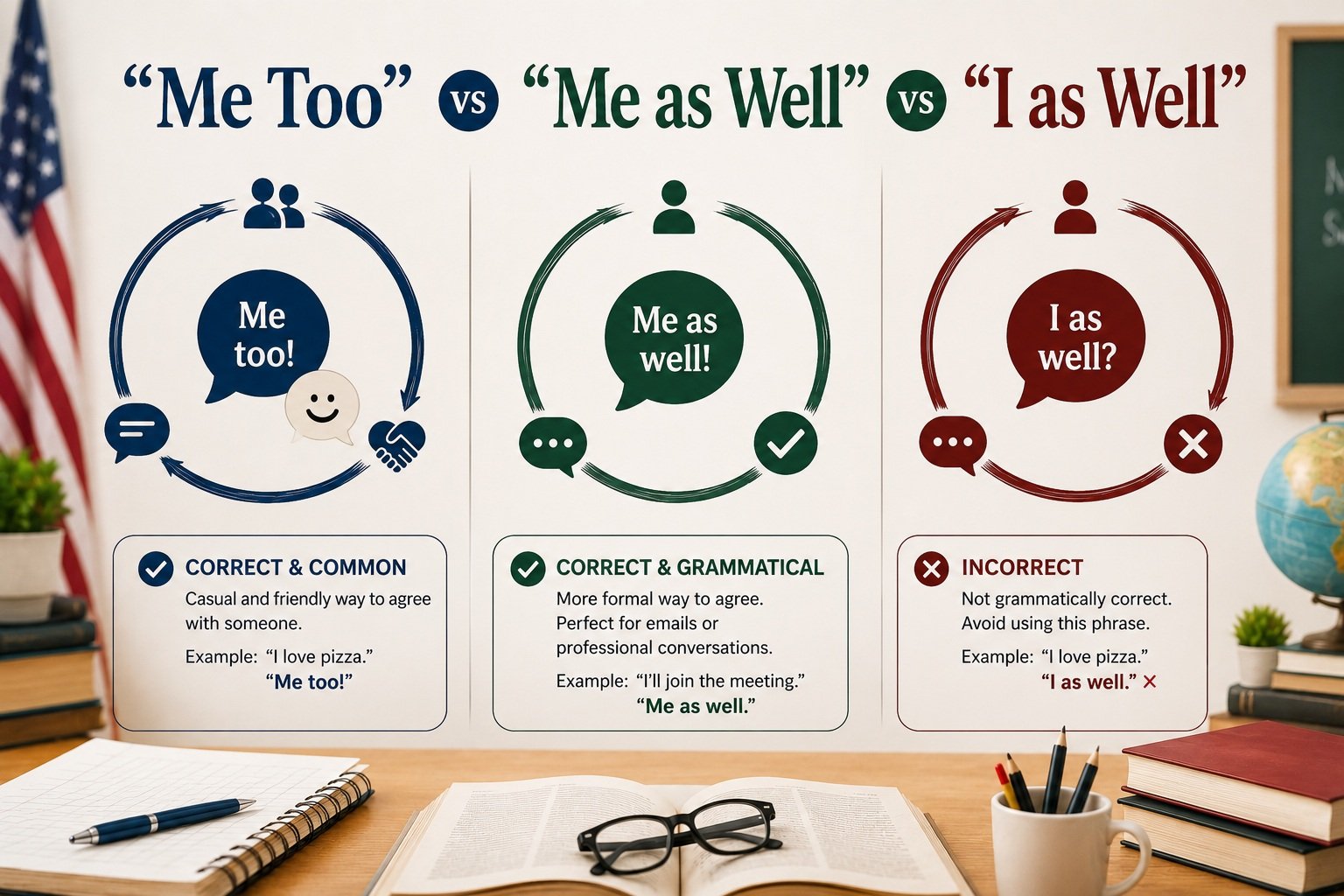

“Me Too” vs “Me as Well” vs “I as Well” can seem similar, but English learners need to understand context and sentence structure to choose the right expression. On the surface, English looks simple, yet similar expressions can create confusion. Me too, me as well, and I as well may seem interchangeable at first glance, but they can sound different in real conversation. People, native speakers, and writers use these phrases in speech, speaking, writing, and everyday situations to express agreement. Me too is common, widely accepted, and natural in casual speech, while me as well can sound more formal and polite. I as well can also work in certain situations, depending on its grammatical role, sentence structure, and context.
From my experience teaching grammar, many learners struggle with these forms because some replies can sound incomplete even when they feel natural. The difference often depends on tone, the type of English being used, and the level of formality. Examples, comparisons, explanations, and a clear table can make the best choice easier to understand. A useful guide helps learners understand what each phrase really means, choose the right expression, and avoid an incorrect form. Grammar books, expert tips, and practice can also help learners build a better level of understanding and recognize how these expressions work in real life.
Clear communication depends on choosing the right words, because small grammar differences can change how a sentence sounds. The choice between these expressions depends on sentence structure, tone, grammatical role, and proper usage. Me too and me as well are closely related, while I as well may be appropriate when the sentence supports it. Learners can study distinct comparisons, see examples, and notice how people use these forms in conversations, writing, and professional communication. With enough practice, they can avoid common mistakes, choose the correct expression, and become more confident when reading, speaking, and responding in real communication.
Let’s dive in!
Quick Answer:
“Me Too” vs “Me as Well” vs “I as Well” is mainly a question of natural usage and grammar. In American English, “me too” is the most natural standalone reply, while “me as well” is also possible but less common. “I as well” normally needs a verb, as in “I am as well” or “I will as well.”
TL;DR:
• “Me too” is natural, common, and conversational.
• “Me as well” means the same thing but sounds more neutral.
• “I as well” is incomplete as a standalone response.
• “I am as well” and “I will as well” are complete forms.
• American speakers commonly choose “me too” in casual conversation.
• Formal writing often benefits from a complete sentence.
What Does “Me Too” Mean?
“Me too” is a short way to say “the same applies to me.” It can show agreement with a feeling, opinion, experience, preference, or action.
For American readers, this is one of the most familiar agreement phrases in everyday conversation. It appears in conversations between friends, family members, classmates, coworkers, and online users.
Common Uses of “Me Too”
You can use “me too” after many types of statements:
• “I’m tired.” → “Me too.”
• “I love pizza.” → “Me too!”
• “I want to go.” → “Me too.”
• “I miss summer.” → “Me too.”
• “I’ve seen that movie.” → “Me too.”
The phrase is short because English speakers often leave out information that listeners can easily understand. Cambridge Grammar specifically notes that “me too” is especially natural in responses consisting of a single object pronoun.
Why “Me Too” Sounds So Natural
The phrase feels natural because it gets directly to the point. You don’t need to repeat the entire sentence.
For example:
“I’m excited about the trip.”
You could say:
“I’m excited about the trip too.”
But in conversation, this is much easier:
“Me too!”
The shorter response feels friendly and spontaneous.
What Does “Me as Well” Mean?
“Me as well” generally means “me too” or “the same applies to me.” The difference is mostly about style and sentence structure.
For example:
“I’m going to the concert.”
A possible response is:
“Me as well.”
The meaning is clear. However, many American English speakers would probably choose “Me too” in casual conversation. Cambridge Grammar gives “Yeah, me too” as the preferred natural response over “me as well” in this type of standalone exchange.
Is “Me as Well” Correct?
Yes, “me as well” can be correct. It simply isn’t as natural in every situation as “me too.”
You’ll often find “as well” inside a complete sentence:
“I’m going to the concert as well.”
Or:
“They invited me as well.”
Here, the structure is complete, so there’s no confusion about what “as well” modifies.
When “Me as Well” Can Work
A standalone “me as well” can be understood easily when the context supplies the missing information.
For example:
“I’m applying for the position.”
“Me as well.”
The second speaker means:
“I’m applying for the position as well.”
So the phrase works through context. It’s an example of how spoken English can leave out words that are already obvious.
Why “I as Well” Sounds Wrong
“I as well” causes the most confusion because I and me have different grammatical jobs.
“I” is normally used as a subject:
“I like coffee.”
“Me” is normally used as an object:
“She called me.”
When “as well” appears at the end of a complete clause, it can mean “also” or “too.” But simply putting “I” before “as well” doesn’t create a complete standalone response.
The Missing Verb
Consider this exchange:
“I’m joining the meeting.”
The natural responses include:
“Me too.”
“Me as well.”
“I am as well.”
But this sounds incomplete:
“I as well.”
The problem is that the third version has no verb. The same basic issue appears with other examples.
Instead of:
“I as well.”
Use:
“I do as well.”
“I am as well.”
“I will as well.”
“I have as well.”
The correct verb depends on the original statement.
A Simple Grammar Pattern
Think of the three forms this way:
| Expression | Typical Use | Example | Naturalness |
| Me too | Short agreement | “I’m tired.” → “Me too.” | Very natural |
| Me as well | Short agreement or added information | “I’m going.” → “Me as well.” | Correct, less common |
| I as well | Usually incomplete alone | “I as well.” | Usually unnatural |
| I am as well | Complete sentence | “I’m tired.” → “I am as well.” | Correct |
| I will as well | Complete future response | “I’ll attend.” → “I will as well.” | Correct |
The important point is that “I as well” is not simply a more formal version of “me too.” The pronoun and sentence structure matter.
“Me Too” vs “Me as Well” in American English
In the United States, “me too” is deeply familiar in everyday speech. It fits casual conversations because it is short, direct, and expressive.
“Me as well” is understandable, but it can sound more deliberate. It may feel less spontaneous because “as well” is often associated with complete sentences.
Casual American Conversation
Imagine two friends talking:
“I’m starving.”
“Me too!”
That sounds completely natural.
Now consider:
“I’m starving.”
“Me as well.”
This isn’t necessarily wrong. However, it may sound slightly more careful or less conversational.
Professional Communication
In a workplace setting, the best choice depends on the whole sentence.
For example:
“I’ll attend the meeting as well.”
This is clear and professional.
You could also write:
“I will as well.”
That form is grammatical when the earlier statement supplies the missing action.
Instead, “Me too” may sound perfectly acceptable in an informal workplace chat. The setting and relationship between speakers matter more than a simple formal-versus-informal rule.
When Should You Use “Me Too”?
Use “me too” when you want a quick, natural expression of agreement. It’s especially useful when another person has just expressed something that applies to you.
Everyday Examples
• “I love this song.” → “Me too!”
• “I’m ready to leave.” → “Me too.”
• “I’ve been there before.” → “Me too.”
• “I want some coffee.” → “Me too!”
• “I’m nervous about tomorrow.” → “Me too.”
The phrase can also carry emotion. A simple “me too” may communicate excitement, sympathy, frustration, or shared experience.
For instance:
“I really miss my hometown.”
“Me too.”
The words are simple, but the emotional meaning comes from the situation.
Read More: Recurring vs. Reoccurring: Meaning and Difference
When Should You Use “Me as Well”?
“Me as well” works when you want to express the same idea as “me too,” especially when the surrounding language already sounds measured or polite.
Examples in Complete Sentences
Instead of using the standalone form, you can make the structure clearer:
“I enjoyed the presentation, and my colleague did as well.”
“She invited me as well.”
“I’m interested in the position as well.”
These sentences show the main strength of “as well.” It fits naturally into complete clauses.
A Useful Rule
If you’re unsure, ask yourself whether you’re answering quickly or writing a complete sentence.
For quick conversation:
“Me too.”
For a complete sentence:
“I’m interested as well.”
For a more formal response:
“I am as well.”
That simple distinction solves many common problems.
Can “I as Well” Ever Be Correct?
Yes, but there’s an important distinction.
The exact sequence “I as well” can appear as part of a larger construction. It isn’t automatically ungrammatical whenever those three words appear together.
For example:
“I, as well as my sister, am attending.”
Here, “as well as” is part of a larger grammatical structure. The word “am” provides the verb needed by the subject “I.”
However, this is very different from answering someone with:
“I as well.”
That standalone response is normally incomplete.
Better Alternatives
If you want to use “I,” include the appropriate verb:
“I am too.”
“I am as well.”
“I do too.”
“I do as well.”
“I will too.”
“I will as well.”
This approach is much clearer than trying to force “I as well” into a standalone reply.
Common Mistakes With These Expressions
Many mistakes happen because learners treat “too,” “as well,” “I,” and “me” as interchangeable pieces.
They aren’t.
Mistake: “I as well”
“I as well.”
Better:
“Me too.”
Or:
“I am as well.”
Mistake: “Aswell”
“As well” is always written as two words.
Correct:
“I like it as well.”
Incorrect:
“I like it aswell.”
The phrase “as well” functions as an adverbial expression meaning “also” or “too.”
Mistake: Assuming Formal Means Better
Some learners believe “I as well” must be more sophisticated than “me too.”
That isn’t how English works.
“Me too” is a standard, natural expression. Its conversational tone doesn’t make it bad English.
“Me Too” vs “Me as Well” vs “I as Well” by Context
The same basic idea can sound different depending on where you use it.
Friends and Family
“Me too” is usually the easiest choice.
“I’m exhausted.”
“Me too.”
It sounds relaxed and natural.
Text Messages
“Me too” also works especially well in texting. The short form fits the quick rhythm of digital conversation.
You might see:
“I can’t wait!”
“Me too!”
There’s little reason to make the response longer.
Workplace Conversations
At work, all three ideas may appear, but complete sentences often sound clearest.
“I’ll be there as well.”
“I will too.”
“I am as well.”
“Me too” can still be perfectly natural in a casual conversation between coworkers.
Academic Writing
Formal writing usually benefits from complete sentences. Instead of writing:
“Me too.”
you might write:
“I agree with this point as well.”
That choice makes the relationship between the subject, verb, and meaning explicit.
The Emotional Meaning Behind “Me Too”
Although these expressions are grammatical, they also carry social meaning.
“Me too” often creates a sense of connection. When someone shares a feeling and you respond with “me too,” you show that they aren’t alone in that experience.
Shared Experience
For example:
“I was nervous before my first presentation.”
“Me too.”
The response doesn’t merely agree. It establishes common ground.
Social Connection
In casual American communication, short agreement phrases can make conversations feel smoother. They show that you’re listening and that the other person’s experience connects with yours.
This is especially noticeable in conversations about emotions, hobbies, frustrations, and personal experiences.
Tone Changes With Punctuation
Compare:
“Me too.”
“Me too!”
“ME TOO!”
The basic meaning remains similar, but the emotional intensity changes.
The first can sound calm. The second may sound excited. The third often signals strong enthusiasm or surprise.
How “Too” and “As Well” Differ
“Too” and “as well” can both mean “also.” However, their position and conversational feel can differ.
Cambridge Grammar notes that “as well” generally appears toward the end of a clause, while “too” has several possible positions.
Examples
“I like it too.”
“I like it as well.”
Both can mean:
“I also like it.”
However:
“Me too!”
is much more natural than:
“Me as well!”
in many casual responses.
That difference is about idiomatic usage, not simply whether one phrase is grammatically possible.
What About “I Also”?
“I also” is often a better alternative when you want a complete sentence.
For example:
“I also enjoy hiking.”
This is clear and grammatical.
You can also say:
“I enjoy hiking as well.”
Or:
“I enjoy hiking too.”
All three communicate the same basic idea, but their placement differs.
Quick Comparison
• “I also like it” places “also” before the main verb.
• “I like it too” places “too” near the sentence ending.
• “I like it as well” usually places “as well” at the end.
• “Me too” works as a short conversational response.
• “I as well” usually needs a larger sentence around it.
How These Phrases Have Changed Over Time
Unlike many words with long cultural histories, these expressions don’t have a major symbolic or religious origin. Their story is mainly about the development of English grammar and everyday conversation.
English speakers have long used short expressions to avoid repeating information. Over time, conversational patterns made phrases such as “me too” highly familiar.
Today, digital communication has made short responses even more common. Texting, messaging, and social platforms reward quick expressions that readers understand immediately.
Modern Digital Communication
A person might write:
“I’m so ready for the weekend.”
A friend can answer:
“Me too!”
No additional explanation is needed.
That efficiency helps explain why “me too” remains especially common in informal communication.
Why These Phrases Still Confuse English Learners
The biggest challenge is that English doesn’t always use the pronoun that learners expect.
A learner may think:
“The original sentence starts with ‘I,’ so my answer should also start with ‘I.’”
But English allows a shortened response:
“I love coffee.”
“Me too.”
The second speaker isn’t literally building a full sentence. Instead, they’re using a conversational fragment whose meaning is understood from the first sentence.
This is normal English usage, not a mistake.
FAQs:
Is “Me Too” correct English?
Yes. “Me too” is correct and very common in casual speech. It’s used to show that you share the same feeling, opinion, experience, or situation as another person.
Is “Me as Well” grammatically correct?
Yes. “Me as well” is grammatically acceptable and means roughly the same as “me too.” However, it can sound slightly more formal or less common in everyday conversation.
Is “I as Well” correct?
Yes, but “I as well” depends more on the sentence structure and context. It often sounds more natural when it appears as part of a complete sentence rather than as a short reply.
What is the difference between “Me Too” and “Me as Well”?
Both expressions show agreement or that something applies to you too. “Me too” is more common and natural in casual conversation, while “me as well” can sound slightly more formal.
Can I use “Me Too” in professional communication?
Yes, but the context matters. “Me too” is natural in friendly or informal communication. In a more formal setting, a complete sentence or a phrase such as “I do as well” may sound more appropriate.
Why does “I as Well” sometimes sound awkward?
The problem usually comes from sentence structure. Unlike “me too,” which works naturally as a short response, “I as well” often needs additional words to make the meaning clear and sound natural.
Which expression should I use: “Me Too,” “Me as Well,” or “I as Well”?
For most everyday situations, “me too” is the simplest and most natural choice. Use “me as well” when a slightly more formal tone fits, and choose “I as well” when the surrounding sentence structure makes it natural.
Conclusion:
“Me too,” “me as well,” and “I as well” all express a similar idea, but they don’t always sound equally natural. “Me too” is the most common choice in everyday conversation, while “me as well” can add a slightly more formal tone.
“I as well” is correct in the right sentence structure, but it requires more attention to context. Understanding these small differences can help you choose the correct expression, avoid common mistakes, and sound more natural and confident in English.