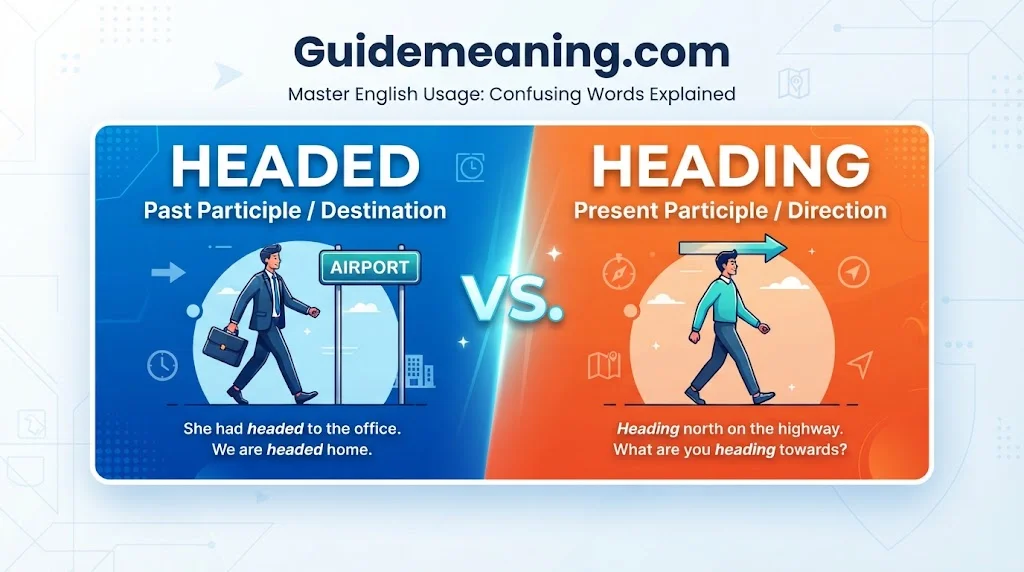

Headed vs. Heading can feel tricky because two words look almost the same, yet each behaves differently when English shows direction and action. One shows direction that is settled in your mind, while the other shows action that is happening right now. Think about travel: heading can feel like stepping onto a road, while headed suggests knowing where you will end up. This simple, clear, and practical idea helps people understand why they mix them. English allows flexibility and freedom, yet that sometimes causes confusion. Don’t worry; you can walk away from this article knowing when to pick each one. I’ve paused while writing and wondered about this difference, so you’re not alone. Learners and native speakers can confuse these forms because they come from the same verb, head, but they serve different grammatical purposes.
The confusion often appears in everyday conversations, emails, social media posts, and professional writing. Writers may write, “I am headed to the office,” or “I am heading to the office.” These two forms are similar, but they are used differently according to sentence structure and intended meaning. Understanding the correct form makes your writing clearer, more professional, and grammatically accurate. The distinction is not complicated once you understand how each form functions and what its meanings are. Grammar rules, examples, common mistakes, practical applications, and expert tips help you confidently use both forms in any situation. They relate to movement and direction; however, they are not fully interchangeable. Tense and context shape their meaning and make the choice sound more natural. This tiny distinction can involve one letter, yet that letter changes the tone, intention, and prediction expressed by the sentence. If you write professionally, teach English, coach clients, or care about precision, this choice matters.
Consider the questions, “where are you headed?” and “where are you heading?” Headed is a past participle used as a participial adjective, describing a state of being that is aimed toward a destination. Heading, by contrast, is a present participle that can emphasize ongoing movement or a process. Both phrases ask about direction or an endpoint, but headed often focuses on the destination and sounds casual in American English, whereas heading emphasizes the journey and appears frequently in British English and formal writing. From my experience explaining this point, the easiest approach is to picture the difference as destination versus journey. When the intention is to describe where someone is directed or aimed, headed fits naturally. When the focus is on movement or an ongoing process, heading often feels more suitable. This approach helps you intentionally choose instead of relying on a quick guess.
Let’s dive in!
Quick Answer:
Heading is the present participle of head. It commonly appears in progressive constructions to describe movement or an action in progress.
“We’re heading to the airport.”
Headed is the past tense and past participle of head. It can also function as an adjective, especially when it describes someone or something moving in a particular direction.
“We’re headed to the airport.”
The simplest way to remember the distinction is:
| Word | Grammatical form | Common focus | Example |
| Heading | Present participle / -ing form | Movement or action in progress | “She is heading home.” |
| Headed | Past tense / past participle; adjective-like use | Direction, destination, or trajectory | “She is headed home.” |
However, don’t turn this into an overly strict rule. “She is heading home” and “She is headed home” can describe the same basic situation. The wording simply places slightly different emphasis on the movement or direction.
What Does “Heading” Mean?
Heading is the present participle of the verb head. When head means “move in a particular direction,” heading usually emphasizes the act or process of moving.
For example:
“The hikers are heading toward the river.”
The sentence presents the hikers as being in the process of moving toward the river.
You can use heading with people, animals, vehicles, weather systems, organizations, and even abstract ideas. Oxford describes head in this sense as moving in a particular direction and gives examples such as “Where are we heading?” and “The boat was heading out to sea.”
Examples of “Heading”
- “I’m heading home.”
- “Where are you heading?”
- “They’re heading toward the station.”
- “The train is heading north.”
- “She’s heading back to work.”
- “The storm is heading toward the coast.”
- “The economy seems to be heading in a different direction.”
Notice the common pattern. The word often appears with am, is, are, was, or were when it describes an action in progress.
“Heading” With Destinations and Directions
Heading works naturally with several kinds of directional expressions.
You can say:
- heading home
- heading to school
- heading to work
- heading toward the station
- heading north
- heading back
- heading for the airport
The choice of preposition depends on the relationship between the movement and the destination.
For example:
“We’re heading to Chicago.”
This identifies Chicago as the destination.
By contrast:
“We’re heading toward Chicago.”
This emphasizes direction. The sentence doesn’t necessarily promise that Chicago is the final destination.
That small distinction can matter when precision counts.
What Does “Headed” Mean?
Headed has two major grammatical roles relevant to this comparison. It is the past tense and past participle of head, and it can also function adjectivally in expressions describing direction or destination.
For example:
“She headed home after dinner.”
Here, headed is simple past. The action happened in the past.
Now compare it with:
“She is headed home.”
Here, headed does not mean that the movement happened in the past. The auxiliary verb is makes the construction present tense. Headed describes her current direction.
That’s one of the biggest traps in the headed vs. heading debate.
Examples of “Headed”
- “We headed north after breakfast.”
- “The plane is headed east.”
- “She is headed for the airport.”
- “They were headed toward the city.”
- “The company is headed in the right direction.”
- “The storm is headed for the coast.”
Cambridge defines headed in this directional sense as going toward a particular place or direction. It also recognizes the figurative pattern headed for, which can describe something likely to happen in the future.
Headed vs. Heading: The Main Difference
The most useful distinction is movement versus direction or trajectory.
Heading often presents the movement as an ongoing action.
“The children are heading toward the playground.”
Headed often presents the subject as being directed toward a destination or outcome.
“The children are headed toward the playground.”
The practical difference is subtle. Native speakers can use both sentences naturally.
Think of it like watching a car.
With heading, the camera focuses on the car’s movement:
“The car is heading south.”
With headed, the camera focuses more on where the car is going:
“The car is headed south.”
Same road. Similar destination. Slightly different spotlight.
Action in Progress vs. Established Direction
It’s tempting to say:
Heading = present
Headed = past
That explanation isn’t accurate enough.
Heading is the -ing form, while headed can be the simple past or past participle. But headed can describe a present direction when it follows a form of be.
For example:
“The ship headed west.”
This is past tense.
But:
“The ship is headed west.”
This describes the ship’s current direction.
The auxiliary verb carries the tense of the second sentence. Headed itself doesn’t force the entire sentence into the past.
Why “Headed” Can Refer to the Present
This point deserves special attention because it causes so many mistakes.
English uses be + past participle in several grammatical constructions. In the case of directional headed, the resulting phrase can describe a current state or trajectory.
Compare:
“They headed toward the beach.”
This tells you about a past movement.
Now compare:
“They are headed toward the beach.”
This describes their current direction.
The same basic distinction appears in other examples:
| Past action | Current direction |
| “The plane headed west.” | “The plane is headed west.” |
| “She headed home.” | “She is headed home.” |
| “They headed toward town.” | “They are headed toward town.” |
So don’t assume that every sentence containing headed refers to a past event.
“We’re Heading Home” vs. “We’re Headed Home”
This pair creates perhaps the most common headed vs. heading question.
We’re Heading Home
“We’re heading home.”
This emphasizes the action of going home. It sounds like you’re describing what you’re doing right now.
For example:
“The movie is over. We’re heading home.”
The focus falls naturally on the movement.
We’re Headed Home
“We’re headed home.”
This emphasizes the direction or destination.
For example:
“Don’t worry about us. We’re headed home.”
Here, the important information is that home is where you’re going.
Are Both Correct?
Yes.
Both are standard constructions in everyday English. Oxford explicitly lists directional head as a verb that can also appear in the construction be headed.
So there’s no need to treat one sentence as a grammatical error.
Read More: If He Was vs. If He Were: What’s the Difference? for 2026
“Heading to” vs. “Headed to”
The same distinction appears with to.
Heading to
“I’m heading to the office.”
This focuses on the action of going to the office.
Headed to
“I’m headed to the office.”
This focuses more on the destination or direction.
In casual American English, both can sound completely natural.
The context often determines which one feels more appropriate.
Example
Imagine someone calls you while you’re driving.
Question: “Where are you?”
Answer:
“I’m heading to the office.”
The response describes your current activity.
You might also say:
“I’m headed to the office.”
That answer emphasizes where you’re going.
Neither construction needs to carry a dramatic difference in meaning.
“Heading North” vs. “Headed North”
Directional words make the contrast especially clear.
“The train is heading north.”
This highlights the train’s ongoing movement.
“The train is headed north.”
This highlights the train’s current course.
Both sentences communicate essentially the same practical information.
Oxford and Cambridge both give directional examples involving head, including forms such as head north, heading toward, and headed constructions.
“Heading for Trouble” vs. “Headed for Trouble”
The difference becomes even more interesting when head describes a future outcome instead of physical movement.
Consider:
“You’re heading for trouble.”
This means your current actions appear to be leading toward trouble.
Now:
“You’re headed for trouble.”
This also means you’re moving toward an undesirable outcome.
The destination isn’t physical. Trouble represents a future result.
Cambridge specifically records headed for as a pattern used for something likely to happen soon, such as being “headed for a recession.”
Physical and Figurative Uses
| Physical meaning | Figurative meaning |
| “The bus is headed for Dallas.” | “The company is headed for trouble.” |
| “She is heading toward the exit.” | “The project is heading toward failure.” |
| “The ship is heading north.” | “The economy is heading in the wrong direction.” |
This metaphor is deeply natural in English. We often imagine events, careers, businesses, and situations as though they’re travelers moving along a road.
Grammar of “Heading”
“Heading” as a Present Participle
The most common grammatical role in this comparison is the present participle.
It appears in progressive constructions:
- I am heading home.
- She is heading downtown.
- They are heading north.
- We were heading toward the station.
The -ing form doesn’t automatically mean present tense. It can appear with different auxiliary verbs.
For example:
“We were heading home when it started raining.”
The action happened in the past, yet heading remains the -ing form.
“Heading” as a Gerund
Heading can also function as a noun.
“Heading home early sounds great.”
Here, heading home early acts as the subject of the sentence.
That’s different from:
“We are heading home early.”
In the second sentence, heading belongs to the verb phrase.
“Heading” as a Noun
The word heading has another common meaning that has nothing to do with the act of traveling.
A heading can be a title or label at the beginning of a section.
For example:
“Add a clear heading above this paragraph.”
It can also refer to direction or course in certain technical contexts.
So context matters enormously.
Grammar of “Headed”
“Headed” as a Past-Tense Verb
When headed appears alone as the main verb in a past-tense sentence, it describes a completed or past action.
“We headed home after dinner.”
The journey began in the past.
Another example:
“The hikers headed toward the river.”
The sentence simply reports what they did.
“Headed” as a Past Participle
Headed also serves as the past participle of head.
You can see this form in constructions such as:
“The team has headed in a new direction.”
However, the directional adjective-like construction is much more common in everyday sentences such as:
“The team is headed in a new direction.”
“Be + Headed”
This pattern deserves special attention:
- am headed
- is headed
- are headed
- was headed
- were headed
Examples:
“I am headed home.”
“She is headed toward the station.”
“They were headed north.”
The auxiliary verb tells you the tense. Headed describes the direction or course.
Headed vs. Heading With Common Prepositions
Headed Home vs. Heading Home
Both are correct:
“I’m heading home.”
“I’m headed home.”
Don’t normally insert to before home in these everyday expressions.
Heading home is standard.
Headed home is also standard.
Headed to vs. Heading to
Use to when you identify a destination.
“We’re heading to Boston.”
“We’re headed to Boston.”
Both work naturally.
Headed Toward vs. Heading Toward
Toward often emphasizes direction rather than a guaranteed endpoint.
“The boat is heading toward the island.”
“The boat is headed toward the island.”
Again, both are grammatical.
Headed for vs. Heading for
For frequently introduces a destination or anticipated outcome.
“They’re heading for the airport.”
“They’re headed for the airport.”
It can also introduce a figurative outcome:
“The company is headed for trouble.”
“The company is heading for trouble.”
Headed vs. Heading in Everyday English
The distinction becomes easier when you see these words in realistic situations.
Case Study: Leaving Work
Imagine the workday has ended.
Someone asks:
“What are you doing now?”
You could answer:
“I’m heading home.”
The sentence emphasizes your action.
If someone asks:
“Where are you going?”
You could say:
“I’m headed home.”
The destination becomes slightly more prominent.
Still, don’t overstate the difference. In ordinary conversation, these expressions can overlap considerably.
Case Study: Tracking a Storm
A weather report might say:
“The storm is heading toward the coast.”
Another report might say:
“The storm is headed toward the coast.”
Both describe the storm’s course.
The first gives a stronger sense of movement in progress. The second presents the storm as currently directed toward the coast.
Case Study: Discussing a Career
Physical movement isn’t necessary.
Consider:
“She’s heading toward a career in engineering.”
This describes a developing direction.
Now:
“She’s headed toward a career in engineering.”
This presents engineering as the direction her current path is taking.
English frequently uses movement vocabulary to describe abstract progress. A career can have a direction. A company can be headed toward growth. A project can be heading toward completion.
Common Mistakes With Headed and Heading
Mistake: Thinking “Headed” Always Means Past
This is the biggest misconception.
Incorrect assumption:
“Headed is past, so I can’t use it for something happening now.”
That’s false.
“The train is headed north.”
The train is currently going north.
The phrase is headed describes its present direction.
Mistake: Adding “To” Before “Home”
In standard everyday English, say:
“I’m heading home.”
Not:
“I’m heading to home.”
When home functions as a destination after movement verbs, English commonly uses it without to.
You can use to with ordinary destination nouns:
“I’m heading to the house.”
But:
“I’m heading home.”
That distinction is worth remembering.
Mistake: Assuming One Form Is Always Correct
English doesn’t work that neatly here.
Both of these are correct:
“They are heading south.”
“They are headed south.”
The surrounding structure and intended emphasis determine the better fit.
Mistake: Confusing “Heading” With a Title
Compare:
“We’re heading downtown.”
with:
“The article needs a heading.”
The first sentence uses heading as a verb form.
The second uses heading as a noun meaning a title or section label.
Headed vs. Heading: Side-by-Side Comparison
| Feature | Heading | Headed |
| Base verb | head | head |
| Form | Present participle / -ing form | Past tense and past participle |
| Common present construction | is heading | is headed |
| Typical emphasis | Movement or action | Direction, destination, or trajectory |
| Can describe present circumstances? | Yes | Yes |
| Can describe physical movement? | Yes | Yes |
| Can describe figurative direction? | Yes | Yes |
| Example | “We’re heading home.” | “We’re headed home.” |
| Common expressions | heading to, heading toward, heading for | headed to, headed toward, headed for |
The table reveals something important: the forms overlap more than many grammar guides suggest.
The real issue isn’t choosing between a universally correct word and a universally incorrect word. It’s understanding what grammatical structure you’re building.
Headed vs. Heading in American English
In American English, both heading and headed are common in everyday directional expressions.
You can naturally hear:
“Where are you heading?”
You can also hear:
“Where are you headed?”
Likewise:
“I’m heading home.”
and:
“I’m headed home.”
Both versions fit ordinary conversation.
The choice often depends on what sounds natural in the immediate context. Heading tends to foreground the act of going somewhere. Headed often foregrounds the direction or destination.
There’s no need to force a sharp distinction when native usage allows overlap.
How to Choose Between Headed and Heading
When you’re unsure, use three quick checks.
Focus on the Action
If you’re describing an action in progress, heading is often a natural choice.
“We’re heading toward the station.”
Think:
What are we doing?
We’re moving toward the station.
Focus on the Direction
If you’re describing where someone or something is directed, headed often fits naturally.
“We’re headed toward the station.”
Think:
Where are we going?
Toward the station.
Check the Verb Structure
Look at what comes before the word.
Heading commonly appears in progressive constructions:
“She is heading home.”
Headed can appear as a past-tense verb:
“She headed home yesterday.”
It can also appear after be to describe current direction:
“She is headed home.”
That third pattern is the one learners often overlook.
A Simple Memory Trick for Headed vs. Heading
Here’s a practical shortcut:
Heading = moving
Headed = directed
So:
“I’m heading home.”
Think: I am moving homeward.
“I’m headed home.”
Think: Home is my current destination.
This isn’t an absolute grammatical rule. It’s simply a memory aid that can help you make a quick choice.
When both versions sound possible, check the sentence structure rather than relying only on the shortcut.
Common Expressions With Headed and Heading
Here are several useful combinations worth learning as complete phrases:
- heading home
- headed home
- heading to work
- headed to work
- heading toward the airport
- headed toward the airport
- heading for the door
- headed for the door
- heading north
- headed north
- heading back
- headed back
- heading in the right direction
- headed in the right direction
- heading for trouble
- headed for trouble
Learning these expressions in context is often more useful than memorizing isolated grammar rules.
FAQs:
What is the difference between headed and heading?
Headed and heading both come from the verb head, but they emphasize different ideas. Headed often describes someone’s direction or destination, while heading usually highlights the action or process of moving toward a place.
Is “I am headed to the office” correct?
Yes. “I am headed to the office” is grammatically correct and very common in American English. It tells the reader that you are going toward the office or have the office as your destination.
Is “I am heading to the office” also correct?
Yes. “I am heading to the office” is also correct. Here, heading emphasizes the ongoing action of traveling or moving toward the office.
Which is more casual, headed or heading?
In many situations, headed can sound slightly more casual, especially in American English. However, heading is also common in everyday speech and writing. The best choice depends on the context and the meaning you want to express.
Can headed and heading be used interchangeably?
Sometimes they can communicate nearly the same basic direction, but they aren’t always interchangeable. Headed tends to focus more on the destination or state, while heading can emphasize the movement or journey.
What does “Where are you headed?” mean?
“Where are you headed?” asks about someone’s destination or intended direction. For example, if someone is leaving a building, you might ask, “Where are you headed?” to find out where they are going.
What does “Where are you heading?” mean?
“Where are you heading?” also asks about someone’s destination or direction. It can place slightly more emphasis on the person’s current movement or journey. In everyday English, both questions are natural.
Conclusion
Understanding headed vs. heading becomes easier when you focus on the difference between a destination and an ongoing journey. Headed commonly points toward where someone is going, while heading highlights the action of moving in that direction.
Both forms are correct in appropriate contexts. Once you pay attention to sentence structure, tense, context, and intended meaning, choosing between them becomes much more natural. With a little practice, you can use headed and heading confidently in conversations, emails, professional writing, and everyday English.




1 thought on “Headed vs. Heading: Meaning, Differences, and Correct Usage for 2026”