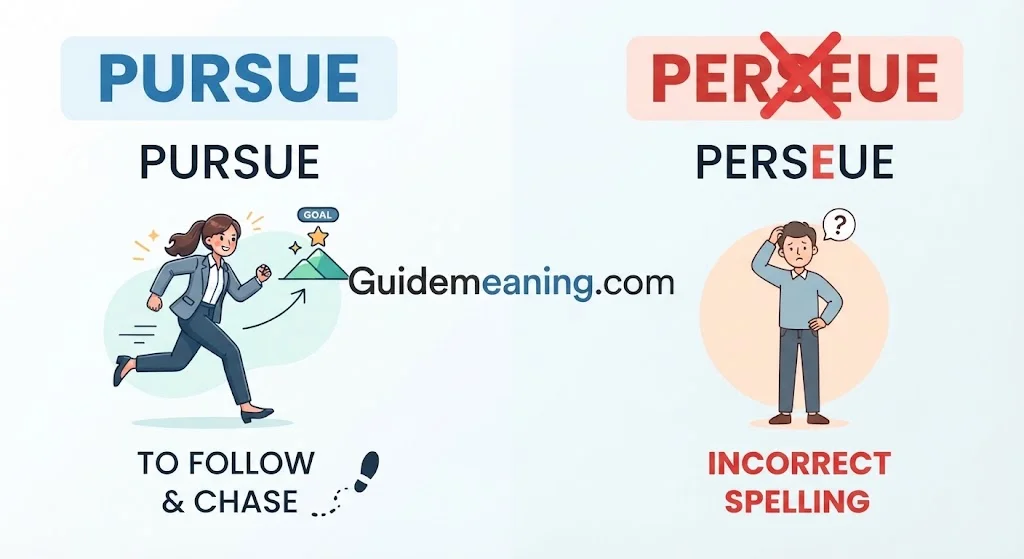

Pursue or Persue is a common spelling question for English learners who want to use the correct form confidently in everyday and professional English. The correct form is pursue, while persue is a wrong spelling and not a recognized word in standard American English. A standard dictionary provides the dictionary definition and pursue meaning as a verb related to following, seeking, or working toward something. The confusion often begins with pronunciation because the sound can make beginners imagine “per-sue.” From my experience, this is a common spelling slips problem that may look right at a quick glance, especially when you have typed the word before. Since English spelling does not always match spoken language, it is smart to double-check before you write it in proper English writing.
A stronger understanding comes from seeing pursue in real situations. You can pursue dreams, pursue knowledge, or pursue careers, and you can also use the verb when discussing relationships, goals, education, and other contexts. Its usage, word forms, tone, and common collocations can affect how a sentence sounds, which is why complete examples are often more helpful than one definition. The pursue vs persuade distinction is another common mix-up because the two words have different meanings, even though people may confuse them while reading. In everyday English and professional English, the correct spelling supports clarity, credibility, and professional impact.
Simple memory tricks can make the pattern easier to remember: pursue contains “pur,” not “per.” You can test yourself with real-life examples and practical examples, such as when you pursue a goal, an opportunity, or something you value. This guide also looks at the history of the word and how its meaning works across different contexts. Case studies can reinforce the pattern because they show how the verb works naturally instead of appearing in isolation. The short answer becomes easier to remember through regular practice: use the word correctly, accurately, and confidently. Once your brain connects its sound with its spelling, you are less likely to misspell it today or later.
Let’s dive in!
Quick Answer:
Pursue is the correct spelling.
Persue is an incorrect spelling that commonly appears when people write the word according to how they think it sounds.
| Spelling | Correct? | Meaning | Example |
| Pursue | ✅ Yes | To follow, seek, continue, or work toward something | She plans to pursue a career in medicine. |
| Persue | ❌ No | Misspelling of pursue | She plans to persue a career in medicine. |
The easiest rule is simple:
Remember the R: P-U-R-S-U-E.
If you’re writing an essay, résumé, email, article, application, or professional document, use pursue.
What Does Pursue Mean?
Pursue is a verb with several closely related meanings. At its core, the word involves following something, seeking something, or continuing toward something.
You can pursue a physical target, such as a person running away. You can also pursue something abstract, such as a career, dream, goal, solution, or opportunity.
For example:
- The police pursued the suspect.
- She wants to pursue a career in law.
- He pursued his dream of becoming a musician.
- The researchers pursued a new line of investigation.
- They decided to pursue the opportunity.
The word often suggests deliberate effort over time. Cambridge describes pursue as trying to achieve a plan, activity, or situation, usually over a period of time. It also uses the word for following someone or something in an attempt to catch them.
Pursue as a Verb
In most everyday sentences, pursue functions as a transitive verb. That means it commonly takes a direct object.
Consider:
She pursued her goal.
Here, she is the subject, pursued is the verb, and her goal is the object.
You can pursue:
- a goal
- a dream
- a career
- an education
- an opportunity
- a solution
- an interest
- a relationship
- a course of action
- a line of inquiry
- a person
- an animal
The exact meaning depends on the object and context.
What Does “Persue” Mean?
In standard English, persue isn’t the correct spelling of the verb.
Writers generally use persue when they intend to write pursue. The mistake often happens because the spoken word doesn’t clearly reveal every letter in its spelling.
For example, someone might think:
“I hear something like per-soo, so perhaps it’s spelled persue.”
That reasoning sounds understandable. Unfortunately, English spelling doesn’t always follow pronunciation neatly.
The correct form is:
P-U-R-S-U-E
Not:
P-E-R-S-U-E
That single vowel-and-consonant difference matters.
Why “Persue” Looks Reasonable
The incorrect form looks believable because English contains many words beginning with per-.
Examples include:
- perform
- permit
- perfect
- person
- perhaps
- perceive
Because per- appears frequently in English, the brain may automatically select it when spelling a word that sounds similar.
However, pursue follows its own spelling pattern. The first four letters are p-u-r-s, not p-e-r-s.
Why Do People Spell Pursue as Persue?
The main problem is the gap between pronunciation and spelling.
In American English, Cambridge gives the pronunciation of pursue as /pɚˈsuː/. The first syllable is unstressed, while the second syllable receives the main stress.
That unstressed first syllable can make the spelling harder to hear.
Think about the difference between reading and listening. When you read pursue, your eyes give you the exact letters. When you hear the word, your ears receive sounds rather than written characters.
That’s where the trap begins.
Pronunciation Doesn’t Always Reveal Spelling
English contains plenty of words whose pronunciation doesn’t provide a perfect spelling guide.
For example:
- receive
- necessary
- separate
- business
- Wednesday
- pursue
You can’t always spell these words accurately simply by listening to them.
That’s why learning the visual pattern PUR-SUE helps more than trying to sound out every letter.
How to Spell Pursue Correctly
The correct spelling is:
P-U-R-S-U-E
A useful way to remember it is to divide the word into two visual parts:
PUR + SUE
The first part is PUR, not PER.
The second part is SUE.
Put them together:
PUR + SUE = PURSUE
This simple breakdown gives you a reliable mental checkpoint.
A Simple Memory Trick
Remember this:
You PURSUE a purpose.
Both pursue and purpose begin with PUR.
You don’t need to force the connection every time you write the word. Just use it as a quick spelling reminder when you’re unsure.
Another useful trick is to remember the family:
pursue → pursued → pursuing → pursuit
Seeing the related words together reinforces the unusual spelling.
Pursue vs. Persue: Examples in Sentences
Seeing the correct spelling in realistic sentences makes it easier to remember.
Everyday Examples
- I want to pursue my dream of becoming a writer.
- She decided to pursue a new hobby.
- He is pursuing a healthier lifestyle.
- They pursued every available opportunity.
- The student plans to pursue graduate studies.
Professional Examples
The word appears frequently in workplace and business writing.
- The company plans to pursue new markets.
- We should pursue a different strategy.
- The team is pursuing several potential clients.
- She decided to pursue a career in marketing.
- The organization will pursue additional funding opportunities.
Academic Examples
Students and researchers also use pursue frequently.
- He plans to pursue a master’s degree.
- She pursued research in environmental science.
- The researchers pursued several lines of inquiry.
- Students can pursue their academic interests through independent study.
Physical Pursuit
The word isn’t limited to goals and ambitions.
It can describe literal following or chasing:
- The police pursued the vehicle.
- The dog pursued the squirrel across the yard.
- The hunter pursued the animal through the forest.
This physical meaning connects naturally with the broader idea of following something closely.
Pursue Has More Than One Meaning
One reason pursue is such a useful verb is its range.
Pursue a Goal
When you pursue a goal, you actively work toward achieving it.
She pursued her goal of becoming a doctor.
This doesn’t necessarily mean she succeeded. It simply means she made an effort toward that objective.
Pursue a Career
This is one of the most common modern uses.
He decided to pursue a career in engineering.
Here, pursue suggests choosing and actively working toward a professional path.
Pursue an Opportunity
You can pursue something that looks promising.
The company pursued the opportunity after reviewing the proposal.
The phrase suggests deliberate action rather than passive interest.
Pursue a Solution
You can also pursue answers to problems.
The researchers pursued several possible solutions.
Here, the meaning is close to seek or work toward finding.
Pursue a Person
The literal meaning remains important.
The officers pursued the suspect.
In this context, the word describes active following or chasing.
Pursue vs. Chase vs. Seek
These words overlap, but they don’t always create the same impression.
| Word | Main idea | Typical use |
| Pursue | Follow, seek, or work toward something | Goals, careers, opportunities, people |
| Chase | Follow quickly to catch something | People, animals, objects |
| Seek | Try to find, obtain, or discover something | Information, help, answers, opportunities |
| Go after | Try to obtain or achieve something | Informal goals and opportunities |
Consider these examples:
She pursued a career in journalism.
This sounds natural and professional.
She chased a career in journalism.
This sounds unusual because chase normally suggests physical pursuit or an aggressive attempt.
She sought a career in journalism.
This is grammatically correct, but the nuance changes. Seek emphasizes looking for or trying to obtain something.
Choosing the right verb isn’t only about grammar. Word choice shapes meaning and tone.
Read More: Headed vs. Heading: Meaning, Differences, and Correct Usage for 2026
Pursue vs. Peruse: Don’t Mix These Up
Pursue and peruse create another spelling trap.
They look similar, but their meanings differ substantially.
| Word | Meaning | Example |
| Pursue | Follow, seek, or work toward something | She pursued her career goals. |
| Peruse | Read or examine something carefully | He perused the report before the meeting. |
If you’re trying to achieve something, you pursue it.
If you’re reading or examining something, you may peruse it.
For example:
The manager perused the report before deciding which strategy to pursue.
This sentence contains both words correctly.
The manager perused the report because he examined it. He then chose a strategy to pursue because he intended to follow or develop it.
That contrast makes the difference easier to remember.
Common Mistakes With Pursue
Spelling mistakes become easier to avoid once you know exactly where they occur.
Mistake: Writing “Persue”
Incorrect:
She wants to persue her education.
Correct:
She wants to pursue her education.
The problem is the e after p. The correct spelling uses u:
PUR-SUE
Mistake: Forgetting the R
Incorrect:
I plan to pusue my goals.
Correct:
I plan to pursue my goals.
The r belongs in the word. Don’t drop it simply because the pronunciation doesn’t make it prominent.
Mistake: Confusing Pursue With Peruse
These words look remarkably similar.
However:
- Pursue = follow, seek, or work toward
- Peruse = read or examine
A student might peruse a textbook while pursuing a degree.
That’s a useful distinction.
Pursue in Different Grammatical Forms
The word changes form depending on how you use it in a sentence.
| Form | Function | Example |
| Pursue | Base verb | I want to pursue my goals. |
| Pursues | Third-person singular | She pursues new opportunities. |
| Pursued | Past tense / past participle | He pursued a different career. |
| Pursuing | Present participle / gerund | They are pursuing a solution. |
| Pursuit | Noun | His pursuit of knowledge continues. |
Cambridge lists pursued as the past tense and past participle and pursuing as the present participle.
Pursue
They pursue their ambitions.
Pursues
She pursues excellence in her work.
Pursued
He pursued the opportunity last year.
Pursuing
The company is pursuing a new strategy.
Pursuit
Her pursuit of knowledge never stopped.
The spelling remains recognizable across the word family, which makes these forms useful for memorization.
Grammar and Usage of Pursue
Because pursue usually takes an object, you can often build sentences with this pattern:
Subject + pursue + object
For example:
She pursued her dream.
The object is her dream.
Another common structure is:
Subject + pursue + a/an + noun
Examples include:
- He pursued a career in medicine.
- She pursued an opportunity abroad.
- They pursued a solution to the problem.
You can also use pursue with noun phrases involving goals and activities:
- pursue an education
- pursue a career
- pursue an interest
- pursue a goal
- pursue a dream
- pursue a solution
- pursue justice
- pursue knowledge
- pursue opportunities
These combinations are especially common in academic, professional, and formal writing.
Pursue in Formal and Informal English
Pursue works in both everyday and formal English, although it often sounds more polished than simpler alternatives.
For example:
I’m pursuing a career in design.
This sounds natural in ordinary conversation.
In a more casual setting, you might say:
I’m working toward a career in design.
Both sentences work. The difference lies mainly in tone and emphasis.
Common Alternatives
Depending on context, you might replace pursue with:
- follow
- seek
- chase
- continue
- work toward
- go after
- aim for
- try to achieve
Don’t treat these as perfect substitutes. Each carries a slightly different shade of meaning.
Pursue often works especially well when the action involves sustained effort.
Pursue in American English
For US English, the standard spelling is pursue.
There isn’t a separate American spelling persue. The latter is simply a misspelling of the standard word.
Cambridge’s American Dictionary entry gives pursue as a verb meaning, among other things, to follow or search for someone or something, to try to achieve something, and to continue doing something.
So if you’re writing for an American audience, use:
pursue
Avoid:
persue
This applies to academic assignments, professional documents, websites, emails, applications, and everyday writing.
A Practical Case Study: Catching the Spelling Error
Imagine that Maya is writing a college application.
She writes:
I hope to persue a degree in psychology.
The sentence communicates her meaning. However, the spelling immediately creates a problem.
She checks the word and changes it to:
I hope to pursue a degree in psychology.
Now the sentence uses the standard spelling.
The lesson isn’t complicated. Meaning alone isn’t enough. Correct spelling matters when you’re communicating in writing.
This becomes especially important in documents where polished language affects how readers perceive the writer’s attention to detail.
Memory Tricks for Pursue
If pursue keeps slipping away from you, try one of these methods.
Remember “PUR”
Think:
PUR + SUE = PURSUE
The first four letters are the key.
Connect It With “Purpose”
Both words begin with PUR:
- purpose
- pursue
You pursue something because you have a purpose or goal.
It’s not a perfect etymological rule. It’s simply a practical memory aid.
Learn the Word Family
Instead of memorizing one word in isolation, remember:
pursue → pursued → pursuing → pursuit
When you recognize the family, the spelling becomes much harder to forget.
Pursue vs. Persue: Common Questions
Is “pursue” or “persue” correct?
Pursue is correct. Persue is a misspelling.
How do you spell pursue correctly?
Spell it:
P-U-R-S-U-E
The important detail is the U-R after the initial P.
What does pursue mean?
Pursue can mean to follow someone or something, seek something, continue an activity, or work toward a goal. The context determines the exact sense.
Why do people spell pursue as persue?
The error likely comes from the relationship between pronunciation and spelling. The unstressed first syllable doesn’t make every letter obvious when you hear the word.
What is the past tense of pursue?
The past tense is pursued.
Example:
She pursued her goal for several years.
What is the difference between pursue and peruse?
Pursue means to follow, seek, or work toward something.
Peruse means to read or examine something.
For example:
He perused the documents before pursuing the opportunity.
What is the noun form of pursue?
The main noun form is pursuit.
For example:
Her pursuit of knowledge shaped her career.
Pursue, Pursued, Pursuing, and Pursuit
These related words belong to the same word family.
Pursue functions as the base verb.
They pursue their goals.
Pursued works as the past form.
They pursued their goals last year.
Pursuing describes an ongoing action.
They are pursuing their goals.
Pursuit is the noun.
Their pursuit of success required patience.
The connection becomes especially useful when you’re expanding your vocabulary. Instead of memorizing four unrelated words, you can see them as different grammatical forms of the same family.
FAQs:
Is “pursue” or “persue” correct?
Pursue is the correct spelling in standard English. Persue is a misspelling and should not be used in formal or informal writing.
What does “pursue” mean?
Pursue means to follow, seek, or work toward something. For example, you can pursue a dream, pursue knowledge, pursue a career, or pursue an opportunity.
Why do people spell pursue as “persue”?
Many people write persue because of the word’s pronunciation. The sound may seem similar to “per-sue,” but the correct spelling begins with pur-.
How can I remember the spelling of pursue?
Use this memory trick: pursue has “pur” at the beginning, not “per.” You can also remember the phrase, “I pursue my purpose.” Both words begin with pur.
Is “persue” found in the dictionary?
Persue is not recognized as the standard spelling of the verb. Dictionaries list pursue, which means to follow, seek, or work toward something.
What is the difference between pursue and persuade?
Pursue means to follow or work toward something. Persuade means to convince someone to do or believe something.
- She wants to pursue a medical career.
- He tried to persuade me to join the project.
Can I use pursue in professional writing?
Yes. Pursue is common in professional, academic, and everyday English. You can write about pursuing goals, pursuing opportunities, pursuing education, or pursuing a career.
Conclusion:
The correct spelling is pursue, not persue. Although the pronunciation may cause confusion, remembering the opening pur- can help you avoid this common spelling mistake. Use pursue when you mean to follow, seek, or work toward something, such as a dream, goal, career, or opportunity.
Regular practice will make the word easier to remember. When you see or write pursue in complete sentences, its spelling and meaning become clearer. Keep the simple rule in mind: you pursue a purpose, but you never persue it.