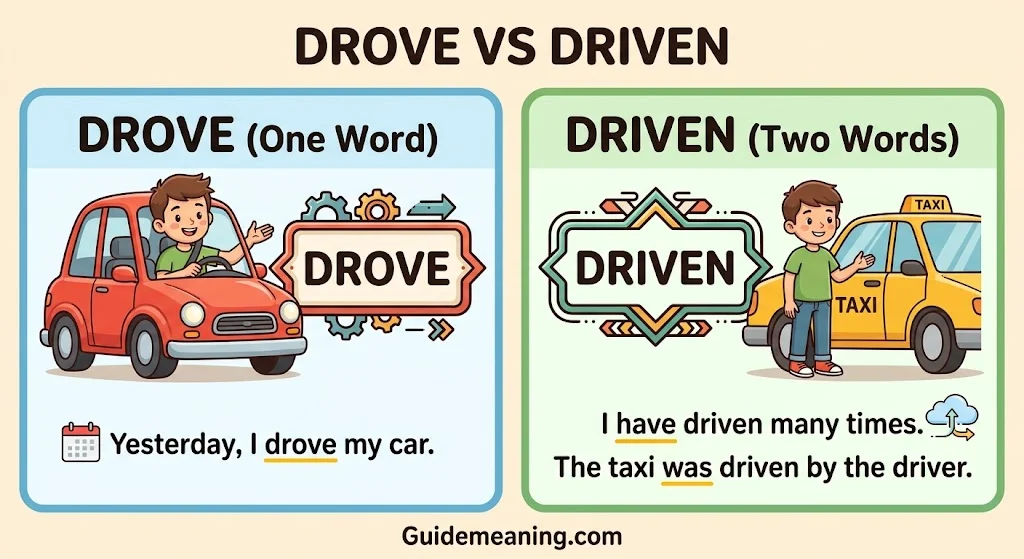

Understanding Drove vs Driven starts with a simple choice: use drove for the past simple and driven with auxiliary verbs. At first glance, choosing between drove and driven can seem easy, yet this common grammar problem causes mistakes for English learners and native speakers. If you hear someone say, “I have drove there before” or “I driven to work today,” you may instantly feel something’s off, and you’re right. This guide walks you through every angle of the topic so you can discover what sets each form apart, when to use each one, and how context shapes your choice. You can avoid common errors and gain confidence once you understand drive, an irregular verb that doesn’t simply add -ed. The base form or root word is drive, the simple past is drove, and the past participle is driven.
Learners often have a difficult time with irregular verbs because there isn’t always a clear rhyme or reason for changes such as ate, eaten, bit, and bitten. You can memorize these forms, and memorization has a place in the learning process, but pattern recognition can make learning easier. In an educational context, verb structure, syntax, semantics, sentence structure, and contextual meaning help explain why one form works in a particular sentence. In spoken English and written English, the correct grammatical tense supports tense consistency, subject-verb agreement, and clear grammar rules. For example, “I drove yesterday” uses the past simple and describes things you traveled with in the past that are no longer happening in the present. On the other hand, “I have driven” uses the past participle with an auxiliary in perfect tenses, describing something that happened before and can still be impacted today.
From a wider language learning view, understanding the drive past tense, drove vs driven, and past tense of drive becomes easier through usage, usage examples, and usage frequency. In natural language processing (NLP), researchers examine lexical forms, lexical variation, structural variation, and verb variation to understand contextual usage. Every action verb has a temporal reference, while each word form can influence meaning. A clear explanation of the difference improves writing clarity and communication. Students, professionals, and native speakers may have wondered which form belongs in a sentence. This article helps clear up those distinctions with examples, proper usage, and practice questions with answers. Once you understand the concept, the multiple past tense forms, and the correct grammatical choice, you can apply them naturally in real English language situations. You’ll also expand your vocabulary and better understand irregularity and transformation as verbs change form. The common source of confusion becomes clearer when you look at different grammatical contexts, rather than treating every form as a separate rule.
Quick Answer:
Drove vs Driven differs mainly in grammatical function. Drove is the simple past form of drive, while driven is the past participle used with helping verbs such as have, has, and had, and in passive constructions.
TL;DR:
• Drove is the simple past form of drive.
• Driven is the past participle of drive.
• Say “I drove home yesterday.”
• Say “I have driven home before.”
• Use driven in passive sentences like “The car was driven.”
• The basic pattern is drive → drove → driven.
What Is the Difference Between Drove and Driven?
The easiest way to understand these words is to look at their grammatical jobs. Both come from drive, but they appear in different sentence structures.
In American English, drove normally describes a completed action in the past. Driven, however, usually needs a helping verb or appears in a passive construction.
Drove as the Simple Past
Use drove when someone performed the action at a finished time in the past.
For example:
- I drove to Chicago yesterday.
- She drove home after work.
- We drove across Texas last summer.
- He drove his truck to the store.
Notice that drove can stand alone as the main verb.
You don’t need have, has, or had before it.
Driven as the Past Participle
Driven is the past participle form. It commonly appears with have, has, or had.
For example:
- I have driven that road before.
- She has driven across the country.
- They had driven for six hours.
- He had driven home before the storm began.
Therefore, “I have drove” is incorrect in standard American English. The correct sentence is “I have driven.”
What Are the Forms of Drive?
The verb drive is an irregular verb. Instead of adding -ed, it changes form.
This is similar to other irregular verbs such as write → wrote → written and ride → rode → ridden.
The Basic Verb Pattern
| Verb Form | Grammatical Role | Example |
| drive | Base form | I drive to work. |
| drove | Simple past | I drove to work yesterday. |
| driven | Past participle | I have driven to work before. |
| driving | Present participle | I am driving to work. |
The most important pair is drove and driven.
If you’re talking about one completed past event, drove is usually the right choice. If a helping verb such as have or had appears, driven is generally required.
A Simple Memory Trick
Think of the pattern this way:
Yesterday, I drove.
I have driven before.
That short contrast handles many everyday grammar questions.
When Should You Use Drove?
Use drove for the simple past tense. It describes something that happened and finished in the past.
The exact time can be stated directly or understood from context.
Examples With Specific Times
Consider these sentences:
- I drove to work yesterday.
- Sarah drove to Boston last weekend.
- We drove through the mountains in July.
- My brother drove the car this morning.
Each sentence describes a completed event.
Because the action is presented as a simple past event, drove is the correct form.
Examples Without a Specific Time
You can also use drove when the past time is understood.
For example:
I drove home after dinner.
The sentence doesn’t say exactly when dinner happened. However, the speaker is describing a completed past event.
Similarly, “She drove to the airport” describes something that happened in the past without needing an exact date.
When Should You Use Driven?
Use driven when the grammar calls for a past participle. Most often, you’ll see it with have, has, or had.
However, driven also appears in passive constructions.
Perfect Tenses
The perfect tenses use forms of have with the past participle.
For example:
- I have driven this route before.
- She has driven for several years.
- We had driven for hours before stopping.
- They will have driven 500 miles by tomorrow.
Here, driven doesn’t stand alone. The helping verb creates the grammatical structure.
Passive Voice
You also use driven when the subject receives the action.
For example:
The car was driven by Marcus.
The car isn’t performing the driving. Someone else is driving it.
Other examples include:
- The truck was driven carefully.
- The race car was driven by an experienced professional.
- The vehicle had been driven for thousands of miles.
In each case, driven forms part of the passive construction.
Drove vs Driven in Everyday American English
For most Americans, these words appear in ordinary conversations about transportation, travel, work, and daily routines.
However, the difference isn’t about American culture alone. It’s a basic feature of English grammar.
Common Everyday Examples
Here are natural examples you might hear in the United States:
- “I drove to the grocery store.”
- “Have you driven this road before?”
- “She drove us to the airport.”
- “I’ve driven through California several times.”
- “He had driven all night.”
- “The car was driven by his sister.”
The surrounding words tell you which form belongs there.
Why Context Matters
Compare these two sentences:
I drove to Denver last week.
I have driven to Denver before.
The first sentence points to a completed past event. The second talks about past experience connected to the present.
Therefore, the difference isn’t really about the meaning of drive. It’s about how the verb functions inside the sentence.
Why Is Drove Correct but “Drived” Wrong?
English learners sometimes expect drived because many English verbs form the past tense with -ed.
For example:
- walk → walked
- talk → talked
- clean → cleaned
However, drive is irregular.
Its past forms developed differently, so standard English uses:
drive → drove → driven
Why English Has Irregular Verbs
English inherited many irregular verb patterns from earlier stages of the language. These patterns existed long before modern American English developed.
The verb drive traces back to Old English drīfan, which carried meanings related to forcing or causing something to move. Over centuries, its forms changed while the irregular pattern survived.
The modern meaning connected with operating a vehicle became especially important after automobiles became widespread.
Other Similar Verb Patterns
You can remember drive by comparing it with related irregular verbs:
- ride → rode → ridden
- write → wrote → written
- rise → rose → risen
- drive → drove → driven
Seeing these patterns can make irregular verbs easier to remember.
Read More: Concurrent vs Simultaneous: What’s the Difference? for 2026
Historical Meaning of the Word Drive
Although today’s most familiar meaning involves cars, drive is much older than the automobile.
Historically, the word could mean forcing something to move or causing something to go in a particular direction.
Before Modern Cars
People could drive cattle, drive animals, or drive someone forward long before cars existed.
For example, a cattle drive involved moving livestock from one location to another. That older meaning remains familiar in American history and culture.
The word could also describe pushing something into a surface, as in driving a nail.
How Transportation Changed the Word
When motor vehicles became common, drive became strongly associated with operating a car.
Consequently, modern Americans often hear drive and immediately think of roads, vehicles, licenses, and travel.
Still, the older meanings remain alive in everyday expressions.
Drove vs Driven in Different Tenses
Understanding tense makes the distinction much easier.
Instead of memorizing isolated sentences, look at the complete verb structure.
Simple Past
Use drove:
I drove to work yesterday.
The action happened in the past and is presented as complete.
Present Perfect
Use have/has driven:
I have driven to work every day this week.
The past action has a connection with the present.
Past Perfect
Use had driven:
She had driven for two hours before taking a break.
One past action happened before another past event.
Future Perfect
Use will have driven:
By Friday, I will have driven 1,000 miles.
Again, the past participle is driven, not drove.
Common Mistakes With Drove and Driven
These mistakes are common because English verb forms don’t always follow predictable patterns.
However, most errors can be corrected with a few simple rules.
“I Have Drove”
Incorrect:
I have drove to work.
Correct:
I have driven to work.
The word have requires the past participle driven.
“I Driven Yesterday”
Incorrect:
I driven to the store yesterday.
Correct:
I drove to the store yesterday.
Here, there is no helping verb. The sentence needs the simple past form drove.
“She Had Drove”
Incorrect:
She had drove all night.
Correct:
She had driven all night.
The word had requires the past participle.
“The Car Was Drove”
Incorrect:
The car was drove by James.
Correct:
The car was driven by James.
The passive structure requires driven.
Is Driven Ever an Adjective?
Yes. Driven can also function as an adjective.
In this use, it doesn’t describe someone operating a vehicle. Instead, it describes someone who is strongly motivated, ambitious, or determined.
For example:
She is a driven student.
Here, driven means highly motivated.
Similarly:
He’s a driven entrepreneur.
The sentence says something about his personality and determination.
Drive Has Several Meanings
This is one reason the word can become confusing.
Drive can refer to:
• Operating a car or other vehicle
• Moving something in a particular direction
• Motivating someone toward a goal
• Providing energy or force behind an action
• Hitting something with force
The correct interpretation depends on context.
Drove vs Driven: A Quick Comparison
| Situation | Correct Form | Example |
| Completed past action | drove | I drove home last night. |
| Present perfect | driven | I have driven there before. |
| Past perfect | driven | I had driven for hours. |
| Passive voice | driven | The car was driven carefully. |
| Present action | driving | I am driving now. |
| Base form | drive | I need to drive home. |
This table shows why simply asking, “Which word means past?” isn’t enough.
Both drove and driven relate to past actions. Their grammatical roles are different.
How to Choose the Right Word Quickly
You don’t need to analyze every sentence like a grammar professor.
Instead, use a quick three-step check.
Step 1: Look for a Helping Verb
Check whether the sentence contains have, has, or had.
If it does, you’ll normally need driven.
For example:
We have driven there before.
Step 2: Look for a Simple Past Time
Words such as yesterday, last night, last week, or in 2025 often signal a simple past event.
For example:
We drove there last week.
However, these time expressions aren’t absolute rules. The entire sentence structure still matters.
Step 3: Check Whether the Sentence Is Passive
If the subject receives the action, driven may be needed.
For example:
The truck was driven across the country.
The truck isn’t performing the action. Someone is driving it.
Why People Confuse Drove and Driven
The confusion is understandable because both forms refer to the same basic verb.
Also, English learners often learn verbs through lists. They may remember drive, drove, driven without understanding when each form belongs.
The Main Source of Confusion
The biggest problem is treating drove and driven as interchangeable past forms.
They’re both connected to past actions, but they don’t fill the same grammatical position.
Compare:
I drove home.
with:
I have driven home.
The second sentence needs a helping verb. That small difference determines the correct form.
Spoken English Can Add Confusion
In casual speech, people sometimes use nonstandard verb forms. However, standard American English still follows the distinction.
For formal writing, schoolwork, professional communication, and careful speech, use drove and driven according to their grammatical roles.
Drove vs Driven in Questions and Negative Sentences
Questions and negative sentences can make the distinction even easier to see.
Questions With Drove
Use did with the base form drive, not drove.
Correct:
Did you drive home?
Not:
Did you drove home?
The helping verb did already carries the past tense.
Questions With Driven
With perfect constructions, use have, has, or had plus driven.
For example:
Have you driven this car before?
Or:
Had she driven that route before?
Negative Sentences
The same principle applies to negatives.
Correct:
I didn’t drive yesterday.
Correct:
I haven’t driven that car before.
Notice that didn’t takes the base form drive, while haven’t takes the past participle driven.
A Simple Rule You Can Remember
When you’re unsure, ask yourself one question:
What is the sentence structure?
If you’re telling a straightforward story about something that happened in the past, use drove.
I drove home.
If you’re using have, has, or had, use driven.
I have driven home.
If the sentence uses passive voice, use driven.
The car was driven home.
This approach works better than trying to memorize dozens of separate examples.
FAQs:
What is the difference between drove and driven?
Drove is the simple past form of drive, while driven is the past participle. For example, “I drove home yesterday” is correct, while “I have driven home” uses the past participle.
Is “I have drove” correct?
No. After have, you need the past participle driven. The correct sentence is “I have driven there before.”
Is “I driven to work” correct?
No. Driven normally needs an auxiliary verb such as have, has, or had. Say “I drove to work today” or “I have driven to work today,” depending on the meaning.
When should I use drove?
Use drove when you describe a completed action in the simple past. For example, “She drove to the store yesterday.”
When should I use driven?
Use driven with auxiliary verbs in perfect tenses. For example, “He has driven this car before” and “They had driven for three hours.”
What are the three forms of drive?
The three principal forms are drive (V1), drove (V2), and driven (V3). Remembering these forms helps you use the verb correctly.
How can I remember drove vs driven?
A useful way to remember them is to connect drove with a completed past action and driven with have, has, or had. Regular practice with real sentences can make the difference easier to recognize.
Conclusion:
The difference between drove and driven becomes much easier once you understand their grammatical roles. Drove works as the simple past form for a completed past action, while driven works as the past participle and usually appears with have, has, or had. If you remember the pattern drive → drove → driven, you’ll have a simple guide for choosing the correct form. With regular practice and attention to context, you can avoid common mistakes and use both forms confidently in everyday English.




1 thought on “Drove vs Driven: The Simple Difference Explained for 2026”