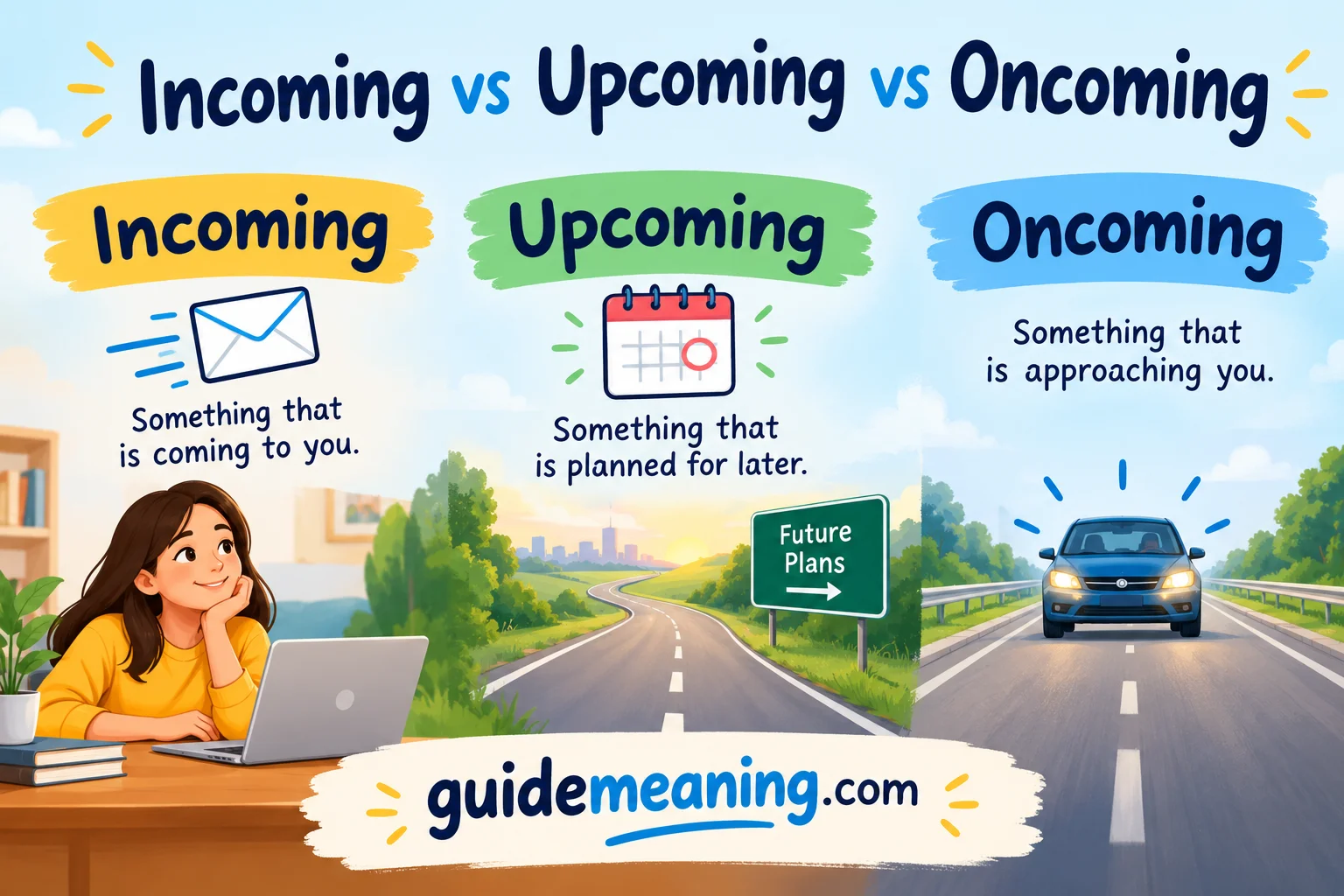

Incoming vs Upcoming vs Oncoming can confuse readers because the three words appear similar, sound alike, and describe something connected with movement, arrival, or the future. However, each word behaves differently in real use and contexts, so the right meaning, definition, and specific context matter. Incoming usually describes arrival or something arriving now, such as an incoming message or messages that arrive immediately. Upcoming points toward future events that are scheduled for the near future, such as an upcoming conference or event. Oncoming describes movement toward a certain point, especially something physically moving toward you, such as oncoming traffic that moves directly toward you. In everyday conversations, daily writing, speech, formal and professional communication, these terms are not always interchangeable. A wrong choice can make a sentence sound strange, unclear, or unnatural, while the correct word helps ensure clear communication.
A practical comparison makes these distinctions easier to understand from every angle. When something is on the way because it is approaching, incoming usually focuses on arrival; upcoming describes what will happen later; and oncoming describes something moving towards you. For example, an incoming traffic jam suggests traffic is arriving, an upcoming event is expected in the future, and oncoming traffic refers to approaching vehicles. These examples show the main difference, while grammar rules, style guides, a complete grammar guide, tables, real-world scenarios, and clear explanations can help you learn the right pattern. From my experience teaching students, I have noticed that these small distinctions can improve understanding in surprising ways when learners review examples, think about the situation, and compare each term carefully.
The best memory tips connect incoming with arrival, upcoming with anticipated future events, and oncoming with movement and possible danger. These memory tricks help you break down tricky but common mistakes, choose the word that fits the situation, and follow a friendly, simple guide. With regular practice, you can relate each word to a familiar situation and use it properly and correctly in writing and speech. Repeated practice helps you know exactly which choice works, while distinguishing each term makes describing objects and events more accurate and confident. The system soon feels natural, the idea becomes easy to use, and even a day or three of focused practice can build complete confidence.
Let’s dive in!
Quick Answer:
The easiest way to remember incoming vs upcoming vs oncoming is to focus on what is actually “coming.”
| Word | Basic Meaning | Main Focus | Common Examples |
| Incoming | Coming in, arriving, or being received | Entry or arrival | incoming call, incoming email, incoming flight |
| Upcoming | Going to happen soon | Time | upcoming event, upcoming exam, upcoming meeting |
| Oncoming | Moving toward you or another point | Direction | oncoming car, oncoming traffic, oncoming train |
Incoming answers the idea of “What is coming in?”
Upcoming answers “What is going to happen soon?”
Oncoming answers “What is moving toward me?”
Cambridge defines incoming as something arriving at or coming toward a place. It also uses the word for calls and messages being received.
Oxford defines upcoming as something that is going to happen soon. Cambridge similarly describes it as something happening soon and notes that it is mainly used in American English, with forthcoming often preferred in British English.
For oncoming, Cambridge and Oxford both emphasize movement toward the person or another point. Typical examples include oncoming traffic, oncoming vehicles, and oncoming trains.
What Does “Incoming” Mean?
Incoming generally describes something that is arriving, entering, or being received.
The word often describes movement toward a destination, recipient, place, or system. Cambridge gives examples such as incoming mail, incoming phone calls, and incoming flights.
Think of a doorway.
Something outside the doorway moves in. That is the basic idea behind incoming.
Common Uses of Incoming
You will often see incoming with things such as:
- incoming calls
- incoming emails
- incoming messages
- incoming mail
- incoming flights
- incoming passengers
- incoming traffic
- incoming data
- incoming information
- incoming requests
- incoming payments
- incoming students
- incoming employees
For example:
Please answer the incoming call.
The call is being received by the person or phone system.
The airport has several incoming flights this afternoon.
The flights are arriving at the airport.
The software automatically filters incoming messages.
The messages are entering the system.
The central idea remains the same: something is coming toward or into a destination.
Incoming as an Adjective
In these examples, incoming functions as an adjective. It describes the noun that follows it.
- incoming + call
- incoming + email
- incoming + flight
- incoming + students
The adjective doesn’t simply mean “future.” It tells you something about the direction or status of arrival.
That’s an important distinction.
Incoming Can Also Describe a New Person in a Role
There is another established use that sometimes surprises learners.
Incoming can describe someone who has recently been selected or elected and will soon begin an important position. Cambridge lists examples such as an incoming government and incoming president.
For example:
The incoming director will begin work next month.
Here, incoming doesn’t mean the director is physically walking into a building. It means the person is about to take over the position.
Oxford also recognizes this use for recently elected or chosen people and institutions.
Incoming vs. Arriving
The words incoming and arriving overlap, but they don’t always emphasize exactly the same thing.
Compare:
The incoming flight is from Chicago.
This describes a flight that is arriving at the airport.
The flight is arriving at 8:30.
This sentence focuses more directly on the action and timing of arrival.
Incoming works especially well when you want to classify something as traffic, communication, passengers, or another thing entering a place or system.
What Does “Upcoming” Mean?
Upcoming describes something that will happen soon.
Unlike incoming, it doesn’t normally focus on something entering a physical space. Its central idea is near-future time.
Oxford defines upcoming as “going to happen soon,” with examples involving elections and albums.
Cambridge gives examples such as an upcoming concert tour, upcoming election, and upcoming events.
Common Uses of Upcoming
You commonly see upcoming with:
- upcoming events
- upcoming meetings
- upcoming exams
- upcoming holidays
- upcoming elections
- upcoming trips
- upcoming concerts
- upcoming releases
- upcoming deadlines
- upcoming projects
- upcoming changes
- upcoming opportunities
For example:
I need to prepare for my upcoming exam.
The exam hasn’t happened yet. It is expected to happen soon.
We’re excited about the upcoming concert.
The concert is a future event that is approaching in time.
The company announced several upcoming changes.
The changes are expected to occur in the near future.
Upcoming Focuses on Time
This is the key point to remember.
Upcoming is primarily about when something will happen.
It doesn’t require physical movement.
A meeting doesn’t physically travel toward you. Neither does an exam. Yet both can be upcoming because they are scheduled or expected to happen soon.
That gives you a useful test:
If you can replace the word with “happening soon,” upcoming may be the right choice.
Upcoming vs. Future
Upcoming and future are related, but they’re not identical.
Future can refer to any time after the present.
Upcoming usually suggests something relatively near or already anticipated.
Compare:
We need to think about our future plans.
This could refer to plans years from now.
We need to prepare for our upcoming plans.
This suggests plans that are closer in time.
In everyday English, upcoming often creates a stronger sense of immediacy.
What Does “Oncoming” Mean?
Oncoming describes something that is moving toward you or coming nearer.
This word has a stronger directional sense than upcoming.
Cambridge defines oncoming as something moving toward you or coming nearer.
Oxford gives the example oncoming traffic and lists common collocations such as headlights, traffic, and train.
Common Uses of Oncoming
Typical expressions include:
- oncoming traffic
- oncoming car
- oncoming vehicle
- oncoming truck
- oncoming train
- oncoming bus
- oncoming cyclist
- oncoming wave
- oncoming storm
- oncoming crisis
For example:
The driver swerved to avoid an oncoming car.
The car is moving toward the driver.
Always watch for oncoming traffic when crossing the road.
The traffic is approaching from the direction in which it is coming.
The hikers prepared for the oncoming storm.
Here, the storm is approaching. The word can therefore extend beyond vehicles and people into situations or natural phenomena.
Oncoming Emphasizes Direction
The easiest way to understand oncoming is to picture yourself standing still while something approaches.
You ← 🚗
The car is moving toward you.
That’s oncoming.
This directional meaning explains why oncoming traffic is such a natural expression. The word tells you that the traffic is moving toward your position or in the opposite direction from your own travel.
Incoming vs Upcoming vs Oncoming: The Main Difference
The three words share the idea of something “coming,” but their focus differs.
Incoming = Entry or Arrival
Something is coming in.
I received an incoming email.
The email is entering your inbox.
Upcoming = Near-Future Time
Something is going to happen soon.
I have an upcoming interview.
The interview is scheduled for the near future.
Oncoming = Movement Toward You
Something is coming toward you.
A cyclist narrowly avoided the oncoming vehicle.
The vehicle is moving toward the cyclist.
Here’s the distinction in one visual:
Incoming → 📥 coming in
Upcoming → 📅 happening soon
Oncoming → 🚗 moving toward you
That simple framework handles most everyday situations.
Read More: SN Meaning in Text: What Does “SN” Mean in a Text Message? 2026
Incoming vs Upcoming
The difference between incoming and upcoming becomes especially clear with communication and scheduled events.
Incoming Call vs. Upcoming Call
Consider these two sentences:
I have an incoming call.
The phone is receiving a call right now or at the moment being discussed.
I have an upcoming call.
The call is usually scheduled for a later time.
The second sentence might describe a business call at 3 p.m. The first describes the phone ringing now.
The same distinction applies to other nouns.
| Phrase | Meaning |
| Incoming email | An email being received |
| Upcoming email | An email expected or planned for later, depending on context |
| Incoming flight | A flight arriving |
| Upcoming flight | A flight scheduled for the near future |
| Incoming students | Students entering or joining an institution |
| Upcoming students | Students who will study later, though this is less natural in many contexts |
| Incoming meeting | A meeting that is coming in, which is generally unusual |
| Upcoming meeting | A meeting scheduled for soon |
The contrast is particularly strong with calls, flights, and events.
Incoming vs Oncoming
Both incoming and oncoming can describe physical movement, but they don’t frame that movement in the same way.
Incoming emphasizes something arriving at or entering a destination.
Oncoming emphasizes something approaching the observer or another point.
Compare:
The airport is handling incoming flights.
The flights are arriving at the airport.
The driver watched the oncoming traffic.
The traffic is approaching the driver.
This difference becomes clearer if you imagine changing your viewpoint.
An airplane approaching an airport can be described as incoming because it is arriving at the airport.
A car moving toward you on the opposite side of the road can be described as oncoming because it is approaching your position.
A Useful Rule
Ask:
Where is the movement going?
If the emphasis is into a destination, consider incoming.
If the emphasis is toward you or another observer, consider oncoming.
Upcoming vs Oncoming
This pair causes confusion because both can describe something that is approaching.
The crucial difference is time versus direction.
Upcoming usually means something will happen soon.
Oncoming usually means something is physically moving toward you or coming nearer.
Compare:
The upcoming conference will attract hundreds of visitors.
The conference is approaching in time.
The oncoming vehicle forced the cyclist to stop.
The vehicle is approaching physically.
The words can occasionally describe the same broad situation while emphasizing different aspects.
For instance:
The upcoming storm may arrive tonight.
This focuses on the future event.
The oncoming storm is already visible.
This focuses on the storm approaching.
The choice depends on what the writer wants the reader to notice.
Can Incoming, Upcoming, and Oncoming Be Used Interchangeably?
Usually, no.
Although these words share coming, they aren’t interchangeable synonyms.
Replacing one with another can alter the meaning.
Consider:
Please prepare for the upcoming meeting.
This clearly refers to a meeting that will happen soon.
Now replace upcoming with incoming:
Please prepare for the incoming meeting.
This sounds unusual because a meeting normally doesn’t “come in” like an email or passenger.
Replace it with oncoming:
Please prepare for the oncoming meeting.
This also sounds unnatural in ordinary workplace English because a meeting isn’t normally described as physically approaching.
The problem isn’t grammar alone. The semantic focus doesn’t match the noun.
Incoming, Upcoming, and Oncoming in Real-Life English
These words become much easier when you see how native speakers use them in different settings.
In Workplace English
Incoming frequently appears with communication and personnel:
- incoming emails
- incoming calls
- incoming requests
- incoming employees
- incoming manager
Upcoming commonly describes scheduled activities:
- upcoming meeting
- upcoming deadline
- upcoming presentation
- upcoming project
- upcoming conference
Oncoming is less common in office language. It becomes natural when discussing physical movement:
- oncoming traffic
- oncoming vehicle
For example:
Please check your incoming emails before the upcoming meeting.
Both words fit because they describe two completely different ideas.
In Academic English
Students frequently encounter:
- incoming students
- upcoming exams
- upcoming assignments
- upcoming semester
- upcoming orientation
For example:
Incoming students should complete the form before orientation.
Here, incoming refers to students who are entering or joining the institution.
Students should review their notes before the upcoming exam.
Here, upcoming refers to an exam that will happen soon.
In Everyday Conversation
You might hear:
I can’t talk right now. I have an incoming call.
Or:
Are you ready for the upcoming holiday?
And while driving:
Be careful. There’s an oncoming truck.
Each word fits because each sentence has a different focus.
Common Mistakes With Incoming, Upcoming, and Oncoming
Mistake: Using Upcoming for Something Being Received
Incorrect or awkward:
I have an upcoming email from my manager.
If you mean the email is currently arriving, incoming email is more natural.
I have an incoming email from my manager.
If you mean your manager plans to send an email later, the sentence needs different wording because upcoming email isn’t normally the clearest choice.
Mistake: Using Incoming for Every Future Event
A future event isn’t automatically incoming.
We have an upcoming meeting.
This is natural.
We have an incoming meeting.
This doesn’t normally express the same meaning.
The meeting is approaching in time, not entering a destination.
Mistake: Using Oncoming for Scheduled Events
An event can be approaching in time, but that doesn’t automatically make it oncoming.
The upcoming conference starts Monday.
Natural.
The oncoming conference starts Monday.
Unusual in standard everyday usage.
Oncoming generally creates a stronger image of physical approach.
Mistake: Ignoring Direction
Many learners focus on the shared word coming and overlook the prefixes.
Yet the prefixes provide a useful clue:
- in → into something
- up → toward a future point
- on → toward the observer or another point
The prefixes aren’t complete definitions by themselves, but they provide a helpful memory aid.
Incoming vs Upcoming vs Oncoming Examples
The following examples show the differences side by side.
| Situation | Natural Expression | Why? |
| A phone is receiving a call | incoming call | The call is being received |
| A meeting is scheduled tomorrow | upcoming meeting | The meeting will happen soon |
| A car is driving toward you | oncoming car | The car is approaching you |
| A plane is arriving at an airport | incoming flight | The flight is arriving |
| A concert is next weekend | upcoming concert | The event is near in time |
| Vehicles approach from the opposite direction | oncoming traffic | The traffic is moving toward you |
| A new manager will take over soon | incoming manager | The manager is entering the role |
| An exam is next Friday | upcoming exam | The exam will happen soon |
Notice how the noun doesn’t automatically determine the word. The intended meaning does.
A Short Case Study: One Trip, Three Words
Imagine you’re driving to an airport.
Your phone rings.
You have an incoming call.
The call is being received.
At the airport, you check your travel schedule.
Your upcoming flight leaves at 6 p.m.
The flight is scheduled for the near future.
While driving home later, another vehicle approaches from the opposite direction.
An oncoming car crosses the center line.
Now all three words appear in one ordinary day. Yet each describes a different kind of “coming.”
That’s the real secret: don’t memorize the words as synonyms. Memorize the relationship each word describes.
Incoming vs Upcoming vs Oncoming: Grammar and Word Class
All three words commonly function as adjectives.
They usually appear before a noun:
- incoming call
- upcoming event
- oncoming vehicle
Their grammatical role is similar, but their meanings differ.
| Adjective | What It Modifies | Meaning |
| Incoming | call, flight, email, passenger | Coming in or being received |
| Upcoming | event, meeting, exam, election | Happening soon |
| Oncoming | vehicle, traffic, train, storm | Moving toward someone |
This is a useful reminder that similar grammar doesn’t mean identical meaning.
A Simple Memory Trick for Incoming, Upcoming, and Oncoming
If the three words still blur together, use this three-question test.
Is It Coming In?
Choose incoming when something is arriving, entering, or being received.
incoming message
Think: IN = entering.
Is It Happening Soon?
Choose upcoming when something is expected to happen soon.
upcoming exam
Think: UPCOMING = near in time.
Is It Moving Toward You?
Choose oncoming when something is physically approaching you or another point.
oncoming vehicle
Think: ONCOMING = approaching.
The shortcut is:
Incoming → IN
Upcoming → SOON
Oncoming → TOWARD YOU
It’s simple, but it works.
Incoming vs Upcoming vs Oncoming: Quick Comparison Chart
| Feature | Incoming | Upcoming | Oncoming |
| Core idea | Coming in | Happening soon | Moving toward |
| Main focus | Arrival or reception | Time | Direction |
| Physical movement required? | Often, but not always | No | Usually |
| Used with events? | Limited | Very common | Usually uncommon |
| Used with calls? | Very common | Possible with a scheduled call | No |
| Used with traffic? | Possible | No | Very common |
| Used with flights? | Very common | Common when discussing schedules | Rare |
| Used with meetings? | Usually unnatural | Very common | Usually unnatural |
| Used with vehicles? | Possible in some contexts | Rare | Very common |
FAQs:
What does “incoming” mean?
Incoming describes something that is arriving or coming toward a place. For example, “We received an incoming message” means a message has arrived or is being received.
What does “upcoming” mean?
Upcoming describes something expected to happen in the near future. For example, “I’m preparing for an upcoming conference” refers to a conference that will happen soon.
What does “oncoming” mean?
Oncoming describes something moving toward you or toward a particular point. For example, “Be careful of the oncoming traffic” refers to traffic approaching you.
What is the main difference between incoming and upcoming?
Incoming focuses mainly on arrival, while upcoming focuses on a future event or situation. You can receive an incoming message, but you can attend an upcoming event.
Can I use “oncoming” for future events?
Usually, no. Oncoming focuses on physical movement toward someone or something. For future events, upcoming is generally the appropriate word.
Is “upcoming event” correct?
Yes, upcoming event is a natural and common phrase. It means an event that is scheduled or expected to happen soon.
How can I remember incoming, upcoming, and oncoming?
Think of incoming as something arriving, upcoming as something happening in the future, and oncoming as something moving toward you. These simple associations make the differences easier to remember.
Conclusion:
Incoming, upcoming, and oncoming may look similar, but they describe different situations. Incoming relates to arrival, upcoming refers to future events, and oncoming describes movement toward a person or point. Once you understand these core differences, choosing the right word becomes much easier. With regular practice and attention to context, you can use all three terms naturally and confidently in everyday English




1 thought on “Incoming vs Upcoming vs Oncoming: Differences, and Correct Usage”