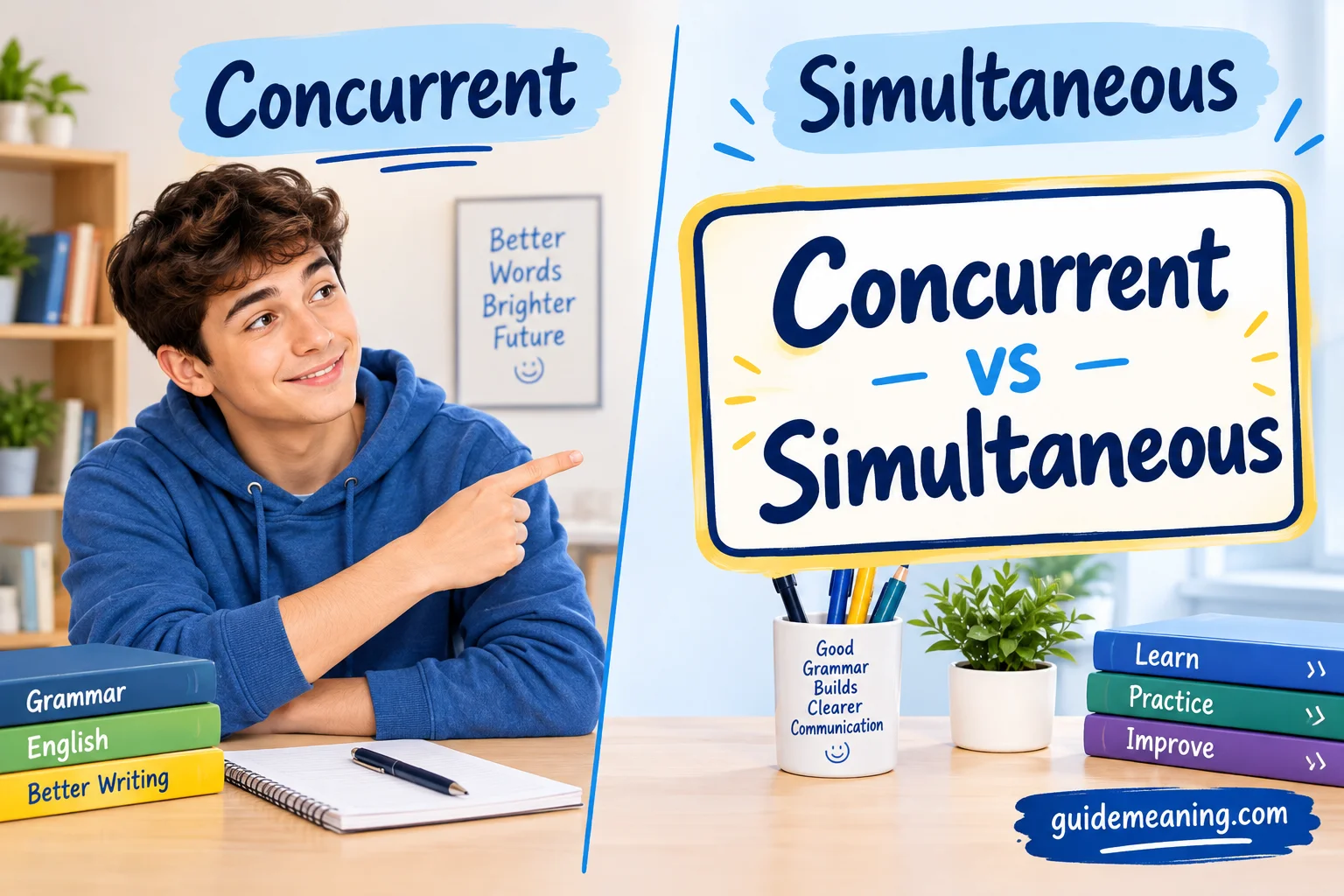

Concurrent vs Simultaneous can seem confusing, but the difference becomes clear when you compare timing, context, and how events happen together. In everyday language and English writing, these words often appear in the same conversation, so experienced writers and English learners may become confused. Both terms describe events happening together at the same time, yet they don’t always mean exactly the same thing. Concurrent usually describes processes or activities during an overlapping period, while simultaneous gives more emphasis to events occurring at the same moment. This subtle difference matters for clarity, precision, and word choice. For example, two projects can be concurrent when one begins Monday and another begins Wednesday, then both continue through Friday because their schedules overlap.
Two alarms that ring exactly 9:00:00, however, are simultaneous because they occur at the same instant. This real-world scenario makes the key difference easier to understand and shows how precisely each term works. The distinction also matters in software engineering, performance testing, technology, computing, and engineering, where multitasking, tasks, and actions may overlap without occurring at one exact instant. Similar issues appear in business, law, medicine, and other technical fields, where careful usage can prevent a wrong word from weakening an explanation.
The real issue is that these words occur in similar contexts, which creates confusion. The truth is that each has a distinct sense, and understanding this nuance helps you use both correctly and confidently. A clear synonym comparison, vocabulary question, in-depth guide, examples, case studies, tables, and real-life usage can make the distinction more human, practical, and easier to apply in professional writing, language, and everyday communication.
Quick Answer:
Concurrent vs Simultaneous: concurrent usually means things overlap in time, while simultaneous emphasizes things happening at exactly the same time. In American English, the two can overlap in meaning, but simultaneous is often more precise about timing.
TL;DR:
- Concurrent describes events or activities existing during the same period.
- Simultaneous emphasizes events happening at the same exact time.
- Concurrent is common for projects, sentences, systems, and overlapping activities.
- Simultaneous often describes sounds, movements, announcements, or coordinated events.
- The words can sometimes be interchangeable without changing the basic meaning.
What Does Concurrent Mean?
Concurrent is an adjective meaning that something happens or exists at the same time as something else. It can describe events that overlap without requiring identical starting or ending points.
For example, two college courses can be concurrent if they occur during the same semester. They don’t have to begin at precisely the same minute.
Concurrent in Everyday English
In everyday American English, concurrent often suggests an overlap.
Consider these examples:
- She worked two concurrent jobs for several months.
- The company launched concurrent projects in three cities.
- Two meetings were scheduled concurrently.
- The students completed concurrent assignments.
- Several investigations continued concurrently.
Notice that none of these examples requires exact timing.
The activities simply exist within the same general period. Therefore, concurrent is especially useful when duration matters.
Concurrent Can Mean More Than Time
The word also has meanings beyond ordinary scheduling.
In mathematics and geometry, concurrent lines meet at one point. In law, concurrent can describe authority or legal powers that operate over the same matter.
The word can also suggest cooperation or parallel action. Therefore, context determines the precise meaning.
What Does Simultaneous Mean?
Simultaneous is an adjective describing things that happen or exist at exactly the same time. The word often draws attention to timing rather than duration.
For example, imagine two phones ringing at precisely 3:00 p.m. Their ringing is simultaneous.
Simultaneous in Everyday English
Americans commonly use simultaneous for events that appear closely synchronized.
Examples include:
- The audience gave a simultaneous cheer.
- Both alarms sounded simultaneously.
- The dancers made simultaneous movements.
- The two broadcasts began simultaneously.
- The children answered simultaneously.
Here, the shared moment is important.
The events may continue for different lengths of time afterward. What matters is that their occurrence or beginning coincides.
Why Simultaneous Sounds More Exact
Simultaneous comes from a Latin root connected with the idea of being together or at the same time. Its modern use has retained that strong timing connection.
As a result, the word often feels more exact than concurrent. However, this doesn’t mean every use of simultaneous requires scientific precision down to the millisecond.
Concurrent vs Simultaneous: The Main Difference
The easiest distinction involves overlap versus exact timing.
Concurrent events can occupy the same stretch of time. Simultaneous events are presented as occurring at the same moment.
Consider two workers completing separate tasks from 9:00 to 10:00. Their work is concurrent. If they both press a button at exactly 9:30, that particular action is simultaneous.
A Simple Time-Line Test
Imagine this:
Concurrent
Task A: 9:00 ───────── 10:00
Task B: 9:20 ─────── 10:30
These tasks overlap, so they’re concurrent.
Now imagine this:
Simultaneous
Action A: ● 9:30
Action B: ● 9:30
These actions occur at the same moment, so they’re simultaneous.
The Difference in One Sentence
A useful shortcut is:
Concurrent = happening during the same period.
Simultaneous = happening at the same moment.
This distinction isn’t absolute in every sentence. Dictionaries commonly list the words as synonyms because their meanings overlap substantially.
Are Concurrent and Simultaneous Interchangeable?
Sometimes they are.
For general statements about things happening at the same time, either word may communicate the basic idea. However, changing one word for the other can slightly change the emphasis.
For example:
The two programs ran concurrently.
This suggests that their operating periods overlapped.
Now compare:
The two programs started simultaneously.
This emphasizes that both started at the same moment.
The second sentence gives you more information about exact timing.
When Substitution Works
The words can often substitute for each other when precision isn’t important.
For example:
- The events occurred concurrently.
- The events occurred simultaneously.
Both sentences tell readers that the events happened at the same time.
However, the second sentence may suggest a tighter temporal match.
When Substitution Changes the Meaning
Replacement becomes less natural when the sentence focuses on duration.
For example:
The two courses ran concurrently throughout the semester.
Here, concurrently fits naturally because the courses overlap over an extended period.
Saying they ran simultaneously may suggest that the classes occurred at exactly the same moments, which probably isn’t what you mean.
Concurrent vs Simultaneous in American English
American English uses both words regularly, but their preferred contexts differ.
Concurrent often sounds more formal and technical. You’ll frequently encounter it in law, business, education, computing, and project management.
Simultaneous is also formal, but it appears more naturally in descriptions involving coordinated actions or exact timing.
Common American Uses
| Context | Concurrent | Simultaneous | Main Emphasis |
| Work | Projects overlap | Tasks happen together | Timing or workload |
| Law | Sentences run together | Events occur at one moment | Legal duration or timing |
| Technology | Processes operate together | Signals occur together | System behavior |
| Education | Courses share a period | Actions happen together | Schedule or exact moment |
| Everyday speech | Activities overlap | Actions coincide | General timing |
Both words are perfectly normal in American English.
The key is choosing the word that matches the timing idea you want readers to notice.
Concurrent vs Simultaneous in Law
Legal English provides one of the clearest examples of why the distinction matters.
In the United States, concurrent sentences are prison terms that are served during the same period rather than one after another. The important idea is overlapping duration.
For example, suppose someone receives two 10-year sentences. If the sentences run concurrently, the person doesn’t automatically serve 20 years simply because there are two sentences.
Concurrent Sentences
The word concurrent works especially well here because the sentences have overlapping periods.
That meaning differs from consecutive sentences, where one sentence follows another.
This creates a useful three-word comparison:
- Concurrent: overlapping periods.
- Simultaneous: occurring at the same moment.
- Consecutive: following one after another.
Therefore, concurrent has a specialized legal meaning that shouldn’t automatically be replaced with simultaneous.
Read More: My Father and I vs My Father and Me: The Easy Rule for 2026
Concurrent vs Simultaneous in Technology
Technology provides another useful distinction.
Modern computer systems often handle multiple processes, requests, or users concurrently. These activities may overlap even when the system doesn’t execute every operation at precisely the same instant.
That difference is especially important in computing.
Concurrent Processes
Imagine a computer handling several tasks during the same period.
One task might begin first. Another might begin shortly afterward. The system can switch between them while both remain active.
Those tasks can be described as concurrent.
Simultaneous Operations
Simultaneous is more appropriate when multiple actions actually occur at the same moment.
For example, several devices might receive an alert simultaneously. The emphasis is on the shared timing of the alert.
Therefore, technology writers often use concurrent when discussing overlapping activity and simultaneous when exact timing matters.
Concurrent vs Simultaneous in Work and Business
American workplaces regularly involve concurrent responsibilities.
An employee might answer emails, attend meetings, manage a project, and review documents during the same workday. These responsibilities are concurrent because their time periods overlap.
However, completing two actions at precisely the same moment is a different situation.
Examples at Work
Consider these sentences:
I’m managing three concurrent projects.
This means the projects overlap in the same general period.
The two departments announced the changes simultaneously.
This suggests both announcements happened at the same moment.
The first sentence focuses on duration. The second focuses on timing.
That small difference can make business writing clearer.
Concurrent vs Simultaneous in Everyday Situations
You don’t need a workplace, courtroom, or computer lab to use these words.
Everyday life gives us plenty of examples.
Suppose you’re cooking dinner while listening to a podcast. Those activities happen concurrently because they overlap.
Now imagine two people saying the same joke at exactly the same moment. Their words were simultaneous.
More Simple Examples
Concurrent:
- She studied and worked concurrently.
- Two festivals took place concurrently.
- Several repairs happened concurrently.
- The teams worked on concurrent projects.
Simultaneous:
- The lights turned on simultaneously.
- Both children laughed simultaneously.
- The doors opened simultaneously.
- The phones rang simultaneously.
These examples show why the words often feel similar.
Still, concurrent gives you more room for overlapping time, while simultaneous highlights coincidence at a particular moment.
The History and Origins of Concurrent
The history of concurrent helps explain why the word carries ideas of coming together.
It ultimately traces back through Latin to a verb associated with running together or meeting. English adopted concurrent centuries ago, and its meanings developed around things occurring together.
Over time, the word gained broader uses.
From Time to Shared Action
The central idea remained connection in time or activity.
That’s why we can talk about concurrent events, concurrent powers, concurrent forces, and concurrent lines.
The word doesn’t always describe two actions occurring at one precise instant. Instead, it can describe things that come together, overlap, or operate within the same field.
Modern Meaning
Today, the time-related sense remains extremely common.
Modern American usage also expanded through law, science, technology, and business. Those fields often need precise language for describing overlapping systems.
The History and Origins of Simultaneous
Simultaneous entered English later than concurrent. Its roots reach back to Latin simul, meaning together or at the same time.
The word developed around the idea of events sharing a particular time.
Why Its Meaning Stayed Focused
Unlike concurrent, simultaneous has remained strongly connected with timing.
That makes it especially useful when several things happen together in a coordinated or closely matching way.
Modern examples include simultaneous translation, simultaneous broadcasts, simultaneous movements, and simultaneous announcements.
The word has therefore retained a strong connection with exact temporal coincidence.
Psychological Meaning of Concurrent vs Simultaneous
These words don’t have fixed psychological symbolism. However, they can create different impressions because they frame time differently.
Concurrent can suggest complexity, multitasking, overlap, and parallel activity. It often makes readers think about several things happening within one larger period.
Simultaneous can suggest precision, coordination, synchronization, and immediacy.
What Each Word Signals
When you choose concurrent, you may be emphasizing:
- Multiple activities sharing a time period.
- Parallel responsibilities or processes.
- Overlapping schedules.
- Several developments happening within one broader period.
When you choose simultaneous, you may be emphasizing:
- Exact timing.
- Strong coordination.
- A shared moment.
- Closely matched actions.
These associations are contextual rather than strict definitions.
Common Mistakes With Concurrent and Simultaneous
The biggest mistake is assuming that the two words are completely different.
They aren’t.
Both can mean that things happen at the same time. The real distinction involves emphasis and context.
Mistake 1: Treating Concurrent as “Exactly Together”
Someone might say:
The two projects began concurrently.
That can be correct if the projects began around the same time. However, it doesn’t necessarily prove that their starting moments were identical.
If exact timing matters, simultaneously may communicate the idea better.
Mistake 2: Using Simultaneous for Long Overlapping Periods
Consider:
The two programs operated simultaneously for six months.
This sentence can be grammatically correct. However, concurrently may sound more natural when the main point is that the programs operated during the same extended period.
Mistake 3: Confusing Concurrent With Consecutive
This is a much bigger difference.
Concurrent means overlapping.
Consecutive means following one another.
For example:
The meetings were concurrent.
The meetings happened during the same period.
The meetings were consecutive.
The meetings happened one after another.
Remembering this contrast can prevent many timing errors.
How to Choose the Right Word
When you’re unsure, ask one simple question:
Am I emphasizing an overlapping period or an exact moment?
If you mean an overlapping period, choose concurrent.
If you mean an exact shared moment, choose simultaneous.
A Quick Decision Guide
Use concurrent when:
- Two projects overlap.
- Several activities continue during one period.
- Multiple systems operate together.
- Legal sentences run during the same period.
- Events exist within the same timeframe.
Use simultaneous when:
- Two actions happen at exactly the same moment.
- Several people speak together.
- Multiple alarms sound together.
- Events are deliberately synchronized.
- Timing precision matters.
However, don’t worry if your sentence allows both words. Native American English often treats them as near-synonyms.
FAQs:
What is the difference between concurrent and simultaneous?
Concurrent means two or more events happen during the same period and may overlap. Simultaneous means they happen at exactly the same time or moment.
Are concurrent and simultaneous synonyms?
They can be similar in some contexts, but they aren’t always exact synonyms. Concurrent focuses more on overlapping timing while simultaneous emphasizes the same moment.
Can two events be concurrent but not simultaneous?
Yes. For example, if one meeting starts at 9:00 AM and another starts at 10:00 AM but both continue until noon, they are concurrent but not simultaneous.
Can events be both concurrent and simultaneous?
Yes. If two events begin and happen at exactly the same moment, they can be described as both concurrent and simultaneous.
Which word is better for software engineering?
Concurrent is often more appropriate when discussing tasks or processes that overlap in execution. Simultaneous is better when you specifically mean that actions occur at the exact same moment.
Is concurrent the same as happening at the same time?
Not necessarily. Concurrent can mean that events occur within the same time period even if they don’t start or happen at exactly the same moment.
Which word should I use in formal writing?
Choose concurrent when you mean overlapping events or processes. Choose simultaneous when you want to stress that two or more things occur at the exact same moment.
Conclusion:
Understanding Concurrent vs Simultaneous becomes easier when you focus on timing. Concurrent describes events, activities, or processes that overlap during a period while simultaneous describes things happening at exactly the same moment. Knowing this small distinction can improve your English writing, word choice, and clarity in everyday and technical contexts.



1 thought on “Concurrent vs Simultaneous: What’s the Difference? for 2026”