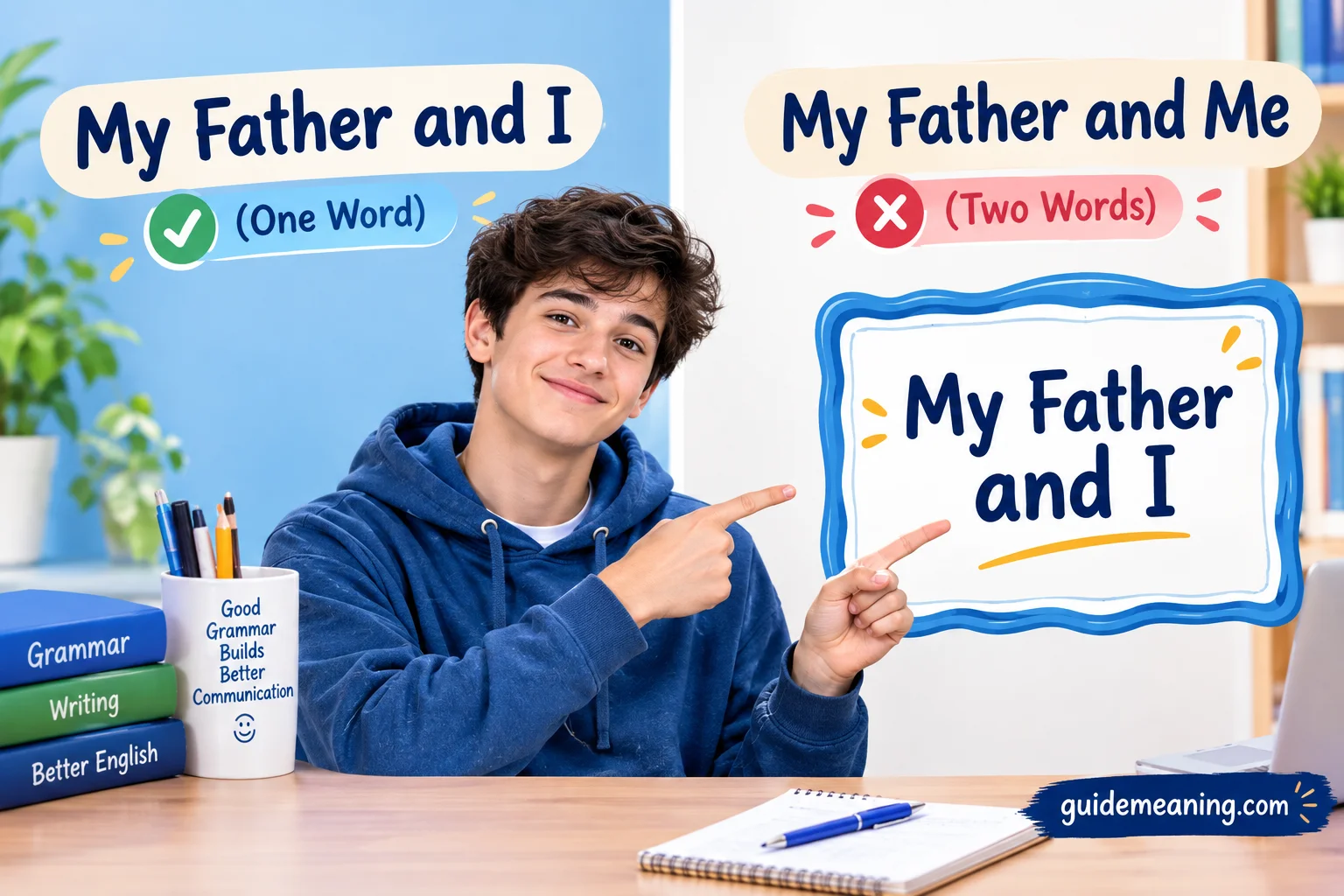

My Father and I vs My Father and Me can confuse native English speakers, but a simple grammar rule helps you choose the right phrase with confidence. Native English speakers may still stumble over this grammar choice, especially when they’ve paused mid-sentence and feel unsure which phrase they should say or write. My Father and I and My Father and Me follow a clear system based on sentence structure, word order, and function rather than politeness, instinct, or preference. The basic rule is easy to understand: I works as the subject while me works as the object. When my father and I are doing the action, use I. When my father and me are receiving an action, use me. This difference can make a huge change in how correct, natural, confident, and polished your writing sounds in everyday speech and formal situations.
A quick check makes it easier to choose the right phrase accurately. Try temporarily removing my father from the sentence and see whether I or me fits. If the remaining word is doing the action, I is usually the answer. If it is receiving something after a verb or preposition, me is the better choice. For example, My Father and I went to the store, while someone gave a gift to my father and me. These real-life examples make the subject, object, verb, and preposition easier to understand. The same rules work in statements, questions, longer sentences, formal writing, and casual writing. Clear explanations, helpful tips, practical tests, and short edits can prevent common mistakes in compound constructions. They also help you identify nouns, pronouns, verbs, conjunctions, prepositions, verb tense, and subject–verb agreement.
From my personal experience, practicing these phrases in real-life situations makes the knowledge stick. I once went to the store with my father and later gave something to someone, and repeating My Father and I or My Father and Me aloud helped me internalise the rules. Using pen and paper, noting examples, and reviewing your writing can build mastery. Mentally pausing, removing extra words, and checking the function of each pronoun can prevent second-guessed mistakes. With daily conversation, speaking, and using these phrases, your clarity, communication, consistency, and confidence can instantly improve. As you express yourself more often, what once felt tricky becomes natural. The guide can break everything down step-by-step, helping you Getting the right phrase without sounding smart or guessing. Good communication depends on being clear, correct, and mindful of the basics.
Quick Answer:
My father and I vs My father and me depends on whether the phrase is the subject or object. Use my father and I when you and your father perform the action, and my father and me when someone acts on you both or when the phrase follows a preposition.
TL;DR:
• Use my father and I when the phrase is the subject.
• Use my father and me when the phrase is the object.
• After prepositions like with and for, use me.
• Remove “my father” to test which pronoun sounds correct.
• “My father and me” is not always wrong.
• Casual speech may use “me and my father,” but formal writing favors I.
What Do “My Father and I” and “My Father and Me” Mean?
Both expressions refer to you and your father together. However, they occupy different grammatical positions.
The Basic Difference
My father and I uses I, a subject pronoun. It identifies the people performing the action.
For example:
My father and I visited the museum.
Remove “my father,” and you get:
I visited the museum.
That works, so I is correct.
By contrast, my father and me uses me, an object pronoun.
The teacher greeted my father and me.
Remove “my father,” and you get:
The teacher greeted me.
Again, the sentence works naturally.
Why Both Forms Are Correct
Neither phrase is automatically right or wrong. The surrounding sentence determines the correct form.
| Phrase | Grammatical role | Example |
| My father and I | Subject | My father and I traveled together. |
| My father and me | Direct object | She invited my father and me. |
| My father and me | Object after preposition | She traveled with my father and me. |
| My father and I | Compound subject | My father and I agree. |
Cambridge Grammar describes I as the subject form and me as the object form. Object pronouns commonly appear after verbs and prepositions.
Why “My Father and I” Is Correct as a Subject
The phrase my father and I is correct when you and your father perform the action.
Common Examples
Consider these sentences:
• My father and I went to the baseball game.
• My father and I cooked dinner together.
• My father and I watched the sunset.
• My father and I discussed the problem.
• My father and I are planning a trip.
In each example, the phrase answers who performed the action?
For example:
My father and I repaired the fence.
Who repaired the fence?
My father and I.
Therefore, I is the correct pronoun.
The “I” Test
When you’re uncertain, remove the other person.
My father and I went shopping.
Becomes:
I went shopping.
That sounds correct.
Now try:
My father and me went shopping.
Remove “my father”:
Me went shopping.
That doesn’t work in standard edited English.
The same test works with other compound subjects. Cambridge gives the same basic principle: choose the pronoun you would use if you were referring only to yourself.
When “My Father and Me” Is Correct
This is where many people get tripped up. My father and me is completely grammatical when the phrase functions as an object.
After an Action Verb
Someone else may perform an action involving you and your father.
For example:
The teacher called my father and me.
The teacher performed the action. Your father and you received it.
More examples include:
• The coach congratulated my father and me.
• The doctor spoke with my father and me.
• She invited my father and me.
• They thanked my father and me.
Notice what happens when you remove “my father”:
The teacher called me.
Not:
The teacher called I.
That immediately reveals why me belongs there.
After a Preposition
You also normally use me after a preposition.
For example:
The gift is for my father and me.
Other common examples include:
She went with my father and me.
The decision was between my father and me.
They sat beside my father and me.
Words such as with, for, between, beside, to, from, and about can introduce phrases containing object pronouns.
The Easiest Way to Choose Between I and Me
The simplest method is the remove-the-other-person test.
Step One: Remove “My Father”
Start with:
My father and I went fishing.
Temporarily remove “my father.”
I went fishing.
That works.
Therefore:
My father and I went fishing.
Now try:
The guide thanked my father and me.
Remove “my father.”
The guide thanked me.
That works too.
Therefore:
The guide thanked my father and me.
Step Two: Ask Who Did the Action
If the phrase performs the action, choose I.
My father and I drove home.
Who drove home?
My father and I.
If someone else performs the action, me may be needed.
Sarah drove my father and me home.
Who drove?
Sarah.
Who received the action?
My father and me.
Step Three: Check for a Preposition
If you see words such as with, for, between, to, from, or beside, check whether the phrase follows that preposition.
For example:
with my father and me
for my father and me
between my father and me
That usually makes the choice straightforward.
“My Father and I” vs “My Father and Me” in Questions
Questions can make the distinction harder because word order changes.
However, the underlying grammatical role stays the same.
Questions With “I”
Did my father and I make the right choice?
Turn it into a statement:
My father and I made the right choice.
Because the phrase is the subject, use I.
Another example:
Did my father and I miss the train?
The underlying statement is:
My father and I missed the train.
So I remains correct.
Questions With “Me”
Now consider:
Did the teacher invite my father and me?
The statement would be:
The teacher invited my father and me.
The teacher is the subject. Your father and you are objects.
Therefore, me is correct.
This same principle applies even when the sentence structure becomes more complicated. The pronoun’s grammatical role doesn’t change simply because the sentence is a question.
“Dad and I” vs “Dad and Me”
Replacing my father with Dad doesn’t change the rule.
The noun changes, but the pronoun’s grammatical function remains the same.
Subject
Dad and I went fishing.
Remove “Dad”:
I went fishing.
So Dad and I is correct.
Object
The guide spoke with Dad and me.
Remove “Dad”:
The guide spoke with me.
So Dad and me is correct.
This matters because people sometimes think my father and I is a fixed expression. It isn’t. The same subject-object rule applies to Dad and I, Dad and me, and similar combinations.
Read More: Gauging Interest vs Gaging Interest: Which Is Correct? for 2026
Why People Overuse “I”
Many English speakers have been taught that I sounds more proper. As a result, they sometimes use it where me is required.
Common Hypercorrection
You might hear:
She spoke with my father and I.
In standard edited English, the preferred form is:
She spoke with my father and me.
Why?
Because with is a preposition, and the phrase following it uses the object form.
The problem often comes from trying too hard to avoid the perceived mistake of using me. Merriam-Webster discusses this broader pattern as a form of hypercorrection involving compound pronouns.
Compare These Sentences
| Incorrect or less suitable form | Preferred form | Reason |
| My father and me went home. | My father and I went home. | Compound subject |
| She called my father and I. | She called my father and me. | Direct object |
| She came with my father and I. | She came with my father and me. | Object of “with” |
| My father and I helped them. | My father and I helped them. | Compound subject |
| They helped my father and me. | They helped my father and me. | Compound object |
The key is to avoid thinking that I is always more correct. It isn’t. The two forms have different grammatical functions.
Is “Me and My Father” Ever Used?
Yes. You’ll hear me and my father in casual conversation, especially in some varieties of spoken English.
For example:
Me and my father went fishing.
However, standard edited American English generally prefers:
My father and I went fishing.
Cambridge notes that object-form me can occur as a subject in informal speech after another subject plus and. It also identifies my friends and me went… as informal and says my friends and I is considered more correct in standard usage.
Why Casual Speech Is Different
Spoken English often develops patterns that differ from formal writing.
People may say:
Me and Dad went downtown.
That doesn’t necessarily mean the speaker doesn’t understand English grammar. It can reflect ordinary conversational usage.
Still, for school assignments, professional writing, formal correspondence, and polished articles, My father and I went downtown is the safer choice.
How Pronoun Order Affects Style
When you mention yourself and another person, English commonly places the other person first.
So these forms usually sound more natural:
My father and I
My father and me
rather than:
I and my father
Me and my father
This is mainly a matter of conventional style and politeness, not a special grammatical rule about the words father or I.
The grammatical distinction remains the same regardless of order. However, putting the other person first generally sounds more polished in formal American English.
“My Father and I” vs “My Father and Me” in Everyday American English
The distinction appears everywhere in American communication.
School and Work
In formal settings, correct pronoun choice can make writing clearer.
For example:
My father and I attended the ceremony.
But:
The principal welcomed my father and me.
The difference is subtle but useful.
Conversation
In everyday speech, people may use forms that are less formal.
You might hear:
My father and I went there.
Or:
Me and my dad went there.
The second version is common enough in casual speech, but it isn’t the preferred form for formal writing.
Emails and Messages
A quick test can help when writing professional messages.
Please contact my father and me if you have questions.
Here, me follows the verb “contact.”
Compare:
My father and I will contact you tomorrow.
Here, I is part of the subject.
The Broader Grammar Pattern: I, Me, He, Him
The same distinction appears throughout English.
Understanding these pairs can make the rule easier to remember.
Subject and Object Pairs
• I → me
• he → him
• she → her
• we → us
• they → them
For example:
He called me.
Here, he performs the action, while me receives it.
Likewise:
My father and I called him.
Your father and you perform the action. Therefore, I belongs in the subject.
This is not a special rule created for the phrase “my father and I.” It’s part of the larger English pronoun system. Cambridge lists I/me, he/him, she/her, we/us, and they/them as subject-object pairs.
What About “It Was My Father and I”?
Some sentences are more complicated.
You may encounter constructions such as:
It was my father and I who organized the event.
This type of sentence can create disagreement because it involves a linking verb and a following clause.
Why It Gets Complicated
Traditional grammar explanations often focus on the pronoun after was, while the larger sentence structure can point toward another analysis.
For everyday writing, there’s an easy solution: rewrite the sentence.
Instead of:
It was my father and I who organized the event.
Write:
My father and I organized the event.
The rewritten sentence is shorter and clearer.
This is a useful writing principle. When a grammatical construction makes the choice unnecessarily difficult, restructuring the sentence can often solve the problem.
Common Mistakes to Avoid
Most errors come from applying one rule everywhere.
Mistake One: Always Choosing “I”
She invited my father and I.
Better:
She invited my father and me.
The phrase is the object of invited.
Mistake Two: Always Choosing “Me”
My father and me went hiking.
Better:
My father and I went hiking.
The phrase is the subject.
Mistake Three: Ignoring Prepositions
She traveled with my father and I.
Better:
She traveled with my father and me.
The word with takes an object form.
Mistake Four: Using “Myself” as a Substitute
Some writers try to avoid the choice entirely:
My father and myself went hiking.
That isn’t the standard replacement for I.
Myself is primarily a reflexive pronoun or an emphatic form. Merriam-Webster notes that it can appear in several constructions, but it shouldn’t simply replace I or me whenever someone feels uncertain.
A Simple Decision Chart for “My Father and I” vs “My Father and Me”
Use this chart whenever you hesitate.
Ask What the Phrase Is Doing
| Question | Use | Example |
| Are we performing the action? | My father and I | My father and I left early. |
| Is someone acting on us? | My father and me | She called my father and me. |
| Does a preposition come before us? | My father and me | She came with my father and me. |
| Does removing “my father” leave “I” naturally? | My father and I | I went home. |
| Does removing “my father” leave “me” naturally? | My father and me | They helped me. |
The chart works because it reduces the problem to the pronoun itself.
Instead of asking, “Which phrase sounds more educated?” ask, “Would I say I or me if my father weren’t mentioned?”
That question usually settles it.
How the Rule Has Shifted in Everyday Speech
English grammar has never existed separately from everyday speech.
People have used nonstandard or informal pronoun patterns for a long time. Modern grammar references recognize that spoken English can differ from formal written English.
Formal Writing
In edited American English, these remain the standard choices:
My father and I went home.
They invited my father and me.
Informal Speech
You may also hear:
Me and my father went home.
That form occurs in casual conversation, but it’s usually avoided in formal writing.
So the distinction isn’t simply about what people say. It’s also about context, audience, and style.
Why This Small Difference Matters
Pronoun errors rarely change the basic meaning of a sentence. However, they can affect clarity and the impression your writing creates.
In Formal Communication
Correct pronoun choice can make your writing feel more polished.
This can matter in:
• School assignments and essays
• Professional emails and applications
• Public-facing writing
• Formal letters and reports
• Edited articles and publications
However, there’s no need to become anxious about every sentence. Once you understand subject and object roles, the choice becomes much more natural.
The Bigger Lesson
The real lesson isn’t “always use I.”
It’s use the pronoun that matches the grammatical role.
That principle also helps with other pairs, such as he/him, she/her, we/us, and they/them.
FAQs:
Should I say “My Father and I” or “My Father and Me”?
Use My Father and I when you and your father are the subjects doing an action. Use My Father and Me when you and your father are the objects receiving an action or following a preposition.
Is “My Father and I” always correct?
No. My Father and I is correct when the phrase acts as the subject. For example, “My father and I went to the store” is correct.
Is “My Father and Me” grammatically correct?
Yes. My Father and Me is correct when the phrase acts as an object. For example, “She gave the gift to my father and me” is correct.
What is the easiest way to choose between them?
Remove “my father” from the sentence temporarily. If “I” sounds right, use My Father and I. If “me” sounds right, use My Father and Me.
Can I use “My Father and Me” in formal writing?
Yes, when me functions as the object. Formal writing doesn’t change the basic grammar rule. The important point is the phrase’s function in the sentence.
Why do native English speakers get this wrong?
People often choose the phrase that sounds more polished instead of checking the subject and object. Compound constructions can make this mistake especially easy to miss.
What is the difference between “I” and “me”?
I is a subject pronoun used for the person doing the action. Me is an object pronoun used for the person receiving the action or following a preposition.
Conclusion:
Choosing between My Father and I and My Father and Me becomes much easier once you focus on function rather than how the phrase sounds. Use My Father and I when you and your father perform the action. Use My Father and Me when the phrase receives the action or follows a preposition.
A quick test can help you avoid common mistakes: remove “my father” and check whether I or me fits naturally. With regular practice, this simple grammar rule can improve your writing, clarity, and confidence.



1 thought on “My Father and I vs My Father and Me: The Easy Rule for 2026”