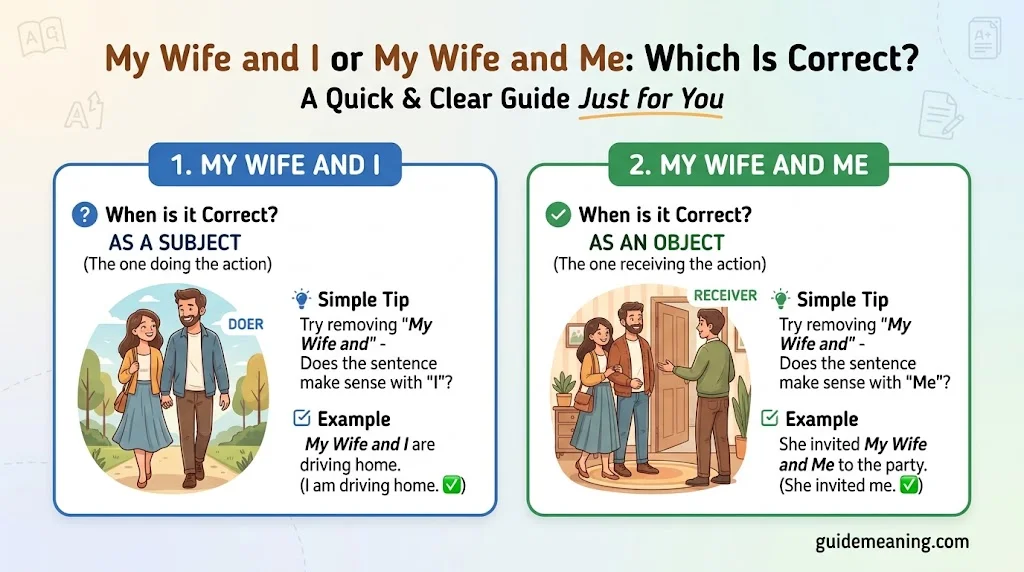

My Wife and I or My Wife and Me can confuse English speakers, but grammar makes the difference clear when you identify the subject or object. If you have wondered about the correct phrase, the basic rule is simple. I is a subject pronoun, while me is an object pronoun. In My Wife and I went to the store, “my wife and I” perform the action, so the phrase works as the subject. In He gave my wife and me a gift, the phrase receives the action, making it the object. This grammatical context explains why both forms can be correct.
The difference becomes easier to understand when you stop trying to sound overly formal and focus on the grammar role. Many English learners and confident writers second-guess their choice because these phrases are similar and commonly used in everyday conversation. A simple rule and foolproof test can clear it up within seconds: remove “my wife” and check whether “I” or “me” fits naturally. This helps you avoid common mistakes, improve fluency and confidence, and use the correct form when you speak or write in emails, essays, social posts, and job applications.
In my experience, real examples from authentic settings show that usage can feel tricky, especially when teachers, tweets, or articles suggest that one form is always wrong. However, the complete guide is really about recognizing subjects, objects, acting, and receiving. Understanding these standard English grammar rules is a fundamental part of English grammar, not a matter of intelligence. Practical methods, clear examples, courses, and careful explanations help readers remember the rules, choose the right phrase, and communicate more naturally and politely with others.
Let’s dive in!
Quick Answer:
Use “my wife and I” when you and your wife are the subject of the sentence.
My wife and I went to the store.
Use “my wife and me” when you and your wife are the object of a verb or preposition.
She invited my wife and me to dinner.
Here’s the quickest comparison:
| Expression | Grammatical role | Example |
| My wife and I | Subject | My wife and I went shopping. |
| My wife and me | Object | She invited my wife and me. |
| My wife and me | Object after a preposition | She spoke with my wife and me. |
A useful rule to remember is:
I does the action. Me receives the action.
This isn’t a complete explanation of every possible construction. However, it handles the overwhelming majority of everyday examples.
What Does “My Wife and I” Mean?
“My wife and I” is a compound subject. It combines the noun phrase “my wife” with the subject pronoun “I.”
You use it when the two of you perform the action described by the verb.
Consider this sentence:
My wife and I traveled to New York.
Who traveled?
My wife and I.
The phrase performs the action of traveled, so I is the correct pronoun.
Cambridge explains that subject pronouns appear as the subjects of clauses and typically occur before the verb.
Examples of “My Wife and I”
- My wife and I went to the restaurant.
- My wife and I bought a new car.
- My wife and I enjoy traveling.
- My wife and I discussed the problem.
- My wife and I are planning a vacation.
- My wife and I attended the meeting.
- My wife and I watched the movie together.
- My wife and I decided to stay home.
In every example, the pair acts as the subject.
The verb changes according to that subject:
- My wife and I went
- My wife and I bought
- My wife and I enjoy
- My wife and I discussed
- My wife and I decided
The pattern stays remarkably consistent.
When to Use “My Wife and I”
The safest way to recognize “my wife and I” is to ask one question:
Are my wife and I doing the action?
If the answer is yes, “my wife and I” is normally the correct form.
Example: Going Somewhere
My wife and I went to the beach.
You and your wife performed the action of going.
Remove “my wife and”:
I went to the beach.
That sentence works perfectly.
Now try the other form:
Me went to the beach.
That doesn’t work in standard English.
Therefore:
My wife and I went to the beach. ✓
Example: Making a Decision
My wife and I decided to move.
Remove the other person:
I decided to move. ✓
The subject form I fits naturally.
Example: Owning an Action
My wife and I made dinner.
Remove the other person:
I made dinner. ✓
Again, I is the subject.
This simple removal test is one of the most useful tools for solving the problem. Several grammar references recommend essentially the same approach.
What Does “My Wife and Me” Mean?
“My wife and me” uses me, the object form of the first-person singular pronoun.
Use it when the phrase functions as an object.
An object can receive the action of a verb or appear after a preposition. Cambridge specifically notes that object pronouns occur in positions such as after verbs and after prepositions.
Consider:
The manager called my wife and me.
Who performed the action?
The manager.
Who received the call?
My wife and me.
That’s why me belongs in the sentence.
Examples of “My Wife and Me”
- She invited my wife and me to dinner.
- The teacher spoke with my wife and me.
- They gave my wife and me some advice.
- The manager contacted my wife and me.
- The doctor helped my wife and me.
- He thanked my wife and me.
- The company sent my wife and me an email.
- They showed my wife and me the new house.
In these examples, my wife and me doesn’t perform the main action.
Someone else does.
The Easiest Test: Remove “My Wife and”
When you’re stuck between “my wife and I” and “my wife and me,” temporarily remove the other person.
This trick strips away the distracting part of the sentence.
Test One: “My Wife and I”
Original:
My wife and I went shopping.
Remove “my wife and”:
I went shopping. ✓
So the original is correct.
Test Two: “My Wife and Me”
Original:
They invited my wife and me.
Remove “my wife and”:
They invited me. ✓
So the original is correct.
Compare the Two
| Original sentence | Shortened sentence | Correct? |
| My wife and I went home. | I went home. | ✓ |
| My wife and me went home. | Me went home. | ✗ |
| They invited my wife and me. | They invited me. | ✓ |
| They invited my wife and I. | They invited I. | ✗ |
| My wife and I agreed. | I agreed. | ✓ |
| She spoke with my wife and me. | She spoke with me. | ✓ |
Think of the test as taking the grammatical “training wheels” off the sentence. Once my wife disappears, the correct pronoun usually becomes obvious.
“My Wife and I” vs. “My Wife and Me” in a Table
| Situation | Correct expression | Example |
| You and your wife perform the action | My wife and I | My wife and I went out. |
| Someone invites you both | My wife and me | They invited my wife and me. |
| Someone calls you both | My wife and me | She called my wife and me. |
| You and your wife make a decision | My wife and I | My wife and I decided to stay. |
| A person speaks with you both | My wife and me | He spoke with my wife and me. |
| A preposition introduces the phrase | My wife and me | This gift is for my wife and me. |
| You and your wife travel together | My wife and I | My wife and I traveled abroad. |
| Someone photographs you both | My wife and me | She took a picture of my wife and me. |
The rule doesn’t change because the sentence sounds formal, casual, professional, or sophisticated.
Grammar determines the form.
Why People Confuse “My Wife and I” and “My Wife and Me”
The confusion often comes from a useful rule that gets overgeneralized.
Many English speakers learn that “me and my friend” sounds incorrect when used as a subject. They then absorb a broader idea:
“Use I instead of me.”
That’s not the real rule.
The actual rule is:
Use the subject form when the pronoun is the subject. Use the object form when it is the object.
Cambridge identifies I/me as a subject-object pair.
This explains why both of these sentences can be correct:
My wife and I visited the museum.
The guide welcomed my wife and me.
The same two people appear in both sentences. Their grammatical roles simply change.
That’s the whole game.
“My Wife and I” or “My Wife and Me” After a Verb?
Look at what happens after the verb.
If you and your wife receive the action, use “my wife and me.”
Correct Examples
The receptionist greeted my wife and me.
The teacher called my wife and me.
The company contacted my wife and me.
They invited my wife and me.
The guide helped my wife and me.
Now remove my wife:
- The receptionist greeted me. ✓
- The teacher called me. ✓
- The company contacted me. ✓
- They invited me. ✓
- The guide helped me. ✓
That confirms the object form.
Compare This With a Subject
My wife and I greeted the receptionist.
Remove my wife:
I greeted the receptionist. ✓
Now the grammatical roles have switched.
“My Wife and Me” After a Preposition
Prepositions provide another strong clue.
Common prepositions include:
- to
- for
- with
- from
- between
- about
- of
- without
- near
- beside
When the phrase follows one of these prepositions, “me” is generally the appropriate first-person object form.
Examples
This letter is for my wife and me.
She spoke with my wife and me.
The decision was between my wife and me.
They talked about my wife and me.
The invitation came to my wife and me.
The photo shows my wife and me.
The removal test confirms each one:
This letter is for me.
She spoke with me.
The decision was between me and someone else.
They talked about me.
The object form fits naturally.
Why “Between My Wife and Me” Is Correct
“Between my wife and me” deserves special attention because it’s a very common mistake.
The correct expression is:
The disagreement was between my wife and me.
Not:
The disagreement was between my wife and I.
Why?
Because between is a preposition, and the pronoun following it takes the object form.
Compare:
- between me
- between him
- between her
- between us
- between them
You wouldn’t normally say:
- between I
- between he
- between she
- between we
- between they
So the same pattern applies when another noun joins the pronoun:
between my wife and me
This is one of the clearest examples of why “my wife and I” isn’t automatically the more correct phrase.
Common Mistakes With “My Wife and I”
“She Invited My Wife and I”
This mistake appears frequently in everyday writing.
❌ She invited my wife and I to dinner.
The problem is that my wife and I functions as the object of invited.
The correct version is:
✓ She invited my wife and me to dinner.
Remove my wife and:
She invited me.
Not:
She invited I.
The answer becomes clear immediately.
“My Wife and Me Went to Dinner”
Now the problem reverses.
❌ My wife and me went to dinner.
Here, the pair performs the action of went.
Remove my wife and:
Me went to dinner. ✗
Use I instead:
I went to dinner. ✓
Therefore:
✓ My wife and I went to dinner.
“This Is a Picture of My Wife and I”
Another common error involves the preposition of.
❌ This is a picture of my wife and I.
The phrase follows of, so the object form is appropriate.
✓ This is a picture of my wife and me.
Remove the other person:
This is a picture of me.
That sounds correct.
“My Wife and I” After “With”
Consider:
❌ The manager spoke with my wife and I.
The phrase follows with, a preposition.
Therefore:
✓ The manager spoke with my wife and me.
However, change the sentence structure:
✓ My wife and I spoke with the manager.
Now the pair is the subject.
Same people. Different grammatical jobs. Different pronoun.
Case Study: One Couple, Two Correct Pronouns
Consider this short sequence:
My wife and I visited the bank yesterday. The manager spoke with my wife and me about our account.
At first glance, the change from I to me might seem arbitrary.
It isn’t.
In the first sentence:
My wife and I → subject → performed the action of visiting.
In the second sentence:
My wife and me → object of with → participated in the conversation as the people being spoken with.
The same two people appear in both sentences. Their grammatical roles changed.
This is why memorizing one phrase as “correct” doesn’t solve the problem. You need to understand the function of the phrase.
Is “My Wife and I” More Formal Than “My Wife and Me”?
No.
“My wife and I” isn’t a more formal replacement for “my wife and me.”
Both forms are standard when they perform their proper grammatical jobs.
You might see someone write:
Please send the documents to my wife and I.
The writer may have chosen I because it feels more polished. Grammatically, however, to introduces an object.
The standard form is:
Please send the documents to my wife and me.
Using I doesn’t make the sentence more professional. It simply changes the pronoun to the wrong grammatical case.
A useful principle is:
Don’t choose the pronoun that sounds fancier. Choose the pronoun that performs the correct grammatical job.
What About “Me and My Wife”?
You may also hear:
Me and my wife went to dinner.
This construction occurs in informal spoken English. Cambridge specifically notes that me can appear as a subject after another subject plus and in informal speech. It also identifies “My friends and I went…” as the more standard form.
For careful writing, especially in school, business, professional, or academic contexts, use:
My wife and I went to dinner.
When the phrase is an object, me remains the object form:
They invited my wife and me.
The word order can vary in casual speech, but the grammatical role of me doesn’t change.
“My Wife and Myself”: Is That Correct?
“Myself” is not simply a fancier version of “me.”
It is a reflexive pronoun. Reflexive pronouns normally refer back to the subject. Cambridge explains that reflexive pronouns such as myself connect back to a subject and can also provide emphasis.
Correct Uses of “Myself”
I hurt myself.
I introduced myself to the manager.
My wife and I prepared ourselves for the trip.
In these sentences, myself has a specific grammatical function.
Incorrect Substitution
❌ The manager contacted my wife and myself.
If the sentence means that the manager contacted the two people, use:
✓ The manager contacted my wife and me.
Don’t use myself simply because me feels too casual.
A Useful Rule
If you can naturally use me, don’t replace it with myself just to sound formal.
That substitution often creates a grammatical error rather than improving the sentence.
My Wife and I or My Wife and Me: Real-World Examples
The following examples cover situations you might actually encounter.
Family and Everyday Life
My wife and I went grocery shopping.
My wife and I cooked dinner together.
My wife and I watched a movie.
My wife and I visited our friends.
These all use I because the couple forms the subject.
Work and Business
My wife and I attended the conference.
The company invited my wife and me to the event.
The manager spoke with my wife and me.
My wife and I discussed the proposal afterward.
Notice how the correct form changes according to the sentence.
Travel
My wife and I traveled to California.
The hotel staff welcomed my wife and me.
The guide showed my wife and me the historic district.
My wife and I enjoyed the trip.
Again, the pattern remains stable.
Photos and Memories
My wife and I took the photo.
Someone took a photo of my wife and me.
This picture shows my wife and me.
My wife and I looked through our old photos.
The preposition of is an especially useful clue in the second sentence.
A Practical Decision Tree
When you’re unsure which expression to use, walk through these questions:
Are you and your wife performing the action?
- Yes → my wife and I
Are you and your wife receiving the action?
- Yes → my wife and me
Does the phrase follow a preposition?
- Usually → my wife and me
Can you remove “my wife and” and use “I” naturally?
- Yes → my wife and I
Can you remove “my wife and” and use “me” naturally?
- Yes → my wife and me
This method is faster than trying to memorize dozens of examples.
My Wife and I vs. My Wife and Me: Quick Comparison
| Question | Answer |
| Which phrase is the subject form? | My wife and I |
| Which phrase is the object form? | My wife and me |
| Which one follows a preposition? | Usually my wife and me |
| Which one performs the action? | My wife and I |
| Which one receives the action? | My wife and me |
| Is “I” always more formal? | No |
| Is “me” always incorrect? | No |
| Is “my wife and myself” a replacement for “my wife and me”? | No |
| What’s the easiest test? | Remove “my wife and” |
A Simple Memory Trick for “My Wife and I” or “My Wife and Me”
If grammar terminology makes your eyes glaze over, use this shortcut:
I = subject
I went home.
Me = object
She called me.
Now add your wife.
My wife and I went home.
She called my wife and me.
That’s it.
Another way to remember it is:
I acts. Me receives.
It isn’t poetry, but it gets the job done.
FAQs:
Is “My Wife and I” grammatically correct?
Yes. “My wife and I” is correct when the phrase acts as the subject of a sentence. For example, “My wife and I went shopping.”
Is “My Wife and Me” grammatically correct?
Yes. “My wife and me” is correct when the phrase acts as the object. For example, “She invited my wife and me to dinner.”
Can I say “Me and My Wife”?
In informal speech, you may hear “me and my wife,” but in standard English, “my wife and I” is preferred as a subject, while “my wife and me” is preferred as an object.
What is the easiest way to choose between “I” and “me”?
Remove the other person from the sentence. If “I” sounds correct, use “my wife and I.” If “me” sounds correct, use “my wife and me.”
Is “My Wife and I” more formal than “My Wife and Me”?
Not necessarily. The choice depends on the grammatical role, not formality. “I” works as a subject, while “me” works as an object.
Why do people confuse “my wife and I” with “my wife and me”?
The confusion often happens because both phrases sound natural in conversation. People may also use “I” because they have heard that it sounds more formal or grammatically correct in every situation.
Which is correct: “My wife and I went” or “My wife and me went”?
“My wife and I went” is correct because the phrase is the subject performing the action. “My wife and me went” does not follow standard English grammar.
Conclusion:
Understanding My Wife and I or My Wife and Me becomes much easier when you focus on the phrase’s role in the sentence. Use “my wife and I” when you are part of the subject, and use “my wife and me” when you are part of the object. A quick test is to remove “my wife” and check whether I or me fits. Once you understand this simple difference, you can avoid common mistakes and use both phrases naturally and confidently.