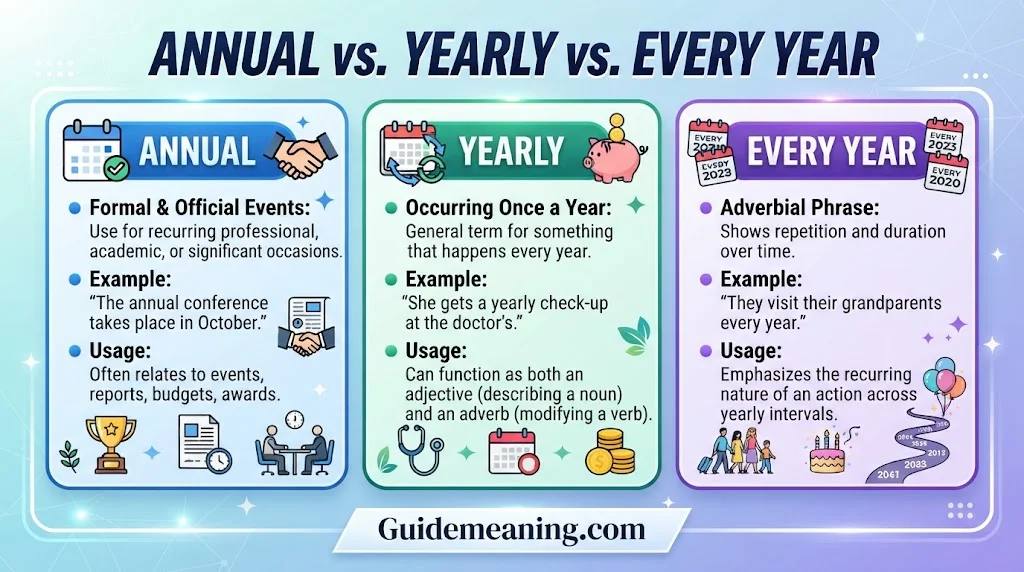

Annual vs. Yearly vs. Every Year explains how three similar terms differ in tone, grammar, context, and everyday language usage for clear writing.
When you wondered which word is the right term, the context can guide your choice. Annual works as a formal adjective in professional and official contexts, while yearly is more neutral and flexible, working as an adjective or adverb. Every year is a phrase that fits everyday language and natural speech, especially when you want to emphasize repetition. All three can describe something that happens once per year, once in a year, or once every twelve months. Although they seem like the same thing on the surface, their tone, grammar, and formality can differ.
This small difference can matter in blogs, emails, reports, contracts, marketing copy, social captions, medical reminders, subscriptions, corporate reports, blog posts, and casual conversations. In my experience with everyday writing, a wrong option can make a message sound stiff or robotic, even when it is technically correct. For real usage, consider a company publishing an annual report: the wording sounds clear, professional, and confident. By contrast, “We review the policy every year” sounds more natural and highlights repeated action. Yearly can work between these styles, depending on the sentence and situation. This approach helps you understand the differences, choose wisely, and make clear decisions without falling into the exact trap of treating the three expressions as interchangeable in every case.
Let’s dive in!
Quick Answer:
Annual, yearly, and every year can all communicate the idea of something happening once a year. However, they have different grammatical functions.
- Annual is mainly an adjective. It usually comes before a noun.
- annual report
- annual meeting
- annual fee
- Yearly can function as an adjective or an adverb.
- yearly report
- The company reviews its policy yearly.
- Every year is an adverbial time expression. It usually explains how often an action happens.
- We visit our relatives every year.
- The school holds a science fair every year.
The simplest rule is:
Use annual or yearly before a noun. Use every year to explain when an action happens.
In terms of tone, annual often sounds more formal, yearly sounds neutral, and every year usually feels more natural in everyday conversation. These are general tendencies, not strict rules. All three expressions can be correct when used in the right sentence structure.
Annual vs. Yearly vs. Every Year: Comparison Table
| Expression | Meaning | Grammatical role | Common tone | Example |
| Annual | Happening once each year | Adjective | Formal or professional | The company released its annual report. |
| Yearly | Happening once each year | Adjective or adverb | Neutral and flexible | We receive a yearly statement. |
| Every year | Once in each year | Adverbial phrase | Natural and conversational | We visit the park every year. |
| Annually | Once each year | Adverb | Formal | The policy is reviewed annually. |
The main difference is not always meaning. It is often how each expression fits into a sentence.
What Does “Annual” Mean?
Annual means happening, occurring, being produced, or being done once each year. It can also describe something calculated over a period of one year.
The word is primarily an adjective, which means it usually describes a noun.
Annual as an Adjective
An adjective gives information about a noun. In phrases such as annual report or annual meeting, the word annual tells us that the report or meeting takes place once a year.
Examples include:
- annual report
- annual meeting
- annual conference
- annual examination
- annual budget
- annual salary
- annual fee
- annual celebration
- annual subscription
- annual inspection
Consider this sentence:
The organization published its annual report in March.
Here, annual describes the noun report. It tells readers that the organization produces the report once each year.
More examples:
- The school holds an annual sports day.
- The company charges an annual membership fee.
- Our town hosts an annual cultural festival.
- The board conducts an annual performance review.
- She receives an annual salary of $60,000.
Why Annual Sounds More Formal
Annual is especially common in professional, academic, financial, governmental, and institutional writing.
You are likely to see it in:
- company reports
- official announcements
- financial documents
- school notices
- government publications
- business contracts
- research papers
- organizational policies
For example:
The committee will present its annual environmental assessment next month.
This sentence sounds official and structured. The word annual fits naturally because the assessment is part of a formal reporting process.
Compare it with:
The committee will present its yearly environmental assessment next month.
The second sentence is grammatically acceptable, but annual environmental assessment is more conventional in formal writing.
Annual in Financial and Business English
The word annual appears frequently in financial language because many financial figures are measured over a twelve-month period.
Common examples include:
- annual income
- annual revenue
- annual profit
- annual expenses
- annual growth
- annual interest rate
- annual percentage rate
- annual operating costs
- annual budget
- annual return
For example:
The investment offers an annual interest rate of 5%.
Here, annual does not necessarily describe an event that occurs once a year. Instead, it describes a rate calculated over a one-year period.
This distinction matters. Annual can refer to:
- Something that happens once each year.
- Something measured or calculated over one year.
Can “Annual” Describe an Action?
Not usually by itself.
You cannot normally say:
We meet annual.
That sentence is incorrect because annual is an adjective, not the usual adverb form needed after the verb meet.
Use one of these instead:
- We meet annually.
- We meet every year.
- We meet yearly.
Compare the structures:
| Incorrect or less suitable | Correct alternative |
| We meet annual. | We meet annually. |
| The event happens annual. | The event happens every year. |
| The company reviews its policy annual. | The company reviews its policy annually. |
The adjective annual generally needs a noun to describe:
- annual meeting
- annual review
- annual inspection
- annual celebration
When you need to describe the frequency of an action, use annually, yearly, or every year.
What Does “Yearly” Mean?
Yearly means happening once each year or relating to a year. Unlike annual, it can function as both an adjective and an adverb.
This flexibility makes yearly useful in many different sentence structures.
Yearly as an Adjective
When yearly acts as an adjective, it describes a noun.
Examples include:
- yearly income
- yearly expenses
- yearly subscription
- yearly review
- yearly payment
- yearly inspection
- yearly report
- yearly increase
- yearly assessment
Examples in sentences:
We pay a yearly subscription for the service.
The landlord carries out a yearly inspection of the property.
Her yearly income increased after she changed jobs.
In these examples, yearly comes before a noun and explains that the income, subscription, or inspection relates to a one-year cycle.
Yearly as an Adverb
Yearly can also describe a verb by explaining how often an action happens.
Examples:
- The company publishes its results yearly.
- We review our goals yearly.
- The machine is serviced yearly.
- The organization updates its guidelines yearly.
- The family travels abroad yearly.
For example:
The company checks its equipment yearly.
Here, yearly modifies the verb phrase checks its equipment. It tells us that the company performs the action once each year.
Is Yearly Formal or Informal?
Yearly is generally neutral. It works in both everyday communication and many professional situations.
However, annual may sound more conventional in fixed professional phrases.
Compare:
- annual report
- yearly report
Both are correct, but annual report is the more established phrase in business English.
Similarly:
- annual financial statement
- yearly financial statement
Both can work, but annual financial statement is more typical in formal financial writing.
In ordinary conversation, however, yearly may sound perfectly natural:
We have a yearly family reunion.
The car needs a yearly checkup.
The price increases yearly.
Yearly vs. Every Year
When yearly acts as an adverb, it often overlaps with every year.
Compare:
We visit our hometown yearly.
We visit our hometown every year.
Both sentences are grammatically correct. The second sentence often sounds more natural in casual conversation because every year clearly expresses frequency.
The difference is mainly stylistic:
- We visit our hometown yearly. — concise and neutral
- We visit our hometown every year. — more conversational and direct
Neither sentence changes the basic meaning.
What Does “Every Year” Mean?
Every year means once in each year or during each successive year. It is a phrase used to express frequency.
Unlike annual and yearly, it does not normally function as an adjective placed directly before a noun.
Every Year as a Time Expression
The phrase every year usually tells us when or how often an action happens.
Examples:
- We travel to the mountains every year.
- The school organizes a competition every year.
- She buys new books every year.
- The festival attracts visitors every year.
- The company updates its website every year.
Consider this sentence:
The city hosts a music festival every year.
The phrase every year explains how often the city hosts the festival. It does not directly describe the noun festival.
Where Can Every Year Appear?
You can place every year in several positions, depending on the sentence.
At the End of a Sentence
We visit our grandparents every year.
The company publishes a report every year.
This is one of the most common patterns.
At the Beginning of a Sentence
Every year, thousands of people attend the festival.
Every year, the school welcomes new students.
When every year begins the sentence, a comma is often used to separate the introductory time phrase from the main clause.
After the Subject
This position is possible in some sentences, especially when the phrase emphasizes the repeated action.
The company every year reviews its hiring policy.
However, this structure can sound less natural than:
The company reviews its hiring policy every year.
For most learners, placing every year at the end of the sentence is the easiest and most natural option.
Why Every Year Sounds Conversational
The phrase uses two familiar words: every and year. Its meaning is direct and easy to understand, so it appears frequently in everyday speech.
Compare:
We go camping every year.
with:
We go camping annually.
Both are correct, but the first sounds more relaxed and conversational. The second is shorter and somewhat more formal.
Every Year vs. Each Year
Every year and each year often mean the same thing.
Compare:
- The event takes place every year.
- The event takes place each year.
Both sentences say that the event happens once in each year.
There can be a small difference in emphasis:
- Every year often presents the years as a repeated pattern.
- Each year may place slightly more emphasis on individual years.
For example:
Each year, the company sets new environmental goals.
This wording can draw attention to the company’s goals in each separate year. Still, the difference is subtle, and the expressions are interchangeable in many situations.
The Main Differences Between Annual, Yearly, and Every Year
The most useful way to understand annual vs. yearly vs. every year is to compare grammar, tone, sentence position, and emphasis.
Difference in Grammatical Role
| Expression | Usual grammatical role | Example |
| Annual | Adjective | annual meeting |
| Yearly | Adjective or adverb | yearly meeting; meet yearly |
| Every year | Adverbial time phrase | meet every year |
This grammatical difference explains why you cannot always replace one expression with another without changing the sentence.
Compare:
The school holds an annual science fair.
The school holds a yearly science fair.
The school holds a science fair every year.
All three sentences are correct. The first two use an adjective before the noun science fair. The third uses a time phrase after the noun and verb structure.
Difference in Formality
A general style comparison looks like this:
- Annual — often formal, official, and professional
- Yearly — neutral and flexible
- Every year — natural, direct, and conversational
This does not mean that yearly is always informal or that every year is unsuitable for professional writing.
For example, this sentence is perfectly acceptable in a business email:
We review the agreement every year.
Likewise, this sentence is acceptable in professional writing:
The company conducts a yearly safety inspection.
The choice depends on the surrounding language and the level of formality you want.
Difference in Sentence Position
The expressions often appear in different places.
Annual + Noun
- annual report
- annual meeting
- annual payment
- annual examination
Yearly + Noun
- yearly report
- yearly meeting
- yearly payment
- yearly examination
Verb + Every Year
- meet every year
- travel every year
- review every year
- publish every year
Verb + Yearly
- meet yearly
- travel yearly
- review yearly
- publish yearly
The important point is that annual generally describes a noun, while every year usually describes the frequency of an action.
Difference in Emphasis
The expressions can also place attention on slightly different parts of the message.
- Annual emphasizes the nature or schedule of a thing.
- The annual conference begins tomorrow.
- Yearly describes something connected with a yearly cycle.
- The company conducts a yearly review.
- Every year emphasizes repetition.
- The company reviews its policy every year.
These differences are usually subtle. In many sentences, the expressions communicate almost exactly the same idea.
Read More: Copy That vs. Roger That: Meaning, Differences, and Examples for 2026
When Can Annual, Yearly, and Every Year Be Used Interchangeably?
The three expressions can often communicate the same meaning when discussing recurring events, payments, reports, or activities.
Example: A Meeting
- The company holds an annual meeting.
- The company holds a yearly meeting.
- The company holds a meeting every year.
All three sentences describe a meeting that takes place once each year.
Example: A Report
- The organization publishes an annual report.
- The organization publishes a yearly report.
- The organization publishes a report every year.
Again, the central meaning remains the same. The grammatical structure changes.
Example: A Payment
- We make an annual payment.
- We make a yearly payment.
- We pay every year.
The first two expressions describe the payment itself. The third describes the action of paying.
Example: A Celebration
- The town holds an annual celebration.
- The town holds a yearly celebration.
- The town celebrates every year.
The best choice depends on what the sentence needs:
- Use annual or yearly before a noun.
- Use every year after the action when expressing frequency.
When You Cannot Replace One Expression with Another
Although the meanings overlap, the expressions do not always fit the same grammatical position.
Annual Cannot Normally Replace Every Year
Incorrect:
We visit our relatives annual.
Correct:
We visit our relatives every year.
Also correct:
We visit our relatives yearly.
Or:
We visit our relatives annually.
The problem is not the meaning of annual. The problem is that the sentence needs an adverb or adverbial phrase to describe the verb visit.
Every Year Cannot Directly Modify a Noun
Incorrect:
The company held an every year meeting.
Correct:
The company held an annual meeting.
Also correct:
The company held a yearly meeting.
Or:
The company held a meeting every year.
The phrase every year cannot normally be placed directly before meeting as though it were a single adjective.
Yearly May Not Be the Most Natural Choice
Yearly is grammatically flexible, but another expression may sound more conventional.
Compare:
The company released its annual financial statement.
The company released its yearly financial statement.
Both are understandable and grammatically acceptable. However, annual financial statement is more established in formal financial language.
Now compare:
We visit the lake every year.
We visit the lake annually.
We visit the lake yearly.
All three are correct, but every year is often the most natural choice in ordinary conversation.
Annual vs. Yearly vs. Every Year in Different Contexts
Business and Workplace English
Professional communication frequently uses annual in established expressions.
Common examples include:
- annual performance review
- annual company meeting
- annual report
- annual bonus
- annual budget
- annual leave
- annual business plan
Examples:
Employees receive an annual performance review.
The company publishes its annual report in April.
The board approves the annual budget before the new financial year begins.
However, every year is natural when describing an action:
The company reviews its compensation policy every year.
You could also write:
The company reviews its compensation policy annually.
Finance and Money
Annual is especially common when discussing financial figures and rates.
Examples:
- annual salary
- annual income
- annual expenses
- annual interest
- annual growth
- annual return
- annual fee
- annual revenue
Consider the difference:
Her annual income is $75,000.
Here, annual describes the amount earned over one year.
She receives her salary every month.
This sentence describes the payment schedule, not the yearly total.
Similarly:
The account has an annual fee of $50.
The fee is charged every year.
Both sentences communicate related information, but the grammatical structure differs.
Education
Schools and universities often use annual in official contexts.
Examples:
- annual examination
- annual assessment
- annual sports day
- annual school festival
- annual academic report
Examples in sentences:
The school conducts its annual examinations in June.
The university publishes an annual academic report.
In everyday speech, students may say:
Our school holds a sports competition every year.
Both styles are correct. Annual sounds more official, while every year sounds more conversational.
Events and Celebrations
The word annual is common in the names of organized events.
Examples:
- annual book fair
- annual music festival
- annual charity walk
- annual cultural event
- annual award ceremony
Examples:
The city’s annual book fair attracts thousands of visitors.
Our neighborhood organizes a yearly food festival.
The town holds a cultural event every year.
The choice depends on whether you are naming or describing the event, or explaining its frequency.
Health and Appointments
All three expressions can appear in health-related contexts.
Examples:
- annual checkup
- yearly medical examination
- visit the doctor every year
Compare:
She schedules an annual checkup.
She schedules a yearly checkup.
She visits the doctor every year.
The first two expressions describe the checkup. The third describes the action of visiting the doctor.
Annual vs. Annually vs. Every Year
Another common confusion involves annual and annually.
Although the words are related, they have different grammatical roles.
Annual Is an Adjective
Use annual to describe a noun.
The company held its annual meeting.
We reviewed the annual budget.
The school published its annual report.
Annually Is an Adverb
Use annually to describe an action.
The company meets annually.
The policy is reviewed annually.
The equipment is inspected annually.
Every Year Is an Adverbial Phrase
Use every year to explain how often something happens.
The company meets every year.
The policy is reviewed every year.
The equipment is inspected every year.
Compare the structures:
| Adjective | Adverb | Adverbial phrase |
| annual meeting | meet annually | meet every year |
| annual inspection | inspect annually | inspect every year |
| annual review | review annually | review every year |
| annual payment | pay annually | pay every year |
In formal reports and policies, annually may be the preferred choice because it is concise and professional. In everyday writing, every year is often clearer and more conversational.
Common Mistakes with Annual, Yearly, and Every Year
Mistake: Using Annual as an Adverb
Incorrect:
The company checks the machines annual.
Correct:
The company checks the machines annually.
Also correct:
The company checks the machines every year.
Mistake: Writing Every Year Before a Noun
Incorrect:
We attended an every year conference.
Correct:
We attended an annual conference.
Correct:
We attended a yearly conference.
Correct:
We attended a conference every year.
Mistake: Treating Annual and Annually as the Same
Incorrect:
The organization meets annual.
Correct:
The organization meets annually.
Correct:
The organization holds an annual meeting.
The first corrected sentence uses an adverb. The second uses an adjective followed by a noun.
Mistake: Writing Every Year as One Word
Incorrect:
We travel everyyear.
Correct:
We travel every year.
Every year is written as two separate words when it means once in each year.
Do not confuse it with everyday, which is an adjective meaning ordinary or routine.
Compare:
- We walk there every day. — on each day
- These are my everyday shoes. — ordinary shoes
- We visit the beach every year. — once each year
Mistake: Assuming Annual Always Means January Through December
Annual does not necessarily mean that something must happen between January 1 and December 31.
An annual event may occur once during any twelve-month cycle.
For example:
The company conducts its annual review every September.
The review happens once a year, but the company’s review cycle may run from September to August.
Similarly, an annual subscription may cover twelve months from the date of purchase rather than a calendar year.
Mistake: Assuming One Expression Is Always Best
There is no single expression that works best in every sentence.
Use grammar and context as your guide:
- Annual is usually best before a noun in formal contexts.
- Yearly is useful before a noun or after a verb.
- Every year is a clear and natural way to express frequency.
- Annually is a formal adverb meaning once a year.
Practical Sentence Patterns You Can Reuse
Learning a few sentence patterns makes the difference much easier to remember.
Annual + Noun
Use annual before a noun.
Examples:
- annual meeting
- annual report
- annual fee
- annual examination
- annual festival
Sentence pattern:
The organization holds an annual + noun.
Example:
The organization holds an annual conference.
Yearly + Noun
Use yearly before a noun when you want a neutral expression.
Examples:
- yearly review
- yearly subscription
- yearly payment
- yearly inspection
Sentence pattern:
We pay a yearly + noun.
Example:
We pay a yearly subscription fee.
Subject + Verb + Every Year
Use every year to describe a repeated action.
Examples:
- We travel every year.
- The company updates its policy every year.
- The school holds a competition every year.
- She visits her family every year.
Sentence pattern:
Subject + verb + every year.
Example:
The museum organizes an exhibition every year.
Subject + Verb + Yearly
Use yearly as an adverb when it describes an action.
Examples:
- The company reviews its goals yearly.
- The machine is serviced yearly.
- The price increases yearly.
This structure is correct, although every year or annually may sound more natural in some contexts.
Subject + Verb + Annually
Use annually when you want a formal adverb.
Examples:
- The report is published annually.
- The committee meets annually.
- The equipment is inspected annually.
Annual vs. Yearly vs. Every Year: Real-World Comparisons
| Situation | Annual | Yearly | Every year |
| A formal business report | annual report | yearly report | report published every year |
| A company meeting | annual meeting | yearly meeting | meeting held every year |
| A recurring payment | annual payment | yearly payment | pay every year |
| A family tradition | annual family gathering | yearly family gathering | gather every year |
| A school event | annual sports day | yearly sports day | sports day held every year |
| A repeated action | Usually needs a noun | review yearly | review every year |
| A formal policy | annual review | yearly review | policy reviewed every year |
The table shows that annual and yearly often modify nouns, while every year commonly appears after a verb or complete action.
Mini Case Studies: Choosing the Best Expression
Case Study: A Company’s Financial Report
Suppose a company prepares a document describing its performance, income, expenses, and future plans.
The most natural phrase is:
The company published its annual report.
Why is annual a good choice?
- It is common in business English.
- It sounds formal and professional.
- It directly modifies the noun report.
- It describes a document produced once each year.
You could say yearly report, but annual report is the more established expression.
Case Study: A Family Tradition
Imagine a family visits the same mountain village during the summer.
A natural sentence would be:
We visit the village every year.
This works well because the sentence describes a repeated action. The phrase every year clearly tells the reader how often the family visits.
You could also say:
We visit the village yearly.
However, every year sounds more natural in many everyday conversations.
Case Study: A Subscription
Suppose a streaming service charges customers once every twelve months.
Several expressions are possible:
- annual subscription
- yearly subscription
- subscription renewed every year
The best choice depends on the context.
A website’s pricing page might say:
Choose our annual subscription and save money.
A casual conversation might sound like this:
I pay for the service every year.
Both sentences are correct. The first focuses on the type of subscription. The second focuses on the payment schedule.
Case Study: A Formal Policy
Suppose an organization checks its safety policy once each year.
A formal sentence might be:
The safety policy is reviewed annually.
Another correct version is:
The safety policy is reviewed every year.
The first sentence sounds more formal and concise. The second is straightforward and easy to understand.
A Simple Memory Trick
You can remember the difference by asking what the expression describes.
Annual
Think:
Annual + noun
Examples:
- annual report
- annual meeting
- annual fee
Yearly
Think:
Yearly + noun or verb + yearly
Examples:
- yearly report
- yearly payment
- reviewed yearly
Every Year
Think:
An action happens every year
Examples:
- We travel every year.
- The event happens every year.
- The company updates its records every year.
A quick test can help:
- If the expression comes directly before a noun, choose annual or yearly.
- If the expression explains how often an action happens, choose every year, yearly, or annually.
- If the writing is formal and the expression describes a noun, annual is often the most conventional choice.
FAQs:
What is the difference between annual and yearly?
Annual and yearly both describe something that happens once each year. Annual is more common in formal, professional, and official writing, while yearly is more flexible and natural in everyday English.
Is annual more formal than yearly?
Yes. Annual often has a more formal tone. For example, “The company released its annual report” sounds appropriate in business writing. Yearly can also be correct, but it generally feels less formal.
Is every year the same as annual?
They can express the same general time idea, but their grammatical roles differ. Annual is an adjective, while every year is a time phrase. For example, “an annual meeting” and “The meeting happens every year” are both natural.
Can yearly be used as an adverb?
Yes. Yearly can work as both an adjective and an adverb. You can say “a yearly payment” or “The fee is paid yearly.” This flexibility makes yearly useful in everyday writing and conversation.
Should I use annual or yearly in professional writing?
Annual is often a natural choice for formal or professional contexts, especially with terms such as annual report, annual meeting, and annual review. However, yearly is not automatically incorrect in professional writing.
When should I use every year?
Use every year when you want to describe an action that happens repeatedly once each year. For example, “We visit our relatives every year” clearly emphasizes repetition and sounds natural in everyday speech.
Are annual, yearly, and every year interchangeable?
Not always. Their basic time meaning is similar, but grammar, tone, context, and sentence structure can affect which expression fits naturally. Understanding these differences helps you choose the right expression for your message.
Conclusion:
Annual, yearly, and every year all relate to something that occurs once during each year, but they do not always function in the same way. Annual is generally more formal and works as an adjective, yearly is flexible and can function as an adjective or adverb, and every year is a common phrase that emphasizes repeated action.
The easiest way to choose is to look at your context and the role the expression plays in your sentence. When you understand the difference between these three options, your writing becomes clearer, more natural, and better suited to the situation.




1 thought on “Annual vs. Yearly vs. Every Year: Meaning, and Correct Usage for 2026”