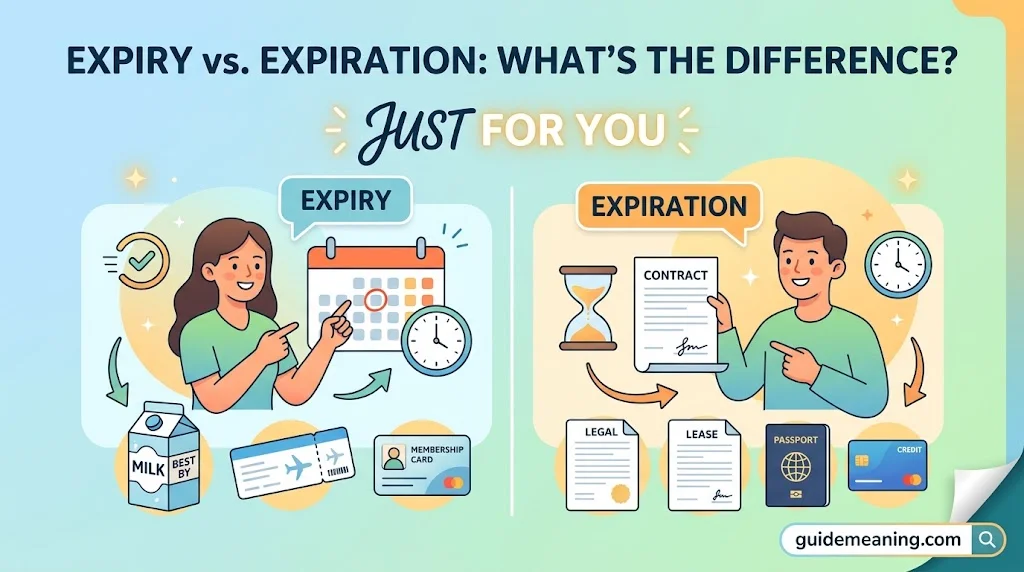

Expiry vs. Expiration can confuse you because both terms describe the end of a period of validity, but regional English affects which word sounds natural. Choosing the correct word matters when two terms have identical meanings in many situations. Expiry is preferred in British English, while expiration is common in American English and other varieties of English. For writers, students, professionals, and English learners, understanding this distinction can improve accuracy, professionalism, and writing. It also supports better vocabulary choices, writing conventions, and preferred style.
The two words aren’t always completely interchangeable, so context matters. In the United States, expiration commonly appears on product labeling, medical information, business documents, legal contracts, and subscriptions. An expiration date may appear on food, medicine, or skincare packaging, so you might notice it while checking a date. A food product may spoil and become unsafe to be eaten safely, while a contract or another condition can become no longer valid. You may also see best by date, sell by date, and use before date. Federal rules require infant formula to carry an expiration date, while individual states have different laws involving milk and eggs. Much of this labeling remains voluntary.
In contrast, expiry date is a British term that is widely used in Europe, where expiry dates are often mandatory. Historical practical examples include Marks & Spencer’s use of expiry dates in its storerooms during the 1950s. Later, food products packaged for the home cook began carrying expiry dates during the 1970s. These examples show how meaning, usage, audience expectations, and context influence the appropriate term. Choosing the right form can make your writing clearer, precise, natural, and consistent. It can also reduce confusion, misunderstandings, and common language mistakes while helping you communicate clearly in everyday conversations, academic work, and professional communication. Keep these tips in mind: consider the relevant English variety, understand the key differences, choose the right word, and use it with confidence, correctly, and confidently.
Let’s dive in!
Quick Answer
Expiry and expiration generally have the same core meaning: the point when something ends or stops being valid.
- Expiration is the more common choice in American English.
- Expiry is especially common in British English.
- Expiration date is the usual American expression.
- Expiry date is the usual British expression.
- Both words can describe the end of a contract, visa, license, subscription, or other fixed period.
- Expire is the related verb: The license will expire next month.
- Neither expiry nor expiration is inherently incorrect.
For US English, the safest rule is straightforward: use “expiration” and “expiration date.” Cambridge specifically labels expiration date as mainly US and expiry date as the UK counterpart.
Expiry vs. Expiration: Key Difference
The difference between expiry and expiration is primarily one of regional preference and usage, not basic meaning.
Expiry means the ending of a period during which something remains valid or usable. Oxford describes it as the ending of the period when an official document can be used or when an agreement remains legally acceptable.
Expiration can carry the same meaning. Collins defines it as the ending of a fixed period or the point when something such as a contract, deadline, or visa comes to an end.
Here’s the practical comparison:
| Feature | Expiry | Expiration |
| Part of speech | Noun | Noun |
| Basic meaning | End of validity or a fixed period | End of validity or a fixed period |
| Common US usage | Less common | Preferred |
| Common UK usage | Preferred/common | Also used |
| US phrase | Expiration date | — |
| UK phrase | Expiry date | — |
| Contract example | Expiry of the contract | Expiration of the contract |
| Related verb | Expire | Expire |
So, if you’re writing for an American audience, expiration will usually sound more natural. If you’re writing for a British audience, expiry often fits better.
What Does “Expiry” Mean?
Expiry is a noun that refers to the end of a fixed period or the point at which something stops being valid.
It commonly appears with things that have a defined period of use or legal effectiveness. For example, you might talk about the expiry of a passport, the expiry of a lease, or the expiry of a visa.
Cambridge identifies expiry as mainly British and gives examples involving leases, visas, patents, and contracts. It also lists expiry date as the British counterpart to expiration date.
Common Uses of Expiry
You’ll often see expiry in these contexts:
- Expiry date of a product
- Expiry of a passport
- Expiry of a visa
- Expiry of a contract
- Expiry of a lease
- Expiry of a license
- Expiry of a subscription
- Expiry of an offer
- Expiry of a patent
- Expiry of an insurance policy
For example:
The tenant must renew the lease before its expiry.
Here, expiry refers to the point when the lease’s current period ends.
Another example:
Please renew your passport before its expiry.
The word works naturally in British English because expiry is an established noun for the end of a document’s validity.
What Does “Expiration” Mean?
Expiration is also a noun describing an ending. In everyday American English, it commonly refers to the point when something is no longer valid, usable, or effective.
For example:
Check the expiration date before using the product.
Or:
Your membership ends upon expiration of the current term.
Collins notes that expiration can refer to the ending of a fixed period, including the end of a contract, visa, or other defined period.
Common Uses of Expiration
American English commonly uses expiration with:
- Expiration date
- Expiration of a contract
- Expiration of a license
- Expiration of a passport
- Expiration of a visa
- Expiration of a subscription
- Expiration of an offer
- Expiration of a membership
- Expiration of a policy
- Expiration of an agreement
For example:
The expiration date on my passport is next year.
Or:
The contract will end upon its expiration.
The important point is that expiration isn’t a different concept from expiry. In many contexts, the two nouns simply represent different regional preferences.
Expiry vs. Expiration in American English
When writing for readers in the United States, expiration is usually the better choice.
American English strongly favors expressions such as expiration date, expiration of a contract, and expiration of a license. Cambridge identifies expiration date as mainly American English and gives expiry date as the British equivalent.
For example, an American writer would typically say:
- Check the expiration date.
- The offer ends at expiration.
- The license is approaching expiration.
- The contract expires in December.
- The card’s expiration date is printed on the front.
You might still encounter expiry in American contexts. The word exists in American English dictionaries, so it isn’t meaningless or grammatically impossible. However, it isn’t the usual everyday choice for the sense of a fixed validity period.
That distinction matters when you want your writing to sound naturally American rather than merely understandable.
Expiry vs. Expiration in British English
British English commonly uses expiry, particularly in expressions such as expiry date and expiry of a contract.
For example:
Please check the expiry date on your passport.
Or:
The agreement will terminate upon expiry of the initial term.
Oxford lists expiry as especially British and says North American English usually uses expiration instead.
However, British English hasn’t banned expiration. The word remains a legitimate part of English and can appear in formal writing.
This is an important distinction. Regional preference doesn’t create a strict grammatical wall.
Expiry Date vs. Expiration Date
The phrase expiry date and the phrase expiration date generally refer to the same basic idea: the date marking the end of a product’s, document’s, service’s, or agreement’s validity.
The regional preference is what changes.
| Audience | Preferred phrase |
| United States | Expiration date |
| United Kingdom | Expiry date |
| American business writing | Expiration date |
| British business writing | Expiry date |
| International audience | Choose based on the primary audience |
Cambridge defines an expiration date as the last date on which something can be used and labels the expression mainly US. It gives expiry date as the UK equivalent.
Examples
American English:
What is the expiration date on this credit card?
British English:
What is the expiry date on this credit card?
Both sentences communicate the same basic idea.
Expiry vs. Expiration in Different Contexts
The choice becomes easier when you look at real-world situations.
Food and Beverages
You may encounter both expiration date and expiry date on products sold in different English-speaking markets.
For US-focused writing, expiration date is the natural choice:
Always check the expiration date before consuming the product.
For British-focused writing, expiry date is more familiar:
Always check the expiry date before consuming the product.
However, don’t assume that every date printed on food packaging has exactly the same legal or safety meaning. Terms such as best before, use by, and sell by can have distinct meanings depending on the country and product.
So, the language distinction between expiry and expiration shouldn’t be confused with food-labeling rules.
Medicines
Medical products frequently carry dates indicating the period during which the manufacturer guarantees their specified quality, safety, or effectiveness.
In US English, expiration date is the standard phrase:
Check the medication’s expiration date before taking it.
In British English, expiry date is common:
Check the medicine’s expiry date before using it.
When discussing medicines, however, the important issue isn’t merely which noun sounds better. Follow the product’s labeling and applicable medical guidance.
Passports and Identification Documents
Passports have a defined validity period, making both words especially common in this context.
US English:
My passport’s expiration date is approaching.
British English:
My passport’s expiry date is approaching.
Oxford specifically gives passport validity as an example of how expiry works in British English.
Contracts and Agreements
Contracts provide another useful example because the noun can describe the end of a defined contractual period.
American English:
The contract will continue until its expiration.
British English:
The contract will continue until its expiry.
You may also see the verb expire:
The contract expires on December 31.
That last sentence works naturally in both major varieties of English.
Licenses and Permits
Licenses also have fixed validity periods.
For US readers:
The license’s expiration date is June 30.
For British readers:
The license’s expiry date is June 30.
The underlying idea remains unchanged. The regional noun changes.
Subscriptions and Memberships
Digital services often use language such as:
- Subscription expiration
- Membership expiration
- Expiry date
- Subscription expiry
For a US-facing website, subscription expiration is usually the more natural choice.
For a UK-facing service, subscription expiry may sound more familiar.
Credit and Debit Cards
Financial websites frequently ask users to enter their card’s expiration information.
In American English, the familiar term is:
Expiration date
In British English, you may see:
Expiry date
This is a good example of why localization matters. A form can be grammatically correct yet still sound slightly foreign to its audience.
Expire vs. Expiry vs. Expiration
These three words belong to the same word family, but they don’t perform the same grammatical job.
Expire is the verb.
Expiry is a noun.
Expiration is also a noun.
Compare these sentences:
| Word | Example | Function |
| Expire | The license will expire soon. | Verb |
| Expiry | The license’s expiry is approaching. | Noun |
| Expiration | The license’s expiration is approaching. | Noun |
The verb expire is especially useful because it avoids the regional noun choice altogether.
For example:
The contract will expire in December.
That sentence sounds natural in both American and British English.
This can be useful when you’re writing for an international audience and don’t need to emphasize a specific regional style.
Is “Expiry” or “Expiration” More Correct?
Neither word is universally more correct.
Instead, regional convention determines which one sounds more natural.
Oxford identifies expiry as especially British and says North American English usually uses expiration.
Cambridge makes the same broad distinction, identifying expiry as mainly UK and expiration date as mainly US.
Therefore:
- For US English, prefer expiration.
- For UK English, expiry is often the better choice.
- For mixed international audiences, choose one based on your primary readership.
- Within one document, maintain consistent terminology.
Think of it like color and colour. The regional preference changes, but the underlying English remains perfectly recognizable.
Expiry vs. Expiration vs. Termination
These words overlap, but termination can carry a different implication.
Expiration and expiry often describe something reaching the end of a period naturally.
Termination can suggest that someone actively ends an agreement, service, employment relationship, or other arrangement.
Compare these examples:
The contract ends upon expiration of its two-year term.
This describes the contract reaching the end of its scheduled period.
Now consider:
The company terminated the contract early.
This suggests that someone actively ended the contract before its normal endpoint.
That distinction becomes particularly important in legal and business writing. A contract can expire naturally without either party taking action. It can also be terminated before its scheduled expiration under the terms of the agreement.
Expiry vs. Expiration vs. Deadline
An expiration date and a deadline aren’t always the same thing.
A deadline is the latest time by which an action must happen.
An expiration marks the end of validity or duration.
For example:
Applications must be submitted by Friday’s deadline.
Here, Friday is the cutoff for submitting an application.
Compare:
The offer expires on Friday.
Here, Friday marks the end of the offer’s validity.
Sometimes an expiration creates a practical deadline. However, the concepts aren’t identical.
Common Mistakes With Expiry and Expiration
Using “Expiry Date” in US-Focused Writing
Expiry date isn’t wrong, but expiration date is usually more natural for American readers.
If your website targets the United States, choose the American form consistently.
Assuming the Words Have Different Core Meanings
Many learners assume that expiry means one thing while expiration means another.
In most ordinary contexts, that’s not the case.
Both can describe something reaching the end of its valid period.
Treating “Expiration” as Exclusively American
Although American English strongly favors expiration, British English also uses the word.
Calling it exclusively American would be too absolute.
The better description is that expiration is the usual American preference, while expiry is especially common in British English.
Confusing Expiration With Termination
A contract can expire because its agreed period ends. Termination may involve an intentional act that ends the agreement.
Those concepts can overlap in some legal contexts, but they shouldn’t automatically be treated as synonyms.
Mixing Regional Styles
If an American-facing document repeatedly switches between expiration date and expiry date, the terminology can feel inconsistent.
Pick the form that matches your audience and stick with it.
Expiry vs. Expiration: Real-World Examples
Here are practical examples showing how the words work naturally.
| Situation | American English | British English |
| Product label | Check the expiration date. | Check the expiry date. |
| Passport | My passport’s expiration date is near. | My passport’s expiry date is near. |
| Contract | The contract ends upon expiration. | The contract ends upon expiry. |
| License | The license’s expiration date is June 1. | The license’s expiry date is June 1. |
| Credit card | Enter your card’s expiration date. | Enter your card’s expiry date. |
| Subscription | Your subscription is nearing expiration. | Your subscription is nearing expiry. |
| Lease | The lease will reach expiration next year. | The lease will reach expiry next year. |
| Offer | The promotion ends at expiration. | The promotion ends at expiry. |
Case Study: A US Website
Imagine a software company based in California.
Its website says:
Your subscription expires on June 30. Your renewal must be completed before the expiration date.
That wording fits American English naturally.
Replacing expiration date with expiry date wouldn’t make the sentence incomprehensible. However, it would introduce a term that sounds more British than American.
Case Study: A UK Website
Now imagine a British insurance provider.
Its website says:
Your policy will automatically renew before its expiry date.
That wording fits British usage naturally.
Changing expiry date to expiration date would still be understandable. However, the original sounds more aligned with the company’s regional audience.
These examples show why audience matters more than abstract claims about correctness.
How to Choose Between Expiry and Expiration
If you’re unsure which word to use, ask one simple question:
Who will read this?
For an American audience, choose expiration.
For a British audience, expiry will often sound more natural.
Use this quick guide:
- 🇺🇸 US audience: expiration
- 🇬🇧 UK audience: expiry
- 🌎 International audience: follow the dominant audience
- 📄 Legal document: follow the terminology used by the applicable jurisdiction or organization
- 💻 Website or app: match your localization style consistently
- ✍️ General writing: use the regional form your readers expect
The verb expire can also provide a neutral alternative:
The license expires next month.
That’s concise, clear, and natural across major varieties of English.
FAQs:
Is expiry the same as expiration?
Yes, expiry and expiration generally refer to the end of a period of validity. The main difference is regional usage. Expiry is more common in British English, while expiration is more common in American English.
Which is correct, expiry or expiration?
Both are correct. Your choice depends mainly on your audience and the variety of English you’re using. Use expiry for British English and expiration for American English.
Is expiry British English?
Yes. Expiry is commonly used in British English and is also familiar in other regions that follow British English conventions. For example, you may see expiry date on product labels and official documents.
Is expiration American English?
Yes. Expiration is strongly associated with American English. You’ll commonly find phrases such as expiration date in the United States, particularly on products, contracts, and official documents.
Should I say expiration date or expiry date?
Both phrases are correct. Use expiration date when writing for an American audience and expiry date when following British English conventions. The meaning is generally the same.
Can I use expiry and expiration interchangeably?
In most everyday situations, yes. However, regional style still matters. Mixing both forms in the same document can make your writing less consistent, especially in formal, academic, or professional contexts.
Why is it important to know the difference between expiry and expiration?
Knowing the difference helps you choose the word that best matches your audience and writing style. It can make your writing clearer, more natural, and more professional while reducing unnecessary confusion.
Conclusion:
Expiry and expiration have essentially the same meaning, but regional English determines which term sounds more natural. Expiry is preferred in British English, while expiration is more common in American English. When writing for a specific audience, choose one form and use it consistently. Once you understand this simple regional distinction, choosing between expiry and expiration becomes much easier.