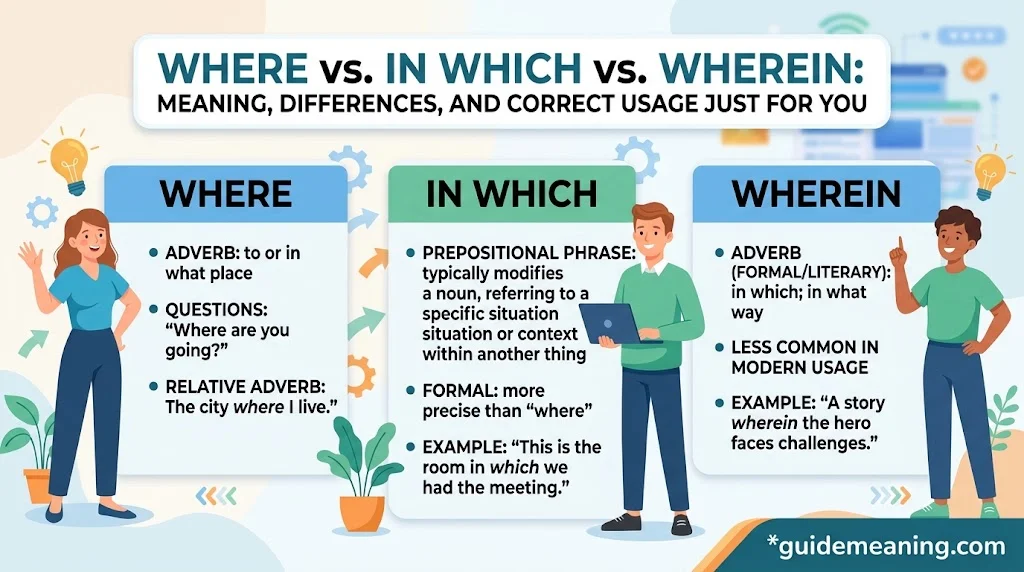

Where vs. In Which vs. Wherein helps you choose the right connector for a place, situation, condition, or formal relationship in clear writing.
At first, choosing the right connector can feel overwhelming because where, in which, and wherein look similar on the surface. However, these English expressions can behave differently depending on their role in a sentence. Where usually points to a place or familiar situation, as in “the city where I studied.” In which can often replace where, but it usually creates a more formal and precise connection between clauses. Wherein has an even more formal tone and appears mainly in legal contexts, academic contexts, and other highly formal contexts. This difference matters because writers need to consider their readers, context, and desired formality level before making a choice. Once you understand the basic meanings and usage of these forms, the confusion becomes much easier to handle.
The evolution of English also explains why these forms can feel different. Modern English often favors simplicity, while formal English, legal English, and older forms preserve structures that may sound outdated or overly formal to modern readers. For example, “the system in which rules apply” fits naturally in academic writing or professional documents because it creates a clear relationship between ideas. Similarly, “an agreement wherein both sides agree” has a more polished tone and authoritative tone, making it suitable for legal text and other formal writing. By contrast, where works comfortably in everyday sentences, including spoken English and ordinary written English. When you study these similar phrases through examples, comparisons, tables, and case studies, the process becomes easier. You can learn a few simple rules, recognize common usage rules, and avoid common mistakes without memorizing complicated grammar.
Once you recognize the patterns, you can use all three forms more confidently and make the right choice for each situation. Where is usually the natural option for a place or familiar situation, while in which often suits a more formal structure, especially when discussing a system, condition, or relationship between clauses. Wherein has its own role, so you shouldn’t use it simply because it seems interchangeable with the other forms. Some learners may mix these words and assume they mean exactly the same thing. However, their distinct role and subtle difference become clearer with practice. The goal isn’t to make every sentence sound stiff. Instead, you should know exactly when to use each word. With daily practice, reading, and attention to good writing, you can master these three words and improve your confidence. The key to proper usage is simple: identify whether you’re describing a place, situation, condition, or formal relationship, then choose the form that matches your purpose.
Let’s dive in!
Quick Answer:
The simplest way to remember the difference is this:
- Where usually refers to a place, location, or situation.
- In which means “in that place, situation, system, context, or thing.”
- Wherein means “in which” but sounds formal, literary, or old-fashioned.
For example:
This is the house where I grew up.
This is the house in which I grew up.
Both sentences are correct. The first sounds more natural in everyday English. The second sounds more formal.
Now consider:
They created a system in which every employee could participate.
Here, in which is a particularly natural choice because system isn’t simply a physical place.
And then:
They created a system wherein every employee could participate.
This is grammatically possible, but wherein makes the sentence noticeably more formal.
Where vs. In Which vs. Wherein at a Glance
| Expression | Core meaning | Common use | Tone |
| Where | In/at a place or situation | Places and certain abstract settings | Natural and conversational |
| In which | In that place, situation, or thing | Places, systems, contexts, processes | Neutral to formal |
| Wherein | In which | Formal, literary, legal, or elevated writing | Very formal |
The key isn’t simply choosing the “most correct” word. All three can be correct in the right context. The real question is which construction expresses the intended relationship while fitting the tone.
What Does “Where” Mean?
Where is one of the most flexible location words in English. It can function as a question word, conjunction, or relative word. In relative clauses, it commonly points back to a place. Cambridge Grammar notes that where can introduce relative clauses and can mean “in the place that.”
Where for Physical Places
The clearest use involves an actual location.
Consider these examples:
- This is the restaurant where we met.
- That’s the school where my sister studied.
- I visited the town where my grandfather was born.
- Do you remember the hotel where we stayed?
In each sentence, where refers back to a noun representing a location.
You can often understand the structure as:
place + where + clause
For example:
This is the hotel where we stayed.
The underlying idea is:
We stayed in the hotel.
That’s why where works so naturally here.
Where for Situations and Circumstances
Here’s where the grammar gets more interesting.
Where doesn’t always require a literal physical location. It can also introduce a clause describing a situation or circumstance. Cambridge specifically notes that where can mean “in situations that.”
For example:
We reached a point where we had to choose.
There isn’t necessarily a physical “point” on the ground. The word refers to a stage in a situation.
Another example:
This is a situation where patience matters.
Here, where means something close to “in which.”
This usage is common in modern English, especially when the abstract noun has a natural sense of a setting, condition, or stage.
When “Where” Sounds Most Natural
Choose where when you want your sentence to sound direct and conversational.
Compare:
This is the office where I work.
with:
This is the office in which I work.
The second sentence isn’t wrong. It simply sounds more formal than most everyday speakers need.
What Does “In Which” Mean?
In which consists of the preposition in followed by the relative pronoun which.
The construction explicitly tells the reader that something happens inside, within, or as part of the noun being described.
Cambridge explains that which commonly appears with prepositions, including constructions such as “in which.”
In Which for Places
When the noun represents a physical location, in which can often replace where.
For example:
This is the house where I grew up.
This is the house in which I grew up.
Both communicate essentially the same idea.
Other examples include:
- The city in which she lives is enormous.
- The building in which they work is historic.
- The room in which we met was surprisingly small.
- The country in which he was born has changed considerably.
The difference is mainly one of construction and register.
In Which for Situations, Systems, and Contexts
This is where in which becomes particularly useful.
Consider:
They developed a system in which every payment is recorded.
The phrase in which tells us that the action happens within the system.
You can use the same pattern with many abstract nouns:
- a situation in which
- a process in which
- a system in which
- an environment in which
- a context in which
- a period in which
- circumstances in which
- a case in which
For example:
We entered a period in which prices rose rapidly.
She works in an environment in which creativity is encouraged.
This is a situation in which careful planning becomes essential.
These sentences sound natural because in which clearly establishes the relationship between the noun and the following clause.
In Which After Formal Nouns
In which becomes especially useful when you’re describing a framework rather than a physical location.
For example:
The agreement in which the terms were established remains valid.
Here, the agreement isn’t a place you physically enter. The clause describes information contained within or specified by the agreement.
That’s an important distinction.
What Does “Wherein” Mean?
Wherein is a single word meaning “in which” or, in some contexts, “in which part.” Cambridge labels it as formal or old use.
So:
the situation wherein the problem occurred
essentially means:
the situation in which the problem occurred
The meaning is similar. The register is different.
Wherein as a Formal Equivalent of “In Which”
Consider these sentences:
This is the document in which the conditions are stated.
This is the document wherein the conditions are stated.
The second version sounds considerably more formal.
That doesn’t make it automatically better. In fact, for most modern writing, in which is usually the safer and clearer choice.
Wherein in Legal and Formal Writing
You may encounter wherein in formal documents, legal language, historical writing, and elevated prose.
For example:
The agreement wherein both parties accepted the terms…
or:
The document wherein the conditions are specified…
The word has a long-established formal flavor. Cambridge’s examples also show wherein being used with situations and contexts, not just physical places.
Wherein in Everyday English
Here’s the practical point: most people don’t need wherein in ordinary conversation.
If you’re telling a friend:
That’s the restaurant where we ate.
you wouldn’t normally say:
That’s the restaurant wherein we ate.
The second sentence sounds theatrical.
Likewise, if you’re writing a normal professional email, in which will usually be clearer than wherein.
Where vs. In Which: Are They Interchangeable?
Sometimes, yes. Not always.
The easiest place to see their overlap is with physical locations.
Cases Where Both Work
| With where | With in which |
| The house where I grew up. | The house in which I grew up. |
| The city where she lives. | The city in which she lives. |
| The hotel where we stayed. | The hotel in which we stayed. |
| The office where he works. | The office in which he works. |
The meaning remains substantially the same.
However, the sentences don’t have exactly the same feel.
Where is usually smoother and more conversational. In which can sound more formal or deliberate.
Cases Where “In Which” Is Better
Consider:
We developed a process in which every application receives two reviews.
This works naturally because process describes a structured procedure.
You could try:
We developed a process where every application receives two reviews.
Modern English speakers may accept this, especially in informal contexts. Still, in which makes the relationship more explicit.
The same applies to:
a system in which
a context in which
a framework in which
a period in which
In careful formal prose, in which often gives you greater precision.
Cases Where “Where” Is More Natural
Sometimes formal grammar isn’t the same thing as good writing.
Compare:
This is the café where we first met.
with:
This is the café in which we first met.
Both are grammatically sound. The first feels effortless. The second feels more polished or formal.
If you’re writing a personal story, blog post, email, or conversation, where usually wins.
In Which vs. Wherein: What’s the Difference?
This comparison is easier because their meanings are closely related.
Same Core Meaning
Wherein essentially means in which.
For example:
The situation in which they found themselves was difficult.
and:
The situation wherein they found themselves was difficult.
The core relationship is similar.
The Main Difference Is Register
The important difference is how the sentence sounds.
| Expression | Typical impression |
| In which | Clear, standard, formal when needed |
| Wherein | Highly formal, literary, legal, or old-fashioned |
This distinction matters because writers sometimes assume that a more unusual word automatically makes their writing stronger.
It doesn’t.
Precision beats ornament.
If your audience needs a straightforward explanation, in which will often communicate better.
Which One Should You Prefer?
For most formal writing, choose in which unless wherein genuinely fits the style.
For example:
The report describes the conditions in which the experiment was conducted.
This sounds professional and clear.
You could write:
The report describes the conditions wherein the experiment was conducted.
It’s understandable, but it adds a layer of formality that the sentence doesn’t need.
Where vs. Wherein: Can You Replace One With the Other?
Not mechanically.
Although both can appear in relative clauses, where and wherein don’t have identical ranges.
Where for Natural Modern English
Use where for ordinary location-based expressions:
That’s the house where I grew up.
This is the place where we met.
I remember the town where she lived.
These sentences sound natural without any stylistic baggage.
Wherein for Formal “In Which” Constructions
Use wherein when the intended meaning is specifically “in which” and the formal register makes sense.
For example:
The agreement wherein the parties define their obligations…
A more modern alternative is:
The agreement in which the parties define their obligations…
The second version is usually easier for a broad audience.
Why Direct Replacement Can Sound Awkward
Consider:
That’s the park where we played as children.
Replacing where with wherein produces:
That’s the park wherein we played as children.
The grammar may be interpretable, but the style is conspicuously formal.
It’s like wearing a tuxedo to buy groceries. Nothing is inherently wrong with it. The outfit simply doesn’t match the occasion.
Where, In Which, and Wherein in Different Contexts
The context often gives you the answer before grammar rules do.
| Context | Recommended choice | Example |
| Casual conversation | Where | That’s where we met. |
| Physical location | Where | The hotel where we stayed |
| Formal description of a place | In which | The building in which they worked |
| System or process | In which | A system in which users can vote |
| Academic writing | In which | A period in which major changes occurred |
| Legal/formal language | In which / Wherein | The agreement wherein the parties consent |
| Literary or historical style | Wherein | The world wherein he lived |
This table isn’t a rigid set of laws. Context and sentence structure still matter.
Common Grammar Patterns With “Where”
Noun + Where + Clause
The most common pattern is:
noun + where + subject + verb
Examples:
- the house where I live
- the city where she works
- the restaurant where we ate
- the stage where the problem began
- the situation where everyone benefits
The noun typically provides a place or figurative setting.
Where + Subject + Verb
The clause following where normally contains its own subject and verb.
For example:
This is the office where she works.
Here:
- where = location relationship
- she = subject
- works = verb
This structure makes the sentence easy to follow.
A Common Problem With “Where”
Don’t use where merely because a sentence contains an abstract noun.
For example, formal writing may benefit from:
The process in which the data is analyzed…
rather than automatically choosing:
The process where the data is analyzed…
The second construction may occur in contemporary usage. However, in which can make the grammatical relationship clearer in careful writing.
Common Grammar Patterns With “In Which”
Noun + In Which + Clause
This is the core structure:
noun + in which + clause
Examples:
The system in which the software operates…
The environment in which the bacteria grow…
The period in which the changes occurred…
The context in which the statement was made…
The construction explicitly links the clause to the preceding noun.
Why the Preposition Matters
Compare:
The system in which they work…
with:
The system which they work…
The second sentence is incomplete or changes meaning because work normally needs the preposition in to express the intended relationship.
A more informal version can move the preposition:
The system which they work in…
Both can work. Cambridge notes that English allows prepositions before which in formal styles and can also leave the preposition later in the clause.
Thus:
The building in which she works.
and:
The building which she works in.
are structurally related.
Common Grammar Patterns With “Wherein”
Noun + Wherein + Clause
The standard pattern is:
noun + wherein + clause
For example:
The document wherein the conditions are explained…
The situation wherein the error occurred…
The system wherein users can submit applications…
The word itself carries the in relationship.
Wherein as “In Which”
You can usually expand wherein to in which to understand its meaning.
the system wherein they operate
becomes:
the system in which they operate
That substitution is an excellent way to understand the word.
Wherein vs. “Where in”
Don’t confuse wherein with the separate words where in.
Compare:
The document wherein the rules appear…
Here, wherein means in which.
But:
Where in the document can I find the rules?
Here, where is an interrogative word and in belongs to a separate prepositional structure.
The spacing changes the grammar and meaning.
Common Mistakes With Where, In Which, and Wherein
Mistake: Assuming All Three Are Always Interchangeable
They overlap, but they aren’t identical in every context.
Where naturally expresses location. In which explicitly expresses an “in” relationship. Wherein packages that same idea into a highly formal word.
Mistake: Using “Wherein” to Sound More Intelligent
A rare word isn’t automatically a better word.
If you write:
The restaurant wherein we dined…
the reader may notice the wording more than the message.
If your goal is natural communication, write:
The restaurant where we ate…
Strong writing doesn’t show off. It gets the point across.
Mistake: Using “Where” for Every Abstract Noun
Modern English does use where with abstract settings. Still, in which can be clearer when the noun describes a formal system, process, or framework.
For example:
The procedure in which each sample is tested…
is more precise than blindly substituting where.
Mistake: Thinking “Wherein” Is Wrong Because It Sounds Old
Wherein is a legitimate English word. Cambridge defines it as meaning “in which” and identifies its use as formal or old.
Its problem isn’t correctness. Its issue is register.
Mistake: Removing “In” From “In Which”
The preposition can carry important meaning.
Compare:
The environment in which plants grow…
with:
The environment which plants grow…
The second sentence doesn’t preserve the intended relationship.
Where vs. In Which vs. Wherein: Real Sentence Comparisons
Physical Location
Natural:
This is the town where I was born.
More formal:
This is the town in which I was born.
Highly formal:
This is the town wherein I was born.
All three can communicate the same basic location. The first is the most natural for everyday use.
A System
They designed a system in which every employee has access.
This is a strong choice because the system provides a framework.
They designed a system wherein every employee has access.
Grammatically possible, but more formal.
A Situation
We reached a situation where nobody knew what to do.
This sounds natural in ordinary English.
We reached a situation in which nobody knew what to do.
This sounds more formal and analytical.
We reached a situation wherein nobody knew what to do.
This sounds markedly elevated and is unlikely to be the best choice for ordinary prose.
Where vs. In Which vs. Wherein in Formal Writing
Formal writing doesn’t always require the most formal expression.
That’s an important distinction.
Academic Writing
In which often works well in academic prose because it is precise without being archaic.
The study examined the environment in which participants made decisions.
This sounds professional and controlled.
Business Writing
Business writing usually benefits from clarity.
The report identifies the conditions in which the project succeeded.
Using wherein would rarely improve the sentence.
Legal Writing
Wherein can appear naturally in legal or highly formal language.
The agreement wherein the parties establish their respective obligations…
However, legal drafting has its own conventions. Writers shouldn’t insert wherein simply to make ordinary business language sound more authoritative.
Literary Writing
Here, wherein can serve a stylistic purpose.
He returned to the village wherein his childhood memories remained.
The unusual word can reinforce an intentionally elevated or historical voice.
A Simple Test for Choosing the Right Expression
When you’re stuck between where and in which, use this quick test.
Ask What the Noun Represents
If it’s a physical location, where is usually a natural choice.
The house where she lives.
If it’s a system, process, context, or formal situation, in which may be more precise.
The system in which she works.
Try Replacing the Expression
Ask whether the sentence can naturally use:
“in that place” or “in that situation.”
For example:
The city where he lives.
You can understand it as:
He lives in that city.
That relationship supports where.
Now consider:
The process in which the data is collected.
The phrase clearly means:
The data is collected in the process.
That supports in which.
Consider Your Audience
If you’re writing for a broad audience, prioritize familiar language.
If you’re writing a legal document or intentionally formal literary passage, wherein may fit.
The goal isn’t to sound complicated. The goal is to sound appropriate.
Case Study: Choosing the Best Version
Imagine you’re writing about a university study.
Version A
The laboratory where the researchers conducted the experiment had strict safety rules.
This sounds natural and accessible.
Version B
The laboratory in which the researchers conducted the experiment had strict safety rules.
This sounds more formal and academic.
Version C
The laboratory wherein the researchers conducted the experiment had strict safety rules.
This sounds unusually formal.
Best Choice
For a general article, Version A is probably the best.
For a research paper, Version B may fit better.
For ordinary modern writing, Version C would usually add formality without adding useful meaning.
That’s the central lesson: grammatical correctness and stylistic suitability are two different questions.
Quick Facts About Where, In Which, and Wherein
- Where can introduce relative clauses referring to places and certain situations.
- In which combines the preposition in with the relative pronoun which.
- Wherein means “in which” or, in some uses, “in which part.”
- Wherein is marked as formal or old use by Cambridge.
- Where and in which can often describe the same physical location.
- Where is generally more natural in everyday speech.
- In which often works well in academic, professional, and formal prose.
- Wherein has a much stronger formal, literary, or historical flavor.
- The best choice depends on both meaning and register.
Where vs. In Which vs. Wherein: Final Comparison
| Feature | Where | In Which | Wherein |
| Refers to a place | Yes | Yes | Yes |
| Refers to a situation | Yes | Yes | Yes |
| Works with abstract contexts | Often | Yes | Yes |
| Common in conversation | Very common | Less common | Rare |
| Suitable for academic writing | Yes | Very suitable | Sometimes |
| Suitable for legal writing | Yes, depending on context | Yes | Yes |
| Formality | Neutral | Neutral/formal | Very formal |
| Meaning includes “in” | Sometimes implied | Explicitly | Explicitly |
| Best general-purpose choice | Where | In which | Usually not |
| Main advantage | Naturalness | Precision | Formality |
How to Choose Between Where, In Which, and Wherein
Use this simple guide:
Choose Where When:
- You’re talking about a physical place.
- You’re referring to a natural figurative setting.
- You want conversational, modern English.
- The sentence sounds smoother with where.
Example:
That’s the restaurant where we had dinner.
Choose In Which When:
- You mean “in which.”
- You’re describing a system or process.
- You’re discussing a formal situation or context.
- You want precise, professional wording.
- Where feels too loose for the intended relationship.
Example:
The process in which the data was collected took several weeks.
Choose Wherein When:
- You deliberately want a formal register.
- You’re writing legal, literary, historical, or ceremonial prose.
- You specifically need a formal equivalent of in which.
Example:
The contract wherein the parties established their obligations…
For most readers, though, in which will be clearer.
FAQs:
Is “where” always used for a place?
No. Where can describe a physical place, but it can also refer to a situation or condition. For example, “This is the house where I grew up” refers to a place, while “We reached a point where we needed help” refers to a situation.
Is “in which” grammatically correct?
Yes. In which is completely grammatical and often sounds more formal than where. You’ll commonly see it in academic writing, professional documents, and formal explanations.
Can “where” and “in which” mean the same thing?
Sometimes, yes. In many sentences, where can replace in which without changing the basic meaning. For example, “the system in which we work” and “the system where we work” can communicate a similar idea, although the first sounds more formal.
What does “wherein” mean?
Wherein generally means “in which” or “in what”. It has a distinctly formal tone and commonly appears in legal, academic, and official writing. It can sound unusual in everyday conversation.
Is “wherein” more formal than “in which”?
Yes. Wherein generally carries a higher level of formality than in which. It can make a sentence sound authoritative or traditional, so you should use it when that tone fits the context.
Should I use “wherein” in everyday English?
Usually, no. Where is generally more natural for everyday spoken English and casual writing. In which works well when you need a more formal structure. Reserve wherein for contexts where its formal tone feels appropriate.
Which one should I choose: where, in which, or wherein?
Choose based on the context and level of formality. Use where for natural, everyday sentences. Choose in which for formal or precise writing. Use wherein mainly when you want a highly formal or traditional style.
Conclusion:
Understanding where vs. in which vs. wherein becomes much easier once you focus on their roles rather than memorizing complicated rules. Where usually sounds natural and conversational, while in which provides a more formal connection between ideas. Wherein carries the strongest formal tone and works best in legal, academic, or official contexts. The key is to consider your reader, purpose, and context before choosing a connector. With regular reading and practice, you’ll quickly recognize which form sounds natural. When in doubt, where is often the simplest choice for everyday English, while in which gives your formal writing a polished touch.