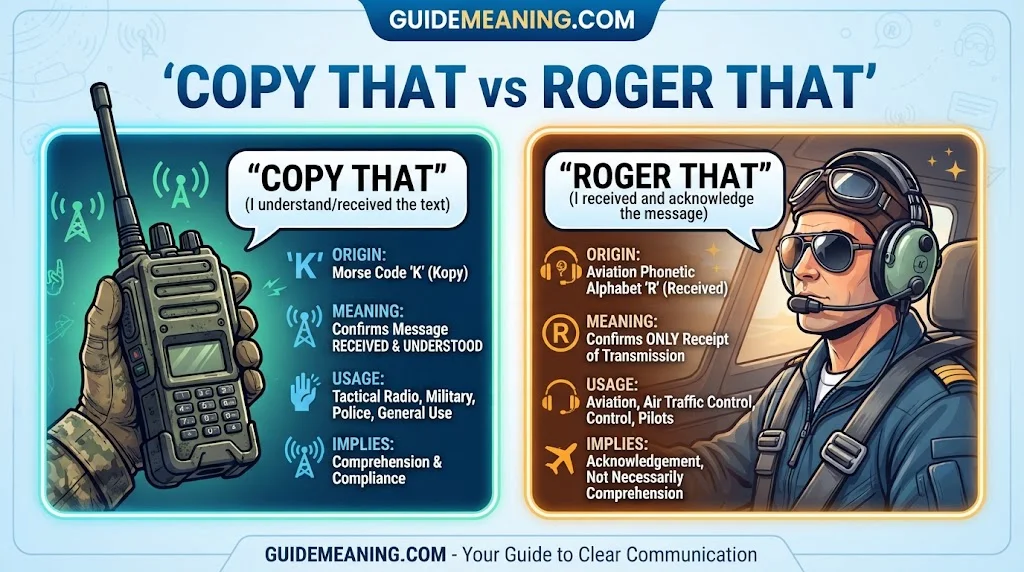

Copy That and Roger That may sound like the same thing, but they have different meanings, different uses, and different backgrounds. These phrases have a similar purpose because both can show that you received and understood a message. In a military movie, air traffic control audio, or rapid communication, one person may say one phrase while another replies with the other. Movies, daily conversation, and casual everyday texting often use these expressions interchangeably, which creates confusion. In reality, the subtle differences matter when you want to understand the real meaning and use each phrase correctly. The basic idea is easy to understand when explained in simple, clear language, without complex words or heavy explanations.
Copy That usually means “I received your message” or “I understand what you said.” It is common in radio communication, military settings, aviation, police communication, military-style conversations, and casual speech. Roger That has a similar purpose because it also confirms that a message was received and understood, but its older radio communication practices give it a different background. Roger represented the letter R, which was used to indicate that a message had been received. From my experience explaining these short communication phrases, learners usually find the distinction clearer when they connect Copy That with receiving or understanding information and Roger That with acknowledgment. This approach keeps the language precise while showing why both phrases can appear in everyday conversations.
The difference becomes especially useful when considering tone, situation, and levels of confirmation. Both phrases can provide acknowledgment and show understanding instructions, and they are widely used in contexts where clarity is important. However, formal communication and structured communication may require more precise wording than casual speech. The meanings, tones, and different uses can therefore help you choose the expression that fits the situation.
Let’s dive in!
Quick Answer:
“Copy that” and “roger that” both generally acknowledge that a message has been received. In everyday conversation, they often communicate a similar idea: “I heard you,” “I understand,” or “Message received.”
The main difference is their background and tone:
- Copy that is connected with receiving, hearing, or recording a message. It often sounds modern, direct, and operational.
- Roger that comes from historical radio communication, where “Roger” represented the letter R and indicated “received.” It often sounds more traditional, military-style, or radio-oriented.
- Neither phrase automatically means “I agree,” “permission granted,” “the task is complete,” or “I will definitely do it.”
- In formal or safety-critical communication, clearer words such as “understood,” “confirmed,” “approved,” or “I will comply” may be more appropriate.
In short, both expressions acknowledge communication, but the best choice depends on the context.
What Does “Copy That” Mean?
“Copy that” is an expression used to acknowledge that someone has received and understood information. It is especially associated with radio communication, team coordination, emergency-style communication, and informal conversations influenced by radio language.
When someone says “copy that,” they usually mean:
- “I heard your message.”
- “I received the information.”
- “I understand what you said.”
- “I have noted the instruction.”
- “You don’t need to repeat that message.”
For example:
Manager: “Please send the revised report before 3 p.m.” Employee: “Copy that.”
The employee is acknowledging the instruction. However, the response does not necessarily prove that the report has already been sent or that the employee agrees with the deadline.
The Meaning of “Copy” in Radio Communication
The word “copy” has a special meaning in communication. It does not refer to making a duplicate of a document or copying text from one place to another.
In radio language, copying a message traditionally involved receiving information clearly, often by listening carefully and writing it down. Because radio signals could be affected by static, interference, distance, or poor equipment, operators needed short expressions to confirm that they had received a transmission.
Over time, “copy” became a practical acknowledgment. It could indicate that the listener had heard the message clearly enough to record, understand, or act on it.
The exact meaning depends on the situation. In ordinary conversation, people often use “copy that” simply as a radio-style version of “got it.”
Examples of “Copy That”
Workplace Example
Supervisor: “The client moved the meeting to Friday.” Team member: “Copy that. I’ll update the calendar.”
Here, “copy that” acknowledges the new information.
Instruction Example
Parent: “Please lock the front door when you leave.” Child: “Copy that.”
The response means the child heard the instruction. It does not necessarily confirm that the door has already been locked.
Travel Example
Driver: “Take the second exit after the bridge.” Passenger: “Copy that.”
The passenger confirms that the direction was received.
Team Coordination Example
Team leader: “We’ll begin the next stage after everyone checks their equipment.” Team member: “Copy that.”
The phrase acknowledges the plan.
Casual Example
Friend: “You’re responsible for bringing snacks to the road trip.” You: “Copy that.”
In this situation, the phrase may sound playful or slightly dramatic because it imitates radio communication.
Is “Copy That” Formal or Informal?
“Copy that” is generally informal or conversational outside technical communication. It may sound perfectly natural in a team chat, a gaming group, or a casual conversation. However, it can sound abrupt in a formal email or official business document.
Compare these examples:
Informal Team Chat
Coworker: “Please upload the file before lunch.” You: “Copy that.”
This is short and understandable.
Formal Workplace Communication
Manager: “Please upload the file before lunch.” You: “Understood. I’ll upload the file before noon.”
The second response is more precise. It confirms understanding and states the intended action.
Better Alternatives to “Copy That”
Depending on the situation, you could use:
- “Understood.”
- “Got it.”
- “I understand.”
- “I’ll take care of it.”
- “I’ve noted that.”
- “Confirmed.”
- “I’ll send it before the deadline.”
The best alternative depends on whether you need to acknowledge information, promise action, or confirm a fact.
What Does “Roger That” Mean?
“Roger that” is a phrase used to acknowledge that a message has been received. It is strongly associated with radio communication, aviation, military language, emergency services, and action-oriented dialogue.
In simple terms, “roger that” can mean:
- “Message received.”
- “I heard you.”
- “I acknowledge your transmission.”
- “I understand the message.”
- “I have received that instruction.”
For example:
Team leader: “Move to the next checkpoint.” Team member: “Roger that.”
The response acknowledges the instruction. It does not automatically mean the team member has already moved or that the instruction has been officially approved.
Where Did “Roger That” Come From?
The origin of “roger” is one of the clearest differences between the two expressions.
Before the modern NATO phonetic alphabet became standard, radio operators used different words to represent letters. In one historical system, “Roger” represented the letter R.
The letter R was associated with the word “received.” Therefore, saying “Roger” became a way to communicate that a message had been received.
The phrase later developed into “roger that,” which means that the speaker acknowledges the specific message just transmitted.
The modern NATO phonetic alphabet uses “Romeo” for the letter R, not “Roger.” However, the older expression “roger that” remained popular because of its long history in radio communication and its widespread use in aviation, military stories, television, and movies.
Important Historical Fact
The word “Roger” in “roger that” does not normally refer to a person named Roger. It comes from historical communication terminology.
That is why someone can say:
“Roger that.”
without addressing anyone named Roger.
Examples of “Roger That”
Military-Style Example
Commander: “Report to the eastern checkpoint.” Soldier: “Roger that.”
The response acknowledges the instruction in a military-style way.
Aviation-Related Example
Controller: “Traffic is passing on your left.” Pilot: “Roger.”
In real aviation communication, pilots and controllers use standardized phraseology. “Roger” indicates receipt of a transmission, but it should not be treated as a universal substitute for every required aviation response.
Emergency Response Example
Dispatcher: “The response team is entering the building.” Operator: “Roger that.”
The operator acknowledges the update.
Everyday Example
Friend: “Please call me when you get home.” You: “Roger that.”
This is understandable, but it may sound more dramatic or playful than simply saying “Sure” or “Got it.”
Humorous Example
Friend: “Your mission is to bring the pizza.” You: “Roger that, captain.”
Here, “roger that” creates a humorous command-and-response style.
Does “Copy That” Mean Understanding While “Roger That” Only Means Receipt?
This distinction requires care.
Some explanations describe “copy that” as confirming understanding and “roger that” as confirming only receipt. That distinction can be useful as a learning aid, but it is not a universal rule in modern everyday English.
In actual usage, both expressions can indicate that the listener received and understood a message. The meaning often depends on:
- The communication setting
- The speaker’s intention
- The surrounding words
- Whether the message requires action
- Whether the communication follows a formal protocol
Therefore, it would be misleading to claim that “roger that” always means only receipt or that “copy that” always guarantees complete understanding.
A safer explanation is:
“Copy that” often emphasizes receiving or understanding information, while “roger that” carries a stronger traditional radio-acknowledgment flavor.
Copy That vs. Roger That: Tone and Style
The difference becomes more noticeable when people use these expressions outside radio communication.
“Copy That” Often Sounds:
- Practical
- Short
- Neutral
- Operational
- Modern
- Team-oriented
For example:
“The meeting has moved to Room 204.” “Copy that.”
This sounds like a quick acknowledgment.
“Roger That” Often Sounds:
- Traditional
- Tactical
- Military-inspired
- Dramatic
- Confident
- Playful in casual situations
For example:
“Your assignment is to secure the snacks.” “Roger that.”
The phrase may sound like dialogue from an action movie, even when the subject is ordinary.
Why Does “Roger That” Sound More Military?
The expression’s history in radio communication helped connect it with pilots, soldiers, dispatchers, and command structures. Films and television strengthened that association.
As a result, people often use “roger that” to imitate a military or aviation tone. The expression may sound more serious than the message actually requires.
Read More: Disloyal vs. Unloyal: Meaning, Correct Usage, and Examples 2026
Are “Copy That” and “Roger That” Interchangeable?
In Everyday Conversation
In many casual situations, yes. Both phrases can acknowledge a message.
Person A: “The restaurant opens at six.” Person B: “Copy that.”
or:
Person A: “The restaurant opens at six.” Person B: “Roger that.”
Both responses generally mean:
“I heard you and received the information.”
In Workplace Communication
They may be understandable, but they are not always the best choices. A workplace message may involve deadlines, responsibilities, or specific commitments. In those cases, a clearer answer is often better.
For example:
Manager: “Please send the report by 2 p.m.” Employee: “Understood. I’ll send it by 2 p.m.”
This response is stronger than simply saying “copy that” because it confirms the intended action.
In Technical or Regulated Communication
In aviation, emergency response, military operations, and other regulated environments, standardized terminology matters.
A phrase that sounds acceptable in a movie or casual conversation may not be suitable in a real operational setting. Professionals must follow the communication procedures used by their organization or agency.
The goal is not to sound impressive. The goal is to avoid ambiguity.
Copy That vs. Roger That in Aviation
Aviation provides an important example because radio communication must be precise.
In aviation, “roger” generally indicates that a transmission has been received. It does not automatically mean that the pilot agrees with an instruction, has permission to proceed, or will comply with every part of a message.
For example, receiving information about another aircraft is different from receiving an instruction to change altitude.
Aviation communication may require specific responses such as:
- Affirm: Yes
- Negative: No
- Wilco: I received your message, understood it, and will comply
- Unable: I cannot comply
- Say again: Repeat the transmission
- Stand by: Wait for further communication
These terms are not interchangeable.
Why “Roger” Is Not Always Enough
Suppose a controller gives a pilot an instruction that requires an exact readback. Simply saying “roger” may not provide the necessary confirmation.
The pilot may need to repeat the assigned altitude, heading, frequency, or clearance. This ensures that both parties understand the same information.
That distinction is important:
Acknowledging a message is not always the same as confirming an instruction.
Copy That vs. Roger That in Military Communication
Military communication often values brevity because messages may need to travel quickly under difficult conditions. Radio traffic can become crowded, and unclear instructions can create serious problems.
Short acknowledgments may help operators:
- Confirm that a transmission was heard
- Avoid unnecessary repetition
- Keep communication efficient
- Signal that the message reached the intended recipient
- Maintain a structured exchange
However, real military communication is more complex than the language shown in films. Different units and organizations use specific procedures, codes, and reporting formats.
A casual “roger that” in a movie should not be treated as a complete guide to real military radio procedure.
Copy That vs. Roger That in Workplace Communication
In modern workplaces, both expressions may appear in:
- Team messaging apps
- Group chats
- Remote-work conversations
- Project coordination
- Informal meetings
- Customer support teams
- Technical operations
Their usefulness depends on the workplace culture.
When “Copy That” Works
Team leader: “We’ll use the new presentation template from tomorrow.” Employee: “Copy that.”
This sounds concise and practical.
When “Roger That” Works
Project lead: “Keep monitoring the system until the update finishes.” Team member: “Roger that.”
This can work in an informal technical team, although it may sound slightly theatrical.
When a Clearer Response Is Better
Manager: “Please contact the client before the end of the day.” Employee: “Understood. I’ll contact the client before 5 p.m.”
This response confirms both understanding and responsibility.
Copy That vs. Roger That in Gaming and Online Chats
Both phrases are common in gaming because players often coordinate quickly. Team-based games may involve instructions about movement, equipment, strategy, objectives, or timing.
Gaming Example
Player One: “Wait here until the opposing team passes.” Player Two: “Copy that.”
The response acknowledges the strategy.
Military-Style Gaming Example
Player One: “Move to the northern position.” Player Two: “Roger that.”
This sounds more tactical and may fit the atmosphere of the game.
Humorous Online Use
Friend: “Your only job is to bring the drinks.” You: “Roger that.”
Here, the phrase is not technical. It simply adds humor.
What “Copy That” and “Roger That” Do Not Mean
These expressions are often misunderstood because they sound decisive. Their short, confident style can make them appear stronger than they really are.
They Do Not Necessarily Mean “I Agree”
Consider this conversation:
Person A: “I think we should cancel the event.” Person B: “Copy that.”
Person B may only be acknowledging the statement. If the intention is to express agreement, the response should be:
- “I agree.”
- “That makes sense.”
- “Yes, I support that decision.”
They Do Not Mean “The Task Is Complete”
Manager: “Please finish the report today.” Employee: “Roger that.”
This means the employee acknowledges the instruction. It does not mean the report is finished.
Better responses include:
- “The report is complete.”
- “I’ve finished the report.”
- “I’ll let you know when it’s done.”
They Do Not Automatically Mean “I Will Do It”
A person can hear an instruction without accepting responsibility for it.
Person A: “Please repair the printer.” Person B: “Copy that.”
The response does not clearly establish whether Person B will repair the printer.
A more precise response would be:
“I’ll check the printer after lunch.”
They Do Not Mean “Permission Granted”
Person A: “Can I enter the restricted area?” Person B: “Roger that.”
This may create confusion because acknowledgment is not authorization.
Use:
- “Approved.”
- “Permission granted.”
- “You may proceed.”
- “No, you cannot enter.”
They Do Not Always Mean “Confirmed”
The word “confirmed” can suggest that information has been checked or verified.
For example:
“The appointment is at 10 a.m.” “Confirmed.”
This may mean the speaker has verified the appointment.
By contrast:
“The appointment is at 10 a.m.” “Copy that.”
This usually means the listener received the information.
Real-Life Case Studies
Case Study: A Workplace Deadline
A manager tells an employee:
“Please submit the financial report by 4 p.m.”
The employee replies:
“Copy that.”
The manager knows the employee heard the instruction, but the response does not clearly confirm whether the employee can meet the deadline.
A better response would be:
“Understood. I’ll submit the financial report by 4 p.m.”
Lesson: Use a specific response when a deadline or responsibility matters.
Case Study: A Team Chat
A team leader writes:
“The meeting has moved from Room 101 to Room 204.”
A team member replies:
“Roger that.”
This is generally fine in a casual group chat. The message only requires acknowledgment.
Lesson: Either expression can work when the listener simply needs to confirm receipt of information.
Case Study: A Safety Instruction
A supervisor says:
“Do not enter the area until the equipment has been switched off.”
A worker replies:
“Copy that.”
Although the response acknowledges the instruction, a safety-critical situation may require a clearer confirmation, such as:
“Understood. I will stay outside until the equipment is switched off.”
Lesson: Safety-related communication should prioritize clarity over style.
Case Study: Expressing Agreement
A friend says:
“We should postpone the trip because of the weather.”
You respond:
“Roger that.”
The friend may not know whether you agree or merely heard the suggestion.
A clearer response would be:
“I agree. Let’s postpone the trip.”
Lesson: Use “I agree” when agreement is the actual message.
Common Mistakes with “Copy That” and “Roger That”
Treating Them as Perfect Synonyms in Every Situation
Their meanings overlap, but their tone and historical associations differ. “Roger that” often sounds more traditional or tactical, while “copy that” may sound more neutral.
Assuming They Guarantee Understanding
A person may say “copy that” or “roger that” quickly without fully understanding a complicated instruction.
If the message is important, ask for clarification or repeat the key details.
Assuming They Confirm Action
Acknowledging an instruction does not prove that the task has been completed.
Use “done,” “completed,” or a specific action statement when completion matters.
Using Them in Formal Emails Without Considering Tone
These phrases may sound abrupt in formal writing. Consider using:
- “Understood.”
- “Thank you for the clarification.”
- “I confirm receipt of your message.”
- “I’ll complete this by the requested deadline.”
Using Informal Radio Language in Regulated Settings
Aviation, emergency response, and other technical fields may require standardized language. Do not replace official terminology with casual expressions simply because they sound familiar.
How to Choose Between “Copy That” and “Roger That”
Use this quick guide to choose the expression that fits your situation.
Choose “Copy That” When:
- You want to acknowledge information.
- You are speaking casually with a team.
- You are using radio-style language.
- You want a direct and practical response.
- You are confirming that you heard an instruction.
Choose “Roger That” When:
- You want a traditional radio-style expression.
- The context has a military or aviation flavor.
- You are participating in a game or role-play situation.
- You want to sound playful, tactical, or dramatic.
- You are acknowledging a message in an informal setting.
Choose a Clearer Alternative When:
- The conversation involves safety.
- The message includes legal or financial responsibility.
- Someone needs a firm commitment.
- You must express agreement.
- You must confirm permission.
- You need to verify information.
- You are writing a formal email.
FAQs:
What does “Copy That” mean?
“Copy that” generally means that you received and understood the message. It is commonly associated with radio communication and can also appear in casual conversations.
What does “Roger That” mean?
“Roger that” means that a message has been received and understood. Roger comes from an older radio communication system in which the word represented the letter R.
Are “Copy That” and “Roger That” exactly the same?
They are similar because both can acknowledge a message. However, their backgrounds and traditional uses are different, so they aren’t always interchangeable in every communication setting.
Is “Copy That” used in the military?
Yes. “Copy that” is widely associated with military-style communication and other situations where people need to acknowledge information quickly and clearly.
Is “Roger That” only used by pilots or soldiers?
No. Although “roger” has strong connections with older radio communication, people also use “roger that” in movies, everyday conversations, and casual speech.
Which phrase should I use in everyday conversation?
Either phrase can work when you simply want to show that you received or understood something. Your choice can depend on the situation, tone, and style of the conversation.
Why do movies use “Copy That” and “Roger That” so often?
Movies often use these expressions because they quickly communicate acknowledgment during military, aviation, police, or other radio-based scenes. Their short form also makes rapid dialogue sound natural.
Conclusion:
Copy That and Roger That both communicate acknowledgment, but they have different histories and traditional uses. Copy That focuses naturally on receiving or understanding a message, while Roger That comes from older radio communication practices. Knowing these differences makes it easier to understand both expressions and choose one that fits the situation and tone.




1 thought on “Copy That vs. Roger That: Meaning, Differences, and Examples for 2026”