
At first glance, Annunciate vs. Enunciate can seem like look-alike verbs, but their meanings are distinct. These English terms may sound similar, yet their uses and connotations differ.
Both words have roots in the Latin language, which helps explain why they seem so alike. Annunciate connects with announce and declaring information, while enunciate focuses on pronouncing words clearly. Annunciation and enunciation also have different uses, despite some overlapping meaning. Once you understand this difference, the distinction becomes easier to remember, and the mix-up becomes less confusing.
When speaking or writing, you may have wondered about the correct usage of these words. This confusion is common among fluent speakers, especially in professional and formal contexts. You may hear someone insist on one term when the other better fits the situation. Enunciate relates to pronunciation, speech, and clarity, while annunciate relates more closely to an announcement or the act of declaring something. Learning these differences helps you communicate with greater confidence and avoid common mistakes.
A friendly guide can make the topic easier with examples, tables, analogies, case studies, and bite-sized explanations. A useful way to remember the distinction is to consider your goal: annunciate is connected with announce, while enunciate concerns clear pronunciation. In real life, this makes the correct usage easier to apply. You can then use each word naturally, distinguish between the two, and avoid being deceived by their similar-sounding forms. Their shared history is interesting, but their modern uses give each word its own place.
Let’s dive in!
Quick Answer:
Annunciate vs. Enunciate comes down to purpose. In American English, annunciate means to announce or proclaim something, while enunciate means to pronounce words clearly or express an idea precisely.
TL;DR:
• Annunciate means to announce, proclaim, or make something known.
• Enunciate means to pronounce words clearly and distinctly.
• Both words ultimately connect to Latin words involving announcing or reporting.
• Enunciate is much more common in modern American English.
• Use context to decide whether you mean an announcement or clear speech.
What Does Annunciate Mean?
Annunciate is a verb meaning to announce or proclaim something. In American English, dictionaries describe it as a formal or uncommon alternative to announce.
Meaning and Use
When someone annunciates something, the focus is on making information known. The word can suggest a formal declaration rather than an ordinary statement.
For example:
The official annunciated the new policy.
Here, the speaker is announcing the policy. The sentence isn’t mainly about how clearly the speaker pronounced each word.
Today, however, announce is usually the more natural choice in everyday American English. Annunciate may sound old-fashioned or unusually formal.
A Simple Memory Trick
Think of annunciate → announce.
If your sentence is about revealing information, proclaiming something, or making an official statement, annunciate can fit.
What Does Enunciate Mean?
Enunciate has two closely related modern meanings. It can mean to pronounce words clearly, or to express an idea clearly and precisely.
Clear Pronunciation
This is the meaning most Americans encounter.
For example:
Please enunciate your words during the presentation.
The speaker should make each word easy to hear and understand. This doesn’t necessarily mean speaking loudly. Instead, it emphasizes clear articulation.
Actors, teachers, broadcasters, presenters, and language learners often use the word this way.
Clear Expression
Enunciate can also describe expressing a thought, principle, or position clearly.
For example:
The professor enunciated her main argument carefully.
Here, the focus isn’t simply pronunciation. The professor expressed the argument in a clear and definite way.
Annunciate vs. Enunciate: What’s the Difference?
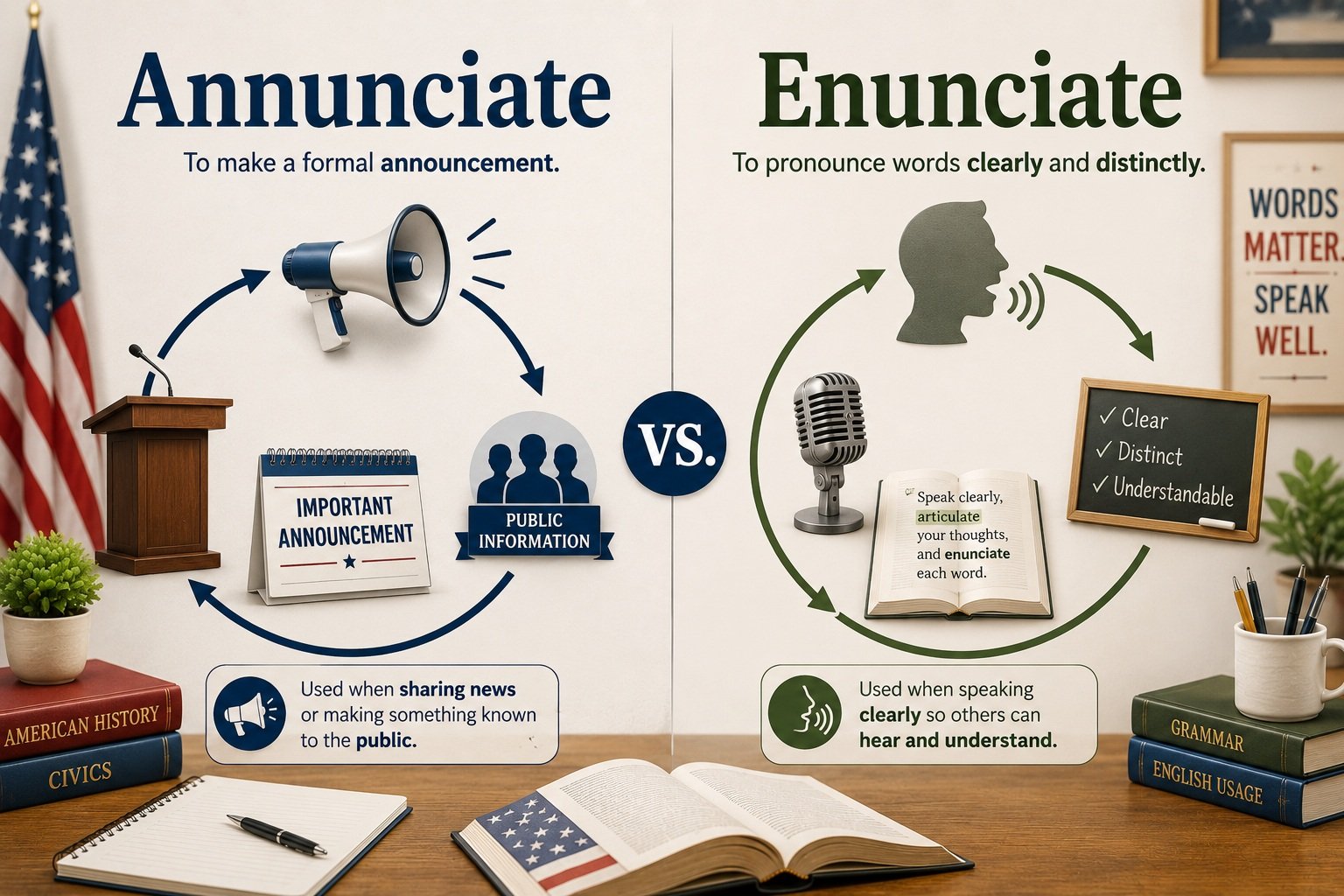
The easiest distinction is announcement versus articulation.
Annunciate concerns making something known. Enunciate concerns saying words clearly or expressing an idea precisely.
| Word | Main Meaning | Common American Context | Example |
| Annunciate | Announce or proclaim | Formal declarations | The leader annunciated the decision. |
| Enunciate | Pronounce clearly | Speaking and pronunciation | Please enunciate each word. |
| Enunciate | Express clearly | Ideas and arguments | She enunciated her position. |
| Announce | Make something known | Everyday communication | They announced the winner. |
The Fastest Rule
Ask yourself one question:
Am I announcing something, or am I speaking clearly?
If you’re announcing something, annunciate may be appropriate. If you’re talking about pronunciation, enunciate is the right choice.
Why Are Annunciate and Enunciate Confused?
These words confuse people because they share similar sounds and historical roots. Both are connected to the Latin verb nuntiare, meaning to report or announce.
Similar Sound, Different Meaning
In fast speech, the two words can sound almost alike. That makes the difference difficult to notice when you hear them rather than read them.
However, their modern meanings have separated.
Annunciate points toward announcing information. Enunciate usually points toward clear speech or precise expression.
A Common Mistake
A speaker might say:
Please annunciate your words.
That usage is usually a mistake when the intended meaning is “pronounce your words clearly.”
The better sentence is:
Please enunciate your words.
Likewise, enunciate shouldn’t automatically replace announce.
What Are the Historical Origins of Annunciate?
The history of annunciate reaches back through Medieval Latin to the Latin verb annuntiare. That verb carried the idea of announcing, reporting, or making something known.
Latin Roots
The Latin family behind annunciate is also connected with words such as announce and annunciation. The root ultimately relates to the idea of a messenger bringing news.
English later developed several related forms from these Latin and French traditions.
Annunciate appears in English by the 16th century, although related forms existed earlier. Its meaning stayed close to the idea of declaring or announcing something.
Religious History
The related noun Annunciation became especially important in Christian history. It refers to the biblical event in which the angel Gabriel announces to Mary that she will bear Jesus.
The term became associated with a major Christian feast observed on March 25.
That religious history gives annunciate a strong association with formal announcement in older texts.
However, the verb itself isn’t limited to religious writing. Its basic dictionary meaning remains “to announce.”
What Are the Historical Origins of Enunciate?
Enunciate also comes from Latin, but its immediate root is enuntiare. This carried meanings such as speaking out, expressing, declaring, or making something known.
From Speaking Out to Clear Speech
The word entered English with meanings related to declaring or expressing something. Later, its meaning developed toward clear articulation and pronunciation.
Merriam-Webster records its first known English use in 1623. The pronunciation-related sense appeared later, around the 18th century.
That shift explains why enunciate can still describe both speech clarity and clear expression today.
Why the Shared Root Matters
Both words grew from ancient ideas involving messages, speech, and communication.
Over time, however, English separated their jobs. Annunciate became associated with announcing. Enunciate developed a stronger connection with clear speech and precise expression.
Read More: Froze vs Frozen: The Simple Guide to Using Them Correctly for 2026
How Are These Words Used in American English?
American English strongly favors enunciate when discussing pronunciation. You’ll hear it in classrooms, workplaces, acting, broadcasting, presentations, and language learning.
Common Uses of Enunciate
• Asking someone to pronounce words more clearly
• Coaching actors on understandable dialogue
• Teaching students careful pronunciation
• Improving clarity during presentations
• Expressing an argument in precise language
By contrast, annunciate is relatively uncommon in casual American conversation. Most speakers simply use announce.
For example, Americans usually say:
The company announced its new product.
They’re less likely to say:
The company annunciated its new product.
The second sentence isn’t necessarily impossible. It simply sounds much more formal and unusual.
How Do You Use Annunciate in a Sentence?
Because annunciate is uncommon, context matters. It works best when the writer deliberately wants a formal tone.
Example Sentences
• The mayor annunciated the new initiative during the ceremony.
• The proclamation annunciated a major change in policy.
• The speaker annunciated the decision before the assembled crowd.
• The priest annunciated the message during the formal service.
In ordinary writing, though, announce will usually sound more natural.
When Annunciate Sounds Too Formal
Imagine telling a friend:
I’m going to annunciate the news.
That sounds stiff and unusual.
A natural American speaker would probably say:
I’m going to announce the news.
So, knowing a word’s dictionary meaning isn’t enough. You also need to understand how natural it sounds in modern conversation.
How Do You Use Enunciate in a Sentence?
Enunciate fits naturally when clarity of speech matters. It’s especially useful when pronunciation affects how well listeners understand you.
Example Sentences
• Please enunciate the final sentence.
• The actor enunciated every line clearly.
• She enunciated each name during the ceremony.
• The teacher asked students to enunciate carefully.
• He enunciated his main point during the debate.
The word can also describe written or spoken ideas.
For example:
The author enunciated a clear position on education.
Here, enunciate means expressing the position clearly rather than simply pronouncing words.
Is Annunciate or Enunciate Correct for Speaking Clearly?
If you mean speaking clearly, choose enunciate.
This is one of the most useful distinctions for American English learners. Dictionaries specifically define enunciate as saying or pronouncing words clearly.
Speech Example
Correct:
You need to enunciate your words.
Usually incorrect for this meaning:
You need to annunciate your words.
The second sentence changes the intended idea because annunciate means announcing something.
Think “Clarity”
When pronunciation is the issue, think:
Enunciate = clear articulation.
That simple connection will prevent most mistakes.
Annunciate vs. Enunciate in Public Speaking
Public speaking shows the difference particularly well. A speaker can announce something while also enunciating every word clearly.
One Action Can Include Both
Imagine a school principal speaking to students.
First, the principal announces a new school policy. That concerns the message being made known.
At the same time, the principal may enunciate every sentence carefully. That concerns how the message is spoken.
So, the two words aren’t competing descriptions of exactly the same action.
They can describe two different parts of one communication event.
Are Annunciate and Enunciate Pronounced the Same?
They are very close in pronunciation, which helps explain the confusion. The initial vowel distinguishes them in standard American pronunciation.
Annunciate is commonly pronounced roughly like uh-NUN-see-ate. Enunciate is roughly ee-NUN-see-ate.
Why Hearing Them Can Be Difficult
In normal conversation, unstressed sounds can become less distinct. As a result, the difference may seem smaller than it does in careful pronunciation.
That’s why spelling and context often help listeners identify the intended word.
Common Misunderstandings About These Words
The biggest misunderstanding is treating annunciate and enunciate as interchangeable.
They aren’t interchangeable in modern standard usage.
Watch for These Errors
• Using annunciate when asking someone to pronounce words clearly
• Assuming enunciate always means speaking slowly
• Replacing the everyday verb announce with annunciate unnecessarily
• Thinking similar pronunciation means identical meaning
Also, enunciate doesn’t strictly mean “speak loudly.” Someone can speak quietly while enunciating very clearly.
The key idea is clarity and precision, not volume alone.
How Have the Meanings Shifted Over Time?
Both words began with broader connections to declaring or communicating information. English gradually gave them more specialized modern roles.
Earlier Usage
Annunciate remained closely connected to announcing or proclaiming. Its relationship with annunciation also preserved a formal and religious flavor in some historical contexts.
Enunciate, meanwhile, moved from expressing or declaring ideas toward clear articulation and pronunciation.
Modern Usage
Today, enunciate is the practical word for pronunciation and speech clarity.
Annunciate survives, but it’s uncommon. In most everyday American situations, announce is the more natural alternative.
That difference is important because a grammatically possible word can still sound unusual to modern readers.
FAQs:
What is the main difference between annunciate and enunciate?
Annunciate is connected with announcing or declaring something, while enunciate means to pronounce or express words clearly.
Is “enunciate” related to pronunciation?
Yes. Enunciate is commonly used when talking about clear pronunciation and making your speech easy to understand.
Can I use “annunciate” when talking about speaking clearly?
Usually, no. If you mean speaking or pronouncing words clearly, enunciate is the better choice.
Why are annunciate and enunciate often confused?
They look and sound very similar, and both have roots connected to speaking or expressing something. Their modern meanings, however, are different.
What does annunciate mean?
Annunciate means to announce, declare, or make something known. It’s much less common in everyday English than enunciate.
What does enunciate mean?
Enunciate means to pronounce words clearly and carefully. It can also mean expressing an idea or statement clearly.
How can I remember the difference?
Think of annunciate as being related to announce, while enunciate is related to clear pronunciation. This simple connection can help you choose the right word.
Conclusion:
Understanding annunciate vs. enunciate becomes much easier once you focus on what you’re trying to say. Use annunciate when the idea is to announce or declare something, and use enunciate when you mean clear pronunciation or expression.
Although the words look and sound similar, their meanings and uses are different. Remembering this small distinction can help you speak and write with greater clarity and confidence.