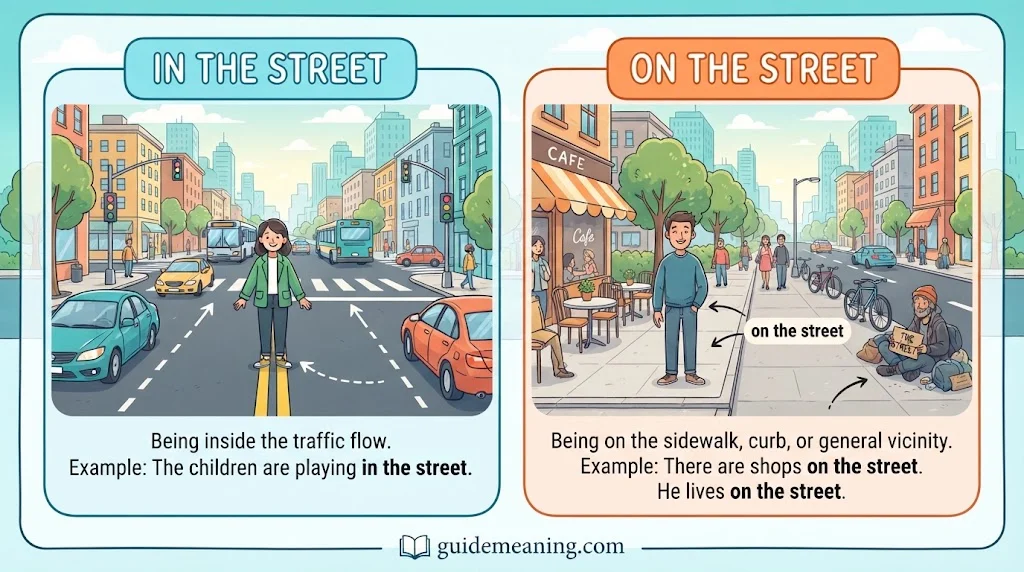

In the Street vs. On the Street helps you understand how a small preposition can change meaning and context in everyday English. Both phrases are correct English, but their different purposes and different nuances depend on whether you mean a general location, an address, or a physical position.
In American English, especially standard American English, on the street works naturally for a location phrase, address, everyday activity, or being near a street. “She lives on the street” gives a general location statement, while people walking along the street describes ordinary activity. By contrast, in the street places someone physically inside the roadway. If children are playing within the boundaries of the actual road, the phrase clearly shows that physical position. This difference creates useful visual logic: on suggests the surface or a position beside the street, while in suggests being inside it.
The preposition can completely change a sentence and its tone. Someone physically standing in the middle of the road may sound alarming because of traffic, while someone on the street may simply be nearby or involved in an activity. Getting it wrong can therefore make a sentence sound unnatural or change its intended meaning. Americans commonly use “on Main Street” for an address or position, while British English often uses in the street for physical street location. This reflects regional convention and social context, especially in specific situations.
For learners, a practical way to understand the difference is to compare real examples instead of relying on vague explanations. These tiny words aren’t always interchangeable, although they are sometimes used interchangeably in casual speech. To clearly grasp the distinction, remember that on the street often indicates surface placement, general presence, or an address, whereas in the street usually indicates a literal position within the roadway. This simple language guide gives you useful rules without fluff and makes idiomatic usage easier to understand quickly. Your choice can affect precision, urgency, and how readers interpret the sentence. Once you understand the pattern, knowing when to use each one becomes easier, and clear communication follows.
Let’s jump in!
Quick Answer: In the Street vs. On the Street
Both in the street and on the street are grammatically correct. The difference usually comes down to location, physical position, and regional usage.
In standard American English, use on the street when you mean that someone or something is located along a street or associated with a particular street. This is especially common with addresses, businesses, buildings, and general locations.
Use in the street when you want to emphasize that someone or something is physically within the street area, especially the roadway where vehicles travel.
| Phrase | General meaning | Typical American English use | Example |
| On the street | Along or associated with a street | Addresses, businesses, general location | “She lives on Oak Street.” |
| In the street | Within the street or roadway | People, vehicles, objects occupying the road | “A child was playing in the street.” |
A simple way to remember the difference is:
On the street usually identifies a location along the street.
In the street often places something physically within the street space.
There is an important regional wrinkle, though. British English commonly uses in the street in situations where American English often uses on the street.
What Does “On the Street” Mean?
On the street generally refers to a location along a street or to something associated with street life.
In American English, the phrase has a broad range of uses. You can use it to talk about where someone lives, where a business operates, where someone was seen, or where something is located.
For example:
- “I live on Maple Street.”
- “There’s a bakery on the street.”
- “I saw Sarah on the street yesterday.”
- “Several stores are located on Main Street.”
- “We found a small café on the street near the station.”
Notice that none of these sentences necessarily puts the subject in the middle of the roadway.
That’s the key point.
When you say someone lives on a street, you’re identifying the street connected with their home. When you say a business is on a street, you’re identifying its location.
Cambridge gives a natural example with Main Street, using the construction “on Main Street” for a business location.
Why “On” Works With Streets
The preposition on often expresses position along a surface, route, or line.
A street can function conceptually as a route. Buildings, businesses, homes, and other locations sit along that route.
That’s why these expressions sound natural:
- on Main Street
- on Oak Avenue
- on Fifth Street
- on Park Road
- on the corner
- on the street
Think of the street as a line running through a neighborhood. A building doesn’t normally sit inside the street. It sits along it.
That distinction becomes particularly important with addresses.
What Does “In the Street” Mean?
In the street usually emphasizes physical presence within the street itself.
In American English, this often means that a person, vehicle, animal, or object occupies the roadway.
For example:
- “The children were playing in the street.”
- “A truck stopped in the street.”
- “There’s a large branch in the street.”
- “Don’t stand in the street.”
- “The dog ran in the street.”
The phrase can create a stronger physical image than on the street.
If someone says, “There’s a man in the street,” you may picture him standing in the roadway. If someone says, “I saw a man on the street,” the location sounds broader. He might have been walking along the sidewalk, standing near a shop, or simply somewhere in the street environment.
Context fills in the details.
“In the Street” Often Suggests the Roadway
The distinction becomes especially clear when traffic is involved.
Compare:
A woman was standing on the street.
This gives you a general location.
Now compare:
A woman was standing in the street.
The second sentence more strongly suggests that she was standing in the roadway.
That difference can matter.
If you’re warning someone about a child near moving vehicles, in the street gives a more precise picture of the child’s position.
In the Street vs. On the Street: The Main Difference
The easiest way to understand in the street vs. on the street is to picture the physical setting.
On the street usually gives you the broader location.
In the street usually zooms in on the actual street space.
| Situation | More natural choice in American English | Reason |
| Someone lives along a named street | On the street | It identifies an address or location |
| A restaurant has a street address | On the street | The business is located along the street |
| A child is playing in the roadway | In the street | The child occupies the roadway |
| A fallen tree blocks traffic | In the street | The tree is physically in the road |
| Someone is walking along a street | Usually on the street | The phrase gives a general street location |
| A person is standing in traffic | In the street | The roadway is the important detail |
| A shop is located on Main Street | On Main Street | This is standard American usage |
The distinction isn’t an absolute mathematical rule. English prepositions depend heavily on how speakers frame a situation.
Still, this guideline works well:
Use “on” for the street as a location or route. Use “in” when the street itself is the physical space being occupied.
In the Street vs. On the Street for Addresses
One of the clearest rules involves street names.
In American English, you normally say:
- “I live on Main Street.”
- “The office is on Elm Avenue.”
- “She works on Fifth Street.”
- “There’s a bookstore on Market Street.”
You generally don’t say:
- “I live in Main Street.”
- “The office is in Elm Avenue.”
For American English, on + street name is the normal construction.
Cambridge’s dictionary examples likewise use on Main Street for a business location.
Why the Rule Can Be Confusing
The confusion comes from another common English pattern.
You say:
- in the city
- in the neighborhood
- in the building
- in the house
These places behave like containers or bounded areas.
A street works differently in the common American address pattern. English treats the street as a route or location line.
So:
I live in New York.
but:
I live on Main Street.
Both prepositions make sense because the two nouns represent different kinds of locations.
In the Street vs. On the Street for Walking
Walking provides one of the most useful examples of this difference.
Consider:
I was walking on the street.
In American English, this can describe being out on or along a street. Depending on context, the speaker could mean the general street area.
Now consider:
I was walking in the street.
This more strongly suggests that the person was walking within the roadway.
That distinction becomes even clearer in a safety-related sentence:
Don’t walk in the street when there’s a sidewalk available.
Here, in the street clearly identifies the roadway as the location.
However, regional habits matter. British English frequently uses in the street more broadly than American English does. Cambridge examples include British usage such as someone being bumped into in the street.
So don’t treat every occurrence of in the street as proof that someone stood in traffic.
The variety of English matters.
In the Street vs. On the Street With Cars
Vehicles make the distinction particularly useful.
“The car is on the street.”
This can simply mean the car is parked or located along the street.
For example:
“My car is parked on the street outside my house.”
The sentence doesn’t necessarily suggest a problem.
“The car is in the street.”
This can suggest that the vehicle is physically in the roadway, especially if the context involves stopping, blocking, or obstructing traffic.
For example:
“A broken-down car is sitting in the street.”
Now the roadway itself becomes important.
A Practical Comparison
| Sentence | Likely interpretation |
| “The car is on the street.” | The car is located or parked along the street |
| “The car is in the street.” | The car is physically occupying the roadway |
| “A truck stopped in the street.” | The truck stopped in the traffic area |
| “There are cars parked on the street.” | Cars are parked along the street |
The context can still change the exact interpretation. English isn’t a collection of rigid mathematical formulas.
In the Street vs. On the Street With Objects
The same distinction applies to objects.
Consider a fallen tree branch.
“There’s a branch in the street.”
This suggests that the branch is lying in the roadway.
Now consider:
“There’s a sign on the street.”
This sounds like a sign located along the street.
The object itself doesn’t determine the preposition. Its relationship with the street does.
More Examples
In the street:
- A fallen tree
- A damaged traffic barrier
- A basketball
- A stray dog
- A stalled vehicle
- A large puddle
On the street:
- A storefront
- A street sign
- A parked car
- A vendor
- A restaurant
- A house
These aren’t absolute rules. A parked car can certainly be described differently depending on the speaker’s intended focus.
In the Street vs. On the Street for People
People create even more interesting differences.
Compare these sentences:
“I met him on the street.”
This sounds like you encountered him while you were out in the street area.
Now:
“I saw him standing in the street.”
This gives a much more specific physical picture. He appears to be standing in the roadway.
Here’s another pair:
“The protesters were on the street.”
This can describe their general public presence.
“The protesters were in the street.”
This can emphasize that they occupied the roadway.
The verb matters, but the speaker’s intended picture matters even more.
Read More: Swap vs. Swop: Meaning, Usage, and the Difference Explained for 2026
In the Street vs. On the Street for Playing
Children provide a classic example:
The kids are playing in the street.
In American English, this normally suggests that the children are playing in the roadway.
Now compare:
The kids are playing on the street.
This can be understood, but many American speakers would choose in the street when they specifically mean that the children are playing in the road.
However, British English commonly uses in the street for ordinary street activity. Regional convention can therefore influence what sounds most natural.
The important lesson is simple:
Don’t assume that every preposition choice has exactly the same meaning in every English-speaking region.
In the Street vs. On the Street in American and British English
Regional English deserves special attention because it explains many apparent contradictions.
American English commonly uses on the street for general location and addresses:
“She lives on King Street.”
British English can use in the street for broader street location:
“There were several people in the street.”
This doesn’t necessarily mean the British speakers believe those people were standing in traffic.
Oxford-related usage research discussed by Grammarphobia notes that in is standard with street-location constructions in Britain while on is standard in North America. The same source also notes regional and Irish British usage of on.
Cambridge also explicitly marks some expressions as regional. For example, “the man/woman in the street” is marked UK, while the American form is “the man/woman on the street.”
This is a useful reminder that grammar isn’t always a single global rule.
American vs. British Pattern
| Meaning | American English | British English |
| General street location | Often on the street | in the street is common |
| Named street address | on Main Street | on is also used, though in the High Street is traditional/common |
| People in roadway | in the street | in the street |
| Ordinary person idiom | man/woman on the street | man/woman in the street |
The regional distinction doesn’t mean one variety is grammatically superior. It means speakers have developed different conventional patterns.
“At the Street”: Is It Correct?
You may also wonder about at the street.
This expression isn’t normally interchangeable with in the street or on the street.
At generally points to a particular location or point.
For example:
- “Meet me at the street corner.”
- “She is waiting at the intersection.”
- “He stopped at the traffic light.”
You might hear at the street in a context where speakers have already identified a particular street as a meeting point. However, it isn’t the normal choice for giving a street address.
Compare:
“I live on Main Street.”
with:
“Meet me at the corner of Main Street and Oak Avenue.”
The first identifies a street location. The second identifies a specific point.
Common Expressions With “On the Street”
The phrase on the street also appears in several expressions where its meaning extends beyond simple physical location.
On the Street as a General Location
“I saw her on the street yesterday.”
The phrase identifies the general setting.
On the Street as Public Life
“Street vendors sell food on the street.”
Here, the phrase refers to activity occurring in public street spaces.
On the Street as Homelessness
“He spent several months on the street.”
In this context, on the street can mean living without stable housing.
Word on the Street
The expression word on the street means information or rumors circulating among ordinary people.
This is an idiomatic use, so you shouldn’t interpret it literally.
English has several expressions built around street imagery. Cambridge lists idioms such as “the man/woman on the street” and “on the streets.”
Common Expressions With “In the Street”
In the street also appears in literal and idiomatic expressions.
Common examples include:
- in the street
- out in the street
- in the middle of the street
- people in the street
- playing in the street
- standing in the street
- dancing in the street
The exact meaning depends on context and dialect.
For example:
“People were dancing in the street.”
In American English, this can suggest that the dancing took place within the roadway or public street area.
The phrase can also become part of a broader expression. Cambridge records “the man/woman in the street” as a British English idiom meaning an ordinary or average person.
Common Mistakes With In the Street vs. On the Street
Mistake: Using “In” With an American Street Address
A common error is:
❌ “I live in Main Street.”
For standard American English, use:
✅ “I live on Main Street.”
This is one of the easiest rules to remember.
Mistake: Assuming “On the Street” Always Means the Roadway
Not necessarily.
If someone says:
“There’s a restaurant on the street.”
they’re identifying a location. They aren’t necessarily saying that the restaurant occupies the traffic lanes.
Mistake: Assuming “In the Street” Is Always Wrong
It isn’t.
In the street is completely grammatical and very common when something occupies the street space.
For example:
“A dog ran in the street.”
That’s a natural sentence.
Mistake: Ignoring Regional English
A sentence that sounds slightly unusual to an American speaker may sound completely ordinary to a British speaker.
For international writing, identify the intended variety of English before judging a preposition as wrong.
Case Study: Why One Preposition Changes the Picture
Imagine a child near a busy road.
Sentence A:
The child was on the street.
The listener receives a broad location. The child could be walking along the sidewalk or somewhere near the street.
Sentence B:
The child was in the street.
Now the listener is more likely to imagine the child in the roadway.
That difference could matter in a news report, safety warning, story, or conversation.
The preposition doesn’t merely make the sentence grammatically acceptable. It helps control the spatial picture inside the reader’s mind.
That’s why choosing between in the street vs. on the street is more than a tiny grammar exercise.
How Verb Choice Affects In the Street vs. On the Street
Some verbs naturally create different expectations.
| Verb | Example | Likely meaning |
| live | “She lives on Main Street.” | Address |
| park | “He parked on the street.” | Vehicle parked along street |
| stand | “He stood in the street.” | Physical roadway position |
| play | “The children played in the street.” | Activity within street space |
| walk | “She walked on the street.” | General street location |
| block | “A truck was in the street.” | Roadway obstruction |
| work | “He works on the street.” | General street-based activity |
| run | “The dog ran in the street.” | Movement through roadway |
These patterns aren’t unbreakable rules.
For example, a person might say “I walked in the street” because there was no sidewalk. Likewise, someone could say “I saw him on the street” without specifying whether he was on the sidewalk or roadway.
Context always has the final say.
A Simple Memory Trick for In the Street vs. On the Street
Use this mental picture:
ON = along the street
IN = within the street space
Imagine a map.
A house sits on Main Street.
Now imagine a basketball rolling into the roadway.
The basketball is in the street.
That distinction gives you a useful starting point:
On the street = location along the street.
In the street = physical presence within the street space.
However, don’t force the rule onto every sentence. Regional English and idiomatic expressions can override the simple spatial picture.
Quick Comparison: In the Street vs. On the Street
| Feature | In the Street | On the Street |
| Basic idea | Within the street space | Along or associated with the street |
| American English | Often roadway-specific | Very common for general location |
| Addresses | Usually not used | Standard choice |
| Traffic context | Very common | Possible, but broader |
| Businesses | Less typical | Common |
| Named streets | Not normally used for US addresses | Standard |
| Playing | Often emphasizes roadway | Can be used depending on context |
| Standing | Can emphasize roadway | Can describe general location |
| British English | Broad street-location use is common | Also used in many contexts |
How to Choose Between In the Street and On the Street
When you’re unsure, ask yourself what you actually want the reader to picture.
Ask: Is It an Address?
Use on.
“The clinic is on Jefferson Street.”
Ask: Is It Along or Associated With the Street?
Use on in typical American usage.
“There’s a coffee shop on the street.”
Ask: Is Something Physically Inside the Roadway?
Use in.
“A fallen tree is in the street.”
Ask: Is Traffic Being Blocked?
In often gives the clearest meaning.
“A delivery truck is blocking traffic in the street.”
Ask: Is the Sentence British English?
Consider whether in the street is the conventional regional choice for a general street location.
This quick decision process works better than memorizing dozens of isolated examples.
Practice: In or On the Street?
Choose the correct preposition for each sentence in standard American English.
Example One
The children were playing ___ the street.
Answer: in
“The children were playing in the street.”
The sentence emphasizes their physical presence within the street area.
Example Two
She lives ___ Main Street.
Answer: on
“She lives on Main Street.”
This is the standard American address construction.
Example Three
A tree branch fell ___ the street.
Answer: in
“A tree branch fell in the street.”
The branch is physically occupying the roadway.
Example Four
The restaurant is ___ Oak Avenue.
Answer: on
“The restaurant is on Oak Avenue.”
The phrase identifies the restaurant’s street location.
Example Five
Don’t stand ___ the street.
Answer: in
“Don’t stand in the street.”
The sentence emphasizes the roadway and carries a clear safety implication.
FAQs:
Is “in the street” or “on the street” correct?
Both “in the street” and “on the street” are correct. The right choice depends on what you mean. On the street commonly describes a general location, address, or activity near or along a street. In the street usually means physically within the roadway.
What does “on the street” mean?
On the street can describe someone’s general location, an address, or activity happening along a street. For example, “She lives on the street” describes where she lives, while “People are walking on the street” describes their location or movement.
What does “in the street” mean?
In the street usually means being physically inside the roadway. For example, “The children are playing in the street” suggests that the children are in the road rather than simply near it.
Do Americans say “on the street”?
Yes. American English commonly uses on the street for street locations and addresses. For example, Americans normally say “The restaurant is on Main Street” when identifying its location.
Do British speakers use “in the street”?
Yes. British English commonly uses in the street when referring to someone’s physical location in a street. Regional usage can differ, so the preferred preposition isn’t always identical across varieties of English.
Can “in the street” and “on the street” be used interchangeably?
Sometimes they can be understood similarly, especially in casual conversation. However, they aren’t always interchangeable. In the street emphasizes being within the roadway, while on the street often refers to a general location, surface, or position along a street.
How can I remember the difference between “in the street” and “on the street”?
Think about the physical picture. In the street suggests being inside the roadway, while on the street usually suggests being on or along the street. This simple distinction can help you choose the right preposition quickly.
Conclusion:
In the street and on the street are both useful English expressions, but they don’t always communicate the same idea. On the street is common for general locations, addresses, and everyday activity, especially in American English. In the street more strongly suggests a physical position within the roadway and is also common in British English for street location.
The key is to focus on meaning, context, and regional usage rather than memorizing one fixed rule. Once you picture whether someone is on or along the street or actually within the road, choosing the correct preposition becomes much easier.



1 thought on “In the Street vs. On the Street: Meaning, Difference, and Correct Usage for 2026”