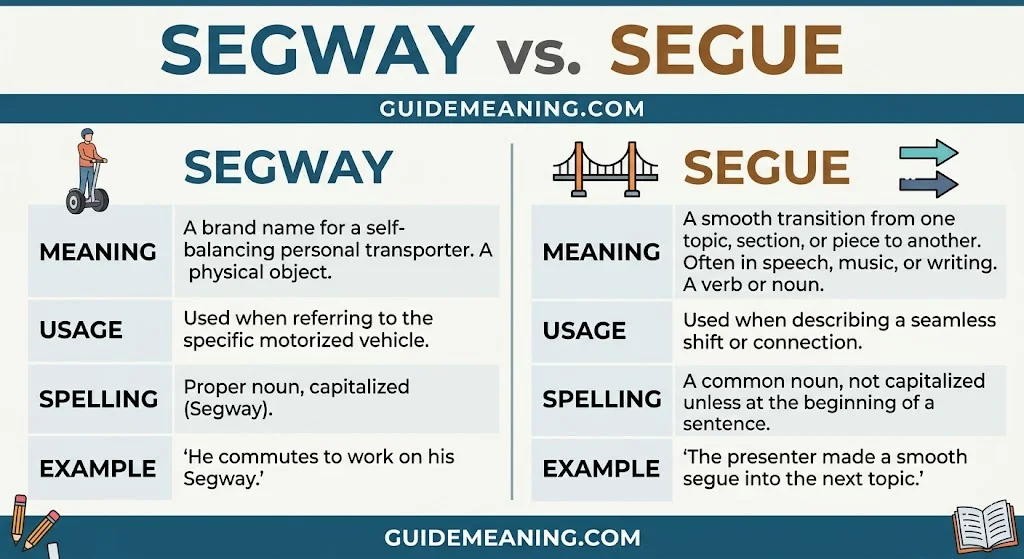

The Segway vs. Segue guide shows how two similar words can cause confusion, while clear context helps readers choose the right term with ease. These English word pairs may sound identical and look similar, but they describe completely different things. In writing, speech, blogs, speeches, marketing copy, captions, and professional articles, this mix-up can affect readers and credibility. Segway is a brand name for a self-balancing scooter, while segue means to move smoothly from one topic, idea, subject, or situation to another. A proper noun with a capital S, Segway can describe a two-wheeled, personal vehicle or personal transportation device, while segue works as a noun or verb for a smooth transition. This simple distinction removes the fog, reduces hesitation, and helps people use each word correctly without having to second-guess the right word.
The origins, practical usage, and examples make the difference easier to remember. Cambridge gives /ˈseɡ.weɪ/ for Segway, while the identical pronunciation of segue explains why the spelling difference feels tricky. A Futuristic Segway from a transportation brand can be used for riding through a city or park, while an elegant word borrowed from music describes a section or transition that moves without a sharp pause. The classic example is a speaker who can segue from one topic to another, moving smoothly toward the next topic, rather than using the vehicle name. Experienced writers can still make mistakes when something looks fine, sounds right, but feels off. A short check can fix errors, keep the meaning clear, and help writers learn how each term works in every context.
The flip side is that knowing these different purposes helps avoid mix-ups, an awkward spelling mistake, and confusing situations in conversations and articles. The words may sound alike, sound similar, or sound the same, yet they mean different things. Think of them as distant cousins at family reunions: related in sound, but separate in meaning and use. A slip of the tongue may send a sentence down the wrong turn, while the right word keeps the intended meaning on the proper path. Synonymous terms are not interchangeable here. Personal transporters and a vehicle may be zoomed around a city, but a segue describes a change from one part of a discussion to another activity or idea. In modern English, this distinction becomes easier to recognize naturally once you notice the different contexts in which each word appears today.
Let’s jump in!
Quick Answer:
The easiest way to remember the difference is this:
- Segue means a smooth transition from one thing to another.
- Segway is a brand name associated with personal transportation products.
- Segue can function as both a noun and a verb.
- Segway is used as a proper name for the brand and its products.
- Both words are pronounced essentially the same in American English.
| Word | Meaning | Common Use | Example |
| segue | A smooth transition | Topics, conversations, music, stories, scenes | “That question is a good segue into our next topic.” |
| Segway | A personal transportation brand | Transportation and related products | “The tourists took a Segway tour.” |
So if you’re writing “Let’s segway into the next topic,” change it to “Let’s segue into the next topic.”
On the other hand, “They rented Segways for the tour” uses the brand name correctly.
The key isn’t pronunciation. Meaning determines the spelling.
What Does “Segue” Mean?
Segue describes a smooth or uninterrupted movement from one thing to another. You might use it when discussing a conversation, presentation, story, piece of music, movie scene, or even a change in activity.
Cambridge defines segue as moving easily and without interruption from one piece of music, part of a story, subject, or situation to another. It also recognizes segue as both a verb and a noun.
Think of a segue as a bridge between two ideas.
For example:
“That question gives us a natural segue into the next topic.”
The speaker isn’t physically moving from one place to another. Instead, the conversation moves smoothly from one subject to another.
You might also write:
- “The host segued into a discussion about education.”
- “The final scene segues into the opening scene.”
- “That example provides a useful segue into the next section.”
- “The song segues into the next track without a pause.”
In each example, segue describes a transition.
Segue as a Verb
As a verb, segue means to move smoothly from one subject, activity, or part to another.
For example:
“After discussing grammar, the teacher segued into pronunciation.”
Here, segues or segued describes the action of making the transition.
Common patterns include:
- segue into a topic
- segue to another subject
- segue from one subject to another
For example:
“The presenter segued from the introduction into the main discussion.”
The transition doesn’t need to be perfectly seamless. The important idea is that one subject or part leads naturally into another.
Segue as a Noun
Segue can also work as a noun. In this form, it refers to the transition itself.
For example:
“That was a smooth segue into the main argument.”
Here, the word segue names the transition.
Other examples include:
- “The interview had an awkward segue between topics.”
- “The final paragraph creates a natural segue into the conclusion.”
- “That joke provided the perfect segue into the next question.”
The noun is especially useful when you want to describe how one part connects to another.
What Does “Segway” Mean?
Segway is a brand name associated with personal transportation products. The company traces its origins to 1999 and describes Segway as a pioneer in self-balancing personal transportation.
The company’s official history states that the Segway Human Transporter was unveiled in 2001 and that the Segway Personal Transporter later became a standard name for its self-balancing products.
So when you’re talking about the product or brand, Segway is the appropriate term.
For example:
- “We rented a Segway for the city tour.”
- “The guide explained how to operate the Segway.”
- “Several tourists were riding Segways.”
- “The company sells several personal transportation products.”
The capitalization matters because Segway functions as a brand name.
Today, Segway-Ninebot has a much broader product portfolio that includes eKickScooters, eBikes, eScooters, self-balancing vehicles, off-road vehicles, and other mobility products.
However, you don’t need to associate every modern Segway product with the original self-balancing transporter. The important point for this grammar question is simple: Segway refers to the brand, while segue refers to a transition.
Segue vs. Segway: The Key Differences
Although segue and Segway sound alike, their meanings live in completely different worlds.
| Feature | Segue | Segway |
| Meaning | A smooth transition | A personal transportation brand |
| Word class | Noun and verb | Proper name/brand |
| Main context | Language, music, stories, conversations | Transportation and mobility |
| Capitalization | Usually lowercase | Capitalized as a brand |
| Pronunciation | /ˈseɡ.weɪ/ | Similar pronunciation |
| Example | “She segued into another topic.” | “He rode a Segway.” |
This is a classic case where sound alone can’t tell you the correct spelling.
Imagine hearing someone say:
“Let’s segue into the next question.”
If you’ve never seen the word written before, you might reasonably assume they said segway. English spelling doesn’t always behave like a neat mathematical equation. Sometimes you have to learn the written form separately from the sound.
That’s exactly what happens here.
Why Do People Confuse “Segway” and “Segue”?
The biggest reason is simple: they sound alike.
Cambridge lists the US pronunciation of segue as /ˈseɡ.weɪ/.
That pronunciation naturally makes the spelling Segway seem plausible. After all, English speakers already recognize way as a common spelling pattern.
The problem becomes especially noticeable when someone learns the word by hearing it rather than reading it.
For example, imagine someone hears a podcast host say:
“That segues nicely into our next question.”
If the listener has never encountered the written word, they might later type:
“That segways nicely into our next question.”
The meaning is clear. The spelling isn’t.
This is why segue vs. Segway is less about grammar rules and more about vocabulary, spelling, and context.
How Do You Pronounce “Segue”?
In US English, segue is pronounced /ˈseɡ.weɪ/. Cambridge gives the same basic pronunciation for both UK and US English.
That means the word sounds like Segway.
This creates an interesting spelling trap. You can’t reliably hear the difference because there usually isn’t a meaningful pronunciation difference between the two words in ordinary American English.
Instead, look at the meaning.
If you’re describing a transition:
“The conversation segued into politics.”
Use segue.
If you’re referring to the brand:
“They rode Segways through the park.”
Use Segway.
Pronunciation tells you how to say the word. Context tells you how to spell it.
Segue in Music, Conversation, and Writing
The word segue isn’t limited to casual conversations. It has a broad range of uses because transitions happen everywhere.
Segue in Music
Music provides one of the clearest examples.
A song can move directly into another song or musical section without a noticeable break. That movement is a segue.
For example:
“The final notes of the first song segue into the next track.”
This use fits the dictionary meaning particularly well because the music itself transitions from one part to another.
Cambridge specifically includes movement between pieces of music among the established uses of segue.
Segue in Conversation
In everyday speech, a segue helps connect subjects.
Suppose two friends are discussing a new restaurant. One person says:
“Speaking of restaurants, have you tried the new Italian place downtown?”
That question creates a natural transition to another restaurant-related topic.
You could describe it as a segue.
In professional settings, the word appears frequently in:
- interviews
- presentations
- meetings
- podcasts
- speeches
- television programs
- panel discussions
For example:
“That brings us to our next topic.”
That’s a verbal transition. You could also describe it as a segue.
Segue in Writing
Writers use segue when one idea flows into another.
For example:
“The first section explains the problem. It then provides a natural segue into possible solutions.”
This usage is particularly useful when discussing the structure of an essay, article, report, or presentation.
Still, don’t force the word into every transition. Sometimes transition, move, or shift is clearer.
For example:
“Let’s move to the next section.”
That’s perfectly natural. You don’t need to say:
“Let’s segue to the next section.”
Both work, but the simpler option may fit better in casual writing.
Read More: Sustain vs Substain: Which Spelling Is Correct? 2026
How to Use “Segue” Correctly in a Sentence
The most useful way to understand segue is to study its common sentence patterns.
“Segue Into”
Segue into means to transition smoothly into something.
Examples:
- “The speaker segued into the main argument.”
- “The discussion segued into a debate about education.”
- “Her answer segued into a broader conversation about technology.”
This is one of the most common constructions.
“Segue To”
You can also use segue to when describing a transition toward another topic or subject.
Examples:
- “Let’s segue to the final question.”
- “The presentation segued to the next section.”
- “The conversation eventually segued to travel.”
The exact preposition can depend on the sentence and intended relationship. The core meaning remains the same: moving smoothly from one point to another.
“Segue From”
Use segue from to identify where the transition begins.
For example:
“The speaker segued from the history of the company into its future plans.”
This structure becomes especially useful when you want to identify both sides of the transition.
“A Smooth Segue”
As a noun, segue often appears with descriptive adjectives.
Examples include:
- a smooth segue
- a natural segue
- an easy segue
- an awkward segue
- a perfect segue
For example:
“That example creates a smooth segue into the next section.”
The phrase makes the transition itself the focus.
Segue Verb Forms: Segue, Segues, Segued, and Segueing
Because segue is also a verb, its forms can cause another small spelling headache.
| Form | Use | Example |
| segue | Base form | “We can segue into the next topic.” |
| segues | Third-person singular present | “She segues into another subject.” |
| segued | Past tense/past participle | “He segued into a discussion of music.” |
| segueing | Present participle/gerund | “She is segueing into the final point.” |
These forms may look strange at first.
Segued is especially easy to overlook because many readers aren’t accustomed to seeing it. Yet it follows the normal pattern for the verb.
For example:
“The discussion segued into a conversation about education.”
And:
“The host is segueing into the final segment.”
The spelling preserves the recognizable segue form rather than turning the word into segway.
Common Mistakes With Segway and Segue
The most common mistake occurs when someone uses segway to mean a transition.
Incorrect
“Let’s segway into the next topic.”
Correct
“Let’s segue into the next topic.”
Another common error is treating segway as a normal lowercase English spelling for a transition.
Incorrect
“The speaker made a smooth segway into the next subject.”
Correct
“The speaker made a smooth segue into the next subject.”
However, don’t conclude that Segway itself is incorrect.
That’s an important distinction.
Correct Brand Usage
“The tourists rented Segways.”
Here, Segway is being used in its transportation sense.
So the rule isn’t:
“Segway is always wrong.”
The better rule is:
Use segue for a transition. Use Segway for the brand.
Segue vs. Segway Examples
Examples make the distinction much easier to remember.
Examples With “Segue”
Conversation:
“That question gives us a natural segue into the next subject.”
Presentation:
“The final slide provides a segue into our recommendations.”
Writing:
“The discussion of grammar creates a useful segue into punctuation.”
Music:
“The first track segues into the second without a pause.”
Film:
“The final scene segues into a flashback.”
Career or activity change:
“She eventually segued from teaching into publishing.”
Each example describes a transition.
Examples With “Segway”
Transportation:
“The tourists rode Segways through the historic district.”
Tour:
“The guide led a Segway tour around the city.”
Product reference:
“The company developed its personal transportation technology under the Segway brand.”
Here, the word refers to transportation products or the brand, not a transition between ideas.
A Side-by-Side Example
Consider these two sentences:
“The host segued into a discussion about travel.”
“The visitors rode Segways during the city tour.”
The first sentence describes a change in subject.
The second describes a means of transportation.
One letter pattern may cause confusion, but the contexts couldn’t be more different.
An Easy Way to Remember Segue vs. Segway
Don’t memorize a complicated rule. Use the meaning.
Segue = transition.
Segway = transportation brand.
Here’s a quick memory test:
Are you moving from one idea to another? Use “segue.”
Are you talking about the transportation brand? Use “Segway.”
You can also remember it this way:
Ideas segue. People ride Segways.
That’s short enough to stick.
For example:
- “The speaker segues from history to science.”
- “The tourists ride Segways through the park.”
If your sentence contains a topic, subject, story, song, scene, or idea that changes into another one, segue is almost certainly the word you need.
Is “Segway” Ever Correct?
Yes.
This point deserves attention because calling Segway simply “wrong” would be inaccurate.
Segway is a legitimate brand name. The official company describes Segway as a personal transportation brand and traces the company’s origins to 1999.
The company has since expanded beyond the original personal transporter into a broad mobility and technology portfolio. Its current product categories include eKickScooters, eBikes, eScooters, self-balancing vehicles, off-road vehicles, and other products.
Therefore:
“They bought a Segway.”
can be correct when the sentence refers to the brand or its products.
But:
“Let’s segway into the next topic.”
is not the standard spelling for the transition meaning.
The distinction is based on what you mean, not simply which spelling you prefer.
Segue vs. Segway in American English
For US English readers, there is no need to treat segue and Segway as competing regional spellings.
They have different meanings.
Segue is the English word used for a transition. Segway is the brand name.
That’s why replacing one with the other can change the meaning entirely.
Consider:
“The presenter made a smooth segue into the next topic.”
The reader understands that the presenter transitioned between subjects.
Now compare:
“The presenter made a smooth Segway into the next topic.”
The second sentence looks incorrect because the brand name doesn’t fit the intended meaning.
This isn’t a British-versus-American spelling issue. It’s a word-choice issue.
Segway vs. Segue: At-a-Glance Usage Guide
When you’re unsure, use this quick guide:
| If you mean… | Use |
| Moving from one topic to another | segue |
| Changing subjects smoothly | segue |
| Moving from one song to another | segue |
| Transitioning between scenes | segue |
| Connecting two ideas | segue |
| A transition itself | segue |
| A personal transportation brand | Segway |
| A Segway tour | Segway |
| A Segway product | Segway |
A Simple Decision Test
Ask yourself one question:
“Am I describing a transition or a transportation brand?”
If you’re describing a transition, choose segue.
If you’re referring to the brand, choose Segway.
That’s the whole distinction.
A Practical Case Study: “Segway Into the Next Topic”
Imagine you’re preparing a presentation about workplace communication.
You finish discussing email etiquette and want to introduce meetings.
You write:
“Now, let’s segway into meeting etiquette.”
At first glance, the spelling may look reasonable. After all, that’s exactly how the word sounds.
But the correct version is:
“Now, let’s segue into meeting etiquette.”
Why?
Because you’re describing a transition between topics.
Now imagine that your presentation includes a sentence about a company tour:
“Visitors can explore the campus on a Segway.”
Here, you’re talking about transportation. Therefore, Segway is appropriate.
This simple comparison demonstrates why context matters more than sound.
Why “Segue” Has Such an Unusual Spelling
The spelling of segue can seem odd because English speakers may expect the pronunciation to follow familiar spelling patterns.
The word comes from Italian musical terminology. English adopted it as a term for moving smoothly from one musical section or piece to another. Over time, its use expanded beyond music into stories, conversations, presentations, and other contexts.
That history helps explain why the spelling doesn’t look as intuitive as its pronunciation.
You don’t pronounce it by sounding out every letter in the way a beginner might expect. Instead, the established English pronunciation is /ˈseɡ.weɪ/.
In other words, segue is one of those words where seeing and hearing it can feel like two different puzzles.
Once you learn the spelling, though, the distinction becomes much easier.
When Should You Use “Segue” Instead of “Transition”?
The two words can overlap, but they don’t always create the same tone.
Transition is broad and straightforward.
Segue often emphasizes a smooth or connected movement between two things.
Compare:
“The article transitions from history to modern usage.”
and:
“The article segues from history into modern usage.”
Both sentences communicate movement between topics. The second one gives slightly more emphasis to the flow between the two parts.
In formal writing, transition may sometimes be the plainer choice. In discussions about media, presentations, music, interviews, and conversational flow, segue can be especially natural.
Don’t use the fancier word simply because it sounds sophisticated. Choose the word that fits the sentence.
FAQs:
What is the difference between Segway and segue?
Segway is a brand name for a self-balancing personal transportation device, while segue means to move smoothly from one topic, idea, or subject to another.
Why are Segway and segue often confused?
They have similar pronunciations and can sound identical in speech, even though their spelling, meaning, and purpose are completely different.
Is Segway a proper noun?
Yes. Segway is a proper noun because it is a transportation brand name. It is normally written with a capital S.
What does segue mean?
Segue means a smooth transition from one topic, idea, section, or situation to another. It can be used as both a noun and a verb.
Is “segway into the next topic” correct?
No. When you mean a smooth change from one topic to another, the correct word is segue, not Segway.
How can I remember the difference?
Think of Segway as a vehicle and segue as a transition. One involves personal transportation, while the other involves moving smoothly between ideas.
Can experienced writers confuse Segway and segue?
Yes. Because the words sound alike, even experienced writers can make this mistake. Checking the context before using either word can prevent an awkward error.
Conclusion:
The difference between Segway and segue is simple once you connect each word with its purpose. Segway refers to the transportation brand and vehicle, while segue describes a smooth transition in writing, speech, music, or conversation. Remembering this distinction can help you avoid common spelling mistakes and choose the correct word naturally.




1 thought on “Segway vs. Segue: Which Is Correct? Meaning, Difference, and Examples 2026”