
Jewel vs. Joule confuses English learners, students, and writers because these words sound alike, yet their spellings and meanings differ completely in everyday English.
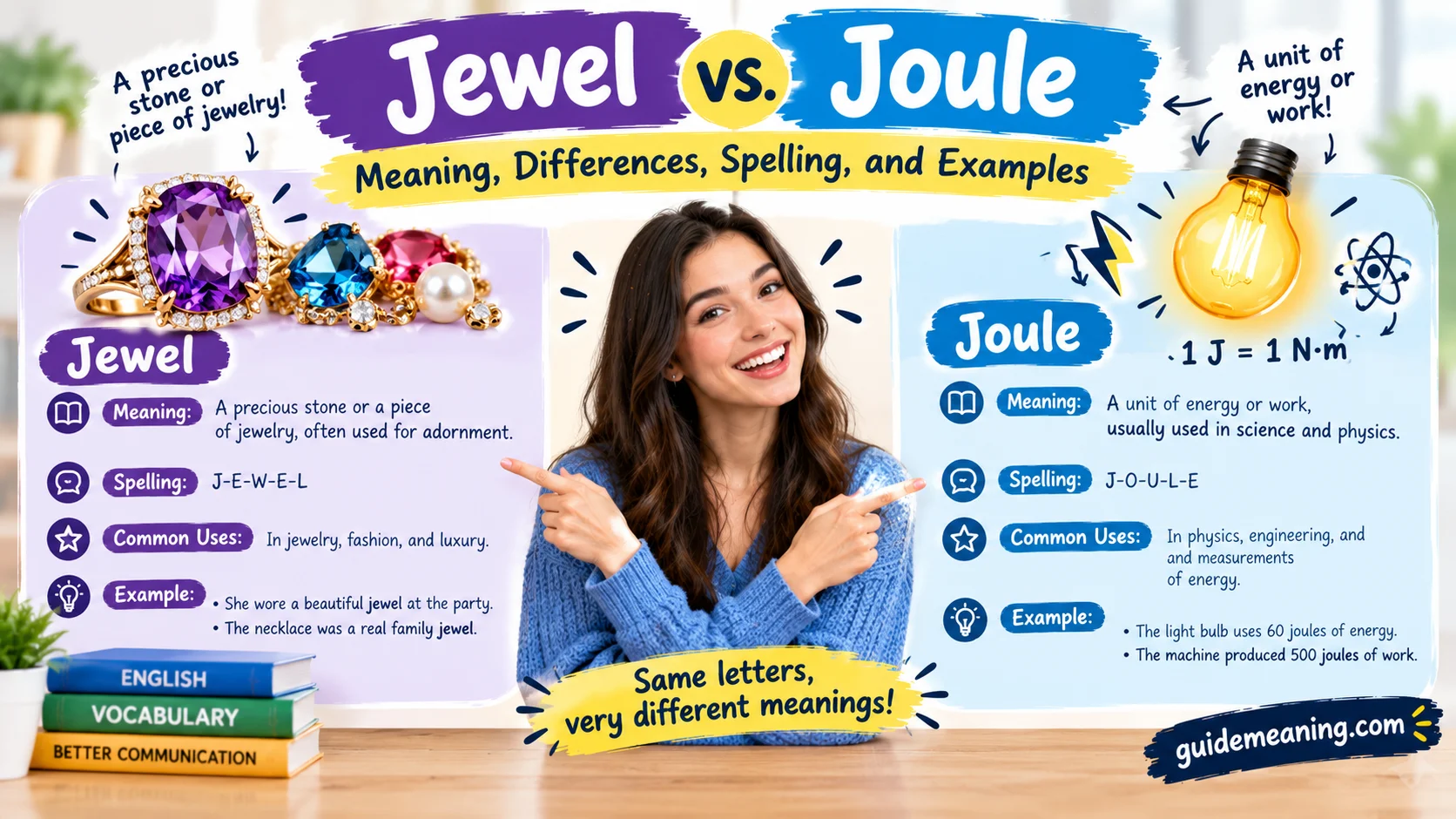
A jewel refers to a precious stone, gem, diamond, diamond ring, or other valuable object associated with beauty, fashion, luxury, and decoration. It may contain valuable gems or precious stones. A joule, however, is a scientific term and an SI unit in the International System of Units. It measures energy, work, and heat in physics, engineering, electricity, and other scientific subjects. This difference makes jewel and joule a classic homophone pair. Their similar pronunciation creates confusion in speech and writing, especially when you hear the words without seeing their spellings. Although they share the j sound and the sound /dʒuː/, jewel usually ends with an additional vowel sound, while joule has one syllable. Understanding these distinctions helps you use both terms correctly.
Grammar, vocabulary, and context help learners understand the completely different meanings of these words. For example, lifting a small apple one meter from the ground helps explain energy measurement, while a beautiful jewel may appear in a ring or other valuable objects. A machine might use 500 joules of energy. In my experience with education and editing, a tiny spelling mistake can change a sentence’s meaning and create confusion. I once noticed this misunderstanding in an assignment where the energy unit replaced a precious stone. The mistake changed the overall context and made the sentence confusing. Word comparison, semantic study, linguistic study, and pronunciation review help learners recognize this distinction and use both terms correctly in real sentences. When reading science lessons, writing about jewelry, speaking English, or studying for an exam, always consider whether the context relates to fashion terminology or energy measurement.
Let’s dive in!
Quick Answer:
Jewel is a noun that refers to a precious stone, a decorative object, or something considered especially valuable. It can also function as a verb meaning to decorate something with jewels.
Joule is a noun that names the International System of Units (SI) unit of energy and work. Scientists, engineers, and students use joules to describe energy transfers, mechanical work, heat, and electrical energy.
For example:
- Jewel: The jeweler placed the sparkling jewel inside a gold necklace.
- Joule: The experiment transferred 250 joules of energy.
Remember this simple distinction: a jewel is something valuable, while a joule is a unit of measurement. Both spellings are correct, but you cannot use them interchangeably.
Comparison Overview
The quickest way to understand jewel vs. joule is to compare their meanings, grammatical roles, spelling, and contexts.
| Feature | Jewel | Joule |
| Meaning | A precious stone, ornament, or treasured thing | A unit used to measure energy and work |
| Part of speech | Noun; also a verb | Noun |
| Common context | Jewelry, gemstones, valuable objects, figurative descriptions | Physics, engineering, electricity, energy |
| Pronunciation (US English) | Commonly /ˈdʒuː.əl/ | Commonly /dʒuːl/ |
| Spelling pattern | Contains ew | Contains ou |
| Plural form | Jewels | Joules |
| Scientific symbol | None | J |
| Example | The crown contains a rare jewel. | The motor performed 500 joules of work. |
| Memory clue | Think of jewelry and gemstones. | Think of energy and measurement. |
Although these words share similar sounds, their meanings give you a reliable way to distinguish them. If the sentence discusses a necklace, gemstone, or valuable person, jewel probably fits. If it describes energy, heat, or mechanical work, joule is the correct choice.
One important detail: the symbol J represents the joule in scientific notation. The full unit name remains lowercase in ordinary writing, even though the symbol is capitalized.
Main Differences Between Jewel vs. Joule
The main difference between jewel and joule lies in what each word represents. One describes an object or something treasured, while the other identifies a standard scientific unit.
Meaning and Definition of Jewel
A jewel is a precious or valuable object, often a gemstone or an ornament containing gemstones. Diamonds, rubies, emeralds, and sapphires can all be described as jewels, depending on how they’re used or presented.
The word also applies to something that people value for reasons beyond its monetary worth. For example, someone might call a historic building a jewel because of its beauty, cultural importance, or architectural design.
Consider these examples:
- The jeweler examined the jewel under bright lighting.
- Her grandmother left her a beautiful jewel.
- The small coastal town is a jewel of the region.
- Everyone considers the new community library a local jewel.
In the last two examples, jewel has a figurative meaning. It describes something cherished rather than a physical gemstone.
Key point: A jewel can have financial, decorative, emotional, or symbolic value. Its meaning depends on the context.
Meaning and Definition of Joule
A joule is the SI unit used to measure energy and work. It also measures quantities of energy transferred as heat.
Scientists use this unit to describe many everyday and technical processes. For example, they may calculate the work needed to move an object, the energy transferred by an electrical device, or the heat absorbed by a material.
One joule equals the work done when a force of one newton moves an object one meter in the force’s direction.
The standard relationship is:
\[ 1\text{ J}=1\text{ N}\cdot\text{m} \]
Here, J stands for joule, N stands for newton, and m stands for meter.
Examples of joule in sentences include:
- The experiment transferred 200 joules of energy.
- The motor performed 500 joules of mechanical work.
- The device released 75 joules of heat.
- The student recorded the result as 100 J.
Unlike a jewel, a joule doesn’t describe a physical object. It expresses a measurable quantity of energy or work.
Key point: A joule tells you how much energy or work is involved in a process. It doesn’t tell you how quickly that energy is transferred.
Jewel vs. Joule: The Difference in Everyday Context
Context makes these words easier to identify, even when they sound similar.
Imagine reading two sentences:
- The museum displayed a rare jewel.
- The museum’s lighting system consumed 800 joules of energy during a test.
The first sentence describes a valuable object. The second reports a scientific measurement.
The surrounding words provide useful clues. Words such as diamond, necklace, gold, and gemstone often point toward jewel. Terms such as energy, force, heat, work, and electrical often signal joule.
However, don’t rely on individual words alone. Always consider the meaning of the entire sentence.
What Does Jewel Mean?
The word jewel has several related meanings, which makes it useful in both literal and figurative writing.
Jewel as a Precious Stone or Ornament
In its most familiar sense, a jewel is a precious or semiprecious stone, especially one valued for its beauty, rarity, or use in jewelry. The term can also refer to an ornament or decorative object made with valuable materials.
For example, a diamond set into a gold ring may be called a jewel. A decorative brooch containing rubies could also qualify.
The word often appears in contexts involving:
- Gemstones and jewelry
- Royal crowns and ceremonial objects
- Antique ornaments
- Valuable collections
- Decorative pieces made with precious materials
Here’s an important distinction: a jewel isn’t necessarily the same thing as a complete piece of jewelry. A jewel may be the gemstone itself, while jewelry refers more broadly to wearable decorative items such as rings, necklaces, earrings, and bracelets.
For instance, a diamond can be the jewel in an engagement ring. The entire ring is a piece of jewelry.
Jewel as a Figurative Expression
English speakers often use jewel to describe something exceptionally valuable, beautiful, or admired. This figurative use makes the word more expressive than a simple reference to gemstones.
Consider these examples:
- The old theater is a jewel of the downtown district.
- Her kindness makes her a jewel among friends.
- The national park is a jewel of natural beauty.
- That little bookstore is a hidden jewel in the neighborhood.
In each sentence, the word communicates admiration. It doesn’t mean that the theater, person, park, or bookstore contains an actual gemstone.
Writers use this expression because jewels are associated with rarity and value. Comparing something to a jewel suggests that it deserves special appreciation.
Jewel as a Verb
Although jewel most commonly appears as a noun, it can also function as a verb. To jewel something means to decorate or adorn it with jewels.
For example:
- The artisan jeweled the ceremonial crown with emeralds.
- The designer jeweled the ornament with tiny stones.
This verb is less common in everyday conversation than the noun. Still, it’s a valid use that readers may encounter in descriptions of decorative craftsmanship.
In US English, the common forms include:
- Jewel: Present-tense base form.
- Jeweled: Simple past and past participle.
- Jeweled: Common US spelling for the adjective or past-tense form.
- Jeweling: Present participle or gerund.
The related word jeweler refers to someone who makes, repairs, or sells jewelry.
Examples of Jewel in Sentences
The following examples show how the word works across different situations.
| Sentence | Meaning of Jewel |
| She wore a sapphire jewel on her pendant. | A precious stone |
| The antique box held several jewels. | Valuable decorative objects or gems |
| The historic bridge is a jewel of the city. | Something admired and valued |
| Her grandmother was a jewel of a woman. | A person considered exceptionally kind or special |
| The artisan jeweled the crown with rubies. | Used as a verb meaning to decorate |
These examples highlight an important point: jewel can describe both tangible objects and things people value emotionally or culturally.
Read More: I’ve Added vs. I Added: What’s the Difference and When Should You Use Each?
What Does Joule Mean?
Unlike jewel, which belongs mainly to everyday descriptions, joule has a precise scientific meaning.
Joule as a Unit of Energy and Work
The joule is the SI unit of energy and work. It provides a standard way to express how much energy a process involves.
Energy can appear in different forms, including kinetic energy, potential energy, chemical energy, electrical energy, and thermal energy. The joule gives scientists a common unit for measuring these different forms.
For example, a physics student might calculate the kinetic energy of a moving ball. An engineer might estimate the electrical energy transferred during a test. Both calculations can produce results expressed in joules.
Mechanical work provides another useful example. When a force moves an object through a distance, the work done depends on the force and the movement in the force’s direction.
For a constant force acting along the direction of motion:
W=Fd
Here:
- W represents work in joules.
- F represents force in newtons.
- d represents distance in meters.
If a force of 10 newtons moves an object 3 meters in the same direction, the work done is 30 joules.
W=103=30J
This formula illustrates why joule appears in scientific explanations. It expresses a measurable amount rather than an object’s decorative or emotional value.
Why Is the Unit Called a Joule?
The word joule honors James Prescott Joule (1818–1889), an English physicist known for his work on heat, energy, and the relationship between mechanical work and heat.
Joule’s experiments helped establish the principle that different forms of energy can be converted into one another. His research contributed to the development of the law of conservation of energy and the scientific understanding of thermodynamics.
The international scientific community adopted his surname for the unit of energy. The unit name is written joule, while its symbol is J.
What Is the Symbol for Joule?
The standard symbol for joule is the uppercase letter J.
Scientific writing uses this symbol to express measurements clearly and consistently. For example:
- 15 joules = 15 J
- 250 joules = 250 J
- 1,500 joules = 1,500 J
The symbol doesn’t change between singular and plural quantities. Both 1 joule and 20 joules use the same unit symbol, J.
Remember these formatting rules:
- Write joule in lowercase when spelling out the unit in ordinary sentences.
- Use the uppercase symbol J when writing the unit symbol.
- Leave a space between the numerical value and the symbol, as in 50 J.
- Don’t add an s to the symbol for plural values.
For example, write “The experiment measured 80 joules” or “The experiment measured 80 J.” Avoid writing “80 Js” when you mean 80 joules.
How Is a Joule Used in Everyday Life?
Although joule sounds technical, energy measurements relate to familiar objects and activities.
Consider a few applications:
- Electrical devices: Engineers measure energy transferred or consumed by electrical equipment.
- Heating systems: Scientists use joules to quantify heat transferred to or from materials.
- Mechanical systems: A joule expresses the work performed by a force.
- Food and chemistry: Energy changes in chemical reactions can be expressed in joules.
- Sports science: Researchers can use joules to calculate mechanical energy during movement.
A joule is a relatively small unit for many everyday energy calculations. Larger amounts often appear as kilojoules, where one kilojoule equals 1,000 joules.
For example, 5 kJ equals 5,000 J. Both quantities express energy, but the kilojoule offers a more convenient number for larger measurements.
One further distinction matters: energy and power aren’t the same thing. Energy measures an amount, while power measures how quickly energy is transferred or used. The watt is the SI unit of power, and one watt equals one joule per second.
Jewel vs. Joule: Spelling Differences
The spelling difference between jewel and joule is small, but it changes the meaning completely. Both words begin with the letter J and end with L. Their middle letters distinguish them.
- Jewel contains the letter combination ew.
- Joule contains the letter combination ou.
Neither spelling is a mistake. The correct choice depends on what you want to communicate.
How to Remember Jewel vs. Joule
A simple memory trick can help you choose the right word without checking a dictionary.
Jewels sparkle; joules measure energy.
Connect jewel with jewelry, gemstones, and precious objects. When you see joule, think about physics, energy, and scientific measurements.
Here are a few examples to make the distinction stick:
| If you’re writing about… | Use this word | Example |
| A diamond ring | Jewel | The jewel sparkled under the light. |
| A precious gemstone | Jewel | The ruby was her favorite jewel. |
| Electrical energy | Joule | The device transferred 100 joules. |
| Mechanical work | Joule | The force performed 30 joules of work. |
| A treasured person | Jewel | Her teacher was a jewel. |
Another helpful strategy is to identify the subject before choosing the spelling. If the sentence involves something valuable or decorative, jewel will usually fit. If it involves a measured quantity of energy, choose joule.
Is Jewel or Joule the American English Spelling?
Both words are standard English words in the United States. Neither is an American-versus-British spelling variant.
This distinction matters because some confusing word pairs have regional spelling differences. For example, color is standard American English, while colour is standard British English. However, jewel and joule differ in meaning rather than regional spelling.
Use jewel when discussing a gemstone or treasured thing. Use joule when referring to the scientific unit.
Jewel vs. Joule: Pronunciation
The words jewel and joule have similar pronunciations, which helps explain why people sometimes confuse them.
In common US English pronunciations, jewel is often represented as /ˈdʒuː.əl/, while joule is commonly represented as /dʒuːl/. Pronunciation varies somewhat by speaker, and some speakers pronounce the words almost identically.
The important lesson is that pronunciation alone may not help you identify the correct spelling. Context often provides the strongest clue.
Are Jewel and Joule Homophones?
Jewel and joule are often treated as homophones because many English speakers pronounce them alike or very similarly.
Homophones are words that sound the same but have different meanings and often different spellings. Common examples include:
- Flower / flour: A blooming plant versus a powder used in cooking.
- Right / write: A direction or entitlement versus the act of putting words on paper.
- Sea / see: A large body of salt water versus the act of using your eyes.
- Jewel / joule: A precious object versus a scientific unit of energy.
Because pronunciation varies, the distinction between jewel and joule may be more noticeable for some speakers than others.
When writing, you don’t need to worry about whether the words sound identical. Focus on the intended meaning and select the appropriate spelling.
Common Mistakes When Using Jewel and Joule
Most mistakes happen when writers remember the sound but forget the meaning. Since both words are legitimate English terms, a spell-checker may not flag the wrong choice.
Using Jewel for a Measurement of Energy
Incorrect: The battery transferred 500 jewels of energy.
Correct: The battery transferred 500 joules of energy.
Why? A joule measures energy. A jewel is a precious or treasured object.
Using Joule for a Precious Stone
Incorrect: She wore a diamond joule on her necklace.
Correct: She wore a diamond jewel on her necklace.
Why? The sentence describes a decorative object rather than a scientific measurement.
Treating Joule as a Regional Spelling
Incorrect: Joule is the British spelling of jewel.
Correct: Jewel and joule have different meanings in both American and British English.
Why? These words aren’t regional spelling variants. They represent different concepts.
Capitalizing Joule Incorrectly
In ordinary prose, write joule with a lowercase J when spelling out the unit name. However, capitalize its symbol, J.
For example:
- Correct: The object gained 40 joules of energy.
- Correct: The object gained 40 J of energy.
- Incorrect: The object gained 40 Js of energy.
The surname Joule is capitalized when referring to James Prescott Joule. The unit named after him follows the standard lowercase spelling convention.
A Practical Case Study: Choosing Jewel vs. Joule
Imagine a student writing a science report about a battery-powered device. The report also mentions a decorative gemstone attached to the device’s case.
The student writes:
“The small joule on the casing looked beautiful. During testing, the battery transferred 200 jewels of energy.”
Both words appear in the wrong places. However, the context makes the corrections straightforward.
| Original wording | Correct wording | Reason |
| The small joule on the casing looked beautiful. | The small jewel on the casing looked beautiful. | The sentence describes a decorative object. |
| The battery transferred 200 jewels of energy. | The battery transferred 200 joules of energy. | The sentence reports an energy measurement. |
The revised passage reads:
“The small jewel on the casing looked beautiful. During testing, the battery transferred 200 joules of energy.”
This example demonstrates why context matters more than sound. Both words can appear in the same paragraph, yet each serves a different purpose.
The same principle applies to essays, school assignments, product descriptions, and professional reports. Identify what the sentence describes before choosing the spelling.
FAQs:
What is the difference between a jewel and a joule?
A jewel is a precious stone or valuable object, often used in jewelry. A joule is a scientific unit of energy. Although these words sound similar, they have completely different meanings and uses.
Is jewel or joule the correct spelling?
Both jewel and joule are correct spellings. Use jewel when discussing precious stones or jewelry. Use joule when referring to energy, work, or heat in science.
Are jewel and joule homophones?
Yes, jewel and joule are commonly treated as homophones because they have similar pronunciations. Their meanings and spellings differ, so context helps readers understand which word you intend.
What does jewel mean in English?
A jewel is a precious stone, such as a diamond, or a valuable decorative object. For example, She wore a beautiful jewel on her necklace.
What does joule mean in physics?
A joule is the standard SI unit of energy. It measures energy, work, and heat. For example, a machine might use 500 joules of energy during an operation.
How can I remember the difference between jewel and joule?
Connect jewel with jewelry, gems, and diamonds. Connect joule with physics, energy, and scientific measurements. Remembering these associations makes it easier to choose the correct word.
Can spell-check tools distinguish between jewel and joule?
Spell-check tools can recognize both words as correctly spelled, but they may not understand the intended meaning. Always review the sentence’s context to ensure you’ve used the appropriate word.
Conclusion:
Understanding jewel vs. joule is easier when you focus on meaning and context. A jewel relates to precious stones, jewelry, and valuable decorative objects. A joule measures energy in science, engineering, and physics. Although these words sound similar, they serve very different purposes. Remembering their meanings, checking your spelling, and proofreading your sentences will help you avoid common mistakes. With regular practice, you can use both words confidently in everyday writing and scientific discussions.