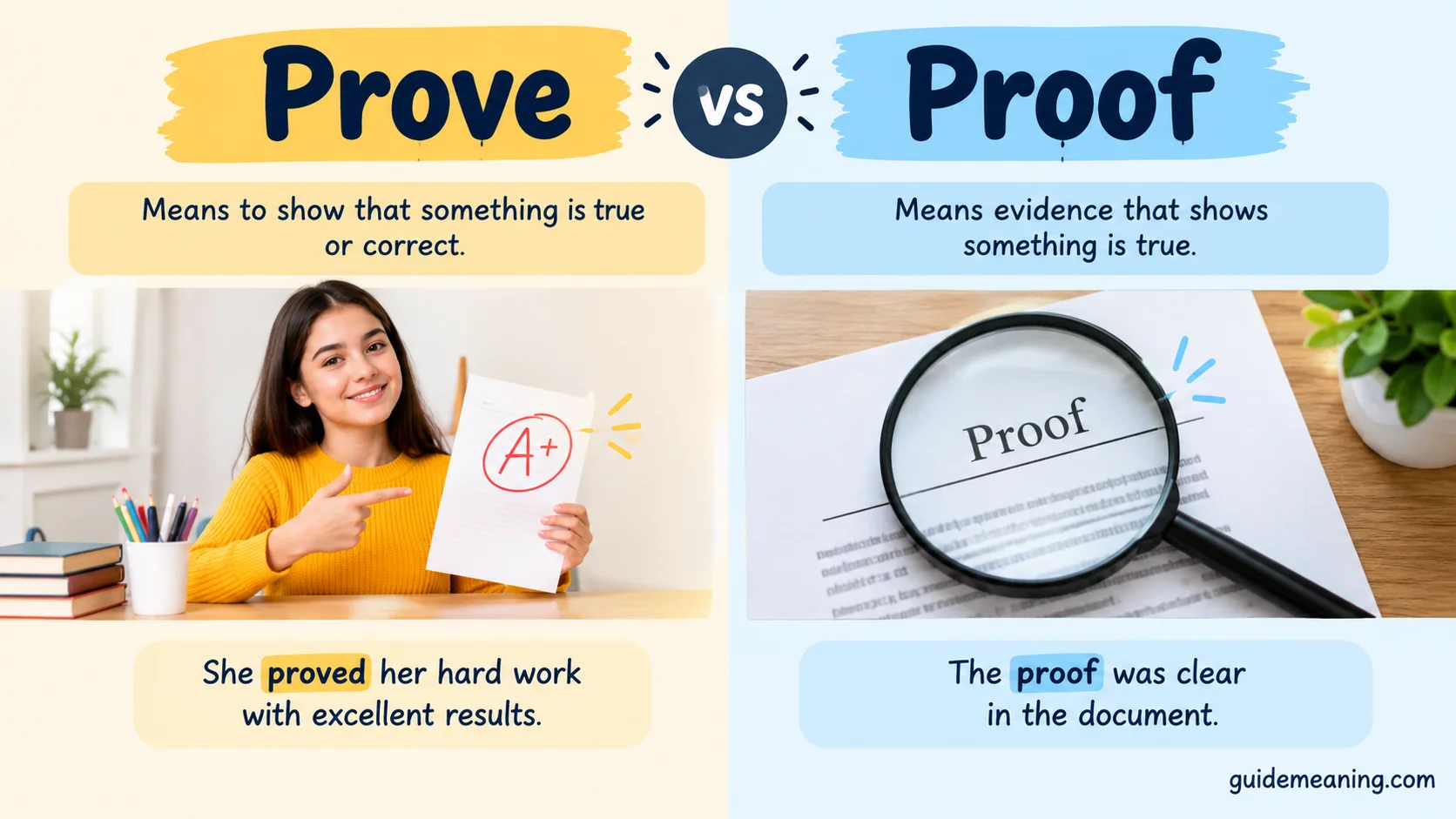

Prove vs. Proof becomes easier to understand when beginners learn how each word works in English sentences and everyday communication. From my experience teaching English, learners often feel unsure about their word choice when writing. Although these words share a common root and have a similar sound, they perform different grammatical jobs. Prove is a verb that describes an action or process, such as demonstrating that an argument is correct. Proof is a noun that refers to evidence, facts, or a real instance that confirms something is true. Understanding their meanings, pronunciation, and grammatical roles helps prevent confusion and improves grammar usage.
To understand their usage differences, compare these practical examples: “I can prove my answer is correct” and “I have proof that my answer is correct.” The first sentence describes an action, while the second refers to supporting evidence. This simple comparison explains their function, form, and contextual meaning across different contexts. It also improves sentence structure, word choice, sentence precision, and readability. With examples-based guidance and instructional guidance, students can avoid common mistakes, such as mixing up these words or using them interchangeably. Recognizing their lexical category and role in language structure also prevents sloppy writing, unclear writing, unnatural expressions, and grammatically incorrect sentences.
Regular practice makes learning English more effective and helps learners develop stronger writing skills. Use transition words to connect ideas, study examples, and check whether a sentence needs an action or evidence. This habit supports clarification, verification, correctness, and confidence in everyday English and professional contexts. It also strengthens communication skills, fluency, intuitive writing, and word usage patterns. As understanding improves, language learning becomes easier and more rewarding, helping beginners write clear English with greater accuracy. Over time, learners can make the correct choice confidently and improve their overall grammar, communication, and learning experience.
Let’s dive in!
Quick Answer:
Prove vs. proof: In American English, prove is primarily a verb meaning to establish something as true, while proof is primarily a noun meaning evidence that supports or establishes a claim. You prove a statement by presenting proof.
TL;DR
- Prove is a verb that describes establishing or demonstrating something.
- Proof is a noun that refers to supporting evidence.
- Use prove that to introduce a fact you want to establish.
- Use proof of to identify evidence supporting a claim.
- Evidence can support a conclusion without establishing absolute certainty.
- Both words appear in everyday conversations, education, science, mathematics, and law.
What Does Prove Mean?
The word prove describes an action that establishes something as true, accurate, valid, or genuine. It can refer to evidence, reasoning, experience, or results that demonstrate a particular point.
In American English, people use this verb in formal writing and casual conversations. For example, you might prove your identity with documents or prove your skills through practice.
Common Ways to Use Prove
The word prove fits several sentence patterns, depending on what you want to express.
- Prove something: The documents prove her ownership.
- Prove that something happened: The video proves that he arrived early.
- Prove someone wrong: The results proved the critics wrong.
- Prove to be: The new method proved to be effective.
- Prove yourself: She worked hard to prove herself.
Notice that prove doesn’t always require formal evidence. Sometimes, an experience demonstrates that something has a particular quality.
For instance, you might say, “The journey proved difficult.” Here, the journey turned out to be difficult rather than establishing a claim through documents.
Is Prove Always About Evidence?
Not necessarily. Although prove often involves evidence or reasoning, it can also describe an outcome that reveals a quality.
Consider the sentence, “The new employee proved reliable.” The employee’s actions demonstrated reliability over time.
Similarly, “The experiment proved successful” describes a result. The word focuses on what the experience demonstrated.
What Does Proof Mean?
Proof is primarily a noun that refers to evidence, information, or reasoning used to establish that something is true. Depending on the context, it can mean a document, a fact, a demonstration, or a convincing collection of evidence.
In the United States, people commonly use the word when discussing identification, purchases, schoolwork, scientific claims, and legal matters. For example, a receipt may serve as proof that someone purchased an item.
Common Ways to Use Proof
The noun proof appears in several familiar expressions.
- Proof of identity: Documents that help establish who someone is.
- Proof of purchase: A receipt or record showing that a purchase occurred.
- Proof of payment: Documentation showing that money was paid.
- Proof of ownership: Records supporting a claim of ownership.
- Proof that something happened: Information supporting a specific statement.
You can also use proof in sentences with verbs such as provide, present, find, and need.
For example, “Please provide proof of payment” asks someone to supply evidence. By contrast, “The receipt proves that payment occurred” describes what the receipt demonstrates.
Can Proof Mean Something Other Than Evidence?
Yes. The word has several additional meanings in English. In printing, a proof is a version prepared for review before final production.
In mathematics, a proof is a logical demonstration showing that a statement follows from accepted facts and rules. The word also appears in expressions such as waterproof and future-proof, where it can suggest resistance or protection.
These meanings depend on context. However, when comparing prove and proof in ordinary grammar, the most useful distinction remains verb versus noun.
Prove vs. Proof: What Is the Main Difference?
The main difference comes down to grammar and meaning. Prove describes an action, while proof identifies evidence or a demonstration.
The following table shows how these words work in common American English sentences.
| Feature | Prove | Proof |
| Main part of speech | Verb | Noun |
| Basic meaning | Establish something as true | Evidence supporting a claim |
| Common pattern | Prove something | Proof of something |
| Another pattern | Prove that something happened | Proof that something happened |
| Example | The receipt proves the purchase. | The receipt is proof of purchase. |
| Related forms | Proved, proven, proving | Proofs, proofed, proofing |
A Simple Way to Remember the Difference
Think of prove as the action and proof as the evidence. For example, a photograph may provide proof that you attended an event.
You could then say, “The photograph proves that I attended the event.” Both words communicate a related idea, but each serves a different grammatical purpose.
Prove vs. Proof vs. Evidence
Proof and evidence have similar meanings, but their use can differ. Understanding this distinction helps you avoid making claims that sound stronger than your information supports.
When Should You Use Evidence?
Use evidence when information supports a conclusion or makes a claim more likely. The word doesn’t necessarily mean the information settles the question.
For example, several customer reviews might provide evidence that a product works well. However, those reviews alone might not prove that the product works for everyone.
When Should You Use Proof?
Use proof when referring to evidence or reasoning that establishes a point. The word often suggests a stronger conclusion, although its exact meaning depends on context.
Compare these examples:
- Evidence: The results support the researcher’s explanation.
- Proof: The mathematical argument establishes the result.
- Prove: The researcher uses the results to prove the claim.
In everyday conversation, people sometimes use proof loosely to mean any supporting information. In careful writing, however, it’s worth distinguishing between evidence that supports a claim and evidence that establishes it.
How to Use Prove and Proof in American English
Both words are common throughout the United States. You’ll encounter them in emails, school assignments, business documents, conversations, and public discussions.
Common American English Expressions
Here are several expressions you can use in everyday situations.
- Prove your point: Show why your argument is correct.
- Prove yourself: Demonstrate your ability or reliability.
- Proof of address: Documents showing where someone lives.
- Proof of purchase: A record showing that an item was purchased.
- Beyond reasonable doubt: A legal standard used in criminal cases.
- Living proof: A person or example that demonstrates something directly.
These expressions show how the words appear in different settings. Some describe everyday actions, while others belong to specialized fields.
Which Word Fits Professional Writing?
In workplace communication, choose prove when describing what information establishes. Choose proof when asking for or identifying supporting documentation.
For example, a manager might write, “Please provide proof of completion.” A project report might state, “The results prove that the new process reduced delays.”
Both sentences are natural. The correct choice depends on whether you’re naming evidence or describing what it demonstrates.
Common Mistakes With Prove and Proof
Because these words share a meaning, it’s easy to confuse their grammatical roles. Fortunately, a few common mistakes become simple to correct once you know the basic rule.
Using Proof Instead of Prove
Incorrect: The documents proof that she owns the house.
Correct: The documents prove that she owns the house.
The first sentence uses a noun where the sentence needs a verb. You could also write, “The documents provide proof that she owns the house.”
Using Prove Instead of Proof
Incorrect: We need prove of his identity.
Correct: We need proof of his identity.
Here, the sentence requires a noun after need. Another correct option is, “We need to prove his identity,” which uses prove as a verb.
Assuming Proof Always Means Absolute Certainty
The word proof doesn’t guarantee that every reader will accept a claim as unquestionably true. Its strength depends on the type of evidence, the subject, and the standards being applied.
For example, a receipt may prove that a purchase occurred. However, it might not prove that the purchased item was later delivered.
Prove vs. Proof in Science, Mathematics, and Law
The distinction becomes especially important when people discuss facts, research, and formal arguments. In these fields, the meaning of proof depends on how a claim is evaluated.
In Science
Scientists use evidence to evaluate explanations and test predictions. They may describe findings as supporting a hypothesis rather than proving it beyond every possible doubt.
For example, repeated experiments might provide strong evidence for a scientific explanation. New findings can still lead researchers to refine that explanation later.
In Mathematics
Mathematics uses proof in a more specific way. A mathematical proof is a logical argument showing that a statement follows from accepted assumptions and established results.
For example, a student might prove a theorem by following a series of valid logical steps. The completed argument is called a proof.
In American Law
American legal language uses both words to describe how claims are established. A party may try to prove a fact by presenting testimony, records, photographs, or other evidence.
The phrase burden of proof refers to the responsibility to establish a claim under the applicable legal standard. Criminal cases generally require proof beyond a reasonable doubt, while many civil cases use a preponderance of the evidence standard.
These standards differ, so proof doesn’t mean the same level of certainty in every legal setting.
Prove vs. Proof: Practical Examples
Side-by-side examples are a useful way to see how the grammar changes. In each pair, the general idea remains similar, but the sentence structure differs.
Everyday Examples
| Using Prove | Using Proof |
| The receipt proves she paid. | The receipt is proof that she paid. |
| The photograph proves he attended. | The photograph provides proof of his attendance. |
| The records prove ownership. | The records serve as proof of ownership. |
| Her results prove her ability. | Her results are proof of her ability. |
| The test proves the system works. | The test provides proof that the system works. |
School and Workplace Examples
- Prove: The student proved the answer using a mathematical formula.
- Proof: The student showed the teacher a proof of the theorem.
- Prove: The employee proved that the report contained an error.
- Proof: The revised report provided proof of the mistake.
- Prove: The team proved that its new method saved time.
- Proof: The team presented proof of the time savings.
Notice that proof often follows verbs such as show, provide, and present. Meanwhile, prove can directly describe what a person, document, or result establishes.
Is It Proved or Proven?
Another common question concerns proved and proven. Both are accepted forms associated with the verb prove, particularly in American English.
When to Use Proved
Proved is the simple past tense of prove. It also works as a past participle.
For example:
- She proved her point during the discussion.
- The experiment proved successful.
- They have proved the theory through repeated tests.
When to Use Proven
Proven is also widely used as a past participle in American English. It’s especially common in expressions that describe something as established or reliable.
For example:
- The method has proven effective.
- She has proven her ability.
- The company uses a proven process.
In many sentences, proved and proven are both grammatically acceptable. However, fixed expressions such as “innocent until proven guilty” strongly favor proven.
Remember that proven isn’t a noun meaning evidence. The noun remains proof.
FAQs:
What is the main difference between prove and proof?
Prove is a verb that means to demonstrate that something is true. Proof is a noun that means evidence supporting a claim or statement. For example, you prove your point by presenting proof.
Is prove a verb or a noun?
Prove is a verb. It describes an action that demonstrates the truth of something. For example, “She will prove her answer with evidence.”
Is proof a verb or a noun?
Proof is usually a noun. It refers to evidence or information that supports a statement. For example, “The researcher provided proof of the discovery.”
Can I use proof and prove interchangeably?
No, you cannot usually use proof and prove interchangeably because they have different grammatical roles. Use prove for an action and proof for evidence. Choosing the correct word keeps your sentences clear and grammatically correct.
What is an example of prove in a sentence?
Here is an example: “I can prove that the information is correct.” In this sentence, prove describes the action of demonstrating that the information is true.
What is an example of proof in a sentence?
Here is an example: “The email provides proof of the agreement.” In this sentence, proof refers to the evidence that supports the agreement.
How can I remember when to use prove or proof?
Remember this simple rule: prove = action, proof = evidence. If someone demonstrates that a claim is true, use prove. If someone presents facts or evidence supporting that claim, use proof. Practicing with short sentences will help you remember the difference.
Conclusion:
Understanding the difference between prove and proof helps you write clear, natural, and grammatically correct English. Remember that prove is a verb that describes an action, while proof is a noun that refers to evidence supporting a claim or statement. For example, you can prove your answer is correct by providing proof to support it. With regular practice and attention to sentence structure, you can avoid common mistakes and use both words confidently in everyday conversations, academic writing, and professional communication.