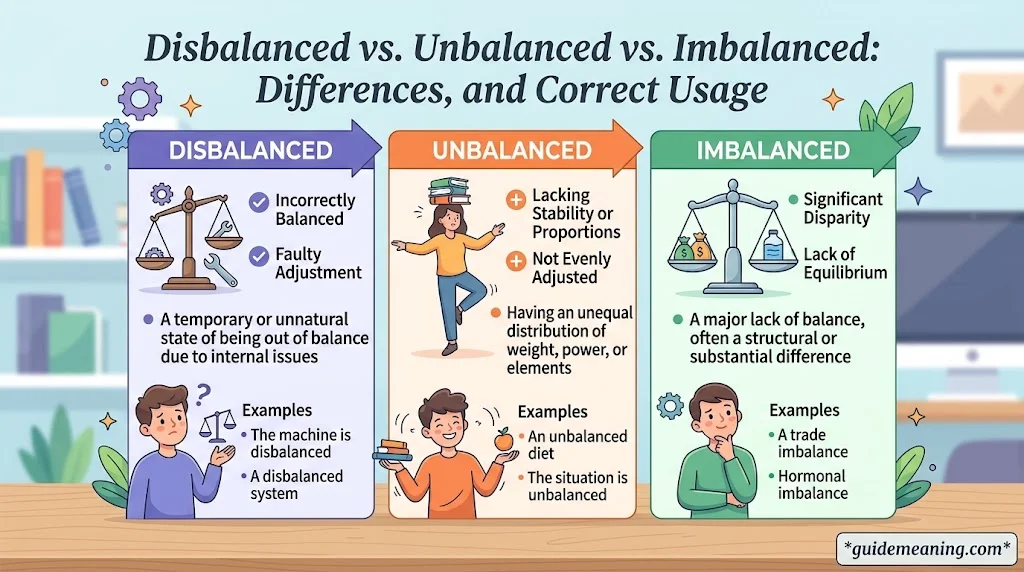

When English speakers, both native and non-native, confuse these words, context and usage can reveal the actual difference. Imbalanced usually describes something unequal, disproportionate, or lacking proper distribution, such as an imbalanced diet, imbalanced workload, or imbalanced economy.
Unbalanced can describe something physically unstable, emotionally unstable, or simply off balance, such as an unbalanced chair or unbalanced load. Meanwhile, disbalanced often sounds awkward or nonstandard in modern English, so experts generally recommend imbalanced or unbalanced instead. For example, an imbalanced dataset contains unequal groups, while an unbalanced person may lack emotional stability.
Understanding these small differences helps you avoid common grammar mistakes, awkward phrasing, and unclear professional writing. Disbalanced vs. Unbalanced vs. Imbalanced becomes easier when you match each form with the right context and meaning.
Let’s dive in!
Quick Answer:
Unbalanced is the best general-purpose choice when something isn’t balanced, stable, fair, or evenly weighted.
Imbalanced is often the better choice when the focus falls on unequal proportions, distributions, or relationships.
Disbalanced exists as an English form, but it’s rare and much less natural in most modern writing. If you’re writing an email, article, report, academic paper, or professional document, unbalanced or imbalanced will usually serve you better. Historical evidence also shows that disbalance has been used as a verb meaning to disturb balance.
| Word | Status and typical use | Example |
| Unbalanced | Common, standard, broad usage | The wheel is unbalanced. |
| Imbalanced | Standard, especially for unequal distribution or proportion | The dataset is imbalanced. |
| Disbalanced | Rare and uncommon in contemporary general English | The system became disbalanced. |
A useful shortcut is this:
Unbalanced usually means “not balanced.”
Imbalanced often emphasizes unequal distribution or proportion.
Disbalanced is possible but rarely the strongest modern choice.
That distinction isn’t an absolute grammar law. English usage has plenty of overlap. Context matters.
What Does “Unbalanced” Mean?
Unbalanced is the broadest and most familiar word of the three.
At its most literal, it describes something that isn’t steady or properly supported. A chair with one short leg might be unbalanced. A washing machine can become unbalanced when its load shifts heavily to one side. Cambridge defines unbalanced as something that isn’t firm and may fall or suddenly change position.
However, the word travels far beyond physical objects.
You can describe an argument as unbalanced when it gives excessive attention to one side. You can describe a diet as unbalanced when it doesn’t provide an appropriate combination of foods and nutrients. You can even describe accounting records as unbalanced when the figures don’t properly match.
Common Uses of Unbalanced
You’ll commonly see unbalanced in contexts involving:
- Physical stability
- Weight distribution
- Machinery
- Arguments
- News reporting
- Diets
- Financial accounts
- Opinions
- Emotional or mental stability
- General situations lacking equilibrium
Consider these examples:
- The bicycle wheel is unbalanced.
- The machine became unbalanced during operation.
- The article presents an unbalanced view of the issue.
- He follows an unbalanced diet.
- The report gives an unbalanced picture of the situation.
Notice the common thread. The word doesn’t necessarily mean that two measurable quantities differ.
Sometimes it simply means that something isn’t properly balanced as a whole.
Why “Unbalanced” Is So Versatile
The prefix un- commonly creates a negative or opposite sense. In unbalanced, it produces a straightforward idea: something isn’t balanced.
Oxford gives examples such as an unbalanced article, an unbalanced diet, and an unbalanced picture. It also recognizes the word for a person who isn’t behaving or thinking normally.
That broad semantic range makes unbalanced a reliable choice when you aren’t dealing with a specialized context.
For example, if you’re describing a chair that rocks because one leg doesn’t sit properly, unbalanced sounds completely natural.
You wouldn’t normally reach for imbalanced there.
What Does “Imbalanced” Mean?
Imbalanced describes something affected by an imbalance.
That sounds similar to unbalanced, and in many situations the meanings overlap. The important distinction lies in what you want to emphasize.
Imbalanced often highlights unequal quantities, proportions, distributions, or relationships.
Cambridge defines imbalance as a situation where two things that should be equal or normally equal aren’t. Its examples include economic, power, trade, nutritional, and demographic contexts.
Oxford similarly describes an imbalance as a situation in which things differ in size or treatment in ways that can create unfairness or problems.
Common Uses of Imbalanced
You’ll frequently encounter imbalanced with concepts such as:
- Imbalanced datasets
- Imbalanced workloads
- Imbalanced diets
- Imbalanced populations
- Imbalanced systems
- Imbalanced economies
- Imbalanced representation
- Imbalanced distributions
For example:
The machine-learning model was trained on an imbalanced dataset.
Here, imbalanced tells you something specific. The data doesn’t contain comparable representation across its classes.
Likewise:
The department has an imbalanced workload.
The problem isn’t necessarily that the department itself is physically unstable. The problem is that work isn’t distributed evenly.
Imbalanced Focuses on Relationships
This is where imbalanced becomes particularly useful.
Suppose one department has 90 employees handling 20% of the workload while another has 10 employees handling 80%. Calling the workload imbalanced draws attention to the unequal distribution.
The same principle applies to power:
The negotiation involved a serious power imbalance.
Here, imbalance works naturally because you’re comparing the relative power held by different parties.
Oxford specifically gives examples involving global power imbalance, gender imbalance, and hormonal imbalance.
What Does “Disbalanced” Mean?
Here’s where the three-way comparison gets interesting.
Disbalanced is a real English form, but it isn’t a common modern choice.
Historical evidence shows disbalance as both a noun and a verb. Wiktionary records the noun as meaning a lack of balance and the verb as meaning to cause something to become unbalanced. It also gives historical examples dating back to the 19th century.
The adjective disbalanced can function as the past participle of disbalance. It has also appeared as an adjective meaning essentially “unbalanced.”
So calling it completely nonexistent would be inaccurate.
At the same time, calling it a normal everyday alternative to unbalanced would also mislead readers.
That’s the crucial point.
Is “Disbalanced” a Standard Modern Choice?
For most contemporary writing, no.
The word appears occasionally, but it doesn’t have the same familiarity or frequency as unbalanced or imbalanced. Historical usage doesn’t automatically make a word the best choice for modern readers.
Think of it this way:
A word can exist without being your best word.
English contains many words that are technically attested yet sound archaic, regional, unusual, or simply unfamiliar to most readers.
Disbalanced falls into that awkward territory.
Why Does “Disbalanced” Sound Strange?
The form looks perfectly logical.
You have:
balance → disbalance → disbalanced
The prefix dis- appears in many legitimate English words. That can tempt writers to attach it to balance and assume the result must be the standard opposite.
English doesn’t work quite that neatly.
Word formation follows historical usage rather than mathematical symmetry. Just because a prefix can create an opposite in one word doesn’t mean speakers use it naturally with every possible base.
That’s why:
- agree → disagree
- honest → dishonest
- connect → disconnect
work naturally.
Yet balanced → disbalanced doesn’t have the same status in everyday modern English.
Unbalanced vs. Imbalanced: What’s the Real Difference?
The most useful comparison isn’t actually disbalanced vs. unbalanced. It’s unbalanced vs. imbalanced.
Both are established. Both can describe a lack of balance. Their typical contexts, however, differ.
Unbalanced Often Means Lack of Stability
Use unbalanced when you want to describe something that lacks physical or general equilibrium.
Consider:
- an unbalanced wheel
- an unbalanced load
- an unbalanced chair
- an unbalanced machine
- an unbalanced argument
- an unbalanced report
The emphasis can vary, but the word has a broad “not properly balanced” meaning.
For physical objects, the choice becomes especially clear.
The wheel is unbalanced.
That sentence sounds natural because you’re talking about mechanical equilibrium.
Imbalanced Often Means Unequal Distribution
Imbalanced becomes particularly natural when you can identify different components that aren’t proportioned appropriately.
For example:
The sample contains an imbalanced representation of age groups.
Here, the issue concerns distribution.
Likewise:
The company has an imbalanced workload across its teams.
The problem involves unequal allocation.
The distinction isn’t rigid. Yet the pattern is strong enough to guide good writing.
They Can Overlap
Don’t turn this distinction into a hard grammar rule.
English speakers can use unbalanced in contexts involving unequal distribution. Cambridge explicitly gives unbalanced examples involving diets and reporting, both of which involve uneven emphasis or composition.
Similarly, imbalanced can describe conditions that aren’t physically or functionally balanced.
The better question isn’t:
“Which word is grammatically allowed?”
Instead, ask:
“What kind of imbalance am I trying to emphasize?”
That small shift makes the choice much easier.
Unbalanced vs. Imbalanced Examples Side by Side
| Context | Better choice | Example | Reason |
| Wheel | Unbalanced | The wheel is unbalanced. | Physical equilibrium |
| Machine | Unbalanced | The machine has an unbalanced load. | Weight distribution |
| Chair | Unbalanced | The chair feels unbalanced. | Physical stability |
| Argument | Unbalanced | The article presents an unbalanced argument. | Uneven treatment |
| Reporting | Unbalanced | The coverage was unbalanced. | One-sided emphasis |
| Dataset | Imbalanced | The dataset is imbalanced. | Unequal class distribution |
| Workload | Imbalanced | The workload is imbalanced. | Unequal allocation |
| Representation | Imbalanced | The sample is imbalanced. | Unequal representation |
| Power | Imbalanced | The negotiation had an imbalanced power structure. | Unequal power |
| Economy | Imbalanced | The economy has become imbalanced. | Uneven economic relationships |
| Diet | Both possible | She has an unbalanced diet. | General nutritional lack of balance |
| Resources | Imbalanced | Resources are imbalanced across regions. | Unequal distribution |
This table gives you a practical rule without pretending English always behaves like a formula.
Can You Use “Unbalanced” and “Imbalanced” Interchangeably?
Sometimes, yes. Not always.
Imagine a diet containing too much sugar and too little protein. You could call it an unbalanced diet. You could also describe it as imbalanced if you’re emphasizing the uneven nutritional composition.
Both ideas make sense.
Now consider a bicycle wheel.
The wheel is unbalanced.
That’s the natural choice.
The wheel is imbalanced.
It’s understandable, but it sounds more technical or less idiomatic in ordinary conversation.
The reverse happens with some specialized contexts.
The dataset is imbalanced.
That’s a well-established technical expression.
The dataset is unbalanced.
This can be understandable, but imbalanced is usually more precise when you’re discussing unequal representation among categories.
When Either Word Can Work
The two words may overlap with:
- Diets
- Workloads
- Systems
- Reports
- Situations
- Resource allocation
- Economic conditions
The best choice depends on what the sentence emphasizes.
When One Word Sounds More Natural
Some combinations have become especially familiar through repeated usage.
Unbalanced works naturally with:
- Unbalanced wheel
- Unbalanced load
- Unbalanced argument
- Unbalanced reporting
- Unbalanced diet
Imbalanced works naturally with:
- Imbalanced dataset
- Imbalanced distribution
- Imbalanced representation
- Imbalanced workload
- Imbalanced population
These aren’t arbitrary preferences. Collocation matters.
A word can be grammatically understandable while still sounding slightly off because native usage favors another combination.
Disbalanced vs. Unbalanced vs. Imbalanced in Different Contexts
The easiest way to master these words is to put them into real situations.
Physical Objects and Machinery
Choose unbalanced for most physical situations.
For example:
The washing machine became unbalanced during the spin cycle.
The machine isn’t necessarily suffering from some abstract statistical imbalance. Its physical load isn’t distributed properly.
Other natural examples include:
- an unbalanced wheel
- an unbalanced tire
- an unbalanced load
- an unbalanced machine
- an unbalanced object
Here, unbalanced is straightforward and idiomatic.
Data and Statistics
In data science and statistics, imbalanced is the more natural term.
An imbalanced dataset contains unequal representation among classes. For instance, imagine a fraud-detection dataset containing 99,000 legitimate transactions and 1,000 fraudulent transactions.
The classes aren’t equally represented.
Calling this an imbalanced dataset precisely describes that distribution.
This is a good example of why context matters. The issue isn’t physical stability. It’s proportion.
Health and Nutrition
Both unbalanced and imbalanced can appear in health-related contexts.
However, unbalanced diet is particularly familiar in general English.
Cambridge defines an unbalanced diet as one that doesn’t contain the correct combination and amounts of foods.
For example:
A diet built mostly around processed foods may be unbalanced.
In more technical contexts, imbalanced may emphasize the unequal levels of particular nutrients or components.
Business and Economics
Imbalanced often works well when comparing quantities, markets, resources, or power.
Examples include:
- imbalanced trade
- imbalanced workloads
- imbalanced resource allocation
- imbalanced markets
- imbalanced representation
The noun imbalance is especially established in economic language. Cambridge gives examples such as economic imbalance and trade imbalance.
Meanwhile, unbalanced can describe financial or accounting situations. Cambridge specifically recognizes unbalanced for accounting records where the totals don’t properly match.
Arguments, Opinions, and Discussions
Here, unbalanced is often the natural choice.
Suppose an article spends 2,000 words attacking one position but gives the opposing side only two sentences.
You could reasonably call it an unbalanced article.
Oxford uses unbalanced for writing that gives too much or too little importance to one aspect.
That makes the word useful for:
- News coverage
- Editorials
- Reviews
- Arguments
- Presentations
- Debates
- Reports
Why “Disbalanced” Gets Confused With the Other Two
The confusion mostly comes from prefix logic.
Writers see balance and naturally look for an opposite:
balance → disbalance
That construction isn’t impossible. Historical evidence confirms that disbalance has existed in English.
The problem is frequency and convention.
Modern English has already settled comfortably around unbalanced and imbalance/imbalanced for many common situations.
As a result, disbalanced can make readers pause.
That pause matters.
When a reader stops to wonder whether a word is correct, the sentence loses some of its momentum. Professional writing should generally avoid that friction when a clearer alternative is available.
Common Mistakes With Disbalanced, Unbalanced, and Imbalanced
Mistake: Assuming “Disbalanced” Must Be Correct Because “Dis-” Means Opposite
English prefixes aren’t plug-and-play components.
A word’s history determines whether a formation becomes established. Disbalanced exists, but its existence doesn’t make it the preferred modern equivalent of unbalanced.
Mistake: Assuming “Disbalanced” Is Completely Wrong
That claim goes too far.
Historical and dictionary-based evidence shows that disbalance and disbalanced have been used.
So the accurate statement is:
Disbalanced is attested but uncommon.
That’s much more precise than simply calling it incorrect.
Mistake: Using “Imbalanced” for Every Situation
Not every lack of balance is best described as an imbalance.
For a wheel, chair, tire, or machine, unbalanced is usually the natural choice.
The tire is unbalanced.
That’s clean and familiar.
Mistake: Using “Unbalanced” for Every Technical Situation
The opposite mistake also occurs.
When you’re discussing class distributions in machine learning, imbalanced dataset is the established expression.
Likewise, imbalance of power, trade imbalance, and gender imbalance are familiar constructions. (Cambridge Dictionary)
Mistake: Treating the Difference as an Absolute Rule
This is perhaps the biggest mistake.
English isn’t a spreadsheet.
Words overlap. Context changes meaning. Established collocations often matter more than theoretical definitions.
Use the distinction as a guide, not a rigid commandment.
Unbalanced vs. Imbalanced vs. Disbalanced in Formal Writing
If you’re writing something formal, clarity should win.
Academic Writing
Prefer unbalanced for broad descriptions and imbalanced when discussing distributions or proportions.
For example:
The study used an imbalanced sample.
That sentence tells the reader that the sample doesn’t represent groups evenly.
Business Writing
Use the word that best describes the underlying problem.
The workload is imbalanced across departments.
That emphasizes distribution.
The proposal presents an unbalanced assessment of the costs.
That emphasizes unequal treatment of different factors.
Professional Emails
Avoid disbalanced unless you’re discussing a source that specifically uses it.
Instead, write:
- unbalanced
- imbalanced
- uneven
- unequal
- disproportionate
- out of balance
These choices reduce ambiguity.
Technical Writing
Imbalanced often carries greater precision when discussing datasets, classifications, distributions, or measurable disparities.
Meanwhile, unbalanced remains perfectly appropriate for mechanical and physical contexts.
Word Forms and Related Terms
Understanding the word family makes the distinction easier.
| Word | Part of speech | Meaning |
| Balance | Noun/verb | A state of equilibrium; to make something even |
| Balanced | Adjective | Having proper balance |
| Unbalanced | Adjective | Lacking balance or stability |
| Unbalance | Verb | To cause something to lose balance |
| Imbalance | Noun | A lack of equal or proper proportion |
| Imbalanced | Adjective | Characterized by an imbalance |
| Disbalance | Noun/verb | A rare term involving lack of balance |
| Disbalanced | Adjective/past participle | A rare form related to disbalance |
Cambridge and Oxford both recognize unbalance as a verb meaning to make something unbalanced or unsteady.
That matters because it shows that un- isn’t merely a casual adjective-building device. Unbalance is an established verb with several meanings.
Unbalance vs. Imbalance: Don’t Confuse the Nouns
There’s another subtle distinction worth remembering.
Imbalance is a very common noun.
For example:
There is an imbalance between supply and demand.
Or:
The company needs to correct the imbalance in workload.
Cambridge specifically uses imbalance for situations involving unequal size, power, importance, or advantages.
By contrast, unbalance is primarily used as a verb.
The sudden movement unbalanced him.
That means the movement caused him to lose stability.
So compare:
The workload is imbalanced.
with:
The sudden shift unbalanced the machine.
The first describes a state of unequal distribution.
The second describes an action that caused loss of balance.
That distinction is extremely useful in polished writing.
Case Study: Choosing the Right Word
Imagine a company has two departments.
The sales department has 10 employees handling 500 monthly cases. The support department has 40 employees handling only 100 cases.
You could write:
The workload is imbalanced across the two departments.
That’s precise because the issue involves unequal distribution.
Now imagine one employee drops a heavy box onto one side of a loaded cart.
You’d write:
The cart became unbalanced.
The problem now concerns physical stability.
Finally, suppose a draft says:
The workload is disbalanced across departments.
The reader can understand it. Yet imbalanced is the cleaner modern choice.
This small example captures the entire distinction.
Quick Decision Guide: Which Word Should You Choose?
Use this simple framework whenever you’re unsure.
Is something physically unstable or generally lacking balance?
→ Choose unbalanced.
Are quantities, groups, proportions, or distributions unequal?
→ Choose imbalanced.
Are you tempted to use “disbalanced” because it sounds like the opposite of “balanced”?
→ Usually choose unbalanced or imbalanced instead.
A Simple Memory Trick
Think of the words this way:
Unbalanced = not properly balanced.
Imbalanced = unequal or disproportionate in some relationship.
Disbalanced = an uncommon alternative that exists but usually isn’t your best modern choice.
That rule won’t solve every sentence. It will solve most everyday choices.
Sentence Comparison: Correct and More Natural Choices
| Less natural choice | Better choice | Explanation |
| The wheel is disbalanced. | The wheel is unbalanced. | Physical stability |
| The dataset is unbalanced. | The dataset is imbalanced. | Unequal class distribution |
| The machine became disbalanced. | The machine became unbalanced. | Physical equilibrium |
| The sample is disbalanced. | The sample is imbalanced. | Unequal representation |
| The argument is unbalanced. | The argument is unbalanced. | One-sided treatment |
| The workload is disbalanced. | The workload is imbalanced. | Unequal distribution |
| The report is disbalanced. | The report is unbalanced. | Uneven emphasis |
| The resources are disbalanced. | The resources are imbalanced. | Unequal allocation |
| The tire is imbalanced. | The tire is unbalanced. | Physical/mechanical balance |
| There is a disbalance of power. | There is an imbalance of power. | Established noun |
The left column isn’t necessarily incomprehensible. In many cases, readers will understand the intended meaning immediately. The right column simply reflects more established contemporary usage.
Is “Disbalanced” Ever Appropriate?
Yes, but use it cautiously.
If you’re quoting an older source, preserving historical wording may make sense. If you’re analyzing a particular author’s language, changing the word could distort the original text.
In ordinary modern writing, however, there’s rarely a strong reason to choose it.
Historical records demonstrate that disbalance has been used for well over a century. Wiktionary documents examples from the 19th and 20th centuries, while its entry for disbalanced identifies the adjective as a synonym of unbalanced.
That history is interesting. It doesn’t make the word the best choice today.
A good editor thinks about the reader first.
If unbalanced says exactly what you mean and sounds natural, why make the reader wrestle with disbalanced?
FAQs:
Is “disbalanced” a correct English word?
Disbalanced exists in some dictionaries and older or specialized usage, but it’s uncommon in standard modern English. In most situations, imbalanced or unbalanced sounds more natural and professional.
Is “imbalanced” or “unbalanced” correct?
Both are correct, but they often emphasize different ideas. Imbalanced usually refers to unequal proportions or distribution, while unbalanced can describe physical instability, emotional instability, or something that isn’t properly balanced.
Should I say “imbalanced diet” or “unbalanced diet”?
Both expressions can work. Imbalanced diet emphasizes unequal or inadequate nutritional proportions. Unbalanced diet is also common and can simply mean a diet that lacks proper nutritional balance.
Is “disbalanced” the same as “imbalanced”?
Not exactly. Although disbalanced may appear in some contexts, imbalanced is generally the more natural choice when you mean unequal, disproportionate, or lacking proper balance.
Which word should I use for an unequal dataset?
Use imbalanced dataset when different groups or classes aren’t represented equally. For example, a dataset with 90% positive cases and 10% negative cases is commonly called an imbalanced dataset.
Can “unbalanced” describe a person?
Yes. Unbalanced person can describe someone who seems emotionally or mentally unstable. However, depending on your meaning and context, a more specific and respectful term may communicate the idea better.
Which word is best for formal writing?
For formal writing, choose imbalanced when discussing unequal proportions, distributions, or relationships. Use unbalanced for physical or emotional instability. Generally, avoid disbalanced unless a particular source or context specifically requires it.
Conclusion:
The difference between disbalanced, unbalanced, and imbalanced becomes much easier once you focus on meaning rather than spelling. Imbalanced is usually the best choice for unequal distribution, proportion, or representation. Unbalanced works well for physical instability, emotional instability, or something that lacks balance. Although disbalanced appears occasionally, it isn’t the preferred choice in most modern formal writing. When you’re unsure, check the context and ask what kind of “balance” you’re describing. That simple habit can help you choose the most natural and credible word.