
Understanding Each Is or Each Are helps you choose the correct singular verb and write clearer sentences with confidence in everyday English. Choosing between each is and each are can feel tricky because people hear both versions in everyday speech, movies, and casual writing. In standard English, each is is the correct form, and this guide explains the grammar concept in a simple way. This small grammar detail can have a big impact on clarity, correctness, and how you communicate when drafting an email, completing an academic assignment, creating website content, or improving your English grammar. Each points to an individual member of a group, so it takes a singular verb even when a plural noun follows. That difference is essential for building an accurate sentence structure, maintaining proper subject-verb agreement, and avoiding common writing mistakes. The confusion often starts when multiple people or objects appear nearby, making learners choose the wrong verb form.
If you’ve paused mid-sentence, wondering whether to write each is or each are, you’re not alone. This tiny word trips up native speakers and English learners alike, mostly because it sits next to plural nouns and can pull the verb in the wrong direction. The short answer is that each is is the grammatically correct form in standard American English every time. The longer answer helps you remember the rule when you face trickier sentences. Each behaves as a singular idea, whether it appears with singular nouns, plural nouns, collective nouns, pronouns, or relative clauses such as who and whom. A useful way to break it down is to focus on the individual member, rather than the group as a whole. This makes singular grammar rules easier to follow and reduces plural thinking in both spoken communication and written communication.
To master this rule, discover it through practical examples, tips, and regular practice. Each are is usually incorrect, while each is follows the main grammar rules and standard usage. Common exceptions may appear in unusual structures, but they don’t change the basic pattern. For example, each of the students is ready, not are ready. This sentence shows the logic clearly: students refers to several things or people, but each remains singular. Writers who understand this misunderstanding can avoid mistakes in writing sentences, emails, exams, and professional writing. A grammar expert may describe these as traditional rules, but the pattern remains clear and easy to apply naturally. With real examples, common mistakes, and a quick-reference table you can bookmark for later, you can know exactly how to use each form and remember it once and for all.
Let’s dive in!
Quick Answer
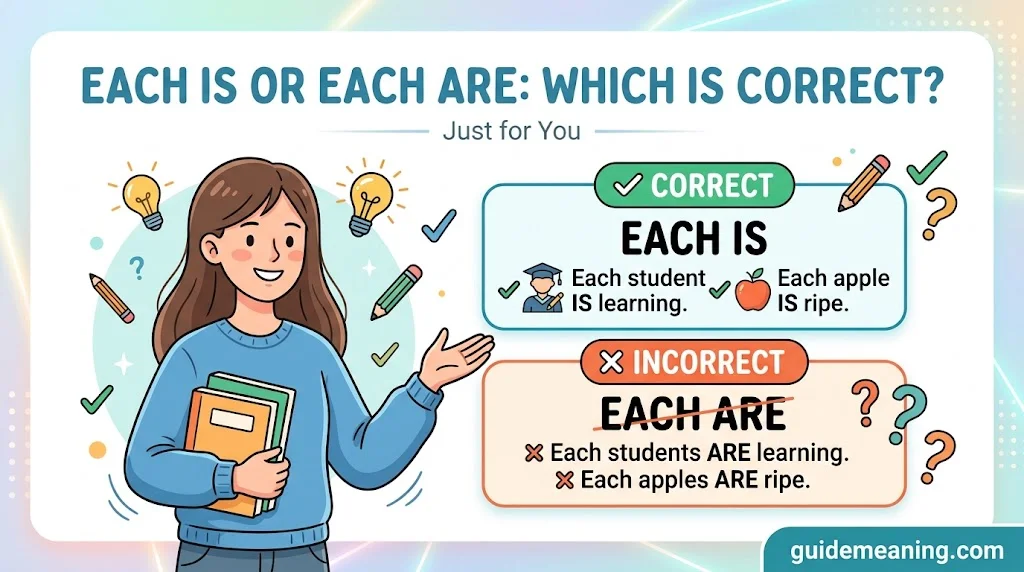
“Each is” is correct when “each” is the subject. “Each are” is generally incorrect in standard English when “each” controls the verb.
Compare these sentences:
- Each is responsible for the project. ✅
- Each are responsible for the project. ❌
- Each of the employees is responsible for the project. ✅
- Each of the employees are responsible for the project. ❌
- They each have a responsibility. ✅
- They are each responsible. ✅
The key is simple: find the grammatical subject before choosing the verb.
If each is the subject, use a singular verb.
Each is ready.
Each has a ticket.
Each was given a copy.
If a plural noun or pronoun is the subject and each simply adds individual emphasis, use the plural verb.
They are ready.
They each have a ticket.
The students are working.
This distinction is the heart of the each is vs. each are question.
Is “Each Is” Correct?
Yes. “Each is” is grammatically correct when each functions as the subject.
The word each focuses on members of a group individually. Think of a teacher standing in front of a classroom and pointing to students one by one. The group contains many students, but the sentence considers them separately.
For example:
Each student is responsible for the assignment.
The sentence doesn’t treat the students as one collective unit. It means that every individual student carries that responsibility.
The same principle works with other singular verbs:
- Each is ready.
- Each has a different opinion.
- Each does the assigned task.
- Each was given a badge.
- Each needs additional information.
- Each receives a confirmation email.
The grammatical number of each doesn’t change simply because it refers to multiple people or things.
Why “Each Is” Works
A useful mental shortcut is to replace each with every one.
Each is ready.
can be understood as:
Every one is ready.
Likewise:
Each has a separate account.
means:
Every one has a separate account.
The individual focus explains the singular agreement.
Is “Each Are” Correct?
When each itself acts as the subject, “each are” is generally incorrect in standard English.
For example:
Each are ready. ❌
The correct version is:
Each is ready. ✅
The same problem appears in longer sentences:
Each of the candidates are qualified. ❌
The standard form is:
Each of the candidates is qualified. ✅
The mistake usually happens because candidates is plural. The writer sees a plural noun and instinctively chooses are.
That’s a classic subject-verb agreement trap.
The important question isn’t “What noun is closest to the verb?” Instead, ask:
“What is the actual subject?”
In each of the candidates, the grammatical head is each. The phrase of the candidates tells you which individuals are being considered. It doesn’t turn each into a plural subject.
Why Does “Each” Take a Singular Verb?
The easiest way to understand the rule is to focus on meaning.
Each means every individual member of a group considered separately.
Imagine four books sitting on a desk:
Each book is different.
Although there are four books, you’re examining them individually.
You could mentally rewrite the idea like this:
- Book 1 is different.
- Book 2 is different.
- Book 3 is different.
- Book 4 is different.
That individual treatment is why the verb remains singular.
Compare that with:
The books are different.
Here, books is plural and the sentence treats the books as a group. Therefore, are is appropriate.
| Sentence | Focus | Verb |
| Each book is different. | Individual books | Singular |
| The books are different. | Group of books | Plural |
| Each employee has an ID. | Individual employees | Singular |
| The employees have IDs. | Employees as a group | Plural |
This distinction is more useful than simply memorizing “each takes is.”
“Each Is” vs. “Each Are”: The Main Difference
The central difference comes down to subject-verb agreement.
| Expression | Correct? | Explanation |
| Each is | ✅ | “Each” is singular |
| Each are | ❌ | “Each” doesn’t normally take a plural verb |
| Each of them is | ✅ | “Each” controls the verb |
| Each of them are | ❌ | “Them” doesn’t control the verb |
| Each student is | ✅ | “Each” takes a singular noun and verb |
| Each students are | ❌ | The noun after “each” should be singular |
| They each have | ✅ | “They” controls the plural verb |
| They are each | ✅ | “They” is the subject |
The last two examples are especially important.
“They each have” doesn’t contradict the rule. In that sentence, they is the subject. Each simply emphasizes that the action applies to every member individually.
Each Is vs. Each Are With Plural Nouns
One of the biggest sources of confusion is the structure:
Each of + plural noun
For example:
Each of the employees is trained.
The word employees is clearly plural. Yet the verb is is.
Why?
Because each remains the subject.
The phrase of the employees identifies the group from which individual members are selected. It doesn’t control subject-verb agreement.
Correct Examples
- Each of the students is prepared.
- Each of the houses has a garage.
- Each of the reports was reviewed.
- Each of the candidates needs an interview.
- Each of the options offers a different benefit.
- Each of the machines requires maintenance.
A useful test is to remove the of phrase:
Each of the students is prepared.
becomes:
Each is prepared.
The sentence still works. That makes the grammatical relationship easier to see.
“Each of Us Is” or “Each of Us Are”?
The correct standard form is “each of us is.”
For example:
Each of us is responsible for our own decision.
The word us is plural, but it doesn’t control the verb.
Here are more examples:
- Each of us has a different role.
- Each of us was given a copy.
- Each of us needs to contribute.
- Each of us is entitled to an opinion.
- Each of us does the work differently.
This structure can feel strange because us clearly refers to multiple people. Still, the grammatical subject is each.
The same principle applies to you:
Each of you is welcome.
Not:
Each of you are welcome. ❌
In everyday conversation, you may occasionally hear plural agreement after each of, particularly in informal speech. Cambridge notes that plural verbs do occur in spoken English. For formal, academic, and professional writing, however, the singular form remains the safer standard choice.
“Each of Them Is” or “Each of Them Are”?
Use “each of them is.”
For example:
Each of them is qualified for the position.
The pronoun them is plural, but each remains singular.
More examples include:
- Each of them has a unique skill.
- Each of them was invited.
- Each of them needs more time.
- Each of them is responsible for a different task.
This pattern also works naturally with singular they in possessive constructions:
Each of them has their own workspace.
Here, their doesn’t change the number of the verb. The verb still agrees with each.
The broader grammar point is straightforward: a plural pronoun after “of” does not automatically require a plural verb. The grammatical subject still determines agreement.
“Each of the Students Is” or “Are”?
The standard form is:
Each of the students is ready. ✅
Not:
Each of the students are ready. ❌
Break the sentence into parts:
- Each = grammatical subject
- of the students = phrase identifying the group
- is = singular verb
- ready = subject complement
The plural word students sits inside the of phrase. It isn’t the subject controlling is.
More Examples
Each of the students has submitted the assignment.
Each of the students was given a locker.
Each of the students receives a certificate.
Each of the students needs additional guidance.
The same structure appears in professional writing:
Each of the applicants is required to submit identification.
This kind of sentence is especially common in policies, instructions, contracts, and application guidelines. Getting the agreement right helps your writing sound polished and precise.
“They Each Are” vs. “They Are Each”
Here’s where the grammar gets more interesting.
Both structures can be grammatical:
They each are responsible for a section.
They are each responsible for a section.
However, “they are each” usually sounds more natural in ordinary American English.
Why can are appear here?
Because they is the subject.
Look at the structure:
They are each responsible.
The verb are agrees with they. The word each adds distributive meaning. It tells us that the responsibility applies to every individual person in the group.
The same pattern appears in:
We each have a different assignment.
The players each have a locker.
The managers each receive a separate report.
In every case, the plural subject controls the verb.
Cambridge describes this use of each after a subject as a way of emphasizing the individual members of that subject.
Can “Each” Be Used With a Plural Verb?
Yes, but the sentence structure matters.
The safest way to understand this is to distinguish between each as the subject and each as a modifier of a plural subject.
Each as the Subject
Each has a ticket.
Each is responsible.
Each of the workers was trained.
Here, each controls the verb, so the verb is singular.
Each With a Plural Subject
They each have a ticket.
We each are responsible.
The workers each received training.
Here, they, we, and the workers are the subjects. Therefore, the verbs agree with those plural subjects.
This distinction prevents a common overcorrection. Once someone learns that each takes a singular verb, they may start writing sentences such as:
They each has a ticket. ❌
That’s also wrong.
The correct sentence is:
They each have a ticket. ✅
The verb doesn’t agree with each because each isn’t the subject in that construction.
Each as a Pronoun vs. Each as a Determiner
Each can work in more than one grammatical role, but its meaning remains centered on individual members.
Each as a Pronoun
When each stands alone, it can function as a pronoun:
Each is unique.
Each has a different purpose.
Each was carefully inspected.
Here, each directly represents the individuals being discussed.
Each as a Determiner
When each comes before a noun, it works as a determiner:
Each student is ready.
Each employee has an ID.
Each answer deserves consideration.
Notice something important: the noun following each is normally singular.
Therefore:
Each student is ready. ✅
Not:
Each students are ready. ❌
This structure reinforces the singular nature of each.
Each vs. Every: Are They the Same?
Each and every are closely related, but they don’t always create exactly the same emphasis.
Both normally take singular verbs:
Each student is prepared.
Every student is prepared.
However, each tends to highlight individuals separately, while every often presents the members as part of a complete group.
Compare:
Each employee received a personal message.
This emphasizes employees individually.
Every employee received a personal message.
This emphasizes the complete set of employees.
There’s another useful distinction. Each can refer to two or more people or things, whereas every is generally used with groups of three or more.
For example:
Each of the two candidates received an interview.
But:
Every candidate received an interview.
The distinction isn’t always dramatic in everyday writing, yet it can affect the emphasis and tone of a sentence.
Common Mistakes With “Each”
Using “Are” After “Each”
Incorrect:
Each are responsible for the task.
Correct:
Each is responsible for the task.
The subject each requires singular agreement.
Letting a Nearby Plural Noun Control the Verb
Incorrect:
Each of the employees are trained.
Correct:
Each of the employees is trained.
Don’t let employees distract you. The subject is each.
Making the Noun After “Each” Plural
Incorrect:
Each employees receives a badge.
Correct:
Each employee receives a badge.
After each, use a singular count noun when a noun follows directly.
Using a Singular Verb After a Plural Subject
Incorrect:
They each has a separate account.
Correct:
They each have a separate account.
Here, they is the subject. Therefore, the verb must be plural.
Confusing “Each” With “All”
Compare:
Each student is prepared.
All students are prepared.
Both sentences can describe the same group. The grammatical structure differs because each is singular while all is plural in this construction.
A Simple Way to Remember “Each Is”
Here’s a quick memory trick:
Each = one at a time → singular verb
If you can replace each with every one, the rule becomes easier to recognize.
| Sentence | Simplified idea | Correct verb |
| Each is ready. | Every one is ready. | Is |
| Each has a role. | Every one has a role. | Has |
| Each does the work. | Every one does the work. | Does |
| Each was invited. | Every one was invited. | Was |
| Each needs help. | Every one needs help. | Needs |
This works especially well when you’re editing quickly.
Real-World Examples of “Each Is”
The rule appears in nearly every kind of writing.
Workplace Writing
Each employee is expected to complete the training.
Each department has its own budget.
Each applicant must provide valid identification.
Academic Writing
Each study provides useful evidence.
Each participant was asked the same question.
Each argument requires supporting evidence.
Everyday English
Each is different in its own way.
Each child has a favorite game.
Each person deserves a fair opportunity.
Instructions and Policies
Each visitor is required to sign in.
Each package must include a tracking label.
Each customer receives a confirmation email.
These examples show why understanding each is or each are matters beyond grammar exercises. The construction appears constantly in real communication.
A Practical Case Study: Fixing a Common Workplace Sentence
Imagine a company writes this instruction:
Each of the employees are required to complete the form.
At first glance, employees are may look perfectly natural. After all, employees is plural.
But the sentence doesn’t say:
The employees are required…
It says:
Each of the employees…
The subject is each, so the corrected version is:
Each of the employees is required to complete the form.
Now change the sentence structure:
The employees are each required to complete the form.
This version is also correct.
The difference becomes obvious once you identify the subject:
| Sentence | Subject | Correct verb |
| Each of the employees is required. | Each | Is |
| The employees are each required. | The employees | Are |
This is a useful editing technique because it works even when the sentence becomes longer or more complicated.
Quick Comparison: Correct and Incorrect Examples
| Incorrect | Correct |
| Each are ready. | Each is ready. |
| Each of them are prepared. | Each of them is prepared. |
| Each of us are responsible. | Each of us is responsible. |
| Each students has a role. | Each student has a role. |
| Each of the workers are trained. | Each of the workers is trained. |
| Each have their own opinion. | Each has their own opinion. |
| They each has a ticket. | They each have a ticket. |
| The students each has a book. | The students each have a book. |
The pattern becomes much easier once you stop looking only at the word immediately before the verb.
Practice: Choose “Is” or “Are”
Test yourself with these sentences.
- Each ___ responsible for the project.
- Each of the applicants ___ qualified.
- They each ___ a different assignment.
- Each student ___ expected to participate.
- We each ___ our own reasons.
- Each of the reports ___ been reviewed.
- The players each ___ a locker.
Answers
- Each is responsible for the project.
- Each of the applicants is qualified.
- They each have a different assignment.
- Each student is expected to participate.
- We each have our own reasons.
- Each of the reports has been reviewed.
- The players each have a locker.
The first, second, fourth, and sixth examples use each as the subject. The third, fifth, and seventh examples have plural subjects that control the verbs.
FAQs:
Is “each is” grammatically correct?
Yes. Each is is the standard form because each is treated as singular. For example, “Each is ready” is correct.
Is “each are” ever correct?
In standard English, each are is generally incorrect when each acts as the subject. Use each is instead.
Why does “each” take a singular verb?
Each focuses on one individual member at a time. Even when it refers to a group, its grammatical meaning remains singular.
Is “each of the students is” correct?
Yes. The correct sentence is “Each of the students is ready.” The plural noun students doesn’t change the singular verb.
Should I use “each is” in professional writing?
Yes. Each is works well in emails, academic assignments, reports, and other forms of professional writing.
Can “each” be followed by a plural noun?
Yes. You can say each of the students, each of the books, or each of the employees. However, the verb usually remains singular.
How can I remember “each is or each are”?
Think of each as meaning “every single one.” If you’re talking about one person or thing at a time, each is is the natural choice.
Conclusion:
Choosing between each is and each are becomes much easier once you remember one simple rule: each is singular. Even when each refers to several people or objects, it focuses on every individual member separately. Therefore, each is is the standard choice in most sentences.
When you write “Each of the students is ready,” the plural noun students doesn’t control the verb. The word each does. Keep this rule in mind when writing emails, assignments, reports, and everyday English. With a little practice, you’ll recognize the correct form quickly and avoid this common grammar mistake.