
Later vs. Later On explains how two similar expressions communicate future timing in everyday English and writing. Although both refer to the future, context, meaning, and emphasis help you choose the more natural phrase.
In the English language, tiny tweaks to phrases can change their meaning and how readers perceive them. These nuances give language its rich texture, yet they create challenges for learners and native speakers. At first glance, the distinction between later and later on may seem trivial. However, understanding their usage can elevate your communication skills. Later is an adverb that refers to a point in time after the present moment or a moment already mentioned. It works well for an unspecified time, making it shorter, flexible, and common in formal communication. Later on is also correct and often interchangeable with later, especially in conversational English, informal English, and everyday situations. For example, “I’ll do it later” provides a simple time reference, while “Later on, we can go for a walk after dinner” can emphasize a connected moment in a series of events.
The main difference involves style, emphasis, and future timing. Later on may add extra weight to an event or suggest something happens farther along in a period, day, or process. Both expressions imply that an event will happen after now or another stated time, although neither identifies the exact time automatically. From my experience with writers and everyday conversations, careful attention to these subtle distinctions helps people avoid common mistakes. For instance, “The doctors found out later that the case was different” describes a discovery in a story. Adding later on may emphasize the sequence of events, depending on the context. Both forms are usually interchangeable, so speakers don’t need to second-guess every choice. Still, understanding grammar, practical language awareness, and consistent learning can improve sentence clarity, reader comprehension, reader understanding, and expression accuracy. These skills build writing confidence and support effective communication, contextual clarity, and natural English usage in real-world settings. With practice, your communication can sound more professional and confident, helping your writing improve, strengthen, and thrive.
Let’s dive in!
Quick Answer:
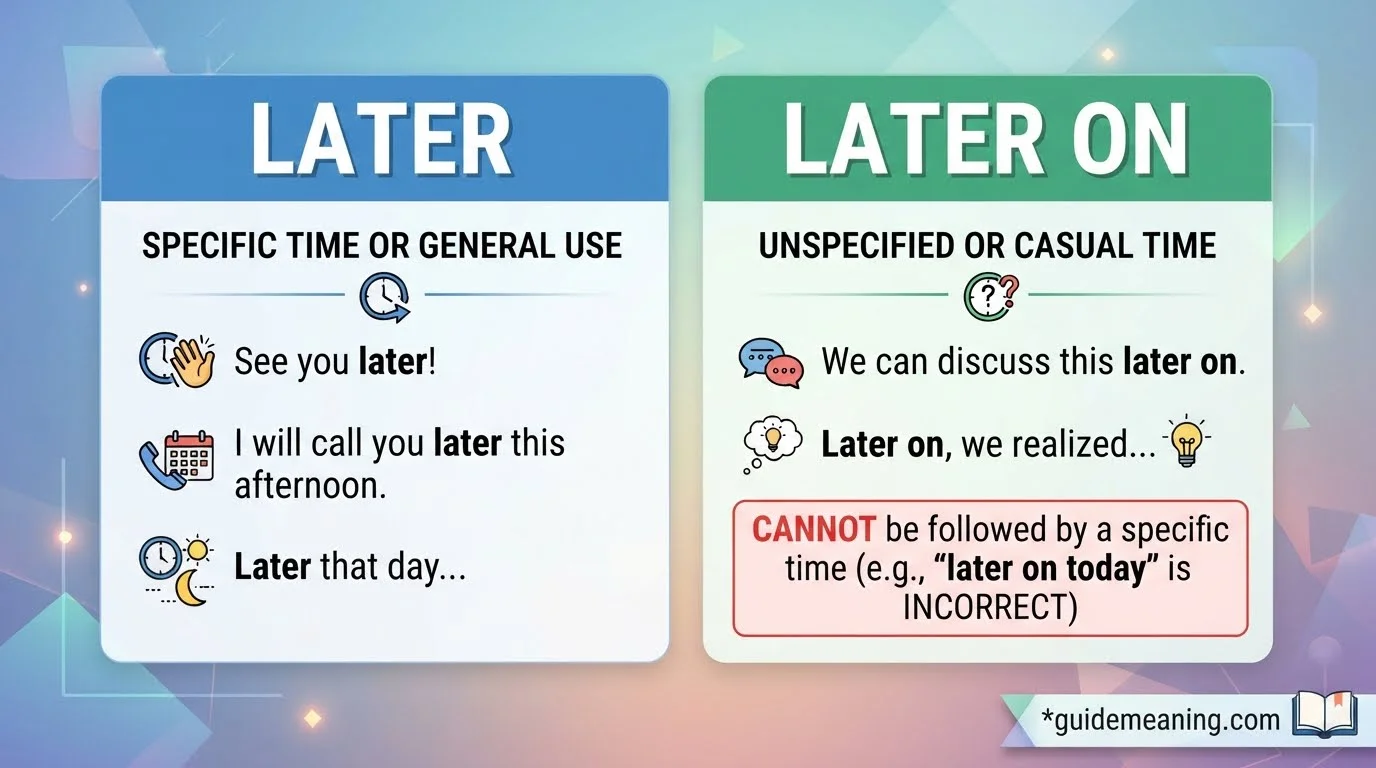
“Later” means at a time after the present or after another event. “Later on” has essentially the same meaning, often referring to a subsequent point in a day, activity, story, or period.
Both expressions are correct in many situations. The best choice depends on your sentence and the meaning you want to convey.
- Use later for short, direct statements, comparisons, and general references to future time.
- Use later on when referring to a subsequent point or stage, especially in conversation or storytelling.
- Use later than when comparing times or events.
- Use later as an informal farewell, as in “See you later!”
Examples:
- I’ll finish the assignment later.
- I’ll finish the assignment later on.
- We arrived later than expected.
- Later on, we discovered what had happened.
The first two sentences express essentially the same idea. The third compares arrival times, while the fourth moves a story forward.
Remember that “later on” doesn’t automatically mean much later. Context determines how much time passes between events.
Comparison Overview
The expressions “later” and “later on” share the same central meaning, but their grammatical uses aren’t identical.
| Feature | Later | Later On |
| Basic meaning | At a future or subsequent time | At a future or subsequent time |
| Grammatical form | Adverb; also an adjective | Adverbial phrase |
| Everyday conversation | Very common | Very common |
| Storytelling | Refers to a subsequent time or event | Often helps emphasize a later stage |
| Formal writing | Suitable in many contexts | Also acceptable when appropriate |
| Comparative sentences | Correct: “later than expected” | Generally unsuitable in the same construction |
| Before a noun | Correct: “a later meeting” | Not used this way |
| Informal farewell | “Later!” is common | Not normally used alone as a farewell |
| Interchangeable meaning | Often | Often |
The key distinction is flexibility. “Later” can serve several grammatical purposes, while “later on” primarily functions as an adverbial phrase.
For example, “We scheduled a later meeting” is correct because “later” describes the meeting. You can’t replace it with “later on” in that sentence without changing the structure.
However, both expressions work in “We’ll discuss the schedule later” and “We’ll discuss the schedule later on.”
What Does “Later” Mean?
Definition of Later
Later refers to a time after the present moment or after another time or event. It helps you describe when something happens without specifying an exact hour, date, or duration.
For example, if your friend asks when you’ll call, you might say, “I’ll call you later.” Your friend understands that the call will happen after the current moment, even if you haven’t chosen a specific time.
The word can also describe events in the past when you’re explaining their sequence.
Consider this example: “We ate dinner and watched a movie two hours later.” Here, “later” refers to a time after dinner rather than a time after the present.
According to its grammatical role, “later” can function as an adverb or an adjective.
- Adverb: I’ll finish the assignment later.
- Adjective: We scheduled a later appointment.
- Comparative adverb: She arrived later than her colleague.
These different uses make “later” a flexible word in everyday English.
Examples of Later in Sentences
The following examples show how “later” works in different situations.
| Example Sentence | Meaning |
| I’ll call you later. | The call will happen in the future. |
| We arrived two hours later. | The arrival happened two hours after another event. |
| She later became a doctor. | Becoming a doctor happened at a subsequent point in her life. |
| Let’s take a later train. | The train will depart after another available train. |
| I’ll finish this later today. | The task will be completed before the current day ends. |
| He apologized later. | The apology happened after an earlier event. |
| The meeting started later than planned. | The meeting began after its expected time. |
| We’ll discuss that at a later date. | The discussion will happen on another date. |
Notice how “later” works in several grammatical structures. Sometimes it appears at the end of a sentence. In other cases, it comes before a verb or noun.
When Should You Use Later?
Choose “later” when you want to express a future time clearly and naturally. It works especially well when the exact timing doesn’t matter or everyone already understands the reference point.
Here are some common situations:
- Making plans: I’ll meet you later.
- Postponing a task: We can finish the paperwork later.
- Describing a sequence: She left work and called me later.
- Comparing times: The second train arrived later than the first.
- Referring to a future period: We’ll review the proposal at a later stage.
For instance, imagine you’re working on a report when a colleague asks for an update. If you haven’t decided when you’ll finish, “I’ll send it later” communicates your intention without promising a specific deadline.
However, if your colleague needs the report before a meeting, a more precise answer would help. Saying “I’ll send it by 2 p.m.” removes the uncertainty.
The word “later” works best when a general time reference provides enough information.
What Does “Later On” Mean?
Definition of Later On
Later on means at a future time or at a point after something else. Speakers commonly use it when discussing plans, telling stories, or describing how a situation develops.
For example, consider this sentence:
“First, we visited the museum. Later on, we went to a nearby restaurant.”
The phrase connects two events and makes their order clear. The restaurant visit happened after the museum visit.
However, “later on” doesn’t require a long delay. You might use it for something happening in an hour, later that evening, or at a much more distant point.
Consider these examples:
- I’ll speak to the manager later on.
- We might travel abroad later on this year.
- Later on, she realized that she’d made a mistake.
- The children played outside and watched a movie later on.
In each sentence, the phrase points toward a subsequent time. The surrounding details establish when that time occurs.
Examples of Later On in Sentences
| Example Sentence | Meaning |
| I’ll finish the report later on. | The report will be completed at a future time. |
| Later on, we went for dinner. | Dinner happened after an earlier activity. |
| You might understand the decision better later on. | Understanding may develop in the future. |
| What are you doing later on this evening? | The speaker asks about plans for a later part of the evening. |
| We discussed the issue again later on. | The discussion happened after an earlier conversation. |
| Later on in life, he became a writer. | Becoming a writer happened during a subsequent stage of life. |
| I’ll explain the details later on in the meeting. | The explanation will come during a later part of the meeting. |
| The team encountered problems later on. | The problems arose after an earlier stage. |
These examples demonstrate that “later on” can refer to both future plans and events in a story about the past.
When Should You Use Later On?
Use “later on” when it helps your sentence flow naturally or highlights a point that comes after something else.
It often works well in three situations.
When discussing plans: You can use the phrase to talk about something you expect to do at a future time.
Example: “I’m busy this morning, but I can help you later on.”
When telling a story: The phrase can help readers follow the order of events.
Example: “The hikers started early. Later on, they found a quiet place to rest.”
When describing a later stage: You can use it to discuss developments that happen after an earlier phase.
Example: “The training seemed difficult at first, but the exercises became easier later on.”
Still, you don’t need to add “on” every time you mention a future event. If “later” communicates your meaning perfectly, the shorter version is equally acceptable.
Main Differences Between Later vs. Later On
Although these expressions overlap in meaning, a few important distinctions affect how you use them.
Difference in Meaning
The main difference concerns emphasis rather than a fixed difference in time.
“Later” is a general reference to a subsequent time. “Later on” can place slightly more emphasis on a point further along in a sequence or period.
Compare these examples:
- I’ll call you later.
- I’ll call you later on.
Both sentences indicate that the call will happen in the future. Neither sentence tells you exactly how long you’ll wait.
Now consider a narrative:
- We started the experiment. Later, we recorded the results.
- We started the experiment. Later on, we recorded the results.
Both versions describe the same sequence. The second may sound more like a transition to a subsequent stage, but this difference is subtle.
Don’t assume that “later on” means tomorrow or next week while “later” means a few minutes from now. English doesn’t establish that rule.
Difference in Grammar
The clearest distinction appears when you examine the grammatical structure.
“Later” can function as an adverb, an adjective, or part of a comparative construction.
Examples include:
- She arrived later.
- We booked a later flight.
- The meeting ended later than expected.
By contrast, “later on” functions as an adverbial phrase. It describes when an action occurs rather than directly modifying a noun.
For example:
- We’ll discuss the matter later on.
- They moved to another city later on.
You wouldn’t normally say “a later on meeting” to describe a meeting scheduled for a subsequent time. Instead, say “a later meeting.”
This distinction matters because replacing one expression with the other can make a sentence grammatically awkward.
Difference in Tone and Natural Usage
Both expressions sound natural in everyday American English. Neither one is automatically more correct, polite, or professional.
However, speakers may choose between them for rhythm and emphasis.
Consider these examples:
- “I’ll see you later.”
- “I’ll see you later on.”
The first is short and familiar. The second can work when you’re referring to a particular future occasion, although it may sound less natural as a simple farewell.
In a story, “later on” can also provide a smooth transition between events. Meanwhile, “later” often keeps the writing concise.
The best choice depends on the sentence, not on a rigid rule about formality.
Difference in Sentence Structure
Sentence structure provides another useful way to distinguish the expressions.
Consider these examples:
- Correct: The delivery arrived later than expected.
- Awkward: The delivery arrived later on than expected.
The first sentence uses the standard comparative construction “later than.” Adding “on” generally doesn’t work in that construction.
Now compare these sentences:
- We’ll discuss the delivery later.
- We’ll discuss the delivery later on.
Both work because neither sentence uses “later” to make a direct comparison.
This is one of the most practical rules to remember when choosing between the two expressions.
Can You Use Later and Later On Interchangeably?
In many sentences, yes. However, interchangeability depends on grammatical structure and intended meaning.
When Both Expressions Are Correct
Both expressions work when you’re referring to a future or subsequent time without using a construction that requires “later.”
| Using Later | Using Later On |
| I’ll send you the details later. | I’ll send you the details later on. |
| We discussed the problem later. | We discussed the problem later on. |
| She’ll explain everything later. | She’ll explain everything later on. |
| They returned home later. | They returned home later on. |
| I’ll finish the assignment later today. | I’ll finish the assignment later on today. |
The final pair deserves a closer look. Both “later today” and “later on today” are natural expressions. However, the shorter version is often more concise.
Likewise, both versions in the other rows can express the same basic meaning. Your choice can depend on conversational rhythm or personal preference.
When You Cannot Easily Replace One With the Other
Some grammatical constructions favor “later” rather than “later on.”
Comparisons
Use “later than” when comparing two times or events.
- Correct: We arrived later than our friends.
- Incorrect in standard usage: We arrived later on than our friends.
Adjective use
Use “later” before a noun when describing a subsequent time or version.
- Correct: We scheduled a later appointment.
- Incorrect: We scheduled a later on appointment.
Informal farewells
“Later!” is a common casual way to say goodbye in American English.
For example:
“I’m heading home now. See you later!”
You wouldn’t normally use “Later on!” as a standalone equivalent. However, “See you later on” may work when referring to a planned meeting later that day.
How Context Changes the Best Choice
Context determines which expression sounds most natural.
In a casual conversation, “I’ll text you later” is direct and familiar. In a story, “Later on, the situation became more complicated” can help introduce another development.
Professional communication also benefits from context. If a coworker asks when you’ll send a file, “I’ll send it later on” is understandable. However, “I’ll send it this afternoon” gives a clearer time reference.
The goal isn’t to choose the longer expression. It’s to communicate the timing without making the reader guess.
Grammar Rules for Using Later and Later On
Using Later With Specific Time References
“Later” commonly appears with time expressions that clarify when something will happen.
Examples include:
- Later today
- Later this week
- Later this month
- Later this year
- Two hours later
- Three days later
- Later than expected
These constructions serve different purposes.
“Later today” refers to a time before the current day ends. “Two hours later” identifies a point two hours after an established reference time. “Later than expected” compares an actual time with an anticipated one.
For example:
“We started the meeting at 10 a.m. Two hours later, we finally reached a decision.”
The phrase “two hours later” works because the earlier meeting time establishes the reference point.
Using Later On With Time Expressions
You can also combine “later on” with expressions that identify a period or stage.
Examples include:
- Later on today
- Later on this evening
- Later on in the week
- Later on in the discussion
- Later on in life
These phrases are grammatically acceptable, although some alternatives sound more concise.
For instance, “I’ll call you later this evening” and “I’ll call you later on this evening” both work. The shorter version may sound smoother in ordinary conversation.
However, “later on in life” is a natural expression when discussing developments across someone’s lifetime.
Example: “He developed an interest in painting later on in life.”
Here, the phrase connects an interest with a subsequent stage of life rather than an exact date.
Sentence Position and Punctuation
Both expressions can appear at the beginning or end of a sentence. They can also appear elsewhere when the sentence structure allows.
Examples:
- Later, we reviewed the results.
- We reviewed the results later.
- Later on, we reviewed the results.
- We reviewed the results later on.
When “later” or “later on” introduces a complete clause, a comma often improves readability.
For example:
“Later on, we discovered the reason for the delay.”
The comma separates the introductory phrase from the main clause. However, you don’t generally need a comma when the time expression appears naturally at the end.
Example: “We discovered the reason for the delay later on.”
Punctuation can also depend on sentence length and style. The important thing is to make the sentence easy to follow.
Later vs. Later On in Everyday Situations
The expressions become easier to understand when you see how people use them in familiar situations.
In Casual Conversations and Text Messages
Short messages usually benefit from direct language.
Imagine your friend asks whether you’re available for a phone call.
You might reply:
- “I’m busy right now. Call me later.”
- “I’m busy right now. Call me later on.”
Both messages are understandable and grammatically acceptable.
However, “Call me later” is shorter and often sounds more natural as a quick instruction.
Here are other everyday examples:
- I’ll tell you later.
- Let’s talk about it later on.
- I’ll see you later.
- We can grab lunch later on today.
When texting, choose the expression that matches your tone. You don’t need to add “on” just to make a sentence sound more conversational.
In Professional Emails and Workplace Communication
In workplace writing, clarity matters more than stylistic variation.
Consider these examples:
Less specific: I’ll send you the report later.
Also less specific: I’ll send you the report later on.
More specific: I’ll send you the report by 3 p.m. today.
The first two sentences communicate an intention but leave the timing open. The third establishes a deadline.
Here are additional workplace examples:
- I’ll review the proposal later today.
- We can discuss the budget later in the meeting.
- I’ll provide further details at a later date.
- The team identified the problem later in the process.
Both “later” and “later on” can appear in professional communication. Neither expression is inherently unprofessional.
However, when a task depends on a deadline, a specific time usually helps everyone plan more effectively.
In Stories and Written Narratives
Writers often use time expressions to guide readers through a sequence of events.
For example:
“Emma arrived at the station just before sunrise. She bought a ticket and found a seat near the window. Later on, the train stopped unexpectedly, and passengers began asking questions.”
The phrase “later on” introduces a subsequent event. It helps move the narrative forward without repeating the entire timeline.
You could also write:
“Emma arrived at the station just before sunrise. She bought a ticket and found a seat near the window. Later, the train stopped unexpectedly.”
Both versions work. The choice depends on the pace and rhythm of the passage.
Writing tip: Avoid beginning every other sentence with “later” or “later on.” Try alternatives such as “afterward,” “eventually,” or “a few hours later” when they accurately express the intended relationship.
These alternatives aren’t perfect substitutes in every context, but they can add variety to a narrative.
In Academic and Formal Writing
Both expressions can appear in formal writing when they fit the sentence. Still, academic work often benefits from precise references to time or sequence.
Consider these examples:
- The researchers examined the results later.
- The researchers examined the results later on.
- The researchers examined the results during a subsequent stage.
All three sentences can work, but the third emphasizes a particular stage in the research process.
For example, a report might say:
“The team collected the initial data in January. Later in the study, researchers compared the results across both groups.”
This sentence identifies the sequence without suggesting an exact interval.
If the timing matters to your argument, use a specific date, stage, or duration instead of relying on a general expression.
Common Mistakes When Using Later and Later On
Even though these expressions are straightforward, a few mistakes appear regularly.
Assuming Later On Always Means Much Later
One common misunderstanding is that “later on” refers to a longer delay than “later.”
That isn’t a reliable grammatical rule.
Compare:
- I’ll call you later.
- I’ll call you later on.
Either sentence could refer to a call in twenty minutes or several hours. The speaker hasn’t specified the delay.
Likewise, “Later on in the meeting” could refer to the next few minutes rather than an event much further in the future.
Remember: Context determines the timing. The word “on” doesn’t establish a minimum waiting period.
Using Later On in Comparative Sentences
Comparative constructions typically use “later than.”
Incorrect: The bus arrived later on than scheduled.
Correct: The bus arrived later than scheduled.
Incorrect: She finished later on than her teammate.
Correct: She finished later than her teammate.
In each corrected example, “later than” compares two times. Adding “on” makes the construction unnatural in standard English.
This is one of the clearest situations where the expressions aren’t interchangeable.
Confusing Later With Latter
Later and latter look similar, but they have different meanings.
“Later” refers to time. “Latter” identifies the second of two items previously mentioned.
Consider these examples:
- I’ll explain the details later.
- We can travel by train or bus. The latter is cheaper.
In the first sentence, the explanation will happen in the future. In the second, “the latter” refers to the second option, which is the bus.
A simple memory trick can help: later relates to time, while latter relates to the second item.
Adding Extra Words That Don’t Improve Clarity
Longer wording doesn’t automatically make a sentence better.
For example:
- Concise: I’ll call you later.
- Longer: I’ll call you later on.
Both are correct, but the shorter version may communicate the same idea more efficiently.
This doesn’t mean you should avoid “later on.” Use it whenever it fits naturally or helps the sentence flow.
The goal is to choose the wording that communicates your meaning without unnecessary repetition.
Later vs. Later On: Examples With Explanations
The following examples cover common situations and show when each expression works best.
| Situation | Example | Explanation |
| Arranging a phone call | I’ll call you later. | Natural, direct reference to a future time. |
| Arranging a phone call | I’ll call you later on. | Also correct, depending on context and preference. |
| Describing a past event | We went shopping and ate dinner later. | “Later” establishes the order of events. |
| Telling a story | Later on, the weather began to change. | “Later on” introduces a subsequent development. |
| Discussing future plans | We can meet later today. | Concise and natural. |
| Discussing future plans | We can meet later on today. | Also correct, though slightly longer. |
| Comparing arrival times | She arrived later than I did. | Correct comparative construction. |
| Comparing arrival times | She arrived later on than I did. | Generally unnatural in standard English. |
| Describing a future appointment | We scheduled a later appointment. | “Later” functions as an adjective. |
| Talking about life stages | He became interested in music later on in life. | Refers to a subsequent stage of life. |
| Saying goodbye | See you later! | Common informal farewell. |
| Referring to a meeting | I’ll explain that later on in the meeting. | Places the explanation at a subsequent point in the meeting. |
These examples show that context and grammar matter more than the length of the expression.
When both options work, choose the one that sounds natural in your sentence. When the construction requires “later,” such as “later than expected,” follow that grammatical pattern.
Later vs. Later On: Which One Should You Use?
If you’re still unsure which expression to choose, focus on three practical guidelines.
Choose Later for Short, Direct Statements
“Later” is a reliable choice when you want to keep a sentence simple.
Examples:
- I’ll see you later.
- We’ll discuss this later.
- She called me later.
- Let’s schedule a later meeting.
It also works in comparisons and before nouns. This flexibility makes it useful in everyday conversations, emails, and formal writing.
When the shorter expression communicates your meaning clearly, there’s usually no need to add “on.”
Choose Later On to Emphasize a Subsequent Point
“Later on” works well when you want to move a conversation or narrative toward another stage.
Examples:
- Later on, we discovered the mistake.
- I’ll explain the next step later on.
- The process became easier later on.
- Later on in the semester, students completed another assessment.
The phrase can make transitions feel natural, especially when describing a sequence of events.
However, don’t force it into a sentence just because you’re discussing the future. “Later” remains correct in many of the same situations.
Use Specific Time References When Timing Matters
Neither “later” nor “later on” tells the reader exactly when something will happen.
If timing affects a plan, choose a more precise expression.
| General Expression | More Specific Alternative |
| I’ll call you later. | I’ll call you at 5 p.m. |
| I’ll send the file later on. | I’ll send the file before noon. |
| We’ll meet later this week. | We’ll meet on Thursday afternoon. |
| I’ll finish the project later. | I’ll finish the project by Friday. |
Specific times and deadlines reduce uncertainty. They’re especially useful when coordinating schedules, assigning tasks, or making professional commitments.
Use general expressions when exact timing isn’t necessary. Choose specific details when other people need to plan around your decision.
FAQs:
What is the main difference between later and later on?
Later is a shorter, more flexible expression for a future time. Later on often sounds more conversational and can emphasize a point farther along in a sequence of events. Both expressions usually have the same basic meaning.
Are later and later on interchangeable?
Yes, later and later on are often interchangeable in everyday English. For example, “I’ll call you later” and “I’ll call you later on” are both correct. The choice usually depends on your preferred style and emphasis.
Is later more formal than later on?
Generally, later works well in both formal and informal English. Later on often sounds more conversational, although it is also acceptable in many professional and written contexts.
When should I use later in a sentence?
Use later when you want to refer to an unspecified future time without adding extra emphasis. For example, “I’ll finish the report later” tells someone that you plan to finish it afterward.
When should I use later on in a sentence?
Use later on when you want a conversational tone or want to highlight a point farther along in a process, day, or sequence. For example, “We’ll discuss the results later on” sounds natural in everyday conversation.
Does later on always mean a longer period than later?
No, later on doesn’t always refer to a longer period. Both expressions can describe events happening after the present moment or another stated time. The difference usually involves style and emphasis rather than an exact time interval.
Which expression is better for professional writing?
Later is often the simpler choice for professional writing because it’s concise and flexible. However, later on can also work when it fits the sentence naturally. Choose the expression that makes your intended meaning clear.
Conclusion:
Understanding later vs. later on is easier when you focus on context, timing, and tone. Both expressions describe something happening in the future, and they often work interchangeably. Use later for a simple, direct time reference. Choose later on when you prefer a conversational tone or want to emphasize a point in a sequence. Neither expression is automatically better in every situation. With regular practice, you’ll learn to use both naturally in conversations, emails, and professional writing.