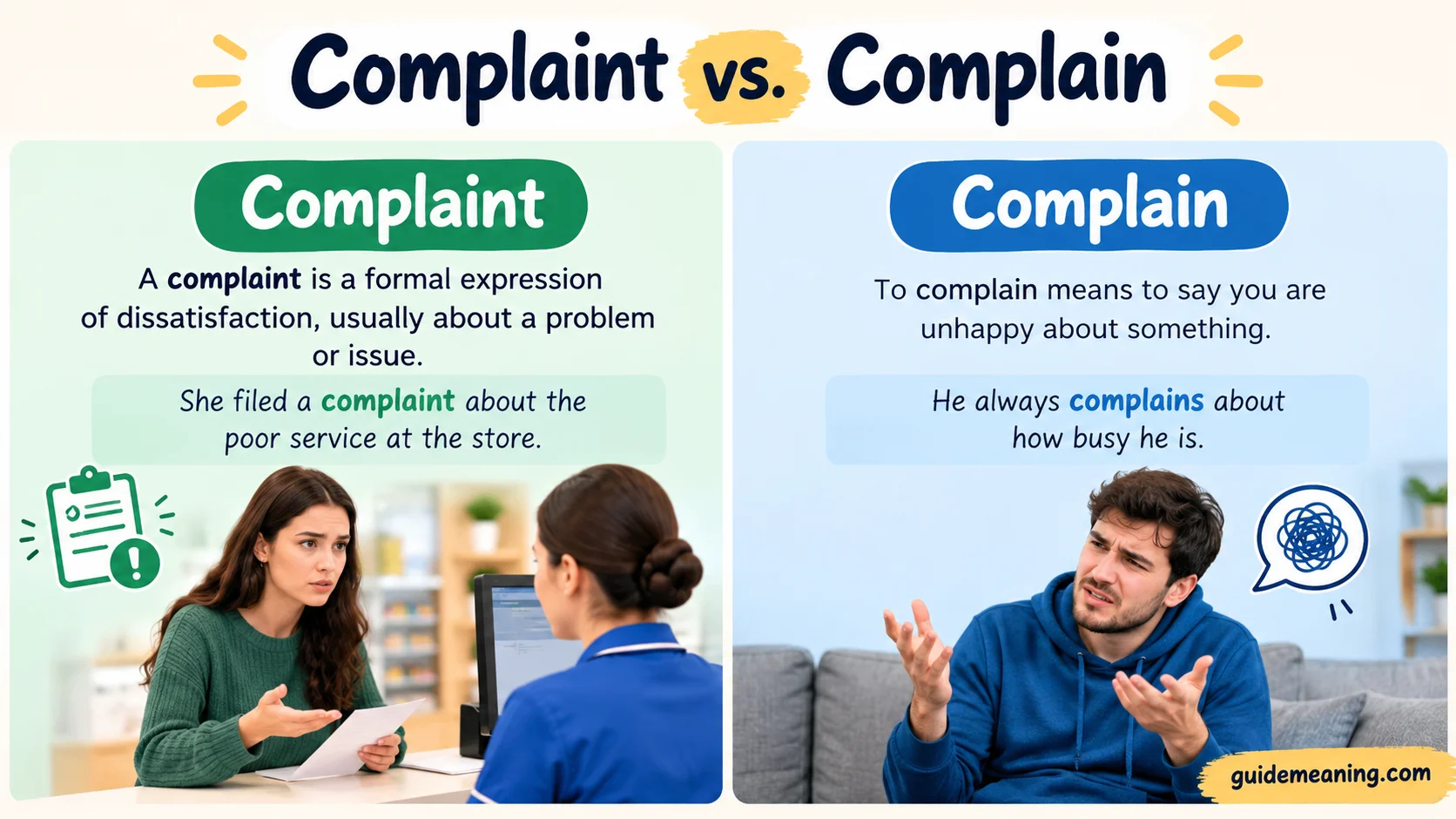

Complaint vs. Complain becomes easier to understand when you learn how these words work in English Grammar and everyday writing. A complaint is a noun that names a problem, a statement of dissatisfaction, or an expression of dissatisfaction. It can also describe a physical symptom, such as pain, grief, or unease. Complain is a verb that describes the action of expressing dissatisfaction, reporting a problem, or mentioning pain. Although both words share a meaning and belong to the same word family, they have different grammatical roles and functions. The main difference is that a noun names something, while a verb expresses an action.
For example, you can say, “I have a complaint about the service,” or “I want to complain about the service.” In the first sentence, complaint names the issue. In the second, complain expresses an action. Use complaint with words such as my or your, and use complain after a subject such as I, we, customers, or employees. These correct sentence patterns, prepositions, and verb forms help you choose the right word. In my editing experience, I have noticed this confusion in customer service messages, workplace emails, school writing, academic reports, medical reports, legal documents, and school notices. Even fluent learners can make common mistakes because the structure seems easy, but the meaning changes with the context. Such small errors can affect accuracy, clarity, tone, and sentence flow in formal communication and official contexts.
A good way to remember the difference is to connect complaint with a thing and complain with an action. This simple rule makes choosing the form easier. Pay attention to usage in everyday conversation, workplace messages, customer-service requests, and formal writing. Once you understand how each word works, you can pronounce both forms correctly, notice patterns, and avoid errors through regular practice. Native English speakers use both words naturally, and writers can improve their communication by checking whether a sentence needs a noun or a verb. This approach helps your writing sound more professional and correct.
Let’s dive in!
Quick Answer:
What Is the Difference Between Complaint and Complain?
Complaint vs. complain comes down to one simple distinction: complaint names a problem or expression of dissatisfaction, while complain describes the act of expressing dissatisfaction. In American English, you make a complaint, but you complain about something.
TL;DR
- Complaint is a noun that names an issue or expression of dissatisfaction.
- Complain is a verb that describes expressing dissatisfaction.
- You make a complaint, but you complain about a problem.
- Complaints can be formal, informal, personal, professional, or official.
- Both words appear in everyday conversations and professional communication.
- Remember the rule: You complain when you make a complaint.
What Does Complaint Mean?
The word complaint refers to a statement, concern, or report about something unsatisfactory. It can describe anything from poor restaurant service to an official report about unfair treatment.
Because it is a noun, complaint names something rather than describing an action. You can have a complaint, make a complaint, or submit a complaint.
Examples of Complaint in Everyday English
Consider these sentences:
- My main complaint is the long waiting time.
- The customer filed a complaint about the damaged product.
- We received several complaints about the noisy neighbors.
- Her only complaint was that the room felt too cold.
- The manager addressed every customer complaint.
In each example, complaint identifies a concern or report. It doesn’t describe the act of expressing dissatisfaction.
Common Forms of Complaint
The word has a few common forms and related expressions.
- A complaint: One concern or statement of dissatisfaction.
- The complaint: A specific concern already mentioned or understood.
- Complaints: The plural form, used for multiple concerns.
- Customer complaint: A report about a product, service, or experience.
- Formal complaint: An officially submitted concern or allegation.
For example, a customer might say, “I have a complaint about my order.” The noun identifies the issue the customer wants someone to address.
What Does Complain Mean?
Complain is a verb that means to express dissatisfaction, annoyance, discomfort, or concern. It describes what someone does when they believe something is wrong or unsatisfactory.
Unlike complaint, the verb changes according to the subject and tense. You can complain today, complained yesterday, or be complaining right now.
Examples of Complain in Everyday English
Here are several natural examples:
- I want to complain about the poor service.
- She complains whenever the office gets too cold.
- They complained about the delayed delivery.
- We are complaining because nobody answered our questions.
- He has complained about the noise several times.
Notice how each sentence describes an action. Someone expresses dissatisfaction, reports a problem, or tells another person about an unpleasant experience.
Common Forms of Complain
The verb takes different forms depending on the sentence.
| Verb Form | Example |
| Complain | I want to complain about the service. |
| Complains | She complains about everything. |
| Complained | They complained about the delay yesterday. |
| Complaining | He is complaining about the temperature. |
| Have complained | We have complained several times. |
These forms help you discuss complaints across different situations and time periods. However, none of them replaces the noun complaint.
Complaint vs. Complain: Key Differences
Although both words share a meaning related to dissatisfaction, their grammatical roles differ. Understanding those roles helps you choose the correct word without memorizing dozens of examples.
Comparison Table
| Feature | Complaint | Complain |
| Part of speech | Noun | Verb |
| Main meaning | A concern or expression of dissatisfaction | The act of expressing dissatisfaction |
| Common phrase | Make a complaint | Complain about something |
| Plural form | Complaints | No ordinary plural form |
| Past tense | Not applicable | Complained |
| Example | I have a complaint. | I want to complain. |
How to Choose the Right Word
Ask yourself whether you’re naming a concern or describing an action.
If you’re naming the concern, use complaint. If you’re describing what someone does, use complain.
For example, “The customer made a complaint” identifies a report. Meanwhile, “The customer complained” describes the customer’s action.
This distinction also works in professional writing, emails, conversations, and formal reports. Once you recognize the grammatical role, the correct choice usually becomes obvious.
Complaint vs. Complain in American English
In the United States, both words appear frequently in customer service, workplaces, schools, healthcare, and everyday conversations. Their meanings remain consistent across these settings, although the tone and level of formality can change.
Everyday American Conversations
Americans often use complain when discussing minor frustrations or expressing dissatisfaction.
For example:
- My brother always complains about traffic.
- I don’t want to complain, but this coffee is cold.
- She complained that the movie was too long.
By contrast, complaint often names the specific concern.
For example:
- I have a complaint about the food.
- His biggest complaint is the lack of parking.
- We received a complaint from our neighbor.
Professional and Customer Service Situations
In American workplaces, complaint often sounds more formal than a casual expression of dissatisfaction. Businesses may record customer complaints, investigate employee complaints, or establish procedures for handling concerns.
The verb complain describes the action of raising those concerns. For instance, an employee might complain to a supervisor about an unfair schedule.
Both words are appropriate in professional settings. However, choosing the right grammatical form helps your message sound clear and polished.
Complaint vs. Complain in Formal Writing
Formal writing often requires precise language because readers need to understand exactly what happened. The distinction between a noun and a verb becomes especially important in emails, business reports, and official correspondence.
Writing a Professional Email
Suppose a product arrives damaged. You could write:
Correct: I would like to make a complaint about the damaged item.
Also correct: I would like to complain about the damaged item.
Both sentences communicate the same concern, but their structures differ. The first names the report you’re making, while the second describes the action you want to take.
Writing Reports and Workplace Messages
Consider these examples:
- The department received three complaints this month.
- Several employees complained about the new schedule.
- The manager reviewed the complaint before responding.
- Customers complained that the instructions were unclear.
In each case, the word fits its grammatical role. Using complain where a noun is required would make the sentence incorrect.
For instance, “The department received three complain” should be “The department received three complaints.”
Common Mistakes With Complaint and Complain
These words are easy to confuse because their spelling and meanings are closely related. Fortunately, most mistakes follow a few predictable patterns.
Mistake: Saying “I Have a Complain”
Incorrect: I have a complain about the service.
Correct: I have a complaint about the service.
The phrase I have a requires a noun in this sentence. Therefore, complaint is the correct choice.
Mistake: Saying “I Want to Complaint”
Incorrect: I want to complaint about the problem.
Correct: I want to complain about the problem.
Here, to introduces the base form of the verb. Since complaint is a noun, it cannot replace complain in this construction.
Mistake: Using Complaint as a Verb
Incorrect: She complaint about the noise every night.
Correct: She complains about the noise every night.
The sentence describes an action performed by she. In the present tense, the correct verb form is complains.
Mistake: Confusing Complained and Complaint
Incorrect: He complaint about the delay yesterday.
Correct: He complained about the delay yesterday.
The word yesterday signals a past event, so the past-tense verb complained is appropriate.
Complaint vs. Complain: Sentence Patterns to Remember
Learning common sentence patterns can make these words easier to use naturally. Instead of focusing only on definitions, pay attention to the words that typically appear before and after them.
Common Patterns With Complaint
Use these structures when naming a concern:
- Have a complaint: I have a complaint about my bill.
- Make a complaint: She made a complaint to the manager.
- File a complaint: They filed a complaint about the incident.
- Receive a complaint: The company received a customer complaint.
- Address a complaint: The supervisor addressed the employee’s complaint.
These expressions work because complaint functions as a noun. Words such as a, the, my, and several can appear before it.
Common Patterns With Complain
Use these structures when describing an action:
- Complain about: He complained about the service.
- Complain to: She complained to the supervisor.
- Complain that: They complained that the room was dirty.
- Complain of: The patient complained of discomfort.
- Keep complaining: He keeps complaining about the weather.
Notice the difference between about and to. You generally complain about the problem and complain to the person or organization receiving your concern.
The History and Development of Complaint and Complain
Although this is a grammar distinction rather than a symbol, the words have an interesting linguistic history. Their shared roots help explain why their spelling and meanings remain closely connected today.
Where Did Complain Come From?
The verb complain entered English through older French forms related to expressing sorrow, grief, or distress. Its deeper history traces to Latin roots associated with lamenting or expressing pain.
Over time, the word developed a broader meaning. Instead of describing only sorrow or suffering, it came to include dissatisfaction, objections, and reports of problems.
Today, people complain about everything from uncomfortable shoes to workplace policies. The word still expresses dissatisfaction, but its use extends well beyond emotional grief.
How Did Complaint Develop?
The noun complaint developed through related French and Middle English forms. It came to describe the expression of distress and, more broadly, the concern being expressed.
As formal systems of business and public administration developed, the noun gained additional uses. It became common for describing recorded concerns, official allegations, and written reports.
However, its everyday meaning remained familiar. A complaint can still be as simple as a comment about cold coffee or a delayed package.
Complaint vs. Complain in Business, Healthcare, and Official Settings
The distinction matters beyond everyday conversations. In the United States, these words appear in settings where accurate descriptions can help people understand concerns and records.
Business and Customer Service
A business might receive a complaint about a defective product. The customer might complain to customer support, while the company investigates the complaint.
These sentences describe connected but different things. The verb describes the customer’s action, and the noun identifies the concern being addressed.
Healthcare
In healthcare, complaint can refer to a symptom or concern reported by a patient. For example, a patient’s main complaint might be a persistent cough or stomach discomfort.
The verb complain describes the act of reporting that concern. A patient might complain of pain or complain about an uncomfortable experience.
Official and Legal Contexts
In some official contexts, a complaint is a formal document or statement that raises allegations. The word has a more specific meaning here than it does in casual conversation.
The verb complain can describe expressing dissatisfaction or reporting an alleged problem to an appropriate authority. The exact meaning depends on the situation and the relevant procedure.
Importantly, the word complaint alone doesn’t prove that an allegation is true. It identifies a concern or formal claim that may require further review.
Emotional Meaning and Social Perceptions of Complaining
Although complaint and complain aren’t traditional symbols, they can carry emotional and social associations. In American culture, complaining may be viewed as helpful problem-solving or unnecessary negativity, depending on the circumstances.
When Complaining Is Constructive
Raising concerns can help people identify problems and improve difficult situations. For example, a customer who complains about unsafe conditions may help bring attention to an important issue.
Likewise, employees who complain about unclear instructions may reveal a problem that affects an entire team. In these situations, expressing dissatisfaction can support communication and change.
When Complaining Sounds Negative
Repeated complaints without constructive discussion may frustrate listeners. Someone who complains about every minor inconvenience might be perceived as overly negative.
However, context matters. A person who raises concerns about unfair treatment shouldn’t automatically be dismissed as difficult or pessimistic.
The noun complaint can sound more neutral because it names the concern itself. The verb complain sometimes carries a negative tone, although it can also describe reasonable and necessary communication.
FAQs:
What is the main difference between complaint and complain?
Complaint is a noun that refers to a problem or an expression of dissatisfaction. Complain is a verb that describes expressing dissatisfaction or reporting a problem.
Is complaint a noun or a verb?
Complaint is a noun. You use it to name a problem, concern, or expression of dissatisfaction. For example, “I filed a complaint about the poor service.”
Is complain a noun or a verb?
Complain is a verb. It describes the action of expressing dissatisfaction, reporting an issue, or mentioning discomfort. For example, “Customers complain about long waiting times.”
How do you use complaint in a sentence?
Use complaint when you want to name an issue or concern. For example, “She made a complaint about the noisy neighbors.” You can also say, “I received your complaint yesterday.”
How do you use complain in a sentence?
Use complain when describing an action. For example, “Employees complain about unfair working conditions.” You can also say, “I want to complain to the manager.”
What are the correct prepositions to use with complaint and complain?
Common expressions include a complaint about something, a complaint against someone, complain about something, and complain to someone. For example, “He complained to the manager about the service.”
Why do people confuse complaint and complain?
People often confuse these words because they look and sound similar and share related meanings. However, their grammatical roles differ. Remember that complaint names an issue, while complain describes an action.
Conclusion:
Understanding complaint vs. complain becomes easier when you focus on each word’s grammatical role. Use complaint as a noun when naming a problem, concern, or expression of dissatisfaction. Choose complain as a verb when describing the act of expressing dissatisfaction or reporting an issue.
With regular practice, you can use both words correctly in everyday conversations, workplace emails, customer service messages, and formal writing. Check whether your sentence needs a noun or a verb, and you’ll avoid common mistakes while making your writing clearer and more professional.