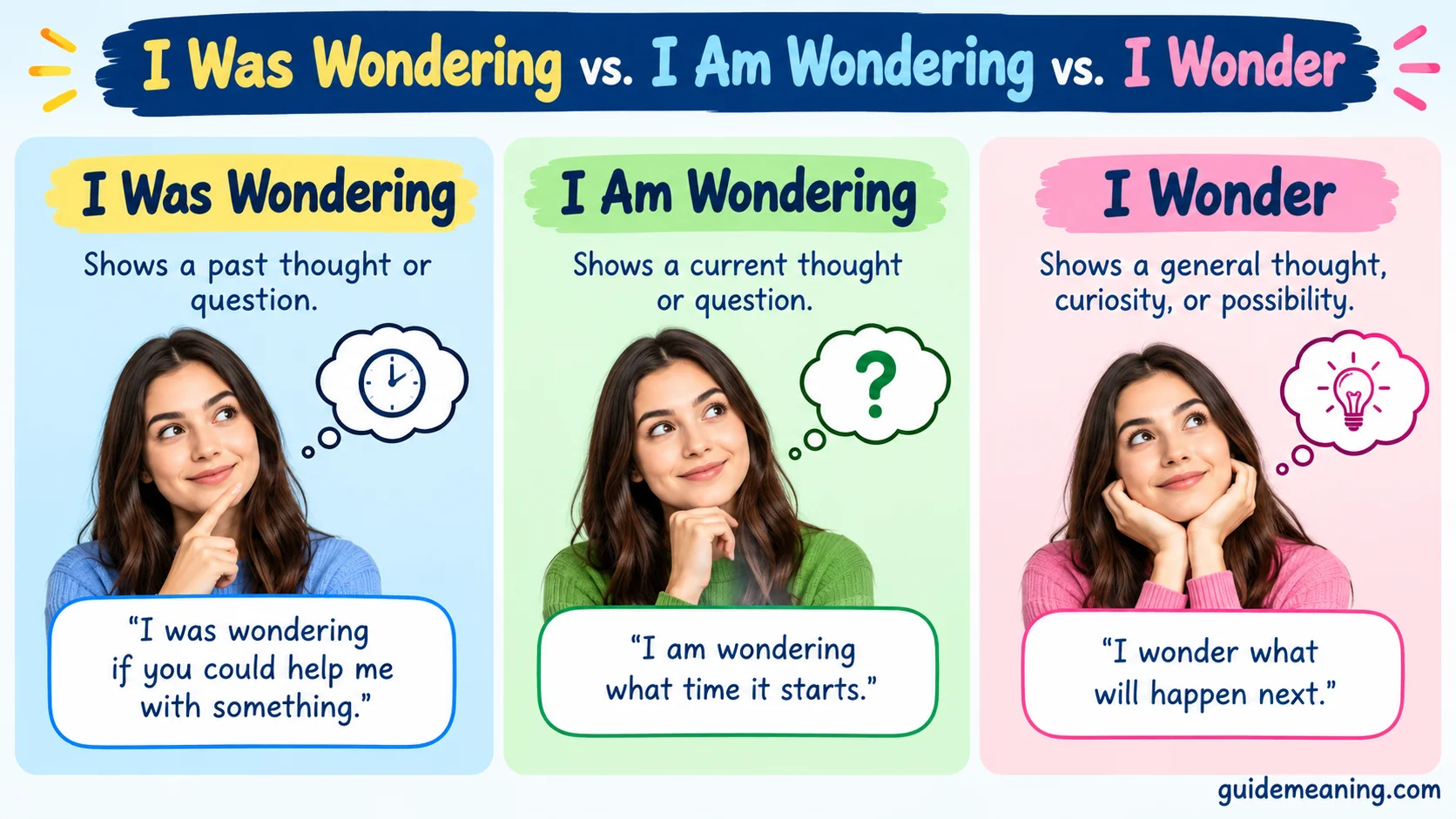

I Was Wondering vs. I Am Wondering vs. I Wonder explains how tense, politeness, and tone shape everyday English communication in real conversations. These expressions share a similar idea, but their subtle differences affect politeness, emotional feeling, and human connection. Your choice of words shapes perception because it helps the listener decide whether you sound polite, gentle, immediate, direct, or thoughtful. The situation, timing, and personal expression matter, especially in professional settings and professional emails. I was wondering often sounds softer and more respectful, while I am wondering feels current and emotionally present. Meanwhile, I wonder often expresses curiosity in stories and personal conversations. These phrases help you express curiosity, explore deeper meaning, and improve English communication through natural communication, emotional expression, and modern language. Understanding their emotional sound makes this more than a simple grammar lesson.
The important differences become clearer when you consider tone, context, and purpose. I was wondering is a polite expression used to introduce a question, request, or indirect request. Although it refers to the past, speakers often use it to sound less direct and less demanding. For example, “I was wondering if you could help me” allows someone to accept or decline without feeling pressured. This wording works well when asking for permission, requesting help, or offering assistance. Adding just can make the request more informal and gentle. In contrast, I am wondering uses the present progressive tense to describe a present thought process. It shows that the speaker is currently thinking without reaching a final decision. I wonder, however, can express general interest, reflection, or a curious, reflective, and interested attitude. These choices improve clarity, clear communication, and effective messages in spoken English, written English, daily conversations, and workplace English.
From my experience with writing and casually talking, common mistakes happen when English learners focus only on grammar and overlook hidden emotional signals. A native speaker may notice a small difference between “I wonder where John is,” “I am wondering where John is,” and “I was wondering where John is.” The basic idea remains similar, but the level of politeness and the reason for speaking can change. In a real conversation, whether you’re chatting, participating in conversations, enjoying natural conversations, or reflecting quietly, these phrases influence communication differently. Practical ways to improve include choosing the correct expression for each situation, considering time, and deciding how direct you want to sound. These basic rules help you understand the usage, use each phrase naturally, and develop stronger communication skills. This guide can help you speak with greater confidence, ask careful questions, make polite requests, and create genuine, meaningful interactions in your personal and professional life.
Let’s dive in!
Quick Answer:
In American English, “I was wondering” often softens a request, “I am wondering” describes an ongoing thought, and “I wonder” expresses curiosity or general reflection. All three are correct, and the best choice depends on your meaning and the situation.
TL;DR
- I was wondering: Commonly introduces polite requests or indirect questions.
- I am wondering: Emphasizes a thought or question you’re considering now.
- I wonder: Expresses curiosity, uncertainty, or reflection.
- All three expressions are grammatically correct.
- The past tense can soften a present-day request.
- Context determines which expression sounds most natural.
What Is the Difference Between I Was Wondering, I Am Wondering, and I Wonder?
These expressions share the verb wonder, which means to think about something because you want to know more. However, their grammatical forms give each phrase a slightly different emphasis.
In everyday American English, the distinction involves both tense and conversational purpose. Understanding those differences helps you choose wording that matches your intentions.
The Basic Difference
Consider these three examples:
- “I was wondering if you could send me the file.”
- “I am wondering whether I should send the file.”
- “I wonder why the file hasn’t arrived.”
The first sentence introduces a polite request. The second describes an ongoing decision, while the third expresses curiosity about an event.
Notice that the subject doesn’t change. Instead, the verb form and sentence context influence how the listener understands the message.
A Simple Comparison Table
| Expression | Grammatical Form | Main Purpose | Example |
| I was wondering | Past progressive | Softening requests | I was wondering if you could help. |
| I am wondering | Present progressive | Describing an ongoing thought | I am wondering what to choose. |
| I wonder | Simple present | Expressing curiosity | I wonder where they went. |
These are common patterns rather than strict rules. For example, “I wonder if you could help me” can also introduce a polite request.
I Was Wondering: Meaning and Correct Usage
“I was wondering” uses the past progressive, also called the past continuous tense. Its structure is was + wondering.
Although the verb refers grammatically to the past, the expression frequently introduces a question or request about the present. In American English, it often sounds considerate because it makes the request less direct.
When to Use I Was Wondering
Use this expression when you want to ask for information, request assistance, or introduce a question politely.
Examples include:
- I was wondering if you could review my application.
- I was wondering whether you had a moment to talk.
- I was wondering if the meeting was still scheduled.
- I was wondering whether you could explain this problem.
- I was wondering if you’d like to join us for dinner.
Each sentence gives the listener room to respond. However, the phrase doesn’t guarantee politeness by itself; your wording and tone still matter.
Why Does the Past Tense Sound Polite?
English speakers sometimes use past-tense forms to create distance from a direct request. This distance can make a question feel less demanding.
Compare these examples:
Direct: Can you help me with this report?
Softer: I was wondering if you could help me with this report.
Both sentences communicate a similar request. However, the second presents the request more indirectly, which often feels more courteous.
The same pattern appears in expressions such as “I was hoping” and “I wanted to ask.” These phrases can refer to current situations despite their past-tense forms.
Is I Was Wondering Only Used for Past Situations?
No. The expression can describe a past thought, but it also commonly introduces a present request.
For example, “I was wondering if you’re available today” asks about current availability. The phrase doesn’t require the person’s availability to belong to the past.
However, context can change the meaning. In “Yesterday, I was wondering where you had gone,” the speaker describes an actual thought from yesterday.
I Am Wondering: Meaning and Correct Usage
“I am wondering” uses the present progressive tense, formed with am + wondering. It emphasizes a thought, question, or uncertainty that is active now.
In casual American conversation, people often shorten it to “I’m wondering.” The contraction usually sounds more natural in everyday speech.
When to Use I Am Wondering
Use this expression when you’re actively considering something or trying to understand a situation.
For example:
- I am wondering whether I should accept the offer.
- I’m wondering why the computer keeps restarting.
- I am wondering how we can improve these results.
- I’m wondering whether we should leave earlier.
- I’m wondering what she meant by that comment.
In each example, the speaker focuses on a question that’s currently occupying their mind. The answer might still be unclear, or the speaker might be weighing several options.
Does I Am Wondering Sound More Immediate?
It can. The present progressive often emphasizes an activity or thought happening around the present moment.
Compare these sentences:
“I wonder whether I should apply.” This expresses general curiosity or uncertainty.
“I’m wondering whether I should apply.” This places more emphasis on an active decision.
The distinction is subtle, however. Both sentences can describe the same uncertainty, and context often matters more than tense alone.
Can I Am Wondering Introduce a Polite Request?
Yes, although it isn’t always the most natural choice.
For example, “I’m wondering if you could send me the document” is grammatically correct. However, “I was wondering if you could send me the document” often sounds more conventional and tactful.
The present progressive emphasizes your current thought. The past progressive often softens the request instead.
I Wonder: Meaning and Correct Usage
“I wonder” uses the simple present tense. It commonly expresses curiosity, uncertainty, speculation, or reflection.
Unlike “I was wondering,” it doesn’t automatically frame a request as especially polite. Instead, it often introduces something the speaker wants to understand.
When to Use I Wonder
Use “I wonder” when expressing curiosity about a person, situation, event, or possibility.
Examples include:
- I wonder why the store closed early.
- I wonder whether she’ll attend the party.
- I wonder what happened after we left.
- I wonder how they solved the problem.
- I wonder if tomorrow will be sunny.
These sentences don’t necessarily ask another person to respond. You might simply be thinking aloud or sharing a question that interests you.
Can I Wonder Be Used for Polite Requests?
Yes. Although “I wonder” often expresses curiosity, it can also introduce a polite request.
For example, “I wonder if you could help me” is a courteous way to ask for assistance. In some situations, it sounds slightly formal or less conversational than “I was wondering if you could help me.”
Both versions are correct. Your relationship with the listener and the surrounding conversation help determine which sounds best.
I Wonder in Everyday Conversation
Americans frequently use this expression when speculating about something they don’t know.
Imagine that your friend hasn’t arrived at a restaurant. You might say, “I wonder if they’re stuck in traffic.”
You’re expressing a possible explanation rather than making a direct request. This makes “I wonder” useful for casual conversation, storytelling, and reflective writing.
I Was Wondering vs. I Am Wondering: Key Differences
These two expressions can describe similar thoughts, but they often communicate different intentions. Understanding their usual roles can help you sound more natural in conversations and professional messages.
Compare Their Meaning in Context
Consider the following examples:
I was wondering if you could review this email.
The speaker is asking someone to do something. The past-progressive form makes the request sound less direct.
I am wondering whether I should rewrite this email.
The speaker is considering a decision. The present-progressive form highlights an ongoing thought.
I wonder whether this email needs rewriting.
The speaker expresses uncertainty or curiosity about the email.
The key distinction is the speaker’s purpose. One expression often softens a request, while the others emphasize thinking or uncertainty.
Can You Use Them Interchangeably?
Sometimes, but not always.
For example, “I wonder if you could explain this” and “I was wondering if you could explain this” can both request an explanation. However, the second often sounds more tentative or tactful.
Meanwhile, “I am wondering whether I should explain this” focuses on the speaker’s decision. Replacing it with “I was wondering” could shift the sentence toward a softer or more reflective tone.
Therefore, choose the expression that best communicates your intention rather than treating the three forms as identical.
I Wonder vs. I Was Wondering: Which Sounds More Natural?
Both expressions are natural in American English, but they often serve different purposes. The main difference is whether you’re expressing curiosity or approaching someone with a question.
When I Wonder Is Better
Use “I wonder” when you want to share a thought or consider a possibility.
For example:
- I wonder why the lights are still on.
- I wonder whether he received the invitation.
- I wonder how long the trip will take.
These sentences sound natural because they express curiosity. You aren’t necessarily asking another person to perform an action.
When I Was Wondering Is Better
Use “I was wondering” when you want to introduce a request or ask someone for information gently.
For example:
- I was wondering if you had the meeting notes.
- I was wondering whether you knew the answer.
- I was wondering if I could borrow your charger.
Here, the speaker addresses another person and seeks a response. The past-progressive form often helps the question sound less abrupt.
Which Should You Choose?
Neither expression is universally better. Instead, consider whether you’re thinking aloud or speaking directly to someone.
If you’re expressing a private thought, “I wonder” often works well. If you’re asking for a favor, “I was wondering” is frequently a good choice.
Grammar Rules Behind the Three Expressions
The expressions become easier to understand when you recognize their verb forms. Each uses the same main verb but presents the thought differently.
Simple Present, Present Progressive, and Past Progressive
Here are the basic grammatical structures:
- I wonder: Subject + simple present verb.
- I am wondering: Subject + am + present participle.
- I was wondering: Subject + was + present participle.
The word wondering is the present participle in the progressive forms. The auxiliary verbs am and was help establish the grammatical tense.
The simple present describes curiosity or reflection without emphasizing an ongoing process. The progressive forms highlight a thought as unfolding or being considered.
Does the Verb Form Change the Meaning?
It can change the emphasis without completely changing the underlying idea.
For instance, “I wonder what she thinks” expresses curiosity. “I’m wondering what she thinks” gives that curiosity a more immediate feel.
Meanwhile, “I was wondering what she thought” can describe an earlier thought. It can also introduce a present question, depending on context.
These patterns show why tense alone doesn’t always determine the time of an entire sentence.
How to Use If, Whether, and Question Words
All three expressions commonly appear before another clause. Choosing the correct connector helps you build clear and natural sentences.
Using If and Whether
Use if or whether when the thought concerns a yes-or-no question or a possibility.
Examples:
- I wonder if she is home.
- I’m wondering whether we should wait.
- I was wondering if you had time.
- I was wondering whether you could join us.
In many everyday situations, if and whether are interchangeable. However, whether can sound more formal and is useful when explicitly considering alternatives.
For example, “I’m wondering whether to stay or leave” presents two options clearly.
Using Question Words
Words such as why, where, when, how, and what introduce questions about specific information.
Examples:
- I wonder why the train is late.
- I’m wondering where we should meet.
- I was wondering when the office closes.
- I wonder how this machine works.
Notice that these clauses use normal statement word order. You say, “I wonder where she lives,” rather than “I wonder where does she live.”
This rule applies to embedded questions, which are questions contained within larger sentences.
Do These Expressions Change the Tense of the Whole Sentence?
No. The tense in one part of a sentence doesn’t automatically control every other verb.
This distinction is especially useful when asking about current situations, future plans, or past events. American English regularly combines different time references within one sentence.
Talking About the Present
Consider this example:
“I was wondering if you’re available today.”
The phrase “was wondering” uses the past progressive, but “you’re available” refers to the present. This combination is natural when someone makes a polite inquiry about current availability.
Likewise, “I was wondering if you can help me” is common in everyday speech. The request concerns a possible action now or in the near future.
Talking About the Past
You can also use these expressions when discussing earlier events.
For example, “I wonder why she left yesterday” expresses present curiosity about a past event. In contrast, “I was wondering why she had left” can describe an earlier thought about an event that occurred before it.
The correct tense depends on the relationship between the events. Choose the form that communicates the intended timing most clearly.
Talking About the Future
These expressions can introduce questions about future plans, too.
For example, “I wonder whether he’ll arrive tomorrow” expresses curiosity about the future. “I was wondering if you’d like to join us next weekend” introduces a polite invitation.
Therefore, don’t assume that a past-tense expression always refers to a completed situation. Consider the entire sentence and its context.
Which Expression Should You Use in Emails and Professional Conversations?
In American workplaces, the right expression can make a message sound more natural and considerate. However, clarity matters more than choosing the most indirect wording every time.
In Professional Emails
“I was wondering” works well when asking a coworker, manager, or client for assistance.
For example:
Polite request: I was wondering if you could review the attached report.
Current concern: I’m wondering whether we should change the project deadline.
General curiosity: I wonder how the team reached this decision.
Each sentence has a different focus. The first requests assistance, the second describes an active concern, and the third expresses curiosity.
In Casual Conversations and Text Messages
Contractions often make these expressions sound more relaxed.
For example, you might text a friend, “I’m wondering what time you’re getting here.” You could also say, “I wonder if we’ll have time for coffee.”
When asking a favor, “I was wondering if you could pick me up” sounds considerate without being overly formal. However, with close friends, a direct question may feel just as natural.
Choosing the Best Expression for Each Situation
| Situation | Recommended Expression | Example |
| Asking a coworker for help | I was wondering | I was wondering if you could review this. |
| Considering a decision | I am wondering | I’m wondering whether to accept. |
| Sharing curiosity | I wonder | I wonder what happens next. |
| Asking someone about availability | I was wondering | I was wondering if you’re free tomorrow. |
| Thinking through a problem | I am wondering | I’m wondering how to fix this. |
These recommendations describe common usage, not strict requirements. You can adjust the wording to match your relationship with the listener and the formality of the situation.
Common Mistakes to Avoid
Although all three expressions are correct, certain sentence patterns can make your English sound unnatural. Fortunately, most mistakes are easy to fix.
Using Incorrect Verb Forms
The progressive forms require a form of be followed by wondering.
Incorrect: I am wonder why she left.
Correct: I am wondering why she left.
Likewise, the correct past-progressive form is “I was wondering,” not “I was wonder.”
Using Direct Question Word Order
Embedded questions generally use statement word order.
Incorrect: I wonder where does he live.
Correct: I wonder where he lives.
The same rule applies to other question words. Say “I’m wondering why she left,” not “I’m wondering why did she leave.”
Assuming I Was Wondering Always Means the Past
This is another common misunderstanding. The phrase can describe an earlier thought, but it also frequently softens present-day requests.
For example, “I was wondering if you could explain this” usually asks for help now. There’s no need to change it simply because the request concerns the present.
Making Every Request Overly Indirect
Politeness doesn’t require long introductions or unnecessary uncertainty.
For example, “Could you send me the file?” is already polite in many workplace situations. You don’t always need to add “I was wondering if you might possibly be able to.”
Choose a level of directness that suits the situation. Clear communication can be both respectful and efficient.
How These Expressions Have Evolved in Modern English
These expressions aren’t new inventions, but their conversational roles show how English uses grammar to communicate social meaning. The verb wonder has long expressed curiosity, while progressive forms describe thoughts as unfolding over time.
From Curiosity to Polite Requests
“I wonder” naturally introduces a question or thought. Over time, expressions such as “I was wondering if” became familiar ways to make requests less direct.
This pattern reflects a broader feature of English politeness. Speakers often soften requests with phrases such as “I was hoping” or “I wanted to ask.”
The past tense can therefore communicate more than a literal reference to earlier time. It can also signal consideration and leave room for the listener’s response.
How Americans Use These Expressions Today
In modern American English, these phrases appear in emails, workplace conversations, customer service, text messages, and everyday discussions.
“I was wondering” remains a common choice for polite inquiries. Meanwhile, “I’m wondering” often emphasizes a current question, and “I wonder” remains useful for curiosity and reflection.
These patterns aren’t exclusive to the United States. English speakers in other countries use them, too, although preferences can vary by region and situation.
FAQs:
What is the difference between “I was wondering,” “I am wondering,” and “I wonder”?
“I was wondering” often introduces a polite request, “I am wondering” describes a current thought, and “I wonder” expresses curiosity or general interest. The best choice depends on your meaning and the situation.
Is “I was wondering” more polite than “I am wondering”?
Yes, “I was wondering” often sounds softer and more polite, especially when asking for help or making a request. For example, “I was wondering if you could help me” sounds less direct than “I am wondering if you can help me.”
When should I use “I am wondering”?
Use “I am wondering” when you want to describe something you’re thinking about right now. For example, “I am wondering why John hasn’t arrived yet” expresses your current curiosity about his absence.
Is “I wonder” grammatically correct?
Yes, “I wonder” is grammatically correct and commonly used in English. It expresses curiosity, uncertainty, or a thought about something. For example, “I wonder what the weather will be like tomorrow.”
Can I use “I was wondering” for a present request?
Yes, you can use “I was wondering” to make a request about the present or near future. For example, “I was wondering if you could review this document” sounds polite even though you’re asking for help now.
Which expression is best for professional emails?
“I was wondering” is often a good choice for polite professional emails, especially when requesting information, assistance, or permission. However, “I am wondering” works when emphasizing a current concern, while “I wonder” can suit reflective statements.
Can “I wonder” and “I am wondering” mean the same thing?
Sometimes, yes. Both can express curiosity, but they emphasize different things. “I wonder why she left” expresses general curiosity, while “I am wondering why she left” emphasizes that you’re thinking about it right now.
Conclusion:
Understanding I Was Wondering vs. I Am Wondering vs. I Wonder helps you communicate more naturally in everyday conversations, professional emails, and workplace settings. Although these expressions share a similar meaning, their tone and purpose can differ. Use “I was wondering” for softer, more polite requests, “I am wondering” for thoughts you’re considering in the present, and “I wonder” to express curiosity or reflection. Once you understand these differences, you’ll find it easier to choose the right expression for each situation and make your English sound clear, confident, and respectful.