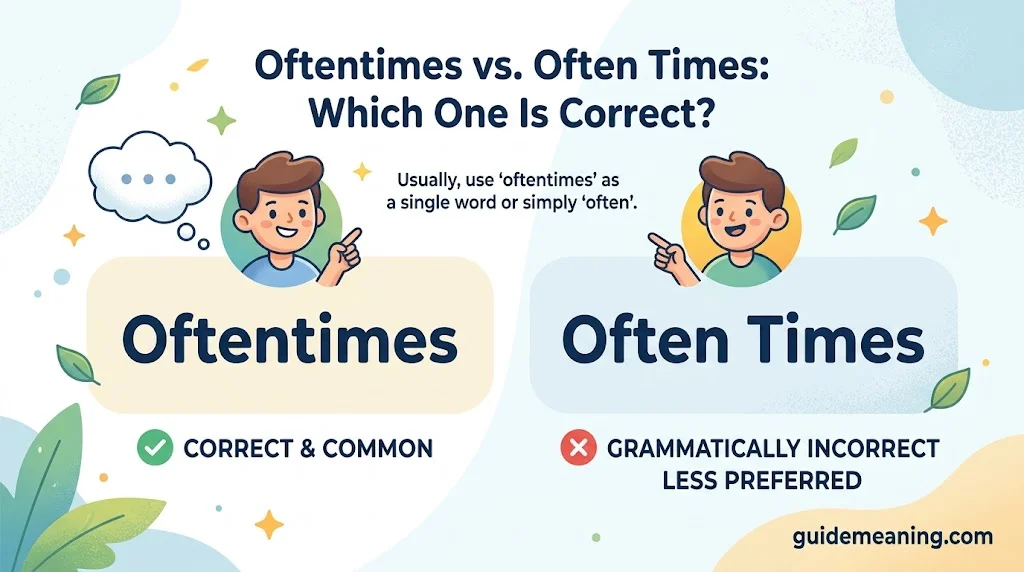

Oftentimes vs. Often Times is a small wording difference that often creates bigger grammar questions than you might expect. The oftentimes, often, times debate can leave confused writers scratching their heads because both forms look similar, sound almost the same, and appear everywhere online. In modern English, the difference is actually easy to understand. The single space in often times creates a tiny gap, yet that gap can cause proofreading headaches, second guesses, and uncertainty in emails, essays, and professional documents.
As a practical guide, the simplest way to build confidence is to recognize oftentimes as an adverb and often times as a separate form that is usually wrong in this meaning. The rule isn’t complicated. A quick check of real usage, examples, tables, and notes can make the confusion simpler. The term comes from older English, which also helps explain why it feels right to many readers. The history becomes even clearer when you consider that oftentimes is an unnecessary variant of often. Replacing it with the shorter word is generally the most appropriate choice. The less common ofttimes also exists, while oftentimes appears frequently in the U.S. and Canada.
This trend has grown over the past decade in U.S. sources, although its occurrence remains far below its 19th-century peak. American news stories from 2010 showed often appearing about 200 times for every instance of oftentimes, compared with a ratio near 500:1 in 2000. In British publications, by contrast, oftentimes appeared only once for every 4,000 instances of often*, making it essentially absent from everyday writing. These case studies and historical ideas help explain the pattern without making it overly technical.
Another interesting detail is that often is a longer form of oft, which goes back to Old English and predates often by many centuries. Modern writers rarely use oft, showing that English can be unpredictable even when a rule seems obvious. I generally use often because it is shorter, natural, and widely accepted. This choice helps avoid common mistakes and makes each sentence feel simple, conversational, and practical. To learn the distinction, simply remember that oftentimes is one word, while often times usually creates an unnecessary separation. The debate may continue, but the right choice becomes much easier when its historical and grammatical background is clear.
Let’s dive in!
Quick Answer:
If you mean “often,” “frequently,” or “on many occasions,” use oftentimes or, more simply, often.
Oftentimes is a recognized adverb. Cambridge defines it as meaning “on many occasions” and lists often and frequently as synonyms. The dictionary also labels it as mainly American English.
Often times isn’t the standard two-word equivalent of oftentimes. However, the two words can occur next to each other when often and times have separate grammatical roles.
| Form | Standard use | Meaning |
| often | Adverb | Frequently; many times |
| oftentimes | Adverb | Often; on many occasions |
| often times | Separate words | Only when the sentence gives each word its own grammatical role |
For most modern writing, the safest rule is straightforward:
If you mean “frequently,” write often or oftentimes.
In fact, often will usually sound more natural and direct.
What Does “Oftentimes” Mean?
Oftentimes means often, frequently, or on many occasions. It describes something that happens repeatedly or occurs with some regularity.
Cambridge classifies oftentimes as an adverb. Its examples include sentences where the word describes actions, preferences, and recurring situations.
Consider these examples:
- Oftentimes, people underestimate how much preparation matters.
- She oftentimes works late during busy seasons.
- Oftentimes, the simplest solution is the most effective.
- He would oftentimes visit his grandparents on weekends.
- These problems oftentimes occur after a software update.
In each sentence, oftentimes tells you about frequency.
You could replace it with often without changing the basic meaning:
- Often, people underestimate how much preparation matters.
- She often works late during busy seasons.
- Often, the simplest solution is the most effective.
The meaning remains essentially unchanged.
Is “Oftentimes” a Real Word?
Yes. Oftentimes is a legitimate English word, not a typo or a modern invention.
Its history actually goes back centuries. Etymological records trace oftentimes to Middle English forms. The word appeared as two words in the late 14th century and as a single word by the early 15th century.
That history matters because some writers assume oftentimes must be an accidental combination of often and times. It isn’t.
English has simply changed over time. Words and phrases that once appeared separately can eventually become established compounds.
Is “Oftentimes” Mainly American English?
Yes. Modern dictionaries identify oftentimes as mainly American English.
Cambridge labels it “mainly US,” while Collins identifies the word as American and notes that it can sound old-fashioned in some contexts.
That doesn’t make it incorrect elsewhere. It simply means American English uses it more naturally than some other varieties of English.
For a broad international audience, often remains the more universally familiar choice.
What Does “Often Times” Mean?
Here’s where the confusion starts.
Often times isn’t simply the spaced version of oftentimes. When often and times appear separately, they need to function as separate words.
Compare these structures:
- many times
- several times
- three times
- at times
- the times when…
In these examples, times is a noun. It refers to occasions, instances, or periods.
However, simply writing often times doesn’t automatically create a natural noun phrase.
For example:
Often times, people make this mistake.
If the intended meaning is “frequently,” this spelling is not the standard choice. Write:
Often, people make this mistake.
Or:
Oftentimes, people make this mistake.
The distinction becomes clearer when times genuinely refers to occasions.
When Can “Often” and “Times” Appear Separately?
The two words can occur in the same sentence when they aren’t functioning as the compound adverb oftentimes.
For example:
There were times when she often felt uncertain about her decision.
Here, times is a noun. It refers to particular occasions. Often separately describes how frequently she felt uncertain.
Another example:
During those difficult times, he often called his brother.
Here, times is part of the noun phrase those difficult times. The word often modifies the verb called.
That’s completely different from treating often times as one frequency adverb.
Oftentimes vs. Often Times: Key Differences
The easiest way to understand the distinction is to examine the grammar.
| Feature | Often | Oftentimes | Often times |
| Number of words | One | One | Two |
| Part of speech | Adverb | Adverb | Separate words |
| Means “frequently” | Yes | Yes | Not as a standard fixed adverb |
| Refers to occasions | Indirectly | Indirectly | Can, when times is a noun |
| Standard dictionary word | Yes | Yes | Not as the equivalent of oftentimes |
| Best general choice | Yes | Sometimes | Usually avoid for this meaning |
The important point isn’t merely the spelling.
Grammar determines the meaning.
If oftentimes appears in a sentence, it functions as one adverb. If often and times appear separately, you need to examine what each word is doing.
Is “Oftentimes” Correct?
Yes. Oftentimes is grammatically correct and dictionary-recognized.
Cambridge defines it as an adverb meaning “on many occasions.” Collins likewise defines it as meaning “often” or “many times.”
For example:
Oftentimes, customers prefer a simpler option.
This means:
Often, customers prefer a simpler option.
Both sentences are grammatically sound.
When Should You Use “Oftentimes”?
You can use oftentimes when you want a legitimate alternative to often.
It can work particularly well in:
- Essays
- Articles
- Narrative writing
- Speeches
- Reflective writing
- General American English
However, don’t force it into every sentence. The word can feel heavier than often, especially in short, practical writing.
Compare:
Users often encounter this problem.
with:
Users oftentimes encounter this problem.
Both are correct. The first feels cleaner and more economical.
When clarity and efficiency matter, often usually wins.
Is “Often Times” Correct?
The answer requires a little more nuance than simply calling it “wrong.”
If you’re trying to write the adverb meaning frequently, often times is not the standard form. The established word is oftentimes.
However, often and times can appear separately when the sentence genuinely requires both words.
Consider:
During those difficult times, she often felt alone.
Here, times belongs to the phrase those difficult times. The word often modifies felt.
Now compare:
Often times, she felt alone.
If the intended meaning is simply “frequently,” the second sentence uses the two-word form where often or oftentimes would be the clearer standard choice.
So the problem isn’t that the sequence of letters can never appear separately. The problem is treating often times as though it were simply another spelling of oftentimes.
Oftentimes vs. Often: Which Is Better?
Both often and oftentimes are correct. Yet they aren’t equally natural in every situation.
Often is shorter, more common, and highly versatile. Cambridge defines it as an adverb meaning “many times on different occasions.” It can appear in several positions within a sentence.
For example:
- I often work from home.
- She often visits her parents.
- They don’t often complain.
- How often do you exercise?
There’s rarely a reason to replace these sentences with oftentimes.
When “Often” Is the Better Choice
Choose often when you’re writing:
- Business emails
- Instructions
- Technical content
- Website copy
- Short explanations
- Everyday messages
- Straightforward academic prose
For example:
Customers often abandon their carts when shipping costs are high.
This sounds natural and direct.
You could write:
Customers oftentimes abandon their carts when shipping costs are high.
It’s still grammatical. However, the longer form doesn’t add much.
Think of often as the plain white shirt of frequency adverbs. It fits almost everywhere.
Oftentimes vs. Often Times vs. Often
Putting all three together makes the distinction much easier.
| Sentence | Correct? | Why? |
| People often make mistakes. | ✅ | Often is an adverb. |
| People oftentimes make mistakes. | ✅ | Oftentimes is an adverb. |
| Often times, people make mistakes. | ❌ for this intended meaning | It incorrectly treats often times as the standard adverb. |
| During difficult times, people often struggle. | ✅ | Times is a noun and often modifies struggle. |
| There were times when she often felt lonely. | ✅ | Times and often have separate grammatical roles. |
This gives you a practical rule:
Use often or oftentimes when you mean “frequently.”
Don’t insert a space simply because the word contains time.
Common Mistakes With “Oftentimes” and “Often Times”
Writing “Often Times” to Mean “Frequently”
This is probably the most common mistake.
❌ Often times, employees forget to update their passwords.
Better:
✅ Often, employees forget to update their passwords.
Or:
✅ Oftentimes, employees forget to update their passwords.
The second version is correct, although often sounds more natural in many contexts.
Treating “Oftentimes” as a Typo
Some writers see oftentimes and assume the word should be split.
That’s not correct.
Oftentimes has a long-established history and appears as a dictionary entry.
It’s a genuine compound adverb.
Assuming “Oftentimes” Is Always Better Than “Often”
Correctness isn’t the same as style.
You can write:
The system often fails during peak traffic.
That’s concise and natural.
You can also write:
The system oftentimes fails during peak traffic.
The second sentence isn’t wrong. It simply sounds more marked.
Good writing isn’t about choosing the longest correct word. It’s about choosing the word that fits the context.
How to Choose the Right Form
Use this simple decision process.
Ask What You Mean
If you mean frequently, choose:
- often
- oftentimes
- frequently
If you mean actual occasions, periods, or instances, determine whether times needs to function as a noun.
Check the Sentence
Ask yourself:
Can I replace this word with “often” without changing the meaning?
If yes, often or oftentimes is probably what you need.
For example:
Oftentimes, people overlook small details.
Replace it:
Often, people overlook small details.
The meaning stays intact.
Now consider:
During those difficult times, she often stayed home.
You can’t simply replace times with often. The sentence needs the noun times.
That distinction exposes the grammar immediately.
Oftentimes vs. Often Times in American English
American English commonly uses oftentimes, and major dictionaries identify it as a mainly American form.
It appears in contemporary sources as well. Cambridge’s corpus examples include material from sources such as NPR, The Washington Post, ABC News, CNN, Wired, and Bloomberg.
That evidence matters because it shows that oftentimes isn’t merely an obsolete relic.
At the same time, often remains the simpler everyday choice.
For most American readers:
People often forget small details.
sounds more direct than:
People oftentimes forget small details.
Neither sentence is grammatically defective. The difference is largely one of style, register, and rhythm.
A Brief History of “Oftentimes”
The history of oftentimes explains why its spelling can feel unusual today.
Etymological records trace the expression back to Middle English. It existed as two words in the late 14th century before appearing as one word in the early 15th century. Earlier related forms included often-tide and oft-times.
The root often itself is much older. Etymological evidence traces it to Middle English and describes its meaning as repeatedly or frequently.
So oftentimes isn’t a random modern compound. It developed naturally within the history of English.
That also explains why the word can look slightly old-fashioned to some readers while remaining perfectly legitimate.
Examples of “Oftentimes” in Real Sentences
Here are practical examples across several contexts.
Everyday English
- Oftentimes, the best solution is the simplest one.
- She oftentimes takes a walk after dinner.
- People oftentimes forget how important sleep is.
Workplace Writing
- Oftentimes, small errors create larger problems later.
- Managers oftentimes need to balance speed with accuracy.
- Customers oftentimes ask for clearer instructions.
Academic Writing
- Oftentimes, researchers encounter conflicting evidence.
- These patterns oftentimes appear across multiple studies.
- Historical events oftentimes influence later political decisions.
Narrative Writing
- Oftentimes, he remembered his childhood during quiet evenings.
- She would oftentimes sit beside the window and read.
- Oftentimes, the smallest moments became the most memorable.
The word works in each case because it functions as an adverb of frequency.
Examples Where “Often Times” Has a Different Structure
Now look at sentences where times remains a noun.
During difficult times, people often discover unexpected strength.
Here:
- times = occasions or periods
- often = frequently
- discover = the verb being modified
Another example:
There were times when she often questioned her decision.
Again, times refers to occasions.
A useful test is to remove often:
There were times when she questioned her decision.
The sentence still works.
That tells you that times has its own grammatical role.
Case Study: Choosing the Right Form in a Sentence
Imagine you’re editing this sentence for a business website:
Often times, customers leave a website when the checkout process feels complicated.
The writer means “frequently.”
The cleanest revision is:
Often, customers leave a website when the checkout process feels complicated.
You could also write:
Oftentimes, customers leave a website when the checkout process feels complicated.
Both work.
However, the first version is shorter and more conversational. That’s usually preferable for web content.
Now consider a different sentence:
During difficult times, customers often need extra support.
Here, changing times to oftentimes would destroy the sentence’s structure.
The two sentences look superficially similar. Their grammar is completely different.
Synonyms for “Oftentimes”
You don’t always need oftentimes. Several alternatives can express frequency.
| Word or phrase | General meaning | Style |
| Often | Frequently | Neutral and common |
| Frequently | Many times | Neutral to formal |
| Regularly | Repeatedly or routinely | Neutral |
| Commonly | Happening often or generally | Neutral/formal |
| Repeatedly | Happening again and again | Emphasizes repetition |
| Usually | Happening in most cases | Focuses on normality |
| From time to time | Occasionally | Less frequent |
| Occasionally | Sometimes | Less frequent than often |
Be careful with usually. It isn’t always interchangeable with often.
For example:
I often drink coffee.
means you do it frequently.
But:
I usually drink coffee.
suggests coffee is your normal or customary choice.
The difference is subtle but important.
Is “Oftentimes” More Formal Than “Often”?
Not necessarily.
Oftentimes can sound more literary, deliberate, or old-fashioned than often, especially outside American English. Collins explicitly labels it “old-fashioned” in one of its entries while also recognizing it as an American English word.
However, calling it simply “formal” would oversimplify its usage.
For example:
Oftentimes, people learn more from failure than success.
has a somewhat polished rhythm.
Meanwhile:
Often, people learn more from failure than success.
sounds plainer and more direct.
Neither register is inherently better. Your audience and context should make the decision.
Should You Use “Oftentimes” in Professional Writing?
Yes, you can. It isn’t grammatically inappropriate.
Still, often usually provides a sharper option in professional communication.
Compare:
More direct:
Employees often need additional training after a major system change.
More marked:
Employees oftentimes need additional training after a major system change.
The first sentence is easier to scan. In business writing, that advantage matters.
For technical documentation, instructions, and short web copy, often is usually the strongest choice.
FAQs:
Is “oftentimes” one word?
Yes. Oftentimes is correctly written as one word when you use it as an adverb meaning “often” or “frequently.”
Is “often times” grammatically correct?
Usually, no. When you mean “frequently,” often or oftentimes is the better choice. Writing often times as two words can look awkward or incorrect in standard modern English.
Is “oftentimes” better than “often”?
Not necessarily. Often is shorter, simpler, and more common. In most everyday writing, it’s the natural choice.
Is “oftentimes” formal English?
Yes, oftentimes is a valid English word. However, it can sound somewhat formal or old-fashioned compared with the simpler often.
Why do people write “often times”?
The two forms sound almost the same, so writers may assume that often times is simply another spelling. The confusion becomes stronger because times is a familiar English word on its own.
Can I use “oftentimes” in professional writing?
Yes. Oftentimes is grammatically acceptable in professional writing. Still, often usually sounds cleaner and more direct, especially in business emails and formal documents.
What is the easiest way to remember the difference?
Remember this simple rule: oftentimes = one word when it means “often.” If you can replace the expression with often, use often or oftentimes, not often times.
Conclusion:
The oftentimes vs. often times question looks complicated, but the rule is straightforward. Oftentimes is a legitimate adverb written as one word, while often times usually isn’t the form you want when expressing frequency. In most situations, often remains the simplest and most natural option. If you’re writing an email, essay, article, or professional document, choosing often can help your sentence sound clear and polished. When you do choose oftentimes, keep it together as one word. That tiny space can make a surprisingly big difference.