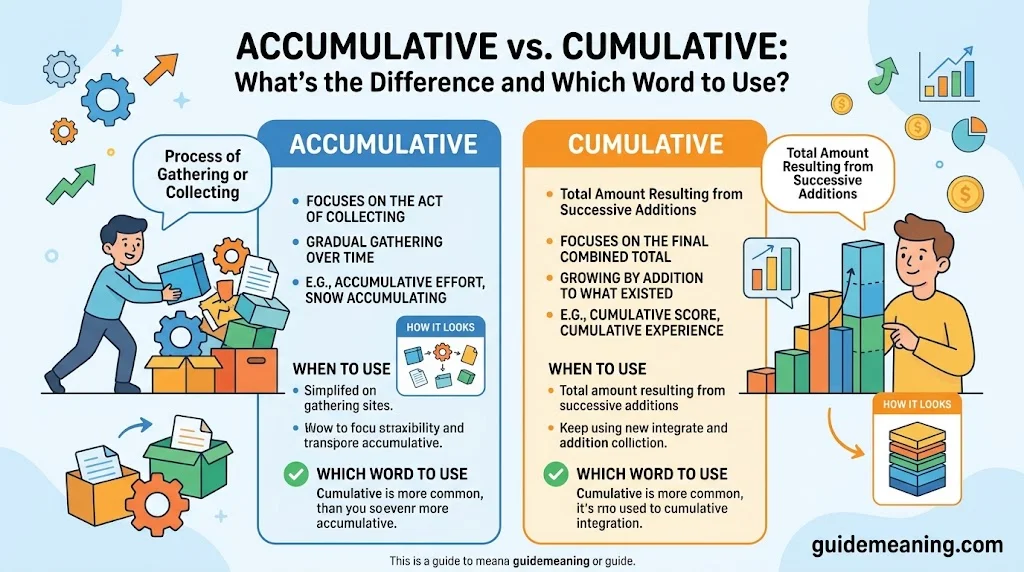

The Accumulative vs. Cumulative difference becomes clearer when you see how each word describes growth, repeated additions, and final results. These words look and feel similar because they are closely related, but they aren’t exactly the same in every situation. Both can describe something that increases through adding over time, although their focus can be slightly different. Accumulative emphasizes the process of gathering, collecting, and building up something gradually, while cumulative focuses on the final combined effect or total amount produced through repeated additions. This meaning helps you understand the right word to write in a sentence or use when you speak with confidence.
Think about small savings added each month. The savings process can be described as accumulative because money is gathered and built up gradually. After several years, the total savings can be called the cumulative amount. In real-world examples, this distinction makes the actual difference easier to understand. Choosing the appropriate term can bring more clarity to your writing, while practical explanations and tables can explain these similar words clearly. This guide can walk you through what you need to know in a simple way, including how each term is used and what it can mean in different context.
The easiest way to remember the distinction is to consider whether you are describing the process of adding things or the final result. This approach helps explain why accumulative and cumulative aren’t always the same thing, even though they may look alike. Once you understand the difference, you can write with greater clarity, speak more naturally, and choose the term that best fits the entire context of your sentence. This post keeps everything straightforward instead of relying on complicated explanations.
Let’s dive in!
Quick Answer:
Accumulative and cumulative are both correct words. They overlap in meaning, but cumulative is generally the better choice when you mean a total, combined effect, or result produced by successive additions.
Accumulative means gradually increasing or tending to accumulate. It can emphasize the process or tendency of gathering.
Cumulative means increasing as additional amounts, facts, effects, or conditions are added. It often emphasizes the combined result.
| Word | Basic meaning | Main emphasis | Common examples |
| Accumulative | Gradually increasing or arising from accumulation | Gathering or building | accumulative process, accumulative effect |
| Cumulative | Increasing through successive additions | Combined total or effect | cumulative cost, cumulative effect |
| Accumulated | Already gathered or collected | Result of previous accumulation | accumulated savings, accumulated debt |
A useful shortcut is this:
Accumulative focuses on accumulation. Cumulative focuses on what accumulates and adds up.
In many sentences, either word may be grammatically possible. Yet cumulative is usually the more natural and established choice when you’re discussing a measurable total or combined effect. Cambridge specifically defines cumulative as increasing with each new addition and including previous amounts.
What Does “Accumulative” Mean?
Accumulative is an adjective meaning gradually increasing in amount, number, or intensity. It can also describe something that tends to accumulate or results from accumulation.
The word comes directly from accumulate, which means to collect or increase gradually over time. Cambridge gives examples involving accumulated wealth, debt, rubbish, and other things that build up progressively.
For example:
- The accumulative effect of repeated delays hurt the project.
- The company faced accumulative errors throughout the calculation.
- Small improvements can have an accumulative impact over time.
- The process has an accumulative nature because each stage builds on the previous one.
The important idea is gradual buildup.
Think about dust collecting in a room. One day of dust might seem insignificant. Weeks or months of dust create a noticeable layer. The buildup is accumulative because small additions occur repeatedly.
Accumulative Definition in Simple English
You can understand accumulative as:
“Building up gradually through accumulation.”
Dictionary sources support this meaning. Cambridge defines accumulative as “gradually increasing in number or amount” and identifies cumulative as a synonym. Collins similarly describes something accumulative as becoming greater in amount, number, or intensity over time.
Examples of “Accumulative”
Here are several natural examples:
- Accumulative pressure eventually affected employee performance.
- The project suffered from accumulative delays.
- Small errors created an accumulative problem.
- Learning can have an accumulative character when each lesson supports the next.
- The company experienced accumulative growth over several years.
- Repeated exposure produced an accumulative effect.
Notice something important: these examples emphasize gradual development rather than simply presenting a final mathematical total.
Common Contexts for “Accumulative”
You may encounter accumulative in contexts involving:
- Gradual growth
- Repeated effects
- Increasing pressure
- Developing problems
- Accumulating errors
- Long-term processes
- Experience and knowledge
- Environmental effects
- Business development
- Scientific processes
Still, natural usage matters. Some expressions that are technically understandable sound much more idiomatic with cumulative.
For example, cumulative effect is far more established than accumulative effect in many formal contexts.
What Does “Cumulative” Mean?
Cumulative describes something that increases through successive additions.
It can refer to numbers, amounts, facts, effects, conditions, experiences, or results. The word often carries the idea that each new addition becomes part of a larger whole.
Cambridge’s American Dictionary defines cumulative as something that increases as each new amount is added or as each new fact or condition is considered.
Consider a savings account.
You save $100 in January, $150 in February, and $200 in March. Your cumulative savings represent the amount gathered across those periods.
The word doesn’t merely describe the act of saving. It highlights the total built from successive additions.
Cumulative Definition in Simple English
A straightforward definition is:
“Growing because each new addition contributes to the total.”
That’s why cumulative appears so frequently in statistics, business, economics, education, and scientific writing.
You can have:
- Cumulative costs
- Cumulative revenue
- Cumulative losses
- Cumulative evidence
- Cumulative knowledge
- Cumulative scores
- Cumulative effects
- Cumulative damage
- Cumulative growth
- Cumulative percentages
In each case, separate pieces combine into something larger.
Examples of “Cumulative”
Consider these sentences:
- The cumulative cost of repairs reached $12,000.
- The cumulative effect of several small mistakes became significant.
- Students build cumulative knowledge throughout the course.
- Her cumulative score was higher than her competitors’ scores.
- The company reported a cumulative loss of $4 million.
- The evidence had a cumulative impact on the investigation.
The emphasis usually falls on the whole created by multiple additions.
Accumulative vs. Cumulative: Key Differences
The easiest way to distinguish these words is to look beyond their shared idea of growth.
Difference in Meaning
Accumulative emphasizes something that accumulates or tends to build up.
Cumulative emphasizes something that results from successive additions.
The difference is subtle. In fact, dictionaries often treat the words as synonyms. Cambridge explicitly lists accumulative as a synonym for cumulative.
However, usage gives cumulative a particularly strong role when discussing totals and combined effects.
Difference in Focus
Think of two pictures.
The first shows someone adding books to a growing stack. The focus is on the building process. That’s closer to accumulative.
The second shows a chart displaying the total number of books after every addition. The focus is on the combined amount. That’s closer to cumulative.
A simple comparison looks like this:
| Focus | Better choice |
| Tendency to build up | Accumulative |
| Gradual increase | Accumulative |
| Combined effect | Cumulative |
| Running total | Cumulative |
| Successive additions | Cumulative |
| Overall result | Cumulative |
| Something already gathered | Accumulated |
Difference in Common Usage
Here’s where the distinction becomes practical.
Cumulative is extremely common in formal and technical expressions. You’ll regularly see it in financial reports, research papers, statistical analysis, education, and scientific discussions.
For example:
- cumulative total
- cumulative frequency
- cumulative effect
- cumulative impact
- cumulative score
- cumulative percentage
- cumulative loss
- cumulative evidence
Accumulative is valid, but it appears less often in these established combinations.
Dictionary.com defines accumulative as “tending to accumulate or arising from accumulation” and also gives cumulative as a direct equivalent.
That overlap explains why writers sometimes use the words interchangeably.
Accumulative vs. Cumulative Examples
Seeing the distinction in actual sentences makes it much easier to understand.
Money
Accumulative:
The business experienced an accumulative increase in savings over several years.
Cumulative:
The company’s cumulative savings reached $500,000.
The first sentence emphasizes gradual growth. The second highlights the total.
Costs
Accumulative:
Accumulative expenses placed increasing pressure on the department.
Cumulative:
The cumulative cost of the project exceeded $2 million.
The second sentence gives us a clear combined amount.
Knowledge
Accumulative:
Language learning is often an accumulative process.
Cumulative:
Advanced writing depends on cumulative knowledge of grammar and vocabulary.
Both can work. The second sounds especially natural because it describes knowledge built from previous learning.
Errors
Accumulative:
The software developed accumulative errors during repeated calculations.
Cumulative:
The cumulative effect of those errors produced an inaccurate final result.
Here, accumulative highlights the errors building up. Cumulative highlights what those errors produced collectively.
“Cumulative Effect” vs. “Accumulative Effect”
This is one of the most important comparisons.
Both cumulative effect and accumulative effect can be found in English. However, cumulative effect is usually the stronger choice when you mean the combined result of multiple factors.
For example:
The cumulative effect of several small changes transformed the business.
That sentence means the changes worked together to produce a larger overall result.
Cambridge uses cumulative effect as a standard example and explains the term through successive additions.
You may also encounter:
The accumulative effect of repeated exposure became noticeable.
This isn’t inherently wrong. Cambridge provides real examples of accumulative effect, including an example involving repeated infections.
Still, if you’re writing polished formal English and you’re describing a combined effect, cumulative effect will usually be the safer and more idiomatic choice.
“Cumulative Growth” vs. “Accumulative Growth”
Both phrases can describe growth that develops over time.
However, the intended meaning can shift slightly.
Cumulative growth commonly emphasizes growth produced by successive increases. It can describe financial figures, population figures, sales, knowledge, or other measurable developments.
Accumulative growth can emphasize the gradual process through which something builds.
For example:
The company recorded cumulative growth of 35% over five years.
This sounds like a measurement of the total growth.
By contrast:
The company’s accumulative growth reflected years of gradual expansion.
Here, the emphasis falls more strongly on the long-term process.
A Practical Rule
If you’re presenting a number or total, choose cumulative more often.
If you’re describing a process of gradual buildup, accumulative may fit.
That isn’t an absolute grammatical rule. Context still controls the final choice.
Accumulative vs. Cumulative in Academic and Formal Writing
Academic writing makes this distinction especially useful.
Researchers frequently describe results that combine information from multiple observations, studies, periods, or variables. In such cases, cumulative is usually the natural choice.
Examples include:
- cumulative evidence
- cumulative findings
- cumulative knowledge
- cumulative data
- cumulative probability
- cumulative frequency
- cumulative impact
For example:
The cumulative evidence supports the proposed explanation.
The sentence says that several pieces of evidence collectively strengthen the conclusion.
In Statistics
Cumulative has a particularly precise role in statistics.
A cumulative total adds each new value to all previous values.
Suppose monthly sales are:
| Month | Monthly sales | Cumulative sales |
| January | $10,000 | $10,000 |
| February | $12,000 | $22,000 |
| March | $15,000 | $37,000 |
| April | $13,000 | $50,000 |
The cumulative figure keeps incorporating everything that came before.
By April, the cumulative sales equal $50,000.
That’s a perfect example of why cumulative is strongly associated with totals.
In Education
Learning often develops cumulatively.
A student doesn’t simply memorize isolated grammar rules. Earlier concepts become building blocks for later ones.
For example:
Advanced writing requires cumulative knowledge of sentence structure, vocabulary, grammar, and style.
Here, cumulative emphasizes how previous learning contributes to later ability.
In Finance
Financial writing uses cumulative extensively.
You might encounter:
- cumulative return
- cumulative loss
- cumulative interest
- cumulative revenue
- cumulative dividends
- cumulative expenses
Suppose a business loses $5,000 in January and another $7,000 in February. Its cumulative loss after February is $12,000.
The word tells readers that the figure includes previous losses.
Accumulative vs. Cumulative: A Simple Visual Guide
The distinction becomes clearer when you picture the process:
Accumulative
Small addition → gradual buildup → increasing quantity
Cumulative
Addition 1 + Addition 2 + Addition 3 → combined total
Another way to remember it:
Accumulative = the buildup
Cumulative = the buildup counted or considered together
The boundary isn’t razor-sharp. English regularly allows these meanings to overlap.
Common Mistakes to Avoid
Using “Accumulative” When You Mean a Combined Total
Suppose you write:
The accumulative cost was $80,000.
Readers will probably understand you. Yet if you’re reporting the total amount generated by several expenses, cumulative cost is usually more precise.
Better:
The cumulative cost was $80,000.
Treating the Words as Perfect Synonyms
The words overlap, but replacing one with the other doesn’t always preserve the same emphasis.
Consider:
The process was accumulative.
This focuses on gradual buildup.
Now compare:
The results were cumulative.
This suggests that individual results contributed to an overall outcome.
The difference may be subtle. Nevertheless, good writing pays attention to such shades of meaning.
Using “Cumulative” for Every Kind of Collection
Cumulative isn’t simply a fancy replacement for “collected.”
If you mean that someone gathered physical objects, accumulated is often better.
For example:
She accumulated hundreds of books during her career.
That’s more natural than:
She cumulatively collected hundreds of books during her career.
The verb accumulate already handles this meaning very well. Cambridge defines it as collecting something over time or gradually increasing in amount.
Ignoring “Accumulated”
Another common mistake involves accumulated.
Compare:
- Accumulated savings = savings that have already been gathered.
- Cumulative savings = savings considered as a running or combined total.
- Accumulative process = a process characterized by gradual accumulation.
These aren’t identical constructions.
Accumulative vs. Cumulative in Everyday English
You don’t need technical vocabulary to see the distinction.
Imagine you clean your house once a month.
The dust gradually accumulates.
Over several months, the buildup becomes accumulative.
If you calculate the total amount of cleaning time spent throughout the year, you’re looking at a cumulative figure.
The same pattern appears everywhere.
Everyday Examples
Exercise
The accumulative benefits of regular exercise can become noticeable over time.
The cumulative number of hours spent exercising reached 200.
Work experience
Her experience developed through an accumulative process of practice and learning.
Her cumulative experience across three industries exceeded 15 years.
Household expenses
Small recurring expenses can have an accumulative impact on a household budget.
The cumulative cost of those subscriptions reached $1,200 annually.
Mistakes
Accumulative errors gradually weakened the project’s reliability.
The cumulative effect of those errors caused a major delay.
Accumulative vs. Cumulative in Technical Contexts
Technical writing often requires more precision because small wording differences can affect interpretation.
Statistics
Use cumulative for running totals, cumulative distributions, cumulative percentages, and similar statistical concepts.
For example:
The cumulative percentage reached 75% by the fourth category.
Finance
Use cumulative when several financial values combine into a total.
The company reported a cumulative loss of $8 million.
Science
Scientists may discuss cumulative effects, cumulative exposure, or cumulative damage when repeated factors contribute to an overall outcome.
The term can describe situations in which individual exposures or events contribute to a larger effect.
Data Analysis
A cumulative value incorporates previous values.
For example:
The chart displays cumulative sales for each quarter.
The January figure remains part of the February total. February remains part of March. The running figure keeps carrying the earlier values forward.
Accumulative vs. Cumulative: Word Forms and Related Terms
These words belong to a larger family.
| Word | Part of speech | Meaning |
| Accumulate | Verb | To gather or increase gradually |
| Accumulation | Noun | The process or result of accumulating |
| Accumulated | Adjective/past participle | Already gathered or collected |
| Accumulative | Adjective | Tending to accumulate or gradually increasing |
| Cumulative | Adjective | Increasing through successive additions |
| Cumulatively | Adverb | In a cumulative manner |
Understanding the family helps prevent confusion.
For example:
The company accumulated debt.
The accumulated debt became difficult to manage.
The debt had an accumulative effect on cash flow.
The cumulative debt reached $3 million.
Each construction places the spotlight somewhere slightly different.
A Real-World Comparison: Business Growth
Consider a small online store.
In its first year, it earns $50,000. In the second year, it earns $75,000. In the third year, it earns $100,000.
The business’s revenue increased over time.
You could describe the growth as accumulative because the business gradually built its revenue base.
However, if you calculate the revenue across all three years, the cumulative revenue is $225,000.
This distinction gives readers useful information.
Accumulative describes the buildup.
Cumulative describes the combined figure.
That’s the central idea in action.
Which Word Should You Use: Accumulative or Cumulative?
When you’re stuck, ask one simple question:
Am I emphasizing gradual buildup, or am I emphasizing the combined result?
Choose accumulative when you want to highlight:
- A tendency to build
- Gradual accumulation
- A developing process
- Increasing intensity
- Something becoming greater over time
Choose cumulative when you want to highlight:
- A combined total
- Successive additions
- An overall effect
- A running figure
- Combined evidence
- A total result
Choose accumulated when you mean:
- Already collected
- Already gathered
- Already built up
Quick Decision Guide
| If you mean… | Use |
| Gradually building up | Accumulative |
| Tending to accumulate | Accumulative |
| Combined effect | Cumulative |
| Running total | Cumulative |
| Total from successive additions | Cumulative |
| Already gathered | Accumulated |
| Collected over time | Accumulated |
FAQs:
What is the difference between accumulative and cumulative?
Accumulative usually describes the gradual process of gathering or building something. Cumulative generally describes the total result produced by repeated additions.
Is accumulative a correct word?
Yes. Accumulative is a correct word. It is commonly used when you want to emphasize something that is gradually gathering, increasing, or building up.
Is cumulative more common than accumulative?
Yes, cumulative is generally more common, especially in academic, scientific, financial, and statistical contexts. It often refers to a total that results from successive additions.
Can accumulative and cumulative be used interchangeably?
Sometimes, but not always. They can overlap in meaning when describing gradual increases. However, accumulative tends to emphasize the process, while cumulative often emphasizes the resulting total or combined effect.
What is an example of accumulative?
An example is the accumulative process of saving money each month. Each new deposit gradually builds the overall savings.
What is an example of cumulative?
If you add your monthly savings together after several years, the resulting cumulative amount represents the total of all those additions.
How can I remember the difference?
Think of accumulative as the process of building up and cumulative as the combined total. This simple distinction can help you choose the right word.
Conclusion:
Accumulative and cumulative are closely related, but their emphasis can differ. Accumulative highlights the gradual process of gathering or building up, while cumulative usually highlights the total or combined effect. Once you understand this small distinction, choosing the right word becomes much easier.