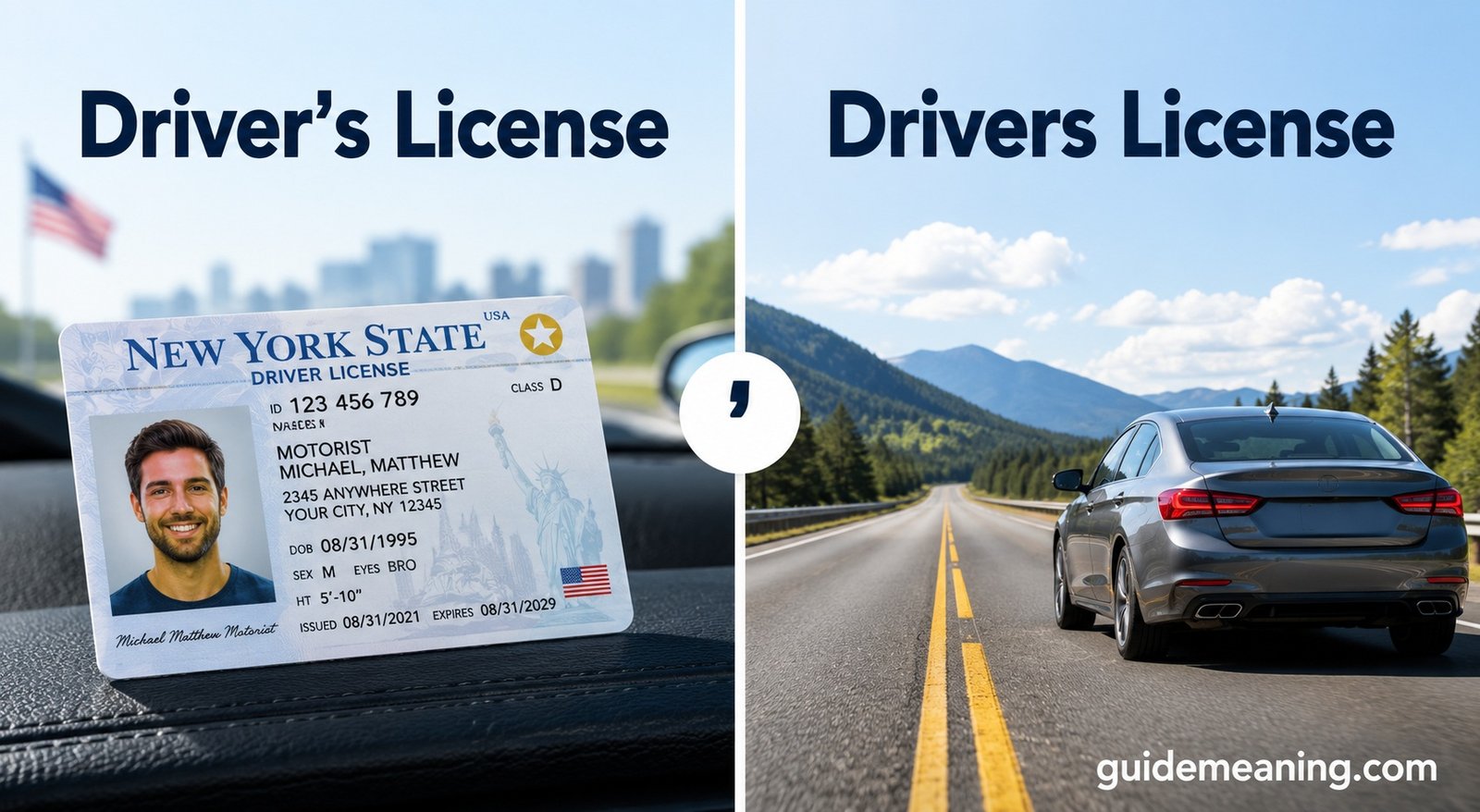

Driver’s License vs Drivers License causes confusion because the apostrophe marks the traditional possessive form in standard American English. When people compare driver’s license, drivers license, and driver license, the key difference comes from grammar, usage, and official terminology. In standard American English, driver’s license remains the traditional and widely accepted spelling for an individual driver. The apostrophe shows possession, while drivers license is generally an incorrect form in formal writing. However, driver license can be legally correct when used as official government terminology by certain jurisdictions. This is why writers, students, bloggers, and professionals may see different forms and become confused. Knowing the basic grammar rules, regional differences, and legal variations helps prevent common mistakes, errors, and misunderstandings.
A driver’s license is not simply a plastic, paper, or card. It provides proof of permission to drive or operate a motor vehicle, and it may serve as an official identification card. The document is issued to an individual driver or person who is legally allowed to drive a car or other vehicle. Its official details can include important identification information, so spelling, placement, and accurate usage matter. When preparing or renewing a legal document, paying attention to tiny details can improve clarity, precision, and understanding while reducing misinterpretation and embarrassment. A learner’s permit is another useful example because it shows how official forms, documents, and communication require careful wording. These small choices can also affect professionalism, especially when dealing with government records or applications.
The most practical advice is to understand the difference, check regional preferences, and follow the guidelines of the relevant agency. Drivers License may appear in everyday conversations, driving discussions, searches, and informal communication, but seeing a form often doesn’t make it grammatically correct. At first glance, both versions may look correct, yet their meaning, placement, and historical usage can differ. A comprehensive guide can use examples, tables, and practical explanations to break down these subtle rules without creating unnecessary confusion. The heart of the issue is accuracy: respect rights and responsibilities, support traffic safety, and use the correct way for each context. A driver should be fully qualified, safe, and respected, while incorrect forms, mistakes, and poor communication can create avoidable problems.
Let’s dive in!
Quick Answer:
Driver’s License vs Drivers License: driver’s license is the standard form in American English when referring to the document issued to one driver. Drivers license is not the standard possessive form, while driver license can appear as an official government term.
TL;DR
• Driver’s license is the standard form in ordinary American writing.
• Drivers license drops the apostrophe and is generally considered incorrect.
• Drivers’ licenses refers to licenses belonging to multiple drivers.
• Driver license appears in some official government terminology.
• The apostrophe marks driver’s as a singular possessive noun.
What Does Driver’s License Mean?
The phrase refers to a government-issued credential that permits someone to legally operate a motor vehicle. In the United States, state governments generally issue these credentials.
The phrase also carries a second meaning today. A driver’s license often works as a widely accepted form of personal identification.
The Basic Meaning
A driver’s license identifies the person who has been licensed to drive. It commonly contains information such as the person’s name, photograph, date of birth, and license details.
The exact design varies by state. However, the basic purpose remains similar across the country.
Why the Phrase Uses “Driver’s”
The word driver’s is the singular possessive form of driver.
Think about these examples:
• teacher’s book means a book belonging to one teacher.
• student’s ID means an ID associated with one student.
• driver’s license means a license associated with one driver.
The apostrophe therefore has a grammatical purpose. It isn’t simply decorative punctuation.
Why Is Driver’s License Usually Correct?
In ordinary American English, driver’s license follows the standard rule for singular possessives. A singular noun usually takes an apostrophe plus s when showing possession or association.
That same pattern appears throughout everyday English. For example, you write doctor’s office, child’s toy, and customer’s account.
Possession Doesn’t Always Mean Ownership
There’s an important detail here. The possessive form doesn’t always mean literal ownership.
For example, a doctor’s office isn’t necessarily owned by the doctor. The phrase can simply show a relationship or association.
Likewise, driver’s license doesn’t need to mean that the driver legally owns the physical document. It identifies the license as the credential associated with that driver.
Why the Apostrophe Helps
Without the apostrophe, drivers normally looks like a plural noun.
Compare these forms:
| Form | Meaning | Typical Use |
| driver | One person who drives | “The driver stopped.” |
| drivers | More than one driver | “The drivers waited.” |
| driver’s | Belonging to one driver | “Her driver’s license expired.” |
| drivers’ | Belonging to multiple drivers | “The drivers’ licenses were checked.” |
| driver license | Official terminology in some contexts | Government documents |
The distinction becomes especially useful when writing formal sentences.
Is Drivers License Ever Correct?
Drivers license without an apostrophe is common enough to cause confusion. However, that doesn’t make it the standard grammatical form.
When people mean the license associated with one driver, driver’s license is normally the better choice.
Why People Drop the Apostrophe
Several factors can make the apostrophe disappear.
First, people often type quickly on phones and computers. Apostrophes are easy to overlook, especially in informal writing.
Second, people encounter government terminology that uses driver license. That can make other variations seem equally acceptable.
Finally, the plural word drivers looks natural before another noun. English contains many noun combinations, so readers may not immediately notice the missing apostrophe.
Casual Writing vs. Standard Writing
You might see drivers license in texts, comments, search queries, or informal posts. Most readers will understand what it means.
Still, understanding the phrase isn’t the same as making it grammatically standard.
For schoolwork, professional writing, articles, applications, and polished communication, use driver’s license unless you’re reproducing an official title exactly.
Driver License vs Driver’s License
This is where the comparison gets more interesting. Driver license is different from drivers license.
The first removes the possessive apostrophe and the final s. Some government agencies use this form as an official term.
Why Government Language Can Differ
Government agencies often create standardized names for forms, credentials, programs, and databases. These names don’t always follow the wording people use in everyday speech.
As a result, a state may label a credential Driver License even though ordinary writers commonly say driver’s license.
That doesn’t mean standard English has suddenly changed. Instead, it reflects a particular official naming convention.
The Important Difference
Consider this simple comparison:
driver’s license → standard everyday expression
drivers license → missing the apostrophe
driver license → official-style term used by some agencies
This distinction explains why you might see Driver License printed on a government card. It doesn’t automatically make drivers license the correct grammatical alternative.
What Is the Plural of Driver’s License?
The plural form can create another apostrophe problem. When you’re talking about licenses associated with multiple drivers, the standard form is drivers’ licenses.
Notice that the apostrophe moves.
Singular Form
Use driver’s license when referring to one driver’s credential.
For example:
She renewed her driver’s license yesterday.
Only one driver is being discussed, so driver’s is singular possessive.
Plural Form
Use drivers’ licenses when discussing licenses belonging to multiple drivers.
For example:
The office processed hundreds of drivers’ licenses.
Here, drivers is plural, so the apostrophe comes after the s.
This is the same pattern found in phrases such as teachers’ classrooms or students’ records.
A Brief History of the Driver’s License
The history of the phrase follows the growth of automobiles in the early twentieth century. As cars became more common, American states gradually developed systems for regulating drivers.
Massachusetts and Missouri were among the first states to require driver licenses in 1903. Early licensing systems were much simpler than modern ones, and testing requirements developed later. Rhode Island introduced an examination requirement in 1908, while New Jersey required both written and road testing in 1913.
Early American Licensing
Early licenses were not necessarily the detailed plastic cards Americans recognize today.
Requirements varied considerably between states. Some early systems focused on registration, identification, or basic eligibility rather than the standardized testing process now associated with driving.
Massachusetts records, for example, show that its 1903 licensing system did not require a driving test. Applicants instead completed an application and met other requirements established by the state.
From Permission to Identification
Over time, licensing became more closely connected with driver testing and public safety.
By the middle of the twentieth century, licensing requirements were much more established across the country. The driver’s license also became increasingly useful as an identification document, not merely proof of permission to drive.
That broader role helps explain why the phrase is now familiar even to people who rarely drive.
Read more: Appreciative of vs Appreciative for: Which Is Correct?
How Driver’s License Became an American Cultural Symbol
A driver’s license isn’t a symbol in the traditional religious or mythological sense. However, it has developed strong cultural meaning in the United States.
For many Americans, getting a license represents independence. It can mark the transition from childhood toward greater personal responsibility.
Independence and Freedom
Driving has long been connected with American ideas of mobility and personal freedom.
A license can therefore symbolize:
• Personal independence and the ability to travel alone.
• Growing responsibility during the teenage years.
• Access to work, school, errands, and social activities.
• A practical form of identification in everyday life.
The meaning varies from person to person. For someone living in a city with strong public transportation, a license may feel less important.
For someone in a rural area, however, driving can be closely tied to daily life.
The Teenage Milestone
In many American families, getting a license is treated as a rite of passage.
A teenager may associate the license with the first solo drive, a first car, or greater freedom from parents.
That emotional meaning helps explain why the document can feel more significant than its official purpose suggests.
Driver’s License as Identification
Modern American driver licenses serve a role beyond driving. They are frequently used to confirm identity in everyday situations.
However, the exact uses and requirements can vary depending on the situation and the issuing state.
Everyday Uses
A driver license may be requested when someone needs to establish identity or age.
Common situations include:
• Confirming identity during certain transactions.
• Showing proof of age for age-restricted activities.
• Checking identity during travel or official procedures.
• Providing information when completing government-related processes.
The license is therefore both a driving credential and a familiar identity document.
REAL ID and Modern Identification
The federal REAL ID system added another layer to the conversation. REAL ID is based on federal standards established by the REAL ID Act of 2005.
Beginning May 7, 2025, travelers generally needed a REAL ID-compliant credential or another accepted form of identification for certain domestic air travel purposes.
This development made the wording on driver licenses even more visible to the public.
Driver’s License in Modern American Life
Today, the phrase appears everywhere from school assignments to government forms. It also appears in conversations about driving, identity, age, independence, and adulthood.
Because of that wide use, the phrase has become part of everyday American vocabulary.
Digital Communication
People often shorten or simplify words when texting. Apostrophes are especially easy to omit.
You may therefore encounter:
• “I need to renew my driver’s license.”
• “Where did I put my drivers license?”
• “My driver license expires next month.”
The first is standard everyday wording. The second is commonly understood but lacks the possessive apostrophe. The third may reflect official terminology.
Social and Cultural Meaning
The phrase can also appear in discussions about growing up.
For younger Americans, it may represent a new stage of independence. For older adults, it can represent continued mobility and self-reliance.
At the same time, not everyone sees driving as essential. Public transportation, walkable communities, economic factors, and changing lifestyles can shape how important a license feels.
Common Mistakes With Driver’s License
The biggest mistake is usually forgetting the apostrophe. However, several related errors can cause confusion.
Understanding the patterns makes the correct form much easier to remember.
Mistake: Drivers License
Incorrect in standard possessive usage: drivers license
Standard form: driver’s license
The problem is that drivers is normally plural. It doesn’t show that the license is associated with one driver.
Mistake: Drivers’ License
This form is grammatically possible in a different structure, but it usually doesn’t express the intended meaning.
Drivers’ means something belongs to or is associated with multiple drivers.
For example:
The drivers’ licenses were checked.
Here, several drivers have several licenses.
Mistake: Driver’s Licenses
This form is completely valid when discussing multiple licenses associated with one driver.
For example:
The company kept copies of each driver’s licenses.
However, that sentence has another issue. A better version would be:
The company kept copies of each driver’s license.
The word each makes the subject singular.
When Should You Use Each Form?
The easiest approach is to match the form with your meaning.
Use Driver’s License
Choose driver’s license in ordinary American writing when referring to one person’s credential.
For example:
I forgot my driver’s license at home.
This is the natural choice in most everyday situations.
Use Drivers’ Licenses
Choose drivers’ licenses when referring to multiple drivers and their licenses.
For example:
The agency reviewed the drivers’ licenses.
Here, multiple drivers are involved.
Use Driver License
Use driver license when an official agency, form, database, or credential specifically uses that wording.
For example, if a state agency officially labels a document Driver License, reproduce the official name as written.
Driver’s License vs Drivers License: At a Glance
The difference becomes much easier once you focus on the apostrophe.
| Expression | Standard? | Meaning |
| Driver’s license | Yes | License associated with one driver |
| Drivers license | No, in standard possessive usage | Commonly intended to mean driver’s license |
| Drivers’ licenses | Yes | Licenses associated with multiple drivers |
| Driver license | Yes in some official contexts | Government-style terminology |
| Driver’s licenses | Yes | Multiple licenses associated with one driver |
The key point is simple: drivers license and driver license aren’t interchangeable.
One is a missing-apostrophe version of the ordinary phrase. The other can be an intentional official term.
Why the Apostrophe Still Matters
Some people wonder whether one tiny mark really matters. In this case, it helps readers understand the grammatical relationship between the two nouns.
English uses apostrophes to mark many possessive relationships. Removing one can change the grammatical structure even when the intended meaning remains obvious.
The Apostrophe as a Meaning Marker
Consider these examples:
driver → one person
drivers → several people
driver’s → associated with one driver
drivers’ → associated with several drivers
That pattern is consistent with many other English nouns.
Why Context Still Helps
Even when someone writes drivers license, most readers know what they mean.
Context makes the intended meaning obvious. Still, clear writing aims to use the standard form rather than rely on readers to correct the phrase mentally.
Does Every U.S. State Say Driver’s License?
No. This is one of the most important reasons the wording can seem inconsistent.
State agencies can use their own official terminology. Some use driver license rather than driver’s license in official titles or documents.
Official Language Can Be Different
Government language often favors short, standardized labels. That can produce terms that differ from normal conversational English.
So, seeing Driver License on a state document doesn’t mean the everyday phrase driver’s license is wrong.
Instead, the two forms can serve different purposes.
What Should You Write?
For ordinary American English, the safest choice is:
driver’s license
For an official title, use the wording required by that agency or document.
This approach avoids confusing official naming conventions with general grammar.
FAQs:
Is “driver’s license” or “drivers license” correct?
Driver’s license is the standard form in American English when referring to a license issued to one driver. Drivers license without an apostrophe is generally not preferred in formal writing.
Why does “driver’s license” have an apostrophe?
The apostrophe shows possession. The license is associated with or belongs to an individual driver, so driver’s license uses the singular possessive form.
Is “driver license” also correct?
Yes. Driver license is an established form used in some official government terminology and jurisdictions. The preferred wording can depend on the agency or region.
What is the difference between “driver’s license” and “drivers license”?
The main difference is the apostrophe. Driver’s license follows the traditional possessive grammar, while drivers license is usually considered an incorrect form in ordinary formal writing.
Should I use “driver’s license” in American English?
Yes. Driver’s license is the safest choice for general American English writing, especially in schoolwork, professional communication, articles, and other formal contexts.
Is “drivers’ licenses” grammatically correct?
Yes, but it has a different meaning. Drivers’ licenses is the plural possessive form and refers to licenses belonging to multiple drivers.
Why do I sometimes see “driver license” on official documents?
Some government agencies and jurisdictions deliberately use driver license as their official terminology. In those cases, following the agency’s exact wording is appropriate.
Conclusion:
The difference between driver’s license and drivers license mainly comes down to grammar and the use of the apostrophe. For general American English, driver’s license is the traditional and widely accepted choice. Driver license can also be correct when it appears as official government terminology. Meanwhile, drivers license without an apostrophe is generally best avoided in formal writing. When completing applications or official documents, follow the terminology used by the relevant agency.