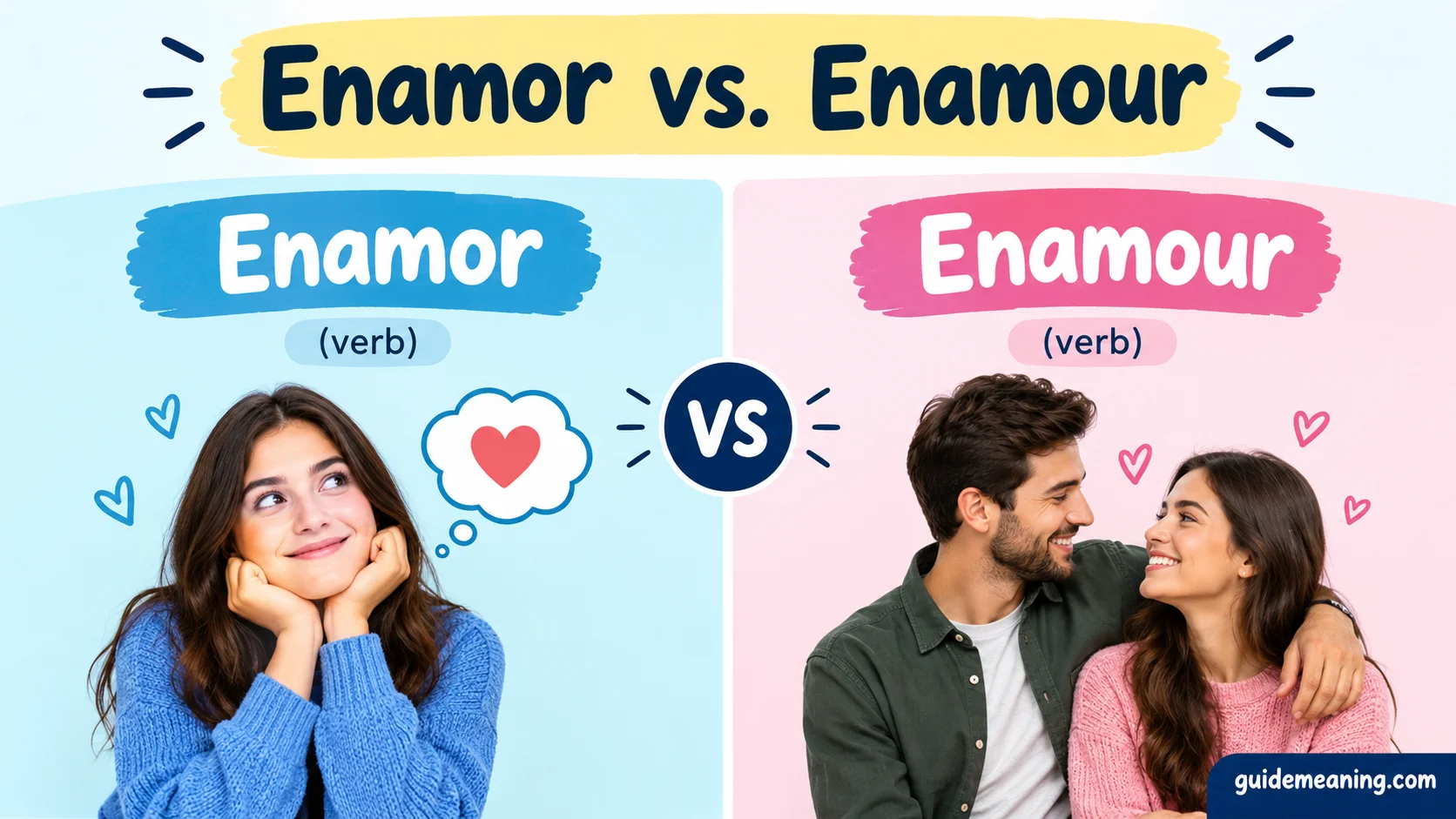

Enamor vs. Enamour explains why two spellings can share one meaning while following different English conventions.
The words enamor and enamour may seem confusing at first glance, but the difference is simple. Both are spellings of the same verb with the same meaning: to fill a person with love, strong affection, or admiration. They can describe someone who feels deeply attracted to or charmed by something. The main spelling difference is regional. American English uses enamor as the standard form, while British English uses enamour, with an extra u. These regional spellings follow different regional conventions, not a change in meaning. Both versions express feeling of love, affection, attraction, and fascination. Collins and Cambridge recognize these regional forms and correct spellings, helping English learners, students, writers, and language enthusiasts understand their usage patterns and contexts.
Consider this example: “The audience was enamored by the magician’s captivating performance.” This sentence demonstrates how the word describes people who are greatly attracted to something impressive. Similarly, “He became enamoured with the beauty of the city” shows how the British form can express admiration. A heartfelt message, such as “I was completely enamored by her smile,” can sound elegant and romantic. However, the spelling does not create different emotions. These deeply connected words share the same emotional essence. Like identical twins separated by a single letter, they carry the same idea while reflecting language history and cultural preference. When crafting a story, writing a love letter, composing an essay, or creating poetry, choosing the right form makes a significant difference to writing consistency. Descriptive language, figurative language, literary devices, metaphor examples, simile examples, and poetic expression add color, emotion, and depth to communication, creating memorable content.
When improving everyday communication or writing skills, consider your specific audience before selecting either form. The American English form is primarily common in American writing, while the British English form appears in standard British English. Both forms are used in sentences to express admiration toward a person or thing. From a practical English usage perspective, keeping your spelling consistent makes the text easier to follow. This natural choice helps writers match their chosen variety of English to their readers. The key distinction is regional usage, not a difference in meaning. Understanding these distinctions can strengthen your vocabulary, contribute to vocabulary enhancement, and help you understand English more clearly. Exploring these terms, comparing examples, reviewing comparisons, avoiding common mistakes, and practicing exercises provide practical usage tips. Improving vocabulary takes time, but learning when to use either spelling can enrich your expression and help you share ideas with greater confidence.
Let’s dive in!
Quick Answer:
Enamor and enamour are two spellings of the same verb. Enamor is preferred in American English, while enamour is preferred in British English. Both mean to inspire someone with love, affection, admiration, or fascination.
- Enamor: The standard choice for most American English writing.
- Enamour: The standard choice for most British English writing.
- Enamored: The American English past participle and adjective.
- Enamoured: The British English equivalent.
- Meaning: To attract, charm, or fill someone with affection or admiration.
- Part of speech: Verb, with related participle forms that can function adjectivally.
Examples:
- American English: She became enamored with the historic town.
- British English: She became enamoured with the historic town.
Both sentences convey the same meaning. The spelling changes, but the underlying idea stays the same.
Comparison Overview
The easiest way to understand enamor vs. enamour is to compare their spelling, meaning, and regional use side by side.
| Feature | Enamor | Enamour |
| Preferred English variety | American English | British English |
| Part of speech | Verb | Verb |
| Basic meaning | To inspire love or admiration | To inspire love or admiration |
| Present-tense example | The painting enamors visitors. | The painting enamours visitors. |
| Past-tense example | The painting enamored visitors. | The painting enamoured visitors. |
| Past participle | Enamored | Enamoured |
| Present participle | Enamoring | Enamouring |
| Common adjective construction | Enamored with | Enamoured with |
| Correctness | Correct | Correct |
| Best choice for US-focused content | Yes | Usually no |
The table highlights the central point: neither spelling is inherently more correct than the other. Each belongs to a different spelling tradition.
For example, an American newspaper would generally use enamored, while a British publication would normally use enamoured. Both editors would be following their usual regional conventions.
Consistency matters more than choosing one spelling for every English-speaking audience. If your article targets American readers, use the American form throughout. If it targets British readers, follow British spelling conventions instead.
Main Differences Between Enamor and Enamour
Although enamor and enamour have the same basic meaning, several practical details help explain when to use each form.
American English vs. British English
The main difference between enamor and enamour is regional spelling.
American English commonly favors shorter spellings in several word families. British English often retains the letter u in words such as colour, favour, and honour. The same pattern appears in enamor and enamour.
Consider these examples:
- American: The children were enamored with the science museum.
- British: The children were enamoured with the science museum.
Both versions are grammatically sound. The spelling simply reflects the writer’s chosen variety of English.
This distinction also applies to related forms. If you write enamor in an American article, you would normally use enamored and enamoring. If you choose enamour for British English, the corresponding forms are enamoured and enamouring.
One spelling rule makes the choice easier: follow the same regional convention throughout the entire document.
Meaning and Definition
Both words mean to inspire love, affection, attraction, or strong admiration in another person. They can describe romantic feelings, but romance isn’t their only use.
For example, someone might become enamored with a charming village, a talented musician, or a fascinating scientific discovery. The word suggests a strong positive response that goes beyond casual interest.
Consider these sentences:
- He was enamored with the musician’s remarkable talent.
- She became enamoured of the countryside’s peaceful atmosphere.
- The students were enamored with the mysteries of astronomy.
Each sentence describes a strong attraction or fascination. None requires a romantic relationship.
Pronunciation and Spelling
The two spellings generally have the same pronunciation in comparable English accents. The extra u in enamour doesn’t normally create an additional sound.
The difference is primarily visual and regional rather than phonetic. Readers familiar with British English may expect enamour, while American readers will more often recognize enamor.
You don’t need to change how you pronounce the word when switching between these spellings. However, regional accents can affect pronunciation details, as they do with many English words.
Are Enamor and Enamour Interchangeable?
Yes. The words are interchangeable in meaning, but the spelling you choose should match your audience.
Suppose you’re preparing two versions of a travel article. One targets readers in the United States, and the other targets readers in the United Kingdom.
You might write:
- US version: Visitors often become enamored with the city’s historic architecture.
- UK version: Visitors often become enamoured with the city’s historic architecture.
Both sentences communicate the same idea. Only the spelling convention changes.
In mixed-audience writing, either form can be understood. Still, a publication may have a house style that requires one spelling, so check its guidelines before submitting your work.
What Does Enamor Mean?
Enamor is a verb that means to inspire someone with love, affection, admiration, or fascination. It describes the effect a person, place, object, or idea has on someone’s feelings.
The word often suggests that someone finds something especially appealing. That attraction might develop gradually or happen almost immediately.
For instance, a traveler might become enamored with a quiet seaside village after spending a weekend there. A reader might feel enamored with a novelist’s writing style after finishing one particularly moving book.
In both cases, the word expresses more than simple approval. It suggests a strong emotional connection or attraction.
Definition and Meaning of Enamor
The verb enamor typically describes causing someone to feel affection or admiration. Its common grammatical patterns include enamor someone with something in appropriate contexts and constructions involving the adjective enamored.
Here are three useful examples:
- The singer’s warm personality enamored the audience. The audience developed a strong liking for the singer.
- He was enamored with the idea of starting his own business. He felt deeply attracted to the possibility.
- She became enamored of the old library’s peaceful atmosphere. She developed a strong appreciation for the place.
Notice that the subject doesn’t have to be a person. An idea, experience, or place can also inspire powerful feelings.
The word can describe romantic affection, but it often works just as naturally in discussions about art, travel, education, and personal interests.
Examples of Enamor in Sentences
The following examples show how American English writers can use enamor and enamored in everyday contexts.
| Sentence | Meaning |
| The garden enamored every visitor who entered. | The garden inspired strong admiration. |
| She became enamored with classical music. | She developed a deep interest in classical music. |
| He was enamored of her confidence and humor. | He admired her personal qualities. |
| The young designer became enamored with minimalist interiors. | The designer developed a strong preference for that style. |
| They were enamored by the beauty of the coastline. | The coastline captivated them. |
The first sentence uses enamored as a verb in the past tense. The other examples mainly use enamored as a participle describing a person’s emotional state.
For everyday writing, the construction become enamored with is particularly useful. It sounds natural in descriptions of people discovering new interests or developing strong preferences.
What Does Enamour Mean?
Enamour has the same basic meaning as enamor. It describes inspiring love, attraction, admiration, or fascination, but it follows the spelling convention commonly used in British English.
The word can describe someone’s feelings toward a person, a place, an activity, or an idea. It doesn’t have a separate definition that distinguishes it from the American spelling.
For example, a British travel writer might describe visitors as enamoured with the Scottish Highlands. An American writer would typically spell the same word enamored.
The meaning remains unchanged.
Definition and Meaning of Enamour
The verb enamour describes the act of causing someone to feel affection or strong admiration. It can also appear in the past participle enamoured, which commonly describes someone who already feels that attraction.
Consider these examples:
- The historic castle enamoured visitors with its dramatic architecture.
- She became enamoured of the poet’s thoughtful observations.
- The students were enamoured with the possibilities of space exploration.
Each sentence illustrates a different kind of attraction. The first focuses on architecture, the second on writing, and the third on intellectual curiosity.
Although enamour appears more often in British English, American readers can still understand it. Its presence in a sentence doesn’t automatically make that sentence incorrect.
Examples of Enamour in Sentences
Here are more examples showing how British English writers can use the word.
| Sentence | Meaning |
| She was enamoured with the peaceful village. | She felt a strong attraction to the village. |
| The audience became enamoured of the young pianist. | The audience developed great admiration for the pianist. |
| He was enamoured by the possibilities of renewable energy. | He felt fascinated by those possibilities. |
| They grew enamoured with the local culture. | They developed a deep appreciation for the culture. |
| The novelist’s style enamoured a new generation of readers. | The novelist’s writing attracted many readers. |
These examples also show that enamour can describe a growing interest rather than an immediate emotional response.
For example, someone might initially enjoy a particular hobby and gradually become enamoured with it. That progression helps convey the depth of the person’s interest.
Grammar Rules for Using Enamor and Enamour
Understanding the spelling difference is only half the story. You also need to know how these words behave in a sentence.
The most important distinction is between the base verb and its related forms. Choosing the correct form helps you avoid awkward or ungrammatical constructions.
Enamor vs. Enamored and Enamour vs. Enamoured
Enamor and enamour are base verbs. Their forms change according to tense and grammatical function.
| Grammatical form | American English | British English |
| Base form | Enamor | Enamour |
| Third-person singular | Enamors | Enamours |
| Simple past | Enamored | Enamoured |
| Past participle | Enamored | Enamoured |
| Present participle | Enamoring | Enamouring |
The past tense and past participle have the same spelling in both varieties, although the presence or absence of u changes the written form.
Here’s how the forms work in context:
Base verb:
- American: Beautiful landscapes enamor many travelers.
- British: Beautiful landscapes enamour many travelers.
Simple past:
- American: The exhibition enamored visitors last summer.
- British: The exhibition enamoured visitors last summer.
Past participle used descriptively:
- American: She is enamored with modern architecture.
- British: She is enamoured with modern architecture.
Present participle:
- American: The designer is enamoring clients with fresh ideas.
- British: The designer is enamouring clients with fresh ideas.
The last construction is grammatically possible, although many writers would choose a more direct alternative, such as The designer is winning clients over with fresh ideas.
In everyday English, enamored and enamoured appear more commonly than the base verbs in many contexts. Learning the complete word family helps you recognize both forms when reading.
Should You Use Enamored With, Of, or By?
The preposition following enamored can influence how natural your sentence sounds. The most familiar constructions are enamored with and enamored of.
Both are established in American English. Their British counterparts are enamoured with and enamoured of.
Enamored with commonly introduces the person, object, or idea that attracts someone.
- She became enamored with the new photography exhibit.
- He is enamored with the possibility of working abroad.
Enamored of is another established construction. It can sound slightly more formal or literary in some contexts.
- The writer was enamored of the natural world.
- She became enamored of his quiet confidence.
Enamored by also appears in English, often emphasizing the person or thing that produces the attraction.
- The children were enamored by the magician’s performance.
- Visitors were enamored by the landscape’s dramatic beauty.
Usage varies, and these prepositions don’t always create sharp differences in meaning. When you want a straightforward, natural sentence, enamored with is a dependable choice.
Avoid leaving out the preposition when using the adjective construction.
- Incorrect: She was enamored the painting.
- Correct: She was enamored with the painting.
However, the base verb can take a direct object:
– Correct: The painting enamored her.
This distinction matters because enamor someone and be enamored with someone or something follow different grammatical patterns.
Can Enamor Describe Things Besides Romantic Love?
Absolutely. Limiting enamor to romantic relationships would leave out much of its practical value.
The word can describe strong admiration or fascination in several settings.
Travel and nature
- The travelers became enamored with the mountain scenery.
- She was enamored of the island’s quiet beaches.
Art and entertainment
- The audience was enamored with the actor’s performance.
- He became enamored with abstract painting.
Education and intellectual interests
- The student grew enamored with astronomy.
- She became enamored of the history of ancient civilizations.
Work and personal projects
- The entrepreneur was enamored with the potential of the new product.
- He became enamored with the craft of furniture making.
In each case, the word suggests a powerful positive response. It may communicate enthusiasm, fascination, affection, or admiration, depending on the context.
For a casual conversation, simpler alternatives such as love, like, admire, or be fascinated by may sound more natural. However, enamor can add a distinctive tone when you want to emphasize a strong attraction.
How to Keep Your Spelling Consistent
Consistency helps your writing look polished and professional. Readers may understand both spellings, but switching between them unnecessarily can distract from your message.
Use these practical guidelines:
- For American English: Choose enamor, enamored, and enamoring.
- For British English: Choose enamour, enamoured, and enamouring.
- For academic work: Follow the spelling guide required by your institution.
- For business writing: Follow your company’s preferred style guide.
- For international publications: Choose one variety of English unless the publication requests otherwise.
A useful tip is to check the entire word family during proofreading. Correcting enamour to enamor while overlooking enamoured elsewhere can leave the document inconsistent.
Common Mistakes When Using Enamor and Enamour
Although the two spellings are easy to understand, writers sometimes confuse regional conventions or grammatical forms. These common mistakes are easy to avoid once you know what to look for.
Assuming Enamour Is a Misspelling
One frequent mistake is treating enamour as an incorrect version of enamor.
That assumption ignores British English spelling conventions. Both forms are correct within their respective varieties.
For example:
- American English: He was enamored with the historic building.
- British English: He was enamoured with the historic building.
Neither sentence contains a spelling error. The appropriate choice depends on the intended audience or publication style.
Treating Enamor and Enamour as Different in Meaning
Another mistake is assuming that one word describes romantic love while the other describes general admiration.
There is no standard distinction of that kind. Both forms can describe romantic attraction, appreciation, or fascination.
Compare these sentences:
- She became enamored with the artist.
- She became enamoured with the artist.
Both can describe a strong attraction to the artist. The surrounding context determines whether that attraction is romantic or primarily admiring.
Confusing Enamor With Enamored
The base verb and the participle don’t serve exactly the same grammatical purpose.
Consider the following examples:
- Incorrect: She is enamor with the novel.
- Correct: She is enamored with the novel.
- Correct: The novel enamors her.
The first sentence uses the base verb where the participle is needed. The second correctly describes her feelings. The third uses enamors as the main verb.
Remember the pattern: someone is enamored with something, but something enamors someone.
The same rule applies to British English, using enamour and enamoured.
Omitting the Necessary Preposition
When enamored functions as an adjective, it commonly appears with with or of.
- Incorrect: He was enamored the sculpture.
- Correct: He was enamored of the sculpture.
- Correct: He was enamored with the sculpture.
However, the base verb can take a direct object without a preposition.
– Correct: The sculpture enamored him.
Recognizing this difference makes it easier to construct sentences that sound natural.
Using Enamor Only for Romantic Relationships
The word can express romantic feelings, but its meaning extends beyond relationships.
For example, a person can become enamored with a new language, a musical instrument, or a scientific subject. These uses emphasize deep interest or admiration rather than romance.
If you write about someone who discovers a passion for gardening, you might say:
She became enamored with gardening after transforming her small backyard.
That sentence communicates a strong and growing interest. No romantic interpretation is necessary.
Enamor vs. Enamour: More Examples in Context
Examples make the spelling difference easier to remember. The following comparisons show how both forms work in common situations without changing the underlying meaning.
Examples About People and Relationships
When you describe affection or admiration for another person, either spelling can work.
| American English | British English |
| She was enamored with his kindness. | She was enamoured with his kindness. |
| He became enamored of her intelligence. | He became enamoured of her intelligence. |
| They grew enamored with each other. | They grew enamoured with each other. |
These examples show why context matters. Enamored and enamoured can describe romantic affection, but they can also convey respect or admiration.
For example, someone might be enamored with a friend’s generosity without feeling any romantic attraction. The word describes the strength of the positive feeling, while the context clarifies its nature.
Examples About Places and Experiences
Writers often use these words to describe places that leave a lasting impression.
| American English | British English |
| We became enamored with the coastal village. | We became enamoured with the coastal village. |
| The tourists were enamored of the old city. | The tourists were enamoured of the old city. |
| She was enamored with the mountain trails. | She was enamoured with the mountain trails. |
Imagine a traveler who plans to spend one night in a small town but decides to stay for a week. The local architecture, friendly residents, and peaceful surroundings capture her attention.
You could say she became enamored with the town. The word communicates a strong attraction that developed through experience.
Examples About Ideas and Interests
You can also use enamor and enamour when describing intellectual curiosity or creative interests.
| American English | British English |
| He became enamored with astronomy. | He became enamoured with astronomy. |
| She was enamored of the author’s ideas. | She was enamoured of the author’s ideas. |
| The team became enamored with the new design. | The team became enamoured with the new design. |
These examples are useful in essays, reviews, personal stories, and professional writing. They show that the words aren’t limited to emotional or romantic situations.
Still, consider your audience. In straightforward business communication, interested in, impressed by, or enthusiastic about may communicate the same idea more directly.
Which Spelling Should You Use?
Choosing between enamor and enamour is simple once you know who will read your writing.
When to Use Enamor
Use enamor when writing for an American English audience. This applies to the base verb and its related forms, including enamored and enamoring.
Examples include:
- The novel enamored readers across the country.
- She became enamored with the world of architecture.
- The filmmaker’s storytelling style enamored a new audience.
American English publications generally prefer the spelling without u. If you’re preparing a US-focused blog post, school assignment, or business document, this is the safest choice.
When to Use Enamour
Use enamour when following British English spelling conventions. Its related forms include enamoured and enamouring.
Examples include:
- The novel enamoured readers across the country.
- She became enamoured with the world of architecture.
- The filmmaker’s storytelling style enamoured a new audience.
British English commonly retains the u in this word family. Following that convention helps your writing match other British spellings.
The same preference applies to publications that use British-style English, including many publications in countries where British spelling conventions remain common. However, individual publishers may have their own style requirements.
Related American and British Spelling Differences
The enamor/enamour distinction follows a familiar pattern in English spelling.
| American English | British English |
| Color | Colour |
| Favor | Favour |
| Honor | Honour |
| Labor | Labour |
| Enamor | Enamour |
| Enamored | Enamoured |
These pairs illustrate a recurring difference between American and British spelling traditions. The pattern doesn’t apply to every word, so it’s best to check a dictionary when you’re uncertain.
A helpful rule is to choose your preferred English variety before drafting. Then apply it consistently to spelling, punctuation, and other style choices.
FAQs:
What is the difference between enamor and enamour?
Enamor is the standard spelling in American English, while enamour is commonly used in British English. Both words have the same meaning: to fill someone with love, affection, or admiration.
Is enamor or enamour correct?
Both spellings are correct. The right choice depends on your preferred variety of English. Use enamor for American English and enamour for British English.
What does enamor mean?
Enamor means to fill someone with love, admiration, or strong attraction. For example, Her kindness began to enamor everyone she met.
What does enamour mean in British English?
Enamour means the same as enamor. It describes a feeling of affection, attraction, or admiration toward someone or something. For example, The beauty of the countryside continued to enamour visitors.
Is enamored the past tense of enamor?
Yes. Enamored is the past tense and past participle of enamor in American English. In British English, enamoured is the usual spelling.
Can enamor and enamour be used in formal writing?
Yes. Both forms are suitable for formal writing, essays, stories, and other types of content. However, you should follow the spelling conventions expected by your audience and keep your usage consistent.
What are some synonyms for enamor and enamour?
Common synonyms include charm, captivate, fascinate, delight, and attract. The best choice depends on the context and the strength of the emotion you want to express.
Conclusion:
The difference between enamor vs. enamour comes down to regional spelling, not meaning. American English generally uses enamor, while British English prefers enamour. Both words express love, affection, attraction, or admiration toward someone or something. Understanding this small spelling distinction helps you avoid common mistakes and write more clearly. Whether you’re composing a formal essay, creating a story, or writing a heartfelt message, choose the spelling that suits your audience and use it consistently.