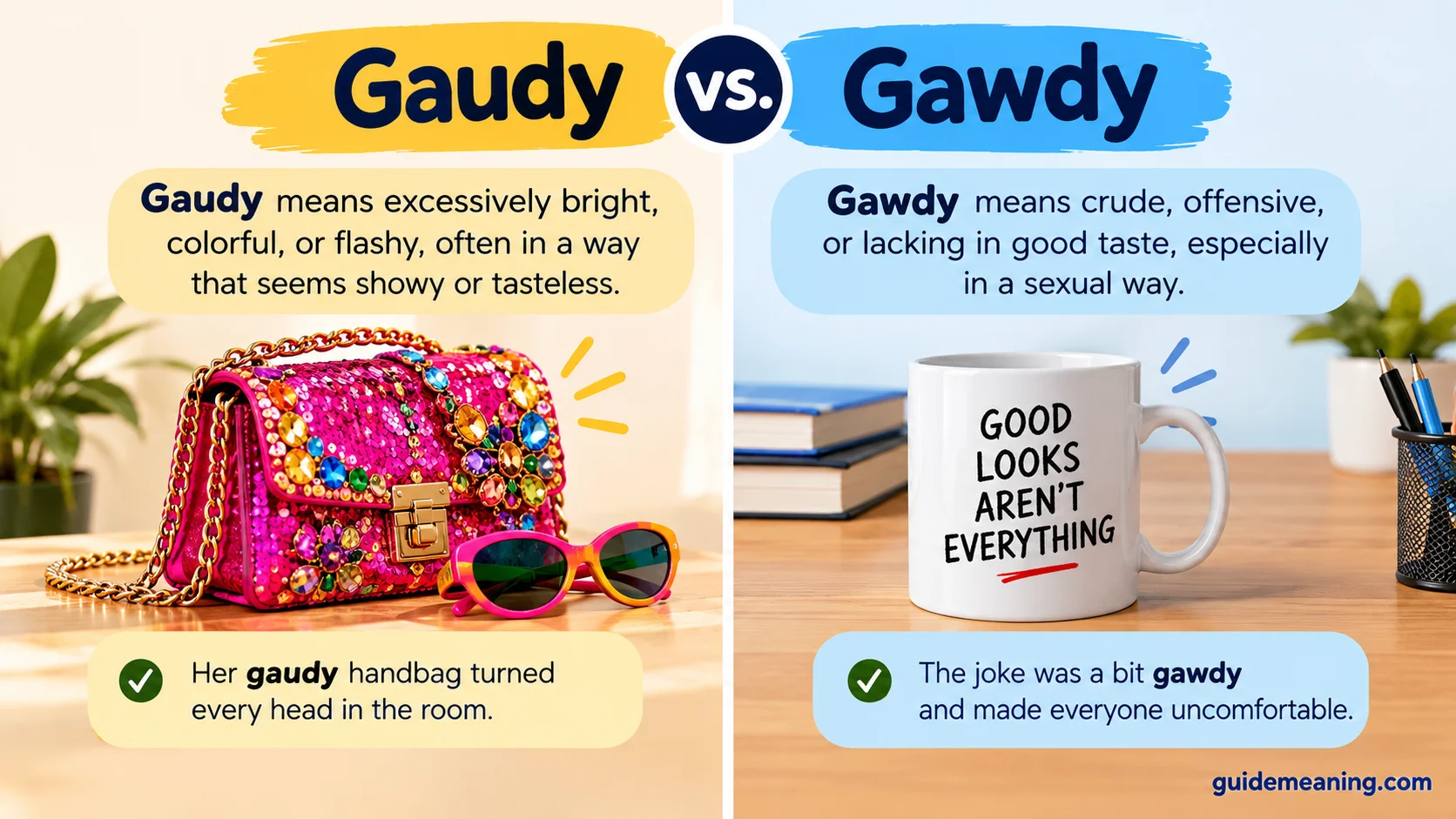

Gaudy vs. Gawdy explains why similar-looking spellings confuse English learners and how to choose the correct word in everyday writing.
The confusing pair Gaudy vs. Gawdy can make readers feel unsure about English spelling because both words look almost identical and sound similar. However, gaudy is a recognized English adjective that means showy, extravagantly bright, bright, tasteless, or vulgar. For example, gaudy neon lights outside a casino create a bold visual impression visible for miles. Casino displays, decorative rooms, gold mirrors, velvet curtains, and glittering chandeliers can become visually overwhelming when every decoration competes for attention. In real-life usage, gaudy can describe colorful clothes, an ornament, or a showy ornament. It can also refer to a festival or a raucous party. Understanding these different meanings helps you make the correct choice and avoid mixing up the words.
Most dictionaries and usage guides recommend Gaudy as the standard spelling. Some references list Gawdy as an accepted variant, while others treat it as a common or likely misspelling that should be avoided. Using gaudy correctly supports accurate communication and clear writing, especially in formal writing and professional settings. People sometimes use the spellings interchangeably in informal contexts or everyday informal language because they sound similar. However, guessing can lead to embarrassing mistakes, negative judgment, and reduced credibility. I remember a case where someone wore a gaudy necklace to a party. The description fit perfectly because the necklace was bright, oversized, and impossible to ignore. This example shows how one precise adjective can improve a description. When learners pause, wonder, or question a spelling, a reliable guide can break down the confusion in a simple, human way.
The word also has historical depth. Its origin traces to Middle English, where gaud referred to a trick or ornament. Later, gaudi became associated with ornamental beads around the 1520s, showing the word’s evolution over time. Studying this history can strengthen your understanding of the word and its development. If you have developed a habit of choosing spellings through guesswork, learning the history and correct usage can improve your language control, vocabulary, and writing skills. You don’t have to feel alone when English seems tricky. This article explains the distinction so you can communicate effectively and accurately in everyday language and professional settings. Understanding the difference starts with recognizing the word and checking whether your chosen dictionary accepts Gawdy or marks it as misspelled. Clear spelling supports better communication, clarity, and confidence whenever you encounter this confusing pair.
Let’s dive in!
Quick Answer:
In American English, gaudy is the standard spelling for something excessively showy, flashy, or tastelessly decorated. Gawdy is usually considered a misspelling today, although the form has appeared historically.
TL;DR
- Gaudy is the preferred modern spelling.
- Gawdy is generally nonstandard in contemporary writing.
- Both forms may be pronounced the same way.
- Gaudy often describes excessive color, decoration, or showiness.
- Historical texts and proper names may explain unusual uses of gawdy.
What Does Gaudy Mean?
The word gaudy is an adjective that describes something excessively bright, flashy, or heavily decorated. It often suggests that an object looks unattractive because its colors or ornaments compete for attention.
However, gaudy doesn’t simply mean colorful. A bright red dress can look elegant, while a dress covered in clashing colors and oversized decorations might look gaudy.
Common Meanings of Gaudy
Depending on the situation, gaudy can suggest several things:
- Excessive brightness that makes an object visually overwhelming.
- Over-the-top decoration that appears crowded or poorly balanced.
- Flashy clothing or jewelry that attracts attention immediately.
- Showiness that seems more concerned with appearance than elegance.
- Extravagance that some observers consider excessive or tasteless.
For example, consider a living room with gold furniture, neon curtains, glittering wallpaper, and colorful rugs. Someone who prefers simple interiors might describe the room as gaudy.
Still, another person might enjoy the same room’s bold personality. The word expresses a judgment about appearance, not an objective rule about beauty.
Gaudy vs. Gawdy: Key Differences
The main difference between these spellings is their status in modern English. Gaudy is the established spelling, while gawdy is generally nonstandard in contemporary writing.
| Feature | Gaudy | Gawdy |
| Modern spelling | Standard | Nonstandard |
| Meaning | Excessively showy or flashy | Usually intended as gaudy |
| Pronunciation | Usually pronounced GAW-dee or GAH-dee, depending on accent | Usually intended to sound the same |
| Formal writing | Appropriate | Best avoided |
| Everyday use | Widely understood | May appear to be a spelling mistake |
| Historical texts | Established form | May occur as an older spelling |
Which Spelling Should You Choose?
Use gaudy in school assignments, professional emails, articles, and everyday messages. It is the safest choice for American English.
Although gawdy appears in some historical material, that doesn’t make it an equal alternative today. If you’re quoting an older source, preserve its original spelling rather than silently changing it.
How Do You Pronounce Gaudy?
Pronunciation helps explain why people confuse these spellings. In American English, gaudy is commonly pronounced either GAW-dee or GAH-dee, depending on the speaker’s accent.
The first syllable sounds like “gaw” to many speakers. Consequently, people may assume the word begins with gaw- instead of gau-.
Why Pronunciation Doesn’t Determine Spelling
English spelling reflects historical changes, borrowed words, and conventions that don’t always match modern speech. As a result, two words can sound alike while following different spelling patterns.
Consider these examples:
- Gaudy: The decorations looked gaudy against the plain walls.
- Bawdy: The comedian told a bawdy joke.
- Haughty: His haughty manner made conversation difficult.
- Tawdry: The advertisement used tawdry images to attract attention.
Notice how bawdy and tawdry contain aw, while gaudy uses au. The similar sounds can make the wrong spelling feel natural.
What Is the Origin and History of Gaudy?
The history of gaudy is more interesting than its modern definition suggests. Its earlier meanings were connected with ornaments, pleasure, and festive occasions rather than simply poor taste.
Medieval Roots
Historical word records trace gaudy to medieval English usage involving decorative beads associated with rosaries. Related forms of gaud referred to ornaments, trinkets, or objects valued for their appearance.
The word’s deeper history is linked to medieval Latin and Old French terms associated with joy, pleasure, and showy decoration. However, the exact path of its development isn’t entirely certain.
How the Meaning Changed
By the 1500s, the word had connections with trickery and deception, alongside meanings involving decoration and festivity. During the late 1500s, it also described joyful or festive qualities.
By around 1600, gaudy had developed its familiar sense of showiness that seems tasteless or excessive. Over time, this critical meaning became its best-known use in modern English.
The word has also appeared as a noun associated with feasts or festivals. That older use survives in limited contexts, including the historical term gaudy day.
What About the Spelling Gawdy?
Older English spelling wasn’t always as standardized as it is today. Writers and printers sometimes used different spellings for the same word.
Therefore, gawdy can appear in historical writing without being a modern typo. Today, however, most writers should use gaudy unless reproducing an original text or referring to a proper name.
Why Do People Confuse Gaudy and Gawdy?
The confusion mostly comes from pronunciation. When people hear a word without seeing it written, they often choose the spelling that seems to match its sound.
Phonetic Spelling
Phonetic spelling means writing a word according to how it sounds. This approach works for some words, but English contains many exceptions.
For instance, someone who hears gaudy might naturally spell it gawdy. The mistake makes sense phonetically, even though it doesn’t follow the standard spelling.
Familiar Spelling Patterns
People also rely on spelling patterns they’ve encountered in other words. Since bawdy and tawdry contain similar sounds, the spelling gawdy may appear reasonable.
However, familiar patterns aren’t always reliable guides. Checking a trusted dictionary is a better approach when a word’s spelling seems uncertain.
How to Use Gaudy in a Sentence
The best way to understand gaudy is to see how it works in everyday American English. It usually modifies a noun and describes something visually excessive.
Examples of Gaudy in Everyday Writing
- The hotel lobby featured gaudy gold decorations.
- He wore a gaudy jacket covered in bright sequins.
- The oversized necklace looked gaudy with her simple dress.
- We replaced the gaudy curtains with softer colors.
- The store displayed gaudy signs in every window.
- Her gaudy costume was perfect for the comedy performance.
- The restaurant’s gaudy interior distracted guests from the food.
- Those gaudy plastic flowers clashed with the elegant table setting.
Examples in Different Contexts
Fashion: The bright suit looked gaudy beside the other guests’ formal clothing.
Home decor: The homeowner removed the gaudy wallpaper during the renovation.
Advertising: The company rejected the gaudy design in favor of a cleaner layout.
Celebrations: The party featured gaudy decorations, glittering balloons, and oversized displays.
Sports and entertainment: A commentator might describe a player’s gaudy statistics to emphasize unusually impressive numbers. In this context, the word can sound admiring rather than critical.
These examples show that context matters. Although gaudy often carries a negative tone, it can sometimes emphasize spectacle or excess without expressing strong disapproval.
Is Gaudy Always a Negative Word?
No. Although gaudy often suggests poor taste, its meaning depends on the situation and the speaker’s attitude.
When Gaudy Sounds Critical
The word usually sounds negative when someone believes an object has too much decoration or visual noise. For example, calling a wedding dress gaudy might suggest that its decorations overwhelm its overall design.
Similarly, describing a room as gaudy can imply that its colors clash or its ornaments look excessive. The criticism reflects the speaker’s preferences, not a universal standard of beauty.
When Gaudy Can Sound Positive
Sometimes, gaudy describes something impressive, extravagant, or impossible to ignore. Sportswriters, for instance, may use the phrase gaudy statistics to describe unusually high numbers.
In that context, the word emphasizes abundance or spectacle rather than poor taste. However, it can still carry a hint of excess, depending on the surrounding sentence.
Gaudy vs. Similar Words: What’s the Difference?
Several English words describe bright, flashy, or excessive appearances. However, each carries a slightly different meaning, so choosing the right one can make your writing more precise.
| Word | Main Meaning | Example |
| Gaudy | Excessively showy or tastelessly decorated | The gaudy necklace overwhelmed her outfit. |
| Garish | Unpleasantly bright or harsh | Garish lights filled the storefront. |
| Flashy | Designed to attract attention | He arrived in a flashy sports car. |
| Flamboyant | Bold, dramatic, and expressive | She wore a flamboyant stage costume. |
| Ostentatious | Intended to display wealth or importance | They built an ostentatious mansion. |
| Tawdry | Cheap-looking or lacking refinement | The room featured tawdry decorations. |
Which Synonym Fits Best?
Use gaudy when something appears excessively decorated or colorful. Choose garish when brightness feels harsh, and use flashy when attention-grabbing appearance matters most.
Meanwhile, flamboyant can describe a confident, expressive style without necessarily criticizing it. Ostentatious emphasizes a display of wealth or status, while tawdry suggests cheapness or poor quality.
These differences aren’t absolute. Still, they help you communicate your intended meaning more clearly.
How Americans Use Gaudy Today
In the United States, gaudy appears in conversations about clothing, home design, entertainment, advertising, and public displays. Its meaning often depends on personal taste and the expectations surrounding a particular setting.
Fashion and Personal Style
A person might call oversized jewelry or a brightly patterned outfit gaudy. However, bold clothing can also express creativity, confidence, and cultural identity.
The distinction matters because not everyone shares the same ideas about elegance. What one person considers gaudy might look playful or stylish to someone else.
Home Decor and Celebrations
The word frequently appears in discussions about interior design and holiday decorations. For example, someone might describe an excessive display of glittering ornaments as gaudy.
Yet holiday decorations often celebrate abundance, color, and spectacle. In that setting, the same features that seem excessive during ordinary days may feel joyful and appropriate.
Social Media and Entertainment
Online discussions sometimes use gaudy to describe extravagant celebrity outfits, elaborate parties, or visually crowded designs. The word can express criticism, amusement, or admiration.
It also appears in entertainment commentary when a display seems deliberately excessive. Context helps readers determine whether the writer disapproves or simply wants to emphasize its scale.
Common Mistakes When Using Gaudy and Gawdy
Most mistakes involve spelling, meaning, or tone. A few simple checks can help you avoid confusion.
Mistake: Writing Gawdy in Standard English
Incorrect: The restaurant had gawdy decorations.
Correct: The restaurant had gaudy decorations.
The second sentence uses the standard spelling. Unless you’re quoting a historical source or reproducing a proper name, choose gaudy.
Mistake: Assuming Gaudy Means Colorful
Incorrect assumption: Every brightly colored outfit is gaudy.
Better understanding: An outfit becomes gaudy when its brightness or decoration seems excessive to the observer.
A colorful outfit can look balanced and attractive. Therefore, use gaudy when you intend to suggest over-the-top styling rather than color alone.
Mistake: Treating Gaudy as an Objective Judgment
Calling something gaudy expresses an opinion about its appearance. One person might dislike glittering gold furniture, while another might love its dramatic effect.
For clearer writing, explain what makes the object seem excessive. Mention clashing patterns, overwhelming decorations, or unusually bright colors instead of relying on the label alone.
FAQs:
What is the difference between gaudy and gawdy?
Gaudy is the standard English spelling for something showy, extravagantly bright, or tasteless. Gawdy is generally treated as a misspelling, although some references list it as a variant.
Is gaudy or gawdy the correct spelling?
Gaudy is the preferred spelling in standard English. Use it in essays, emails, articles, and professional writing to maintain accuracy and clarity.
What does gaudy mean in simple English?
Gaudy describes something excessively bright, flashy, or decorated in a way that looks tasteless. For example, a room filled with clashing colors and oversized decorations might look gaudy.
Can gawdy be used as an alternative spelling?
Some references recognize gawdy as an accepted variant, but many standard dictionaries treat it as a misspelling. When in doubt, choose gaudy for general and formal writing.
What are some examples of gaudy things?
Examples include brightly colored clothes, oversized jewelry, flashy casino displays, and rooms filled with glittering chandeliers, gold mirrors, and bold decorations. These things may look gaudy when their appearance feels excessive.
Where does the word gaudy come from?
Gaudy has historical roots in Middle English. Its history is connected to the word gaud, which referred to a trick or ornament. The word’s meaning and usage developed over time.
How can I remember the correct spelling of gaudy?
Remember that gaudy is the spelling most commonly recommended by dictionaries and usage guides. When writing about something flashy or tasteless, choose gaudy instead of guessing between the two spellings.
Conclusion:
Understanding Gaudy vs. Gawdy helps you avoid spelling mistakes and communicate more clearly. Gaudy describes something flashy, extravagantly bright, showy, or tasteless, while gawdy is generally considered a misspelling in standard English. Although some references recognize it as a variant, gaudy remains the safest choice for everyday and professional writing. Remember the preferred spelling, learn its meaning, and use it confidently whenever you describe something that attracts attention for its excessive appearance.