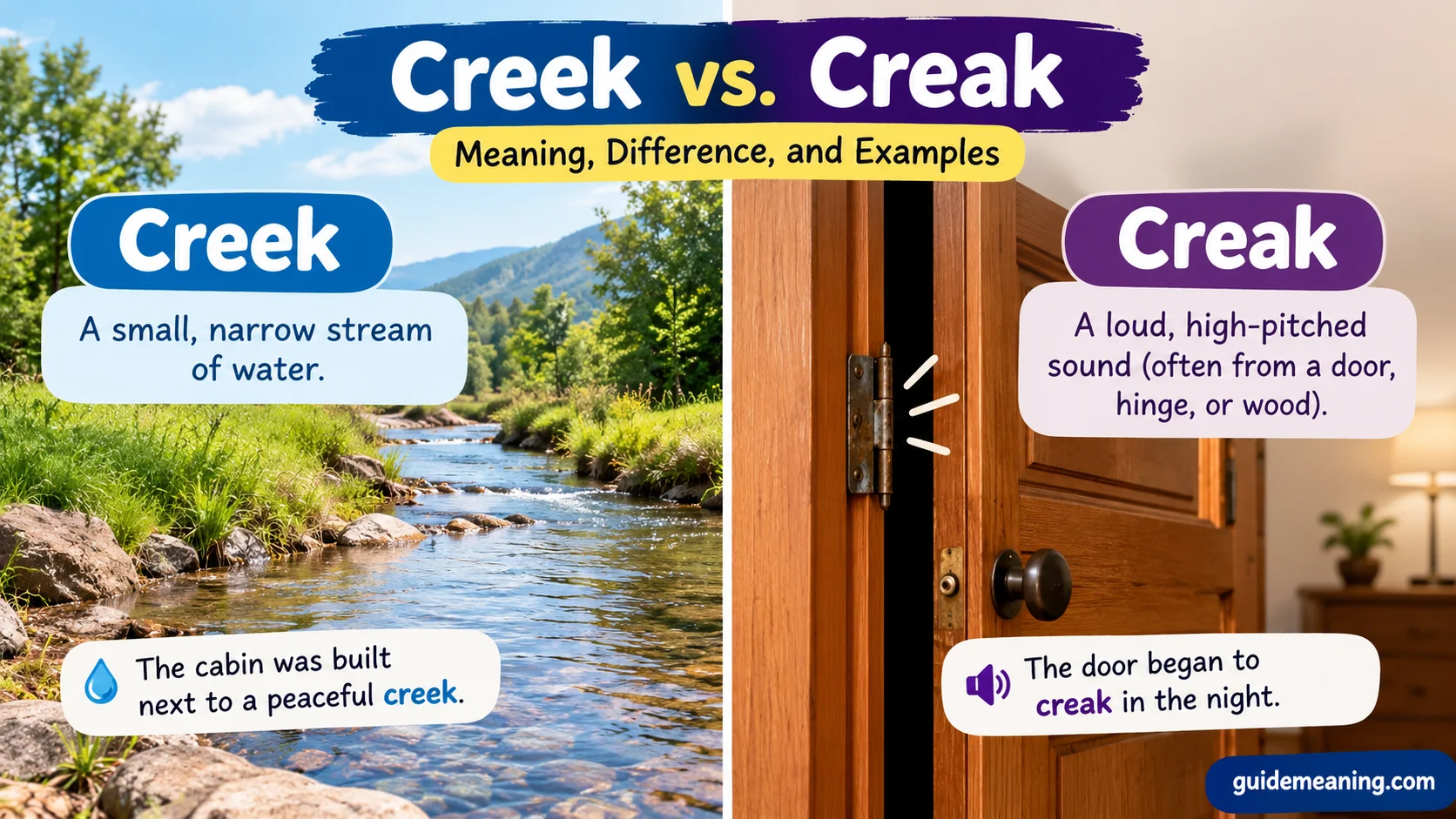

Creek vs. Creak explains how homophones sound alike but differ in meaning, spelling, and usage, helping writers choose the right words in English. Strong writing requires clear meaning, effective communication, and vivid imagery. Imagine walking through a quiet forest at sunset, following a trail beside a narrow stream where water flows over smooth stones with a peaceful rhythm. This natural setting illustrates a creek, a small river or minor tributary found in rural places and wooded areas. In geography, a creek follows a path and may connect to a larger river, forming part of a larger water system. A bubbling creek adds a peaceful feeling and depth to creative writing, descriptive language, and figurative language. Writers use similes, metaphors, and literary devices to express ideas creatively, making their content memorable and engaging.
A creak, however, describes a harsh sound, grating sound, squeaking, or prolonged sound. Imagine stepping onto an old wooden bridge and hearing a long groaning sound beneath your feet. This sound might resemble a soft moan and can be used metaphorically to suggest weakness, strain, pressure, or instability. Creaks often come from old materials or strained materials, including a swinging door, loose hinge, tired floorboard, or rocking chair in familiar interior settings. The word creak functions as both a verb and a noun. A door can creak, or you can hear a creak. In my experience, describing the movement and noise of an object under stress adds vivid sensory detail to spoken communication and written communication. These details describe objects, suggest a need for repair, and improve precise expression. Although creek and creak have almost identical sounds, they describe completely different things and serve distinct roles.
For students, learners, English learners, and professional writers, understanding this common example helps reduce confusion and strengthen writing skills, reading comprehension, and overall language accuracy. People often mix up these words because they sound alike, but paying attention to semantics, phonetics, sentence structure, and context makes the difference easier to recognize. For example, “The creek flowed through the woods” and “The wooden bridge began to creak” demonstrate correct usage. Practicing example sentences, practical examples, and exercises, along with following practical tips, helps writers sharpen vocabulary, improve comprehension, and build confidence in academic writing and professional conversation. The Spellzone dictionary offers a resource for exploring word meanings and uses. Whether a sound is heard, listened to, made, or produced, understanding its context supports accurate learning and helps people use words correctly. This guide explores the emotional connections and deeper lessons behind these fascinating words, encouraging vocabulary enhancement and stronger language understanding while helping writers avoid mistakes that confuse readers, weaken communication, or change the tone of a sentence.
Let’s dive in!
Quick Answer:
In American English, creek means a small natural stream, while creak means a harsh, squeaking, or groaning sound. A creek flows through the landscape; a door creaks when it moves noisily.
TL;DR
- Creek refers to a small stream or waterway.
- Creak describes a harsh squeaking or groaning sound.
- Both words are pronounced alike in many American accents.
- Creek has historical roots connected to bends or inlets.
- Creak developed from older words describing harsh sounds.
- Context helps you choose the correct spelling every time.
What Is the Difference Between Creek and Creak?
Although these words sound identical, their meanings and grammatical uses differ. Understanding that distinction is especially helpful when writing about American landscapes, homes, and everyday experiences.
Meaning of Creek
A creek is a natural waterway, usually smaller than a river. It may flow through a forest, cross a field, or wind through a neighborhood.
For example, you might say, “We spent the afternoon fishing in the creek.” Here, the word refers to the body of water where people are fishing.
Meaning of Creak
A creak is a sharp, rough, or prolonged squeaking sound. It often comes from moving wood, metal hinges, floorboards, or other objects under pressure.
For example, “The old stairs creak whenever someone walks upstairs.” In this sentence, creak describes the sound produced by the stairs.
Creek vs. Creak at a Glance
| Feature | Creek | Creak |
| Meaning | A small natural waterway | A harsh squeaking or groaning sound |
| Part of speech | Noun | Noun and verb |
| Common setting | Riversides, forests, parks | Doors, floors, chairs, machinery |
| Example | We crossed the creek. | The wooden bridge began to creak. |
| Memory clue | Water flows through a creek. | Noisy objects creak when they move. |
The easiest rule is simple: if you’re describing water, choose creek. If you’re describing a noise, choose creak.
What Does Creek Mean in American English?
In the United States, a creek usually means a small stream or a minor waterway. The word appears frequently in rural place names, outdoor recreation, environmental discussions, and descriptions of natural scenery.
How Americans Use Creek
Creeks are familiar features in many American landscapes. Some flow through wooded areas, while others run beside farms, hiking trails, and residential communities.
You might encounter the word in these situations:
- A family walks along a creek during a weekend camping trip.
- A farmer uses a nearby creek as a landscape landmark.
- Children explore shallow water while supervised by adults.
- A hiking guide describes a trail that follows a creek.
- A neighborhood road includes Creek in its official name.
However, the size of a creek varies by location. Some are narrow enough to cross on foot, while others carry substantial amounts of water after heavy rain.
Does Creek Always Mean a Small Stream?
Not necessarily. In American English, the word most often describes a small stream, but regional usage can vary.
In coastal areas, particularly in some Atlantic regions, creek may refer to a narrow inlet or tidal channel. Therefore, local geography can influence exactly what the word describes.
What Does Creak Mean?
The word creak describes a rough, squeaky, or groaning noise. It can function as both a noun and a verb, making it useful for describing sounds and the actions that produce them.
Creak as a Verb
As a verb, creak describes the act of making that sound. The noise often occurs when something moves, bends, or carries weight.
For example:
- The rusty gate creaks whenever the wind blows.
- The old wooden steps creak under heavy footsteps.
- A rocking chair creaks as Grandpa settles into it.
- The wooden ship creaked as the waves moved beneath it.
These examples show how creak adds sound to a description. Instead of merely saying that a door opened, you can describe how it sounded.
Creak as a Noun
As a noun, creak names the sound itself.
For example, “A sudden creak came from the hallway.” The sentence focuses on the noise rather than the action that produced it.
In American storytelling, this word often creates suspense. A creak in a quiet house might suggest someone moving nearby, although the sound could have an ordinary explanation.
Creek vs. Creak: History and Word Origins
The two words developed through different paths in English. Their histories explain why they look similar today but describe unrelated things.
Where Did the Word Creek Come From?
The word creek traces back to Middle English forms such as crike and creke. These forms are linked to Old Norse kriki, meaning a bend or corner.
Over time, the word became associated with narrow coastal inlets and branches of waterways. By the 1600s, American English used creek for small streams as well.
This development reflects how language changes when people describe new landscapes. Early settlers needed words for the waterways they encountered, and existing terms gradually took on additional meanings.
Where Did the Word Creak Come From?
The word creak emerged in Middle English, with recorded forms dating to around the early 1300s. It originally described a harsh cry or sound, including noises resembling animal calls.
Later, the word became associated with squeaking hinges, wooden boards, and other objects. Its sound helps explain its development because creak resembles the noise it describes.
This kind of word formation is called onomatopoeia. It occurs when a word imitates a sound, as in buzz, clang, or hiss.
Creek vs. Creak in American Culture
Both words appear in American life, but they connect to different parts of the country’s culture. A creek often evokes outdoor recreation and local geography, while a creak appears in stories, homes, and descriptions of aging objects.
Creek in American Place Names
Creeks have helped shape settlement patterns and local identities across the United States. Their names appear on road signs, maps, parks, and community landmarks.
For example, a place called Mill Creek might preserve a connection to an older waterway or a nearby mill. Such names can remain long after the surrounding landscape changes.
Creeks also matter to fishing, hiking, wildlife habitats, and environmental protection. Consequently, the word can suggest both a physical location and a connection to nature.
Creak in American Stories and Entertainment
In American movies and books, a creak can set the mood without showing anything frightening. A slowly opening door may build suspense, while a creaking porch can make a rural scene feel familiar.
The sound also appears in comedy. An old chair that creaks dramatically can suggest age or discomfort without a single spoken explanation.
However, these associations depend on context. A creaking floorboard might sound frightening in a horror movie but completely ordinary in someone’s home.
The Cultural and Historical Meaning of Creek
Although creek usually refers to water, the capitalized word Creek also has an important historical meaning in the United States. It appears in the name of the Muscogee (Creek) Nation, an Indigenous nation with deep roots in the southeastern United States.
This meaning deserves separate attention because it concerns people, identity, and history rather than geography alone.
Who Are the Muscogee (Creek) People?
The Muscogee people developed communities and political alliances across parts of what are now Georgia, Alabama, Florida, and surrounding areas. English colonists used the name Creek, associated with the Ochese Creek area, for these Indigenous communities.
The name eventually became widely used for the Muscogee and a broader confederacy of towns and peoples. However, Muscogee is a name the people use for themselves.
Why Does This Meaning Matter Today?
The Muscogee (Creek) Nation continues to maintain its government, culture, and community life. Its history includes forced removal from ancestral homelands during the 1800s.
Therefore, the word Creek can carry historical and cultural significance beyond a description of a stream. When discussing Indigenous history, using the full name Muscogee (Creek) Nation where appropriate shows greater precision and respect.
Importantly, this historical meaning has no direct connection to the word creak, which describes a sound.
Emotional and Psychological Associations of Creek and Creak
Words can bring certain images or feelings to mind, even when they don’t have formal symbolic meanings. In this case, each word can create a different atmosphere for readers and listeners.
What Feelings Does Creek Suggest?
A creek may evoke calmness, movement, freshness, or outdoor adventure. These associations often come from personal experiences with nature rather than a fixed symbolic definition.
For example, someone who spent childhood summers beside a stream might connect creeks with family memories. Another person might associate them with hiking, fishing, or quiet reflection.
In stories, a flowing creek can also represent a journey or the passage of time. That interpretation is a creative choice, not a universal cultural rule.
What Feelings Does Creak Suggest?
A creak can create tension because it signals movement without always revealing its source. In a quiet room, that sound may prompt curiosity or concern.
Writers also use creaking sounds to suggest age, strain, or fragility. However, a creak doesn’t automatically mean something is broken or dangerous.
The emotional effect depends on the setting. A creaking tree in a storm might sound ominous, while a familiar rocking chair might feel comforting.
Common Phrases and Expressions With Creek
American English includes several expressions built around the word creek. These phrases usually rely on the idea of being near water or getting stuck in a difficult situation.
What Does “Up the Creek” Mean?
The expression “up the creek” means being in trouble or facing a difficult situation. Speakers often use it informally when someone lacks an easy solution.
For example, “We’re up the creek if the car won’t start.” The speaker means the situation could become difficult, not that anyone is literally near a stream.
What Does “Up the Creek Without a Paddle” Mean?
The longer expression “up the creek without a paddle” describes being in trouble without the tools or resources needed to escape.
Imagine getting stranded on a river without a paddle. You might struggle to reach the shore, which explains the phrase’s meaning.
Today, Americans use this expression for everyday problems, including missed deadlines or unexpected setbacks. It is informal and often humorous, although the situation itself may be serious.
Does Creak Have Similar Expressions?
Creak doesn’t have an equally common set of idioms centered on its basic meaning. However, the related adjective creaky can describe more than noisy furniture.
For example, someone might call an old process “creaky” when it seems outdated or inefficient. In this figurative use, the word suggests that something needs attention or improvement.
Creek vs. Creak in Writing, Literature, and Social Media
Both words help writers create vivid descriptions, but they serve different purposes. Choosing the correct one makes your message clearer, whether you’re writing a story, a caption, or a casual text.
Using Creek to Describe a Scene
Writers often use creek to establish a setting quickly. A sentence about water flowing past rocks gives readers a clear picture of the environment.
For example:
- The creek wound through the quiet forest.
- We stopped beside the creek to eat lunch.
- Rainwater rushed into the creek after the storm.
- The trail followed a creek toward the campground.
These sentences focus on place, movement, and nature. They work well in travel writing, personal stories, and descriptions of outdoor activities.
Using Creak to Create Sound
Creak adds an auditory detail that helps readers imagine a scene. It can also make an otherwise ordinary action more noticeable.
For example:
- The bedroom door creaked open at midnight.
- A floorboard creaked behind the unsuspecting visitor.
- The old wooden swing creaked in the breeze.
- The chair gave a loud creak when he sat down.
On social media, either word may appear in captions about nature, home renovations, camping, or spooky stories. The correct choice still depends on whether the writer means water or sound.
Common Mistakes When Choosing Creek or Creak
The main challenge is that the words sound alike in many American accents. Because pronunciation offers little help, writers must rely on meaning and sentence structure.
Mistaking a Sound for a Place
A common error is using creek when describing a noise.
Incorrect: “The old door made a loud creek.”
Correct: “The old door made a loud creak.”
The second sentence correctly identifies the noise. The first suggests a waterway, which doesn’t fit the intended meaning.
Mistaking a Place for a Sound
The reverse mistake happens when someone writes creak while describing a stream.
Incorrect: “We swam in the shallow creak.”
Correct: “We swam in the shallow creek.”
Here, creek names the body of water where the swimming takes place.
Choosing the Correct Word From Context
When you’re unsure, identify what the sentence describes before choosing a spelling.
- If you can see or cross it as a waterway, use creek.
- If you can hear it as a noise, use creak.
- If the sentence describes an Indigenous nation, check whether Creek is part of its name.
- If the word describes an old system as inefficient, creaky may be appropriate.
This quick check works better than trying to distinguish the words by sound alone.
FAQs:
What is the difference between creek and creak?
Creek refers to a small stream or narrow river, while creak describes a long, harsh squeaking or groaning sound. Although they sound alike, their meanings and spellings differ.
Is creek a noun or a verb?
Creek is a noun. It describes a small stream of water, often found in wooded areas, rural places, or natural settings. For example, A clear creek flowed through the forest.
Is creak a noun or a verb?
Creak can function as both a noun and a verb. As a verb, it describes making a squeaking or groaning sound. As a noun, it refers to that sound. For example, The old door began to creak.
Are creek and creak pronounced the same way?
Yes, creek and creak are homophones. They share the same pronunciation but have different spellings and meanings. You must use the sentence’s context to determine which word fits.
What is an example sentence using creek?
Here’s an example: We followed the creek through the quiet woods. In this sentence, creek refers to a small stream of flowing water.
What is an example sentence using creak?
Here’s an example: The wooden floor began to creak under his feet. In this sentence, creak describes the groaning sound made by the floorboards.
How can I remember the difference between creek and creak?
Remember that creek relates to water, while creak relates to sound. A creek flows through nature, but a creaky door makes a noise. Connecting each word with a familiar image can help you remember its meaning.
Conclusion:
Understanding Creek vs. Creak helps you choose the correct word in everyday writing. Although these homophones sound identical, they serve different purposes. Use creek when describing a small stream or waterway, and choose creak when referring to a squeaking or groaning sound. For example, The creek flowed beneath the bridge, which began to creak in the wind. Paying attention to meaning and context will help you avoid common spelling mistakes, improve your vocabulary, and communicate your ideas more clearly.