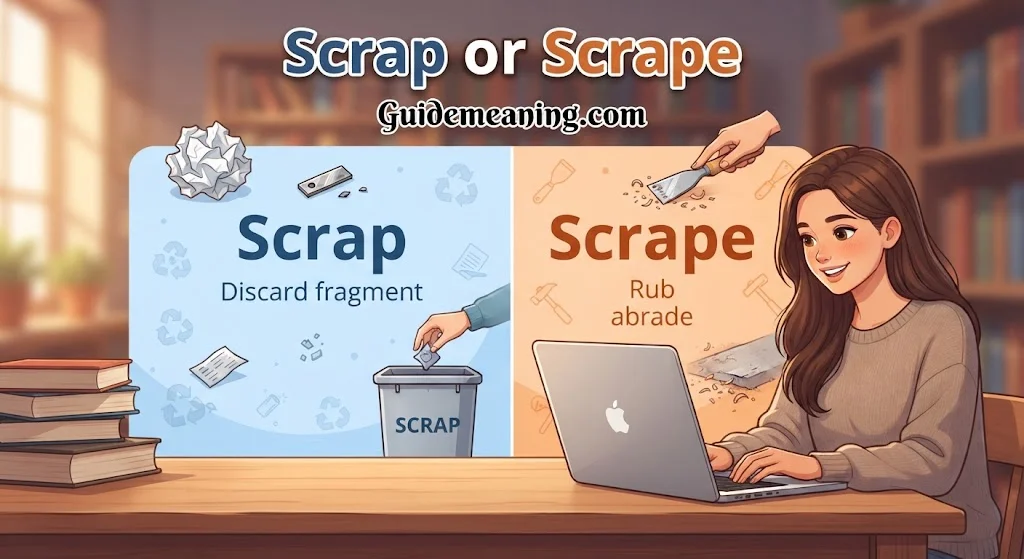

Scrap or Scrape can confuse learners and writers because these English words look and sound similar, but their meaning can change a sentence entirely. In writing, speaking, texting, or daily life, the difference is essential. Scrap usually refers to discarded material, getting rid of something, or deciding to cancel or abandon a plan. For example, you can collect old metal as scrap, or a company can scrap an old project. Scrape, however, usually describes rubbing, removing something from a surface, or making contact with a rough surface. You might scrape food from a plate or get a minor scrape on your knee. As verbs, both words describe different actions and situations, although their meanings can change slightly depending on the context.
The forms scraped and scrapped create another learning challenge. I have often paused mid-sentence, wondering what to write, because the words can feel almost identical in sound. When someone is misusing them, a missing letter may seem like a tiny issue, yet it matters because one choice can flip the idea completely. Scrape can mean to roughen or scuff a surface, or remove a thin layer, while scrap can suggest throwing something away. A spell check program may not catch this mistake, so you must notice the detail yourself. When I type fast, hit send, and later notice a mistake, the confusion feels real. I may mean one thing but write another, and that small slip can affect the whole message.
The actual difference becomes easier when you connect each word with its main meaning. These two different words have two different meanings, so clear understanding helps you avoid the wrong word in your sentences and communication. A useful guide should dive deep into real-world applications, common mistakes, origins, and practical tips without fluff or overly confusing grammar talk.
Let’s dive in!
Quick Answer:
Use scrap when you mean a small leftover piece, discarded material, something canceled, or something abandoned.
Use scrape when you mean rubbing against a surface, removing something from a surface, a shallow injury, or achieving something with difficulty.
| Word | Main meaning | Example |
| Scrap | A small leftover piece | I found a scrap of paper. |
| Scrap | Discard or cancel | They decided to scrap the plan. |
| Scrap | Discarded material | The factory sells scrap metal. |
| Scrape | Remove by rubbing or using an edge | Scrape the paint off the wall. |
| Scrape | A shallow injury | He has a scrape on his knee. |
| Scrape | Barely achieve something | She scraped through the exam. |
A useful shortcut is this:
Scrap = leftover, discarded, or canceled.
Scrape = rub, scratch, remove, or barely manage.
That distinction handles most everyday uses of scrap or scrape.
What Does “Scrap” Mean?
Scrap has several established meanings, but they share an underlying idea of something small, leftover, discarded, or no longer wanted.
As a noun, scrap can refer to a small piece of something or discarded material. As a verb, it can mean to throw something away or abandon a plan. It can also refer informally to a fight or argument.
Scrap as a Noun
The most common noun uses of scrap involve a small piece of something or material that remains after a larger part has been used.
For example:
- a scrap of paper
- a scrap of fabric
- a scrap of metal
- food scraps
- scraps of information
Consider this sentence:
She wrote the phone number on a scrap of paper.
The paper isn’t necessarily worthless. The word simply emphasizes that it is a small or leftover piece.
Similarly:
The tailor kept the scraps of fabric for future projects.
Here, scraps means small pieces left over from cutting fabric.
The word can also describe a small amount of something that isn’t physical:
We couldn’t find a scrap of evidence.
In this construction, scrap means a tiny amount or trace. Cambridge Dictionary specifically includes uses such as a small amount of information and expressions such as “not a scrap of evidence.”
Scrap as a Verb
As a verb, scrap means to abandon, cancel, or get rid of something.
For example:
The company scrapped its old advertising campaign.
This means the company decided not to continue with the campaign.
You can also use scrap with plans:
We scrapped our plans because the weather became dangerous.
Here, scrapped doesn’t mean physically throwing the plans into a trash can. It means abandoned or canceled them.
Other examples include:
- The school scrapped the outdated rule.
- The manufacturer scrapped the defective machine.
- They scrapped the proposal after several problems appeared.
- The team scrapped its original strategy.
Cambridge defines this verb as deciding not to continue with a system or plan or getting rid of something that is no longer useful or wanted.
Scrap as a Noun: A Fight
There’s another informal meaning worth knowing.
A scrap can mean a short fight or argument:
The two boys got into a scrap outside the store.
You might also hear:
They had a little scrap over the last piece of pizza.
This usage is informal. It doesn’t mean a piece of material in these sentences.
Context does the heavy lifting.
Common Expressions With “Scrap”
Several everyday expressions use scrap in its noun or verb forms.
Scrap Metal
Scrap metal means discarded or unwanted metal that can often be collected, sold, or processed for reuse.
The old machinery was sold as scrap metal.
Scrap Paper
Scrap paper means paper that remains available for informal or temporary writing.
Use this scrap paper to calculate the numbers.
Scraps of Information
This phrase describes small pieces of information, often gathered separately.
Investigators collected scraps of information from several witnesses.
Scrap Value
Scrap value refers to the value of something based largely on the materials it contains rather than its original purpose.
For example, an old vehicle might no longer be worth repairing. Its remaining metal and components can still have scrap value.
Scrap Heap
A scrap heap is a pile or collection of discarded materials or objects.
These expressions all connect naturally with the central idea of leftovers or discarded things.
What Does “Scrape” Mean?
Scrape has a different core meaning. It generally involves contact with a surface, especially when something rubs against it or removes material from it.
It can also describe a minor injury, a difficult situation, or barely achieving something. Cambridge Dictionary records these physical, figurative, and idiomatic uses.
Scrape as a Verb
The basic verb scrape describes removing something from a surface using pressure, friction, a rough object, or an edge.
For example:
Scrape the mud off your boots.
The action involves physically removing mud from the boots.
You can also say:
- Scrape the ice off the windshield.
- Scrape the paint from the door.
- Scrape the burned food from the pan.
- Scrape the dirt off the floor.
- Scrape the old sticker from the glass.
The important idea is physical removal through rubbing or contact.
Cambridge describes this use as removing an unwanted covering or top layer, often with something sharp or rough.
Scrape as a Verb: Rubbing Against Something
Scrape can also describe something rubbing against another surface.
The chair scraped across the floor.
The chair isn’t necessarily removing anything. It is making contact with the floor while moving.
Another example:
Her bicycle scraped against the wall.
Here, the word emphasizes the physical contact and friction.
This meaning also applies to injuries:
He scraped his knee on the pavement.
The skin rubbed against a rough surface and became damaged.
Scrape as a Noun
As a noun, scrape commonly refers to a minor injury caused by rubbing against something rough.
I got a scrape on my elbow.
A scrape is generally less serious than a deep cut. It may involve superficial damage to the skin.
For example:
The child fell off the bike and got a few scrapes.
Cambridge defines this noun as a slight injury or an unpleasant noise caused by rubbing against a surface.
The word can also describe the sound itself:
The scrape of the chair against the floor was annoying.
So scrape can describe both the physical result and the sound produced by friction.
Read More: Annual vs. Yearly vs. Every Year: Meaning, and Correct Usage for 2026
Scrape as a Verb: Barely Achieving Something
Here’s where scrape becomes more figurative.
To scrape by, scrape through, or simply scrape something can mean to succeed with difficulty or by a very small margin.
For example:
We scraped through the final round.
This means we succeeded, but only narrowly.
Another example:
She scraped into college with barely enough points.
The result wasn’t comfortably achieved. She just managed to meet the requirement.
Cambridge describes this use as succeeding in getting or achieving something with difficulty or by a very small amount.
Scrape as a Noun: A Difficult Situation
In informal English, a scrape can also mean a difficult or slightly dangerous situation.
He got into a scrape after ignoring the warning signs.
You might hear:
She has gotten into a few scrapes over the years.
This meaning has nothing to do with scratching a surface directly. It developed into the idea of getting into trouble or difficulty.
Scrap vs. Scrape: Key Differences
The easiest way to understand scrap vs. scrape is to focus on the action or thing each word describes.
| Feature | Scrap | Scrape |
| Basic idea | Leftover, discarded, canceled | Rubbing, scratching, removing |
| Noun | A small piece or discarded material | A shallow injury or difficult situation |
| Verb | Discard, cancel, abandon | Rub, scratch, remove |
| Figurative use | Abandon a plan | Barely succeed |
| Common phrase | Scrap metal | Scrape by |
| Physical example | A scrap of fabric | Scrape paint from a wall |
| Pronunciation | /skræp/ | /skreɪp/ |
The pronunciation difference matters, too. Scrap uses the vowel sound in trap, while scrape contains the long vowel sound found in shape.
That small sound difference corresponds to a major difference in meaning.
Difference Between Scrap and Scrape in Action
Sometimes the best way to learn the distinction is to put the words into nearly identical situations.
Consider these examples:
The manager scrapped the project.
The manager canceled the project.
Now compare:
The worker scraped the paint from the project sign.
The worker physically removed paint from a surface.
The words aren’t interchangeable.
Another pair makes the difference even clearer:
I found a scrap of metal.
This means a small or discarded piece of metal.
I scraped the metal against the wall.
This describes an action involving rubbing.
Think of it this way:
Scrap is often the thing left behind. Scrape is often what you do to a surface.
Scrap or Scrape: Side-by-Side Examples
| Sentence | Correct Word | Explanation |
| I need a ___ of paper. | scrap | A small piece of paper |
| Please ___ the mud off your shoes. | scrape | Remove mud from a surface |
| The company decided to ___ the project. | scrap | Abandon the project |
| She has a ___ on her knee. | scrape | A minor skin injury |
| They collect ___ metal. | scrap | Discarded metal |
| We barely ___ through the final exam. | scrape | Succeed with difficulty |
| He wrote notes on a ___ of cardboard. | scrap | A small leftover piece |
| The shovel ___ against the concrete. | scrape | Rubbed against the surface |
| They ___ the outdated policy. | scrap | Canceled or abandoned it |
| We had to ___ the burned food from the pan. | scrape | Remove material from a surface |
These examples show why simply looking at spelling isn’t enough. Meaning determines the correct word.
Common Mistakes With Scrap and Scrape
Using “Scrape” When You Mean “Scrap”
A common mistake occurs when someone wants to say that a plan or project was canceled.
Incorrect:
The company decided to scrape the plan.
Correct:
The company decided to scrap the plan.
Why? Because scrap can mean abandon or cancel.
Scrape doesn’t normally carry that meaning.
Using “Scrap” When You Mean “Scrape”
The reverse mistake happens with physical actions.
Incorrect:
Please scrap the paint from the wall.
Correct:
Please scrape the paint from the wall.
Here, you’re physically removing a layer from a surface. Therefore, scrape is the appropriate word.
Confusing Scrap and Scrape in Injuries
If someone falls and damages their skin by rubbing against a rough surface, use scrape.
He got a scrape on his arm.
Not:
He got a scrap on his arm.
A scrap can mean a fight in informal English, but it doesn’t normally mean a superficial skin injury.
Scrap or Scrape in Different Contexts
Scrap or Scrape in Construction and Repair
Construction and repair work provides plenty of examples of both words.
You might scrape old paint from a door.
You might then collect the unwanted metal pieces as scrap.
For example:
The mechanic scraped rust from the metal surface.
Then:
He put the damaged metal into the scrap pile.
One word describes the action. The other describes discarded material.
Scrap or Scrape With Food
Food provides another useful contrast.
Food scraps are leftover pieces of food.
Put the vegetable scraps in the compost bin.
However, when you remove food stuck to a pan, you scrape it.
Scrape the remaining sauce from the pan.
The distinction is straightforward once you identify whether you’re talking about the leftover material or the action of removing it.
Scrap or Scrape in Business and Projects
Business writing frequently uses scrap in its verb form.
The company scrapped the proposal.
That means the company abandoned the proposal.
You may also encounter scrape in a completely different sense:
The company scraped publicly available data from several websites.
This is a modern computing use of scrape. It means extracting data through software. Cambridge Dictionary recognizes this meaning as well.
So a sentence about software can make scrape look quite different from its traditional physical meaning.
Scrap or Scrape for Personal Injuries
For a minor abrasion, use scrape:
She got a scrape on her knee.
You can also use the verb:
She scraped her knee while playing outside.
The word connects the injury to the physical action of rubbing against a rough surface.
Scrap and Scrape: Word Forms
Understanding the related forms can prevent spelling mistakes.
Forms of Scrap
- scrap
- scraps
- scrapped
- scrapping
Notice the doubled p in scrapped and scrapping.
Examples:
They scrapped the proposal.
The factory is scrapping outdated equipment.
Forms of Scrape
- scrape
- scrapes
- scraped
- scraping
The final e disappears before -ing:
scrape → scraping
For example:
She is scraping the paint off the door.
The spelling patterns differ because the two base words behave differently when adding suffixes.
Related Words and Synonyms for Scrap and Scrape
Synonyms for Scrap
Depending on context, scrap can relate to:
- discard
- abandon
- cancel
- reject
- leftover
- fragment
- piece
- waste
- remnants
However, these aren’t perfect substitutes in every sentence.
For example, scrap metal sounds natural. Discard metal does not work in the same way.
Likewise, scrap the plan works naturally, while leftover the plan makes no grammatical sense.
Synonyms for Scrape
Depending on the context, scrape can relate to:
- scratch
- rub
- abrade
- remove
- shave
- graze
- peel
- barely achieve
Again, context matters.
You can scrape paint from a wall, but you wouldn’t normally say you graze paint from a wall.
A Simple Memory Trick for Scrap or Scrape
Here’s a practical way to remember the difference.
Think “Scrap = Small or Scrapped”
If something is a small leftover piece, think scrap.
If someone scraps something, they abandon or discard it.
scrap paper
scrap metal
scrap the plan
Think “Scrape = Surface or Struggle”
If something involves a surface, rubbing, or removal, think scrape.
If someone barely succeeds, they can also scrape by or scrape through.
scrape the paint
scrape your knee
scrape through the exam
A quick substitution test can help:
Can you replace the word with “cancel,” “discard,” or “leftover piece”?
→ Choose scrap.
Can you replace it with “rub,” “scratch,” “remove,” or “barely manage”?
→ Choose scrape.
Scrap vs. Scrape: A Real-World Comparison
Imagine an old bicycle sitting in a garage.
The bicycle is badly damaged, so its owner decides to throw it away or sell it for materials. The bicycle may eventually become scrap.
Before that happens, someone might scrape rust from its frame.
Now the distinction becomes concrete:
The owner sold the bicycle for scrap.
The mechanic scraped the rust from the frame.
The first sentence describes what the bicycle became. The second describes an action performed on its surface.
That’s the heart of scrap vs. scrape.
Scrap or Scrape: Mini Practice Quiz
Choose scrap or scrape in each sentence.
- Please ___ the ice from the windshield.
- The company decided to ___ the proposal.
- I need a ___ of paper.
- He got a ___ on his elbow.
- The workers collected the metal as ___.
- We barely ___ through the final round.
- Don’t throw away those fabric ___.
- The chair began to ___ against the floor.
- They decided to ___ the outdated rule.
- She ___ the burned food from the pan.
Answer Key
- scrape — You’re removing ice from a surface.
- scrap — You’re abandoning a proposal.
- scrap — You’re referring to a small piece of paper.
- scrape — You’re referring to a minor skin injury.
- scrap — The metal is discarded or recyclable material.
- scrape — The group succeeded with difficulty.
- scraps — These are small leftover pieces.
- scrape — The chair rubs against the floor.
- scrap — The rule is being abandoned.
- scraped — Food is being removed from a surface.
FAQs:
Is it “scrap” or “scrape” metal?
The correct phrase is scrap metal. It refers to unwanted or discarded metal that can often be collected, sold, recycled, or reused.
The old machinery was sold for scrap metal.
Is it “scrap” or “scrape” paper?
The correct phrase is scrap paper. It means a small or leftover piece of paper that you can use for notes, calculations, or temporary writing.
She wrote the address on a scrap of paper.
Is a small injury called a “scrap” or a “scrape”?
A small skin injury is called a scrape. It usually happens when the skin rubs against a rough surface.
He got a scrape on his knee while playing soccer.
What does “scrap a plan” mean?
Scrap a plan means to cancel, abandon, or decide not to continue with it.
The team scrapped the plan after discovering several problems.
Here, scrap works as a verb rather than a noun.
What does “scrape by” mean?
Scrape by means to manage or survive with barely enough money, resources, time, or success.
After losing his job, he managed to scrape by for several months.
The expression suggests that someone succeeds despite difficult circumstances.
What does “scrape together” mean?
Scrape together means to gather something with difficulty, especially when resources are limited.
They scraped together enough money to pay the repair bill.
The phrase often describes collecting small amounts until they become enough for a particular purpose.
Are “scrap” and “scrape” interchangeable?
No. Scrap and scrape have different meanings and aren’t normally interchangeable.
Use scrap for leftover or discarded material and for things that are canceled or abandoned. Use scrape for rubbing, scratching, removing something from a surface, minor skin injuries, or barely achieving something.
Conclusion:
Scrap usually refers to a leftover piece, discarded material, or something canceled. You can have scrap paper, scrap metal, or food scraps, and you can scrap a plan.
Scrape usually involves rubbing, scratching, or removing something from a surface. You can scrape paint from a wall, scrape your knee, or scrape by when you barely manage to succeed.



1 thought on “Scrap or Scrape: Meaning, Difference, and Correct Usage for 2026”