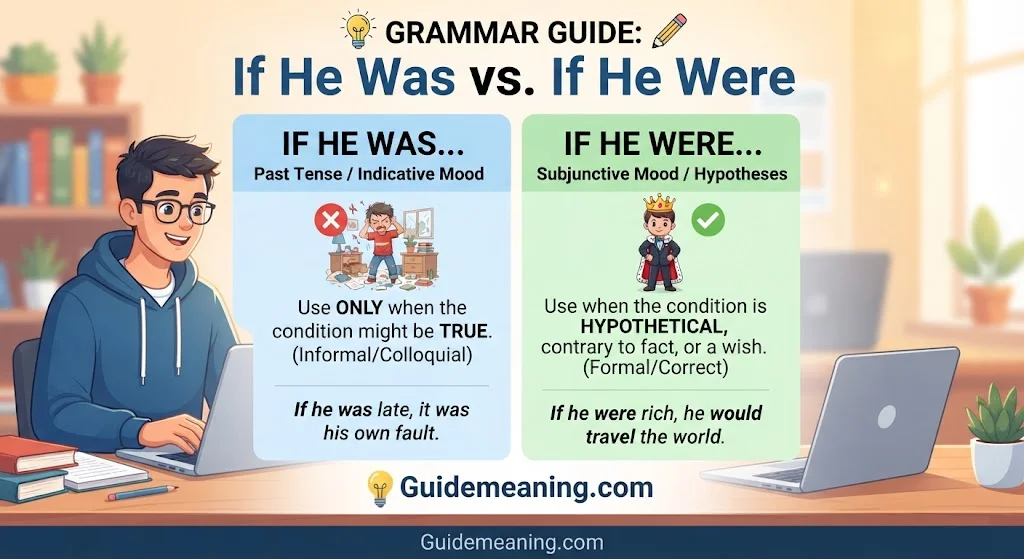

If He Was vs. If He Were helps English learners understand when a real past event differs from an imagined or hypothetical situation in English.
I’ve paused while speaking and wondered whether to use if he was or if he were. Native speakers may hesitate, too, because this tiny grammar choice can have big meaning. The choice depends on reality and imagination. Was often stands on solid ground when you describe something real, while were can float into a world of possibility. The difference becomes clearer when the situation involves a past event, an actual situation, a hypothetical condition, or an imagined situation. If he was can describe a possible past possibility, while if he were can describe something unreal or an imaginary situation. The pattern also connects to the indicative mood and subjunctive mood. The indicative is used for factual statements and possible events, while the subjunctive commonly appears in contrary-to-fact and conditional sentences.
For example, if he was can work when the speaker believes an event may have happened, while if he were can express an imagined condition. These verb forms, past tense, mood, and conditional structure help communicate what the speaker means in a sentence. “If he was at the meeting, he heard the announcement” leaves some uncertainty about a real event. “If he were here, he would help us” presents an imagined condition. When confident writers get stuck mid sentence, the problem often comes from how English hides two moods inside one simple verb.
Both forms can be correct, so guessing is less useful than checking the fact, possibility, and imagination behind the sentence. A clear guide with plain steps, real examples, a comparison table, quiz, or flowchart can make the logic easier to understand. Instead of trying to second guess every phrase, focus on the rule, sentence structure, usage, and intended meaning. This makes questions such as If He Were Or If He Was easier to handle. When you encounter similar grammar questions online, examine the context, identify the relevant moods, and choose the correct forms with greater confidence.
Let’s dive in!
Quick Answer:
Use “if he was” when you are talking about a real or possible situation, especially one in the past.
If he was at the office yesterday, he probably saw the email.
You don’t know whether he was there. You’re considering it as a possibility.
Use “if he were” when you are describing a hypothetical, unreal, or contrary-to-fact situation.
If he were here, he would help us.
The sentence imagines him being here. The speaker is treating his presence as contrary to the actual situation.
The basic distinction
| Phrase | Typical use | Example |
| If he was | Possible or uncertain past situation | If he was there, he saw everything. |
| If he were | Hypothetical or contrary-to-fact situation | If he were here, he would help. |
A useful shortcut is:
Possible reality → “if he was”
Imagined or contrary-to-fact situation → “if he were”
However, this shortcut isn’t a mechanical rule for every sentence. Context matters. English conditionals express several kinds of possibility, uncertainty, imagination, and unreality.
What Does “If He Was” Mean?
“If he was” uses the ordinary past-tense form was. It commonly appears when the speaker doesn’t know whether something happened or whether a particular past condition existed.
Consider this sentence:
If he was at the restaurant last night, he may have seen Maria.
The speaker isn’t necessarily saying that he was there. In fact, the speaker may have no idea. The sentence simply considers that possibility.
This is why “if he was” works naturally with past-time expressions such as:
- yesterday
- last night
- earlier
- last week
- during the meeting
- at the time
- when the accident happened
“If He Was” for Real or Possible Past Situations
Suppose your friend attended a meeting yesterday, but you don’t know whether he arrived before you left.
You might say:
If he was at the meeting, he probably heard the announcement.
The condition remains uncertain. He may have been there. He may not have been.
This distinction matters because was doesn’t automatically mean that the speaker believes the condition is true. It can introduce a possibility.
The MLA Style Center gives essentially the same principle: when a condition “may or may not exist,” ordinary was can be appropriate.
Examples of “If He Was”
- If he was tired, he probably went home early.
- If he was at work yesterday, he saw the manager.
- If he was sick last week, that explains his absence.
- If he was angry, he didn’t show it.
- If he was responsible for the report, he should explain the mistake.
- If he was at the party, I didn’t notice him.
In each example, the condition can relate to an actual past circumstance. The speaker isn’t necessarily creating an imaginary world.
What Does “If He Were” Mean?
“If he were” traditionally uses the subjunctive form of be. It appears when a speaker presents a situation as hypothetical, unreal, imagined, or contrary to fact.
For example:
If he were here, he would know what to do.
This sentence normally suggests that he isn’t here. The speaker imagines a different reality.
That’s the heart of the construction.
The Oxford University Press explains that the were-subjunctive appears in situations that are unreal, hypothetical, or contrary to fact.
“If He Were” for Hypothetical Situations
Imagine you’re discussing a fictional situation:
If he were the manager, he would change the schedule.
The sentence doesn’t claim that he is the manager. Instead, it asks you to imagine that he occupies that role.
You can replace the person with almost any hypothetical identity:
- If he were a doctor, he would understand the diagnosis.
- If he were the president, he would face difficult decisions.
- If he were my neighbor, I’d invite him over.
- If he were a professional athlete, he’d train every day.
- If he were in charge, the process might look different.
The grammar signals that the situation belongs to an imagined scenario.
Why Do We Say “If He Were” Instead of “If He Was”?
Here’s where traditional English grammar enters the picture.
In ordinary past tense, he takes was:
He was tired.
But English has a special form called the subjunctive mood. In certain hypothetical constructions, were can appear even with a singular subject.
So we get:
If he were here…
rather than:
If he was here…
The were doesn’t mean that he has suddenly become plural. Instead, it signals a particular grammatical meaning.
The MLA Style Center describes the subjunctive as a grammatical mood used for uncertain or hypothetical situations and explains that the subjunctive uses were where the indicative would use was.
Compare Ordinary Past Tense and the Subjunctive
| Ordinary past tense | Hypothetical subjunctive |
| He was here. | If he were here… |
| She was taller. | If she were taller… |
| I was you. | If I were you… |
| It was possible. | If it were possible… |
That contrast explains why “if he were” can look unusual even though it’s grammatically established.
If He Was vs. If He Were: The Core Difference
The most important difference involves reality and possibility.
“If He Was” = Possible or Uncertain Reality
If he was at the office, he saw the message.
The speaker doesn’t know whether he was there.
“If He Were” = Hypothetical or Contrary-to-Fact Reality
If he were at the office, he would see the message.
The speaker imagines him being there. The context may strongly suggest that he isn’t there.
Here’s the distinction in a practical table:
| Meaning | Preferred form | Example |
| Possible past event | was | If he was there, he heard it. |
| Uncertain past condition | was | If he was sick, that explains his absence. |
| Imagined present | were | If he were here, he’d help. |
| Contrary-to-fact situation | were | If he were taller, he’d play basketball. |
| Imagined role | were | If he were the manager, he’d change it. |
| Hypothetical future | were | If he were to resign, we’d need a replacement. |
If He Was vs. If He Were in Different Situations
The easiest way to understand this difference is to place the two forms into real scenarios.
Talking About Something That May Have Happened
Imagine you arrived at the office late.
If he was there earlier, he probably saw the director.
You don’t know whether he was there. You’re making a reasonable assumption about a possible past event.
Imagining a Present Situation
Now imagine that the person isn’t currently at the office.
If he were here, he could answer your question.
This sentence creates an alternative reality. In that imagined situation, his presence would change the outcome.
Talking About an Imaginary Role
If he were the team leader, he would handle the problem differently.
The person isn’t being identified as the actual team leader. The sentence simply imagines what would happen under a different condition.
Talking About an Unknown Past Condition
If he was upset, he hid it well.
The speaker doesn’t know whether he was upset. The condition remains possible rather than established.
Real vs. Unreal Conditions: A Simple Way to Think About It
Think of “was” as looking backward toward a question about reality.
Think of “were” as opening a door into an imagined situation.
For example:
If he was sick yesterday, that explains why he missed class.
You’re investigating a possibility.
Now compare:
If he were sick today, he wouldn’t come to class.
You’re imagining a present condition and its likely consequence.
The difference isn’t merely about verb tense. Cambridge notes that English often uses past forms in second conditional constructions to indicate distance from reality rather than simple past time.
That’s a crucial point.
The Past Form Doesn’t Always Mean Past Time
Consider:
If he had more money, he would buy a new car.
He may be talking about his situation right now, not yesterday.
The past form helps create hypothetical distance.
Likewise:
If he were here, we’d ask him.
The word were doesn’t necessarily place the situation in the past. It marks the condition as hypothetical.
Common Mistakes With “If He Was” and “If He Were”
Mistake: Assuming “If He Was” Is Always Wrong
This is one of the biggest misconceptions.
“If he was” is not automatically incorrect.
For example:
If he was at the meeting yesterday, he knows what happened.
That’s perfectly meaningful. The speaker is uncertain about a past event.
The MLA Style Center specifically uses a similar example to explain why was can work when a condition may or may not have existed.
Mistake: Using “If He Was” for a Clearly Contrary-to-Fact Situation
Consider:
If he was here, he would help us.
In everyday speech, you may hear this construction. However, when you clearly mean that he isn’t here and you’re imagining an alternative situation, traditional formal grammar favors:
If he were here, he would help us.
The were makes the hypothetical meaning unmistakable.
Mistake: Thinking “Were” Always Means Past
It doesn’t.
Compare:
He was at home yesterday.
This is a straightforward past statement.
Now:
If he were at home now, he would answer the phone.
This describes an imagined present condition.
The verb were is functioning as a subjunctive marker rather than simply expressing past time.
Mistake: Choosing Only by the Subject
A common classroom rule says:
He was. They were.
That’s correct for ordinary past-tense statements.
But conditional subjunctive constructions have a different pattern:
If he were…
If she were…
If I were…
The subject doesn’t force was when the construction expresses a hypothetical or contrary-to-fact condition.
Read More: Scrap or Scrape: Meaning, Difference, and Correct Usage for 2026
“If He Was” vs. “If He Were” in Formal and Informal English
Modern English doesn’t always follow the traditional distinction perfectly in conversation.
You may hear people say:
If he was here, he’d help us.
Some speakers use was in hypothetical contexts, especially in informal conversation.
However, if he were remains the traditional and clearly established choice when the writer wants to mark a hypothetical or contrary-to-fact condition.
This distinction becomes particularly useful in:
- academic writing
- professional communication
- formal essays
- edited publications
- careful speeches
- grammar tests
- formal correspondence
The Chicago Manual of Style, for example, recommends “if I were you” for the standard hypothetical construction while describing “if I was you” as colloquial.
That doesn’t mean every conversational use of was should be treated as a disaster. Language changes through everyday use. Still, when you’re choosing the clearest formal construction, were is the safer traditional choice for a genuinely hypothetical condition.
If He Was vs. If He Were in American English
American English retains the traditional subjunctive use of were, especially in familiar hypothetical expressions.
Some common examples include:
- If I were you…
- If he were here…
- If she were available…
- If it were possible…
- If that were true…
These constructions are so established that “If I were you” has become one of the clearest examples of the subjunctive in everyday English.
The important point is that American English speakers can use were with singular subjects when the sentence presents an unreal or hypothetical condition.
At the same time, actual speech may contain was in contexts where traditional edited grammar would prefer were. The distinction between formal convention and everyday usage is therefore worth keeping in mind.
How to Choose Between “If He Was” and “If He Were”
When you’re stuck, don’t stare at the verb. Ask what the sentence actually means.
Ask: Could This Have Really Happened?
If you’re discussing a real possibility in the past, was will often fit.
If he was at the store, he probably bought milk.
You’re considering a possibility.
Ask: Am I Imagining a Different Reality?
If you’re imagining something contrary to the current situation, were usually fits.
If he were at the store, he could buy some milk.
The sentence creates an imagined scenario.
Ask: Do I Know the Condition Is False?
If you know the condition isn’t true, were is especially natural.
If he were here, he’d tell us the truth.
The implication is that he isn’t here.
Ask: Is the Condition Simply Uncertain?
If you don’t know whether the condition is true, was can be appropriate.
If he was here earlier, he may have left already.
You’re not necessarily saying that he wasn’t there. You’re simply uncertain.
A Simple Decision Guide for “If He Was” vs. “If He Were”
You can use this quick mental test:
Is the condition a possible or uncertain past fact?
→ Use if he was.
Is the condition imagined, unreal, or contrary to fact?
→ Use if he were.
Does the sentence describe an imagined present or future situation?
→ If he were will often be the appropriate traditional form.
Are you describing something that may have happened in the past?
→ If he was will often be appropriate.
The key word is meaning.
Examples of “If He Was”
Here are several natural examples:
- If he was tired, he didn’t mention it.
- If he was at the concert, I didn’t see him.
- If he was working late, he probably missed dinner.
- If he was responsible for the mistake, he’ll need to explain it.
- If he was sick yesterday, he should rest today.
- If he was driving when it happened, the police will question him.
- If he was already there, why didn’t he call us?
These examples deal with possibilities, uncertainty, or conditions connected to actual events.
Examples of “If He Were”
Now compare the hypothetical construction:
- If he were here, we’d ask him directly.
- If he were older, he could apply for the position.
- If he were the owner, he would make the decision himself.
- If he were more careful, he wouldn’t make so many mistakes.
- If he were available, we’d invite him.
- If he were my brother, I’d give him the same advice.
- If he were a professional chef, he’d probably recognize the technique.
Each sentence asks the reader to imagine a different condition.
“If He Were to…” for Hypothetical Future Situations
The construction “if he were to” deserves special attention.
It can introduce a theoretical or remote future possibility:
If he were to resign, the company would need a replacement.
This doesn’t necessarily predict that he will resign. Instead, it considers what would happen under that hypothetical condition.
More examples include:
- If he were to leave tomorrow, we’d have a problem.
- If he were to change his mind, we’d reconsider the plan.
- If he were to accept the offer, he’d move to Chicago.
- If he were to cancel, we’d need another speaker.
Cambridge recognizes conditional structures as ways of presenting imagined or uncertain situations and distinguishes hypothetical constructions from straightforward real conditions.
Can “If He Was” Be Used for a Hypothetical Situation?
Yes, particularly in informal modern English. You may hear speakers use was where traditional grammar would use were.
For example:
If he was here, he’d know what to do.
This can occur in everyday speech.
However, if you deliberately want to mark the condition as hypothetical or contrary to fact, if he were provides the traditional formal construction:
If he were here, he’d know what to do.
The second version makes the hypothetical distinction more explicit.
So the useful lesson isn’t that every occurrence of “if he was” is wrong. The better lesson is that was and were can signal different relationships to reality.
Can “If He Were” Refer to the Past?
Not by itself in the way ordinary past tense does.
If you’re talking about an unreal condition that happened in the past, English normally uses the past perfect:
If he had been there, he would have helped.
Compare that with:
If he were there, he would help.
The first sentence refers to an unreal or contrary-to-fact past condition.
The second describes a hypothetical present condition.
Compare the Three Patterns
| Situation | Conditional form | Example |
| Possible past | if he was | If he was there, he saw it. |
| Hypothetical present/future | if he were | If he were there, he would see it. |
| Unreal past | if he had been | If he had been there, he would have seen it. |
This three-way comparison prevents a lot of confusion.
“If He Were” vs. “If He Had Been”
These two constructions can look similar because both can describe unreal conditions. The difference is time.
Hypothetical Present
If he were here, he would help us.
He isn’t here now.
Hypothetical Past
If he had been here, he would have helped us.
He wasn’t there at that earlier time.
The difference is subtle but important:
were → hypothetical present or future
had been → hypothetical past
English uses the past perfect to describe conditions that did not happen in the past. Cambridge’s explanation of conditional structures identifies had + past participle as the form used for impossible past conditions.
Related Form: “If I Was” vs. “If I Were”
The same principle applies to I.
Compare:
If I was rude yesterday, I’m sorry.
Here, the speaker isn’t sure whether they were rude. The condition concerns a possible past event.
Now compare:
If I were you, I’d wait.
The speaker knows they aren’t the other person. The situation is inherently hypothetical.
That’s why “if I were you” is the classic example of the subjunctive.
The Chicago Manual of Style explicitly recommends “if I were you” for this hypothetical meaning.
Related Form: “If She Was” vs. “If She Were”
The same distinction works with she.
Possible Past
If she was at the office, she probably saw the report.
You don’t know whether she was there.
Hypothetical Present
If she were at the office, she could answer your question.
You’re imagining her being there.
Again, the subject she doesn’t automatically require was. Meaning determines whether the ordinary past form or the hypothetical subjunctive is appropriate.
A Practical Case Study
Imagine that Daniel usually works from home. One afternoon, you wonder whether he came into the office.
You could say:
If Daniel was at the office yesterday, he probably spoke with Sarah.
You’re investigating a possible event. Maybe he went to the office. Maybe he didn’t.
Now imagine Daniel is definitely working from home today.
You could say:
If Daniel were at the office today, Sarah could ask him directly.
You’re creating an alternative scenario.
Finally, imagine Daniel wasn’t at the office yesterday and you’re discussing what might have happened differently:
If Daniel had been at the office yesterday, he would have spoken with Sarah.
These three sentences describe three different relationships with reality.
| Situation | Sentence |
| Possible past | If Daniel was at the office yesterday… |
| Hypothetical present | If Daniel were at the office today… |
| Unreal past | If Daniel had been at the office yesterday… |
Once you see the timeline, the grammar becomes much less mysterious.
A Few More Paired Examples
Example 1
Possible past:
If he was hungry, he probably ate before leaving.
Hypothetical present:
If he were hungry now, he’d order something.
Example 2
Possible past:
If he was angry yesterday, I didn’t notice.
Hypothetical present:
If he were angry now, we’d know.
Example 3
Possible past:
If he was at the conference, he heard the announcement.
Hypothetical present:
If he were at the conference, he’d be speaking right now.
Example 4
Unreal past:
If he had been at the conference, he would have heard the announcement.
These examples show why simply memorizing “was = past” and “were = hypothetical” isn’t enough. The surrounding context tells you how the conditional works.
A Useful Memory Trick
When deciding between “if he was” and “if he were,” remember:
Was asks whether reality happened. Were imagines reality differently.
For example:
Was:
If he was there, he knows what happened.
Possible reality.
Were:
If he were there, he would know what happened.
Imagined reality.
It isn’t a perfect rule for every conditional construction, but it’s a highly practical shortcut for this particular contrast.
Common Questions About “If He Was” vs. “If He Were”
Is “if he was” grammatically correct?
Yes. “If he was” is grammatically correct when the condition describes a real or possible situation, especially one connected with the past.
If he was at the meeting, he heard the announcement.
The speaker simply doesn’t know whether he attended.
Is “if he were” grammatically correct?
Yes. “If he were” is the traditional subjunctive construction for hypothetical, unreal, or contrary-to-fact situations.
If he were here, he would help us.
Which is correct: “if he was” or “if he were”?
Both can be correct. The correct choice depends on the intended meaning.
Use was for a possible or uncertain condition. Use were for a hypothetical or contrary-to-fact condition.
Why do we use “were” with “he”?
Because were can function as the subjunctive form of be in hypothetical constructions. It doesn’t indicate that he is plural.
For example:
If he were here, we’d ask him.
The were marks the condition as hypothetical.
Is “if he were” formal English?
Yes. “If he were” is a well-established formal construction for hypothetical or contrary-to-fact situations. It’s especially useful in careful writing and edited prose.
Can “if he was” describe a hypothetical situation?
In contemporary informal English, speakers sometimes use was in hypothetical conditions. However, were remains the traditional choice when the condition is clearly hypothetical or contrary to fact.
Does “if he were” always refer to the present?
No. “Were” can introduce hypothetical present or future situations.
For an unreal past condition, English normally uses “had been.”
Compare:
- If he were here, he’d help. → hypothetical present
- If he were to leave, we’d need help. → hypothetical future
- If he had been here, he would have helped. → unreal past
FAQs:
Is “if he was” grammatically correct?
Yes. “If he was” is correct when you’re talking about a real or possible past situation. For example: “If he was at work yesterday, he probably saw the manager.”
Is “if he were” grammatically correct?
Yes. “If he were” is traditionally used for an unreal, imaginary, or contrary-to-fact situation. For example: “If he were here, he would help us.”
What is the main difference between “if he was” and “if he were”?
The main difference is meaning and mood. “If he was” generally refers to a possible or factual past situation, while “if he were” usually introduces a hypothetical or unreal condition.
Can I use “if he was” for a hypothetical situation?
In informal modern English, you may hear “if he was” used in hypothetical contexts. However, “if he were” is the traditional subjunctive form when the situation is clearly unreal or contrary to fact.
Is “if he were” always about the past?
No. Although were looks like a past-tense form, in expressions such as “If he were taller” or “If he were here,” it describes a present hypothetical situation rather than a past event.
Which mood does “if he was” use?
“If he was” normally uses the indicative mood, which is associated with facts, possibilities, or situations that may have happened. The exact interpretation depends on the context.
Which mood does “if he were” use?
“If he were” uses the subjunctive mood in traditional grammar. It commonly expresses an imagined, unlikely, or contrary-to-fact condition.
Conclusion:
Understanding If He Was vs. If He Were becomes much easier when you focus on what the sentence means rather than simply memorizing a rule. Use if he was when you’re considering a real or possible past situation. Use if he were when you’re describing an unreal, imagined, or contrary-to-fact condition.
A simple way to remember it is this: was usually connects the condition to reality or possibility, while were often opens the door to imagination. Once you look at the context, the difference becomes far less confusing.




1 thought on “If He Was vs. If He Were: What’s the Difference? for 2026”