
Understanding Screen vs Monitor vs Display helps you use these terms correctly when choosing screens, monitors, or displays for daily needs. In today’s tech-driven world, screens, monitors, and displays appear on a smartphone, ultra-wide monitor, desk, and home theater. Although people use these terms interchangeably, each has a specific meaning, purpose, and technology.
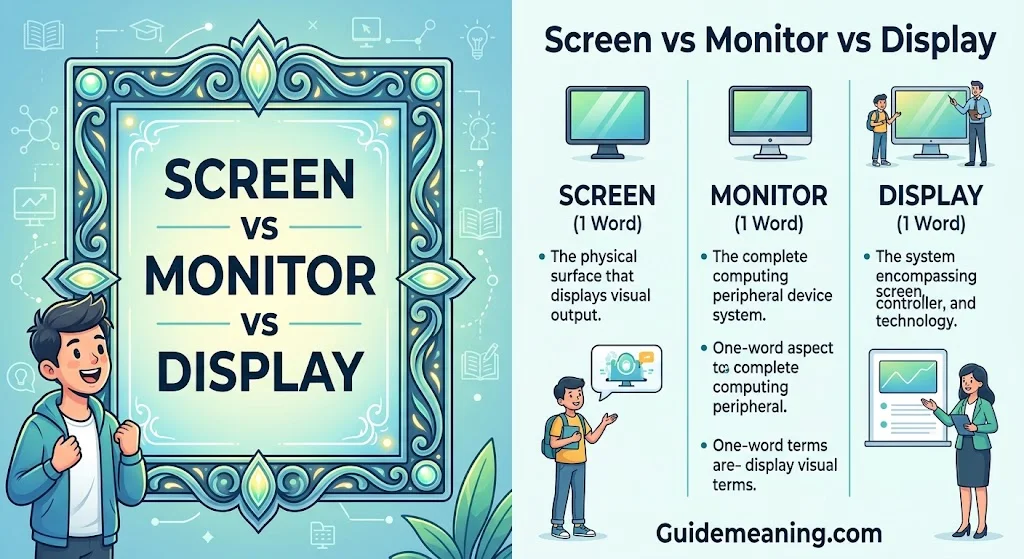
A screen is the visible surface that shows images and visuals, while a monitor is a dedicated external device commonly used with computers. A desktop monitor connects externally, whereas a laptop screen is built into the computer. A display describes the underlying technology, such as an LCD display, that creates the visuals. In everyday use, screen sounds more informal, monitor is more hardware-specific, and display is often the technical term.
These meanings may overlap, but the terms aren’t exact synonyms. Understanding what they mean, how people use them, and the difference between them can help you make smarter choices for gaming, working, and other needs. This article explains these technologies so you can choose the right option and understand the correct way to discuss computer hardware without confusion.
Quick Answer:
Screen vs Monitor vs Display usually comes down to emphasis. In the USA, screen commonly means the visible viewing surface, monitor usually means a dedicated display device, and display is the broadest technical term for presenting visual information.
TL;DR:
• Screen usually emphasizes the visible surface you look at.
• Monitor usually describes a complete dedicated display device.
• Display can describe visual technology, hardware, or presented information.
• American technology language often overlaps these three terms.
• Their meanings developed from older ideas of shielding, watching, and showing.
• Modern devices can combine all three concepts in one product.
What Is the Difference Between Screen, Monitor, and Display?
These three words describe closely related ideas, but they don’t emphasize exactly the same thing. Understanding that distinction helps when you’re talking about phones, computers, televisions, or technical specifications.
A simple way to remember them is to ask what you’re describing.
Screen Means the Viewing Surface
A screen usually focuses on the surface where you see images, text, or video.
For example, Americans commonly say:
• “My phone screen is cracked.”
• “The laptop screen looks too dark.”
• “Don’t sit too close to the screen.”
The word doesn’t necessarily tell you how the image is produced. Instead, it points toward the visual area people interact with or look at.
Monitor Means a Dedicated Device
A monitor generally describes the complete electronic unit used to present visual information.
For example, a desktop computer might have a 27-inch monitor sitting on a desk. That monitor includes more than the visible panel.
It can contain electronics, input ports, controls, speakers, a stand, and other hardware.
Display Has the Broadest Meaning
Display can refer to the technology or system that presents visual information.
Therefore, a smartphone can have a display. A laptop can have a display. A smartwatch, vehicle dashboard, or desktop monitor can have one too.
That broad meaning explains why “display” appears frequently in technical specifications.
What Does “Screen” Mean?
The word screen has a surprisingly old history. Its modern technology meaning developed long after the word was already used for physical barriers and protective surfaces.
For American readers, this history helps explain why “screen” feels natural for both physical and digital viewing areas.
From Barrier to Viewing Surface
In Middle English, screen referred to a protective or separating structure. It could shield people from heat, drafts, or unwanted visibility.
Later, the meaning expanded toward something that concealed or separated one area from another.
By the 19th century, screen could refer to surfaces used for projected images. Eventually, the word moved naturally into television and computer technology.
The modern computer meaning emerged during the 20th century.
The Symbolic Idea Behind “Screen”
The older meaning still gives the word a useful conceptual quality.
A screen can separate, protect, or reveal.
That seems almost contradictory. However, a modern screen does both.
It separates you from the electronic machinery behind the image. At the same time, it reveals information from that machinery.
Screen in American Everyday Language
Today, Americans use “screen” across many settings.
• Smartphone and tablet screens
• Laptop and desktop computer screens
• Television screens
• Movie and theater screens
• Car and dashboard screens
• Touchscreens and interactive kiosks
Because the word is so familiar, it often sounds less technical than “display.”
What Does “Monitor” Mean?
The history of monitor is especially interesting because its original meaning wasn’t about computers at all.
The word came into English from Latin and originally referred to someone who warns, reminds, advises, or oversees.
Monitor Originally Meant a Watcher
A monitor was historically someone who kept watch or helped maintain order.
That idea survived in expressions such as a class monitor. A student monitor might assist a teacher or help supervise other students.
The basic concept was simple:
A monitor watches something and reports or responds to what it observes.
That meaning still appears in modern English.
We monitor weather. We monitor systems. We monitor performance. We monitor activity.
How “Monitor” Became a Technology Term
The technology meaning developed as electronic systems increasingly needed devices that allowed people to observe signals.
By the 20th century, the term was used for equipment that checked audio or visual signals.
Later, computers adopted the word for video display equipment.
This transition makes sense. A computer monitor lets you observe what the computer is producing.
The American Historical Connection
There is also an unusual American historical connection.
During the Civil War, the USS Monitor became famous as an ironclad warship. Its name came from the older meaning of something that warns or admonishes.
That ship helped establish “monitor” as a naval term for a class of armored vessels.
Much later, the word became firmly established in computing.
So, although the modern computer monitor looks nothing like a warship, both uses share the older idea of watching and oversight.
What Does “Display” Mean?
The word display began with an idea very different from computer hardware.
Its early sense involved unfolding, spreading out, or making something visible.
That basic idea remains at the heart of the modern word.
From Unfolding to Showing
In medieval English, display could describe something being unfolded or spread out.
A banner could be displayed. An object could be displayed for people to see.
Over time, the word became strongly associated with exhibition and presentation.
By the 20th century, it entered electronic technology.
A device could now display information without physically unfolding anything.
Display as a Modern Technology Term
Today, display can describe both the technology and what appears through it.
For example:
• An OLED display produces bright, high-contrast images.
• A digital display shows numbers or symbols.
• A vehicle display presents driving information.
• A computer display presents software and graphics.
This flexibility makes “display” particularly useful in technical language.
Display Also Works as a Verb
Unlike some technology terms, display commonly works as both a noun and a verb.
You can say:
“The display is bright.”
You can also say:
“The computer displays the image.”
That second meaning focuses on the action of showing information.
Screen vs Monitor vs Display in Everyday American English
In the United States, everyday speech doesn’t always follow strict technical boundaries.
That’s important because language isn’t a wiring diagram. People choose words based on familiarity, context, and convenience.
Why the Terms Overlap
A desktop monitor contains a display and has a screen.
A laptop has an integrated display and a visible screen.
A smartphone has a display and a screen, but Americans rarely call the whole phone a monitor.
Therefore, the same physical object can reasonably involve all three words.
Common American Usage
| Context | Common Term | What It Usually Emphasizes | Example |
| Smartphone | Screen | Visible viewing area | “My screen is cracked.” |
| Laptop | Screen / Display | Viewing area or technology | “The display is sharp.” |
| Desktop PC | Monitor | Complete external device | “I bought a new monitor.” |
| Smartwatch | Display / Screen | Visual technology or surface | “The display is bright.” |
| Television | Screen / Display | Viewing surface or technology | “The screen looks great.” |
| Car dashboard | Screen / Display | Information interface | “The display shows the temperature.” |
These aren’t rigid rules.
Instead, they show common patterns in American English.
Screen vs Display: Are They the Same?
Screen and display are often interchangeable in casual conversation. However, they can emphasize different aspects.
If you say, “My phone screen is dirty,” you’re focusing on the surface you can see and touch.
If you say, “This phone has an OLED display,” you’re focusing more on the visual technology.
Everyday vs Technical Emphasis
Consider these two sentences:
“My laptop screen is too dim.”
“The laptop has a high-resolution display.”
Both can describe the same laptop.
However, the first sentence sounds personal and conversational. The second sounds more technical.
Why Context Matters
Neither word is automatically better.
Instead, choose based on what you want to emphasize.
Use screen when the viewing surface matters. Use display when the technology, visual output, or information presentation matters.
Monitor vs Display: Are They the Same?
Monitor and display overlap more than many people realize.
A monitor is generally a type of display hardware. However, the word display can describe many things that aren’t separate monitors.
A Monitor Is More Specific
A traditional desktop monitor is a complete device.
It may include:
• A display panel
• Processing electronics
• Video inputs
• Power components
• Physical controls
• A stand or mounting system
By contrast, “display” doesn’t necessarily identify the complete product.
Not Every Display Is a Monitor
A smartphone display isn’t normally called a monitor.
Neither is the display inside a smartwatch.
The same applies to many vehicle dashboards and appliances.
This gives you a useful rule:
A monitor can contain a display, but a display doesn’t have to be a monitor.
Read More: Too Early vs “To Early”: Meaning, Grammar, and Correct Usage for 2026
How the Three Terms Work Together
The easiest way to understand these words is to picture a desktop computer.
The computer sends visual information to a separate monitor.
Inside that monitor is a display system.
At the front is the visible screen.
A Simple Mental Model
Think of the relationship like this:
Monitor → the complete device
Display → the visual technology or system
Screen → the visible viewing surface
This isn’t a universal engineering rule.
Modern hardware can combine these layers in different ways. Still, the model works well for everyday American English.
Why This Model Helps
Suppose someone says:
“My monitor has a beautiful display.”
That sounds natural.
They could also say:
“The screen has a scratch.”
Now each word points toward a different aspect of the same object.
The monitor is the product. The display is the visual system. The screen is the part being viewed.
The Historical Evolution of These Words
The three terms reveal something interesting about language.
Technology rarely invents completely new vocabulary. Instead, it often gives old words new jobs.
Screen: Protection Became Presentation
The oldest idea behind screen involved protection and separation.
Later, screens became surfaces for projected images. Eventually, electronic devices adopted the term.
The basic idea shifted from blocking something to showing something.
Monitor: Watching Became Computing
Monitor originally described a person or thing that watches, warns, or advises.
Then it became associated with devices that observe signals.
Finally, computers used monitors to let people observe digital activity.
The underlying idea of watching remained surprisingly stable.
Display: Unfolding Became Digital Information
Display began with spreading or unfolding something so it could be seen.
Then it came to mean exhibiting objects or information.
Today, a display can reveal millions of pixels in a fraction of a second.
The technology changed dramatically, but the basic idea stayed intact: make something visible.
The Psychological Meaning of Screens in Modern Life
These terms aren’t symbols in the traditional religious sense. However, they carry powerful associations in modern American culture.
Screens especially have become symbols of access, information, entertainment, and connection.
Screen as a Window
People often experience screens like windows into other places.
A phone screen can show a distant friend’s message. A television can bring events into a living room. A computer can open a virtual workplace.
Because of this, screens can symbolize connection across distance.
Monitor as Observation
The word monitor retains its older association with watching.
That makes it especially fitting for systems built around observation.
Security systems, scientific equipment, workplaces, and computers all use monitoring technology.
The word therefore carries an association with attention and oversight.
Display as Visibility
Display has an even more direct conceptual meaning.
To display something is to make it visible.
That can mean information, identity, creativity, emotion, or achievement.
In modern culture, “being on display” can therefore suggest both visibility and exposure.
How These Terms Appear in American Culture
Technology language reflects everyday American life.
Screens appear in homes, schools, offices, stores, cars, airports, and public spaces. As a result, these words have moved beyond computer vocabulary.
Work and Education
American workplaces rely heavily on screens and monitors.
Students use displays for research, communication, creative work, and online learning.
Consequently, the language surrounding visual technology has become ordinary rather than specialized.
Entertainment and Social Life
Streaming, gaming, video calls, and social media have made screens central to leisure.
The phrase screen time now describes a familiar part of daily life.
That expression also shows how the meaning of “screen” expanded beyond hardware. It can now describe an entire activity or habit.
Identity and Self-Presentation
Display has another modern cultural meaning.
People display photographs, achievements, opinions, styles, and personal interests online.
Therefore, the old idea of showing something has taken on a digital form.
Screen, Monitor, and Display in Modern Design
Designers and manufacturers choose these words carefully because each creates a slightly different impression.
For American consumers, those choices can affect how a product sounds.
“Screen” Feels Familiar
Screen is simple and approachable.
It works especially well when discussing everyday experiences.
For example, “a brighter screen” sounds immediately understandable.
“Monitor” Feels Like Hardware
Monitor sounds more like a physical product.
That’s why it appears frequently in discussions about desktop computers, gaming setups, offices, and professional workstations.
“Display” Feels Technical
Display often sounds more precise.
It works naturally with specifications such as:
• Resolution
• Refresh rate
• OLED technology
• LCD technology
• Brightness
• Color accuracy
• High dynamic range
The word itself doesn’t determine quality. It simply gives the discussion a broader technical frame.
Common Misunderstandings About Screen, Monitor, and Display
Many disagreements about these words are really disagreements about context.
There isn’t always one universally correct term.
“A Laptop Has a Monitor”
People may say this, and listeners usually understand them.
However, laptop screen or laptop display is often more natural in American usage. A monitor usually suggests a separate device.
“A Phone Has a Monitor”
This is understandable but uncommon.
Americans generally say phone screen or phone display instead.
“Screen and Display Are Completely Different”
That’s too strict.
In everyday technology language, the terms overlap heavily.
The distinction becomes more useful when precision matters.
“Monitor Only Means Computer Hardware”
Not quite.
Monitor can refer to many devices or people that observe something. It can also describe specialized equipment and processes.
The computer meaning is only one part of the word’s history.
Why Meanings Continue to Change
Language changes because technology changes.
When a word enters a new field, speakers often adapt an existing meaning instead of creating something entirely new.
Old Words for New Technology
This pattern appears everywhere.
A window can now mean a software window.
A mouse can mean a computer pointing device.
A cloud can describe remote computing services.
Likewise, screen, monitor, and display gained modern meanings from older concepts.
The Meanings Aren’t Frozen
Future technology may change these words again.
Wearable devices, augmented reality, flexible displays, projection systems, and other technologies already challenge traditional boundaries.
As devices become more integrated, the difference between a screen, display, and complete device may become less obvious.
That doesn’t make the words useless.
Instead, it shows how flexible everyday language can be.
Which Word Should You Use?
The best choice depends on what you’re describing.
Use “Screen” When You Mean the Visible Area
Choose screen for everyday situations involving the viewing surface.
Examples include:
• A cracked phone screen
• A dirty laptop screen
• A movie theater screen
• A bright television screen
• A touchscreen interface
Use “Monitor” for Dedicated Hardware
Choose monitor when you’re talking about a separate display device.
For example:
“I use two monitors at work.”
That sentence clearly refers to two pieces of computer hardware.
Use “Display” for Broad or Technical Contexts
Choose display when discussing visual technology or information presentation.
For example:
“The phone uses an OLED display.”
That wording naturally focuses on the technology rather than the whole device.
FAQs:
Is a screen the same as a monitor?
Not always. A screen is the surface where you see images or visuals, while a monitor is usually a separate hardware device connected to a computer.
What is the difference between a screen and a display?
A screen usually refers to the visible surface. A display can refer to the technology that produces the images you see on that surface.
Is a laptop screen a monitor?
In everyday conversation, people may call it a monitor. Technically, however, a laptop has a built-in screen or display, while a monitor usually means a separate external device.
Is an LCD a screen or a display?
LCD describes a display technology. An LCD display can be used in a laptop, smartphone, desktop monitor, TV, or other electronic device.
Can I use “screen,” “monitor,” and “display” interchangeably?
Sometimes, especially in casual conversation. However, they don’t have exactly the same meaning. Monitor usually identifies hardware, while screen and display can have broader meanings.
Which term should I use for a computer?
Use monitor when you mean a separate external computer device. Use screen when referring to the visible surface and display when discussing the technology or visual output.
Why is it important to know the difference?
Knowing the difference helps you understand computer hardware and choose the right device for gaming, working, entertainment, or other needs.
Conclusion:
Screen vs Monitor vs Display can seem confusing because these words often overlap in everyday use. A screen is generally the visible surface, a monitor is a dedicated external device, and a display often refers to the technology that creates the visuals. Once you understand these basic distinctions, you can use each term more accurately and make smarter choices when discussing or buying display technology.




1 thought on “Screen vs Monitor vs Display: Meaning and Use for 2026”