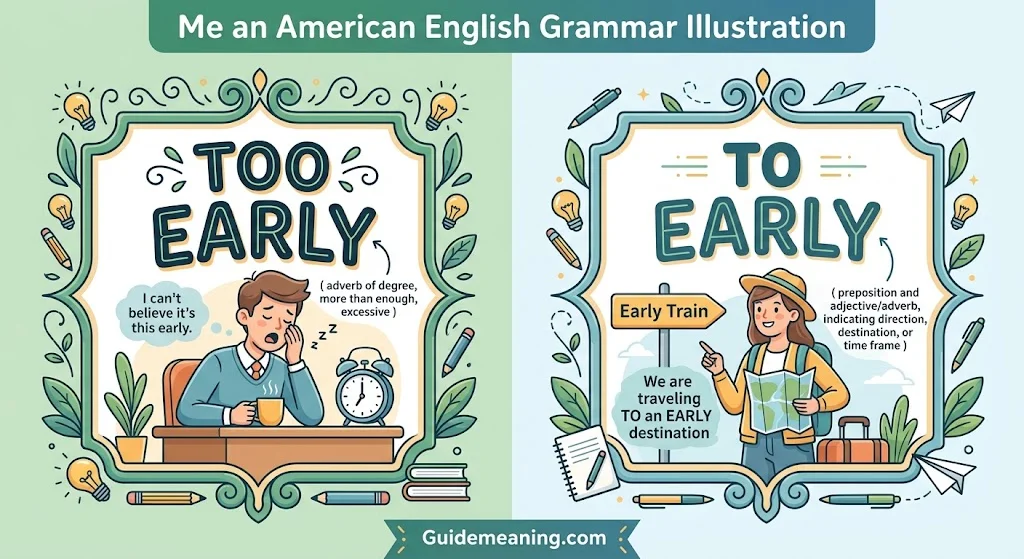

Understanding Too Early vs “To Early” starts with noticing why these tiny words cause confusion in everyday English writing and communication. If you’ve ever paused mid-sentence because of this spelling choice, you’re not alone. Students, bloggers, professionals, and even fluent English speakers can make this mistake every day. Although it may seem harmless because too early and to early sound the same, only too early is always correct in standard English. To early is always wrong when you want to say something happened earlier than suitable, helpful, or expected. For example, “We arrived too early for the meeting” uses the correct form. As a guide for writers and learners, this explanation clears the confusion without asking you to spend time memorizing complicated rules. The key meaning becomes easier to understand once you see how to and too have different jobs in a sentence.
To remember the difference, picture tiny words as beads on a string, with every piece having its own function and place in a grammatical hierarchy. To works as a preposition that can show direction, as in go to the store. It can also introduce an infinitive verb, as in to walk. Too, on the other hand, acts as an adverb meaning excessively or also. The number two makes a useful memory trick because to, too, and two are pronounced alike, or like each other in sound. This simple trick helps you decide the correct choice by checking the context. With regular learning and practice, real-life examples can make correct usage feel natural. You can even notice these misused or abused versions in Reddit posts, online texts, emails, and YouTube comments, where they often appear in everyday communication.
As you keep exploring these differences, use a simple step-by-step check. Ask whether too shows that something happens excessively early. If it does, too early is the right choice. It’s to early is wrong, while It’s too early is correct. This small correction can improve your writing, add clarity, and make your sentences more polished, preferred, and easy for anyone to understand. English grammar sometimes confuses learners, but you can avoid the error by focusing on each word’s function instead of only how it sounds. I’ve found that friend conversations and everyday examples often help people see how small mistakes can change meaning fast and dull a sentence’s shine. Once you understand the pattern, you can apply the rule confidently in your own writing.
Quick Answer:
“Too early” is correct when you mean “earlier than necessary, expected, appropriate, or wanted.” In American English, “to early” is normally an error caused by confusing the homophones to and too.
TL;DR:
- Too early means earlier than expected, needed, or appropriate.
- To early is normally incorrect when describing timing.
- Too works as an adverb modifying early.
- To usually shows direction, purpose, or introduces an infinitive.
- Both words sound alike, so spelling creates the distinction.
- “Too early to…” correctly uses both words for different jobs.
What Does “Too Early” Mean?
The phrase “too early” describes timing that falls before a suitable or expected point. The important idea is not simply that something happened early, but that it happened more early than appropriate.
For example, someone can arrive early without any problem. However, if they arrive two hours before the doors open, you might say they arrived too early.
Early vs. Too Early
The word early simply identifies timing near the beginning or before the expected time. Merriam-Webster defines it as being near the beginning of a period or happening before the usual or expected time.
Meanwhile, too adds the idea of excess. Oxford explains that too can appear before adjectives and adverbs when something exceeds what is good, necessary, or possible.
Compare these sentences:
- I arrived early.
- I arrived too early.
The first sentence is neutral. The second suggests that the early arrival created a problem or was earlier than appropriate.
Common Meanings of “Too Early”
Depending on context, the phrase can suggest:
- Earlier than a planned schedule
- Earlier than someone expected
- Earlier than someone wanted
- Earlier than circumstances allow
- Premature for a decision or judgment
For example, “It’s too early to celebrate” doesn’t necessarily refer to the clock. Instead, it means there isn’t enough evidence yet.
Why Is “To Early” Usually Incorrect?
The main problem is grammatical function. To does not normally modify early to create a phrase meaning “excessively early.”
Instead, to commonly works as a preposition or as an infinitive marker. Merriam-Webster lists uses involving direction, purpose, relationships, and infinitives such as to swim.
So this sentence is incorrect:
❌ We arrived to early.
The intended meaning is that the arrival happened before the appropriate time. Therefore, the correct sentence is:
We arrived too early.
The Grammar Behind the Error
Think of the phrase this way:
too + early
Here, too modifies early. It tells us that the degree of earliness is excessive.
Now compare:
to + verb
For example:
- to leave
- to arrive
- to decide
- to sleep
- to call
That distinction explains why “to early” doesn’t normally work.
The Important Exception
There can be sentences where to appears directly before a word beginning with early. That doesn’t make to early a standard timing phrase.
For example:
The program provides access to early education.
Here, to belongs to access to. The phrase early education is a noun phrase.
So the issue isn’t that the letters to early can never appear next to each other. The issue is using them as a substitute for too early.
Too Early vs. To Early Grammar
The easiest way to understand the difference is to examine the grammatical role of each word. This matters because both words sound identical in normal pronunciation.
| Expression | Role | Meaning | Example |
| too early | Adverb + adverb | Earlier than appropriate | We arrived too early. |
| to | Preposition | Direction or relationship | We went to school. |
| to | Infinitive marker | Introduces a verb | We plan to leave. |
| too | Adverb | Excessively | The coffee is too hot. |
| too | Adverb | Also | She is coming too. |
The distinction becomes especially clear in a sentence like:
It’s too early to decide.
The first too modifies early. The second to introduces the verb decide.
That small difference is the heart of the entire rule.
Why “Too Early to…” Is Correct
The pattern is:
too + early + to + verb
Examples include:
- It’s too early to tell.
- It’s too early to leave.
- It’s too early to decide.
- It’s too early to celebrate.
- It’s too early to know.
- It’s too early to call.
Notice how each word has a separate function.
Too expresses excess. Early describes timing. To introduces the following verb.
The History of “To” and “Too”
The difference between these words is relatively modern in spelling. Their history helps explain why they remain so confusing.
Old English Roots
The word to comes from Old English tō. Merriam-Webster traces its prepositional use back to before the 12th century.
The word too also has an Old English connection. Oxford identifies too as an Old English stressed form of to, with the spelling too becoming established in the 16th century.
Therefore, their similar pronunciation isn’t a strange coincidence. The two words share a historical relationship.
How the Meanings Separated
Over time, to became strongly associated with functions such as direction and infinitives.
For example:
She went to the store.
Or:
She wants to leave.
Meanwhile, too developed important meanings involving addition and excess.
For example:
I want dessert too.
And:
The dessert is too sweet.
Merriam-Webster records both major modern meanings of too: “in addition” and “to a degree greater than wanted or needed.”
That historical separation eventually made spelling the main visual clue.
Why Do “To” and “Too” Sound the Same?
This is one of those English quirks that makes writing harder than speaking.
In standard American pronunciation, to and too can sound identical in many contexts. The difference therefore doesn’t usually appear in your ears.
Homophones Create the Confusion
Words with the same pronunciation but different meanings or spellings are called homophones.
For example:
- to / too / two
- there / their / they’re
- your / you’re
- hear / here
The listener usually understands the intended word from context.
However, writing removes that helpful context from pronunciation. You must choose the correct spelling yourself.
Why Fast Typing Makes It Worse
Digital writing can make the mistake especially easy.
Because to is an extremely common word, your fingers may automatically type it. Spell-check may also fail to notice because to itself is spelled correctly.
The problem isn’t spelling in the usual sense. It’s word selection.
When Should You Use “Too Early”?
Use “too early” when timing is earlier than a useful, expected, or appropriate point.
This applies to ordinary schedules, personal routines, decisions, and broader situations.
Everyday Timing
Consider these examples:
I woke up too early this morning.
We arrived too early for the concert.
She left too early to say goodbye.
The store opened too early for most customers.
In each example, too tells us that the timing crossed a reasonable limit.
Decisions and Judgments
The phrase also works with abstract situations.
It’s too early to know the answer.
It’s too early to make a prediction.
It’s too early to judge the project.
It’s too early to decide what happened.
Here, early refers to a stage in a process rather than a specific hour.
That broader meaning is important in American English because people regularly use time words metaphorically.
Read More: Myself vs My Self: Meaning, Grammar, and Identity for 2026
Too Early vs. Too Soon
These expressions overlap, but they aren’t always identical.
Too early often focuses on position within a period or process. Too soon often emphasizes that insufficient time has passed.
Compare the Two
Consider:
It’s too early in the morning to call.
The focus is the time of day.
Now consider:
It’s too soon after the announcement to know the impact.
The focus is the amount of time that has passed.
However, some situations allow both:
It’s too early to tell.
It’s too soon to tell.
Both can sound natural. The surrounding context determines which one feels more precise.
A Simple Difference
You can remember the distinction this way:
- Too early → the timing is ahead of the appropriate point.
- Too soon → not enough time has passed.
The difference is subtle, not absolute. Native speakers often use the expressions interchangeably.
Common Examples of “Too Early”
The best way to learn this distinction is through ordinary sentences. These examples show how the phrase works across different situations.
Daily Life
The baby woke up too early.
I got to work too early.
We booked the restaurant too early.
He went to bed too early.
Work and School
We submitted the assignment too early.
It’s too early to announce the results.
The meeting started too early.
She responded too early without reading the full message.
Weather and Nature
The phrase can also describe natural events.
Spring arrived too early this year.
The flowers bloomed too early.
The first snowfall came too early.
In these examples, too early compares actual timing with an expected seasonal pattern.
Common Mistakes With “Too Early”
Because the words sound identical, the same mistakes appear repeatedly. Understanding the patterns can help you catch them during editing.
Mistake: “I Woke Up To Early”
Incorrect:
❌ I woke up to early.
Correct:
I woke up too early.
The intended meaning is “earlier than I wanted.”
Mistake: “It’s To Early to Tell”
Incorrect:
❌ It’s to early to tell.
Correct:
It’s too early to tell.
This example is particularly useful because both too and to appear correctly in the same sentence.
Mistake: “We Arrived To Early”
Incorrect:
❌ We arrived to early for class.
Correct:
We arrived too early for class.
The word too modifies early, while for introduces the purpose or context.
Mistake: “They Left To Early”
Incorrect:
❌ They left to early.
Correct:
They left too early.
The meaning is that their departure happened sooner than appropriate.
How to Remember “Too Early”
A simple memory trick can make this distinction almost automatic.
Use the “Extra O” Trick
The word too has an extra o.
Think of that extra letter as representing extra timing.
If something happens more than necessary, use too.
too early
too late
too fast
too slowly
too soon
The trick isn’t a formal grammar rule. However, it’s useful for remembering the spelling.
Try the “Excessively” Test
Replace too with excessively.
If the sentence still expresses your intended meaning, too is probably correct.
For example:
We arrived too early.
Becomes:
We arrived excessively early.
The second sentence sounds more formal, but the meaning remains understandable.
Now consider:
I went to school.
Replacing to with excessively clearly fails.
This test helps separate the two functions.
Emotional and Practical Meaning of “Too Early”
Although this is a grammar issue, the phrase often carries a small emotional message.
When someone says “That’s too early,” they usually aren’t making a neutral observation. They often signal inconvenience, surprise, reluctance, or concern about timing.
Common Feelings Behind the Phrase
Depending on context, too early can suggest:
- Mild annoyance
- Physical tiredness
- Surprise
- Lack of preparation
- Concern about premature action
- A desire to wait longer
For example:
“Seven a.m. is too early for me.”
This isn’t simply a statement about the clock. It expresses a personal preference.
Similarly:
“It’s too early to celebrate.”
This can signal caution. The speaker believes more time or information is needed.
Context Changes the Meaning
Interestingly, too early doesn’t always mean something is objectively wrong.
One person might say:
“Eight o’clock is too early.”
Another person might consider eight o’clock perfectly reasonable.
Therefore, too often expresses a judgment about timing rather than an absolute fact.
How “Too Early” Appears in Modern American Writing
Today, the phrase appears across everyday communication. It works equally well in professional messages, casual conversations, school writing, and online posts.
Text Messages and Social Media
People frequently use short expressions such as:
Too early for coffee.
Way too early for this.
Is it too early to ask?
Too early to celebrate?
The phrase works well because it communicates a complete idea with very few words.
Professional Communication
In workplace writing, the phrase can sound neutral and practical.
For example:
It may be too early to finalize the schedule.
Or:
I think it’s too early to make that decision.
Here, the phrase often signals caution rather than emotion.
The Role of “Way”
American English also commonly uses “way too early” for emphasis.
We got there way too early.
This is informal and conversational. In more formal writing, “far too early” or simply “too early” may sound more appropriate.
Is “To Early” Ever Correct?
This question deserves a careful answer.
When someone intends to say “earlier than appropriate,” “to early” is incorrect. However, the two words can occasionally appear next to each other for completely different grammatical reasons.
For example:
The program gives families access to early education.
Here, to belongs with access. It doesn’t modify early.
Another example is:
She prefers to leave early.
Here, to introduces the verb leave. The word early comes afterward.
This distinction matters because simply seeing the letters to early together doesn’t automatically tell you whether the sentence is wrong.
The question is always: What job is “to” performing?
How Meaning Has Shifted Over Time
The modern distinction between to and too developed from a shared historical background.
From One Root to Different Modern Functions
Historically, too developed from a stressed form connected with to. Oxford notes that the spelling too became established from the 16th century.
Meanwhile, to remained central to English grammar as a preposition and infinitive marker.
That history helps explain today’s strange situation. Two words can remain nearly identical in sound while becoming very different in written function.
Why the Distinction Matters Today
Modern readers depend heavily on spelling.
A spoken sentence such as:
“It’s too early to leave.”
can be understood easily.
But when written incorrectly as:
“It’s to early to leave.”
the grammatical mistake becomes immediately visible.
Therefore, spelling now carries information that pronunciation doesn’t provide.
FAQs:
Is “too early” correct?
Yes. Too early is the correct expression when you mean something happens earlier than expected, suitable, or necessary.
Is “to early” grammatically correct?
No. To early is not standard English when you mean “earlier than expected.” The correct form is too early.
Why do people confuse “to” and “too”?
People often confuse them because to and too sound alike. However, they have different meanings and grammatical functions.
What does “too early” mean?
Too early means something happens before the appropriate or expected time. For example, “You arrived too early for the meeting.”
What is the difference between “to” and “too”?
To commonly shows direction or forms an infinitive, as in “go to school” or “to walk.” Too means “excessively” or “also,” as in “too early” or “I want to go too.”
Is “It’s too early” correct?
Yes. It’s too early is grammatically correct. It means that the current time is earlier than appropriate for something.
How can I remember “too early”?
A simple trick is to connect too with the idea of “more than needed.” If something happens earlier than it should, use too early, not to early.
Conclusion:
The correct form is too early, while to early is incorrect in standard English. Although both words sound similar, they serve different purposes in a sentence. Remember that too can express excess, which makes it the right choice when something happens earlier than expected. With regular practice, you can easily avoid this common grammar mistake.




1 thought on “Too Early vs “To Early”: Meaning, Grammar, and Correct Usage for 2026”