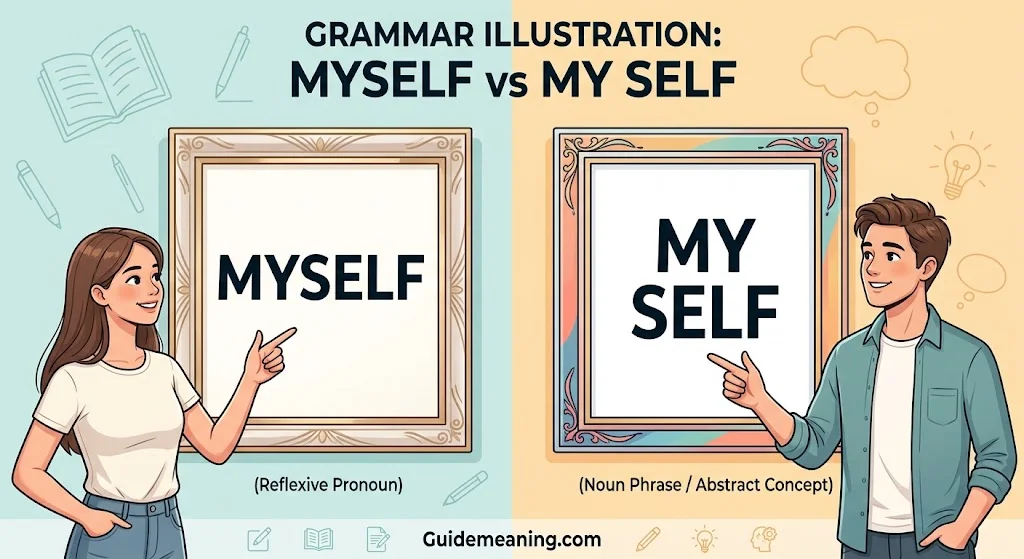

Myself vs My Self can seem confusing because both forms look similar, but they have different meanings and uses. Myself is a reflexive pronoun that refers back to the subject of a sentence, while my self usually refers to your identity or inner being. This difference matters in English grammar, especially for learners, students, professionals, and native speakers who want clear communication.
The simple rule is to use myself when the subject and object refer to the same person. For example, in “I taught myself,” I performs the action and myself receives it. This use supports correct sentence structure, pronoun usage, sentence accuracy, and clarity in spoken English, written English, and everyday usage. Through teaching, guidance, textual-examples, and structured-examples, you can learn how each form works and avoid mistakes.
My self, written as two words, appears mainly in psychology and philosophy when discussing personal identity, self-awareness, self-expression, reflection, and identity-expression. Its meaning depends on the context, so nuance, subtlety, and clarity-of-meaning matter. In professional-writing, academic-writing, and everyday-writing, careful comparisons, practical-application, critical-thinking, and observation-skills can improve language-precision, effective-communication, correct-usage, semantic-distinction, clarity-of-expression, textual-understanding, analytical-thinking, precision-of-meaning, accuracy, and confidence.
Quick Answer:
Myself vs My Self is mainly a difference between grammar and identity. In American English, use myself for reflexive or emphatic functions; use my self only when self is intentionally being treated as a separate noun.
TL;DR:
- Myself is normally one word and functions as a pronoun.
- My self treats self as a separate noun.
- Use myself when an action returns to the speaker.
- Use myself for emphasis when you personally performed something.
- My self can appear in reflective, philosophical, or literary writing.
- American English generally favors myself in ordinary sentences.
What Does Myself Mean?
The most important step is understanding what myself actually does in a sentence. For American readers, this prevents the common mistake of treating it as a fancy replacement for I or me.
Myself as a Reflexive Pronoun
A reflexive pronoun refers back to the subject.
For example:
- I hurt myself.
- I taught myself Spanish.
- I reminded myself to call.
- I prepared myself for the meeting.
In each sentence, I performs the action, while myself refers back to that same person.
Merriam-Webster describes reflexive pronouns as forms that refer back to the subject. The same pattern appears in yourself, himself, herself, ourselves, and themselves.
Myself for Emphasis
However, myself can also emphasize personal involvement.
Consider:
I painted the room myself.
The sentence still works without myself:
I painted the room.
Therefore, myself isn’t necessary for the grammar. Instead, it stresses that I personally did the work.
You can use the same pattern in sentences such as:
I myself made the decision.
I completed the project myself.
I spoke with the manager myself.
This use is especially common when someone wants to highlight personal responsibility or involvement.
What Does My Self Mean?
My self is different because self is being treated as a noun. The phrase can point toward a person’s identity, personality, inner nature, or sense of being.
Self as an Identity
The noun self has several meanings. It can refer to someone’s typical character, temporary state, individuality, identity, or entire person.
For example:
I want to understand my self.
Here, the writer isn’t simply using a reflexive pronoun. The wording deliberately makes self into something being examined.
Still, modern American English often chooses a more natural alternative:
I want to understand myself.
Or:
I want to understand my identity.
Or:
I want to understand my sense of self.
These versions are usually clearer in ordinary writing.
Reflective and Philosophical Writing
The separated form can appear when writers want to emphasize the idea of the self.
For example:
My self is shaped by my memories and experiences.
This sentence sounds more philosophical than:
I am shaped by my memories and experiences.
The distinction is subtle. The first treats self almost like an object of reflection.
Philosophy has long asked questions about personal identity, including what makes someone the same person over time. Modern philosophical discussions use self in several different ways, and the term doesn’t always have one fixed meaning.
Why Does the Space Matter?
The space between my and self isn’t merely a spelling detail. It changes how the reader understands the words.
One Word: Myself
When written as one word, myself functions as an established pronoun.
| Construction | Function | Example |
| I hurt myself | Reflexive | The action returns to the speaker |
| I taught myself | Reflexive | The speaker receives the action |
| I did it myself | Emphatic | The speaker stresses personal involvement |
| I myself agree | Emphatic | The speaker adds emphasis |
| I feel like myself | Identity-related expression | The speaker describes a familiar state |
The word has been established in English for centuries. Merriam-Webster dates its first known use to before the 12th century.
Two Words: My Self
When separated, my works as a possessive word, while self functions as a noun.
That construction can emphasize:
- personal identity
- inner character
- individual consciousness
- a particular version of oneself
- philosophical ideas about personhood
However, this form is uncommon in normal American conversation.
The Historical Roots of Myself and Self
The history behind these words helps explain why their forms can feel confusing. English didn’t always treat compounds exactly as modern writers do today.
Early English Origins
The word myself developed from older combinations involving words meaning my or me and self. Merriam-Webster traces its history to an early English form dating before the 12th century.
This history matters because modern speakers may mentally break myself into my + self. Yet modern grammar treats myself as an established pronoun.
In other words, its historical parts don’t determine how you should spell it today.
The Older Two-Word Pattern
English has also used forms like my self in older writing. Historical English frequently allowed combinations that later became fixed compounds.
This helps explain why readers sometimes encounter separated forms in older literature. A historical example doesn’t automatically mean modern writers should copy that spelling.
Merriam-Webster also notes that forms of myself have appeared in literary writing for centuries, including works by writers such as Shakespeare and Emily Dickinson.
How Myself Works in American English
American English generally makes the everyday distinction quite simple. If myself refers back to I, it is usually one word.
Common Reflexive Patterns
These sentences follow ordinary American usage:
I blamed myself.
I introduced myself.
I cut myself.
I taught myself to cook.
I asked myself a question.
The subject and the reflexive pronoun point to the same person.
Common Emphatic Patterns
You can also use myself to emphasize who performed an action.
I wrote the article myself.
I checked the figures myself.
I personally handled the problem myself.
In the last example, however, using both personally and myself may be unnecessary. Good writing often becomes stronger when one emphasis is enough.
Can Myself Replace I or Me?
This is one of the biggest sources of confusion in American English.
Myself Isn’t a Fancy Version of Me
Some speakers use myself because it sounds more formal.
For example:
Please contact Sarah or myself.
Many traditional style guides would prefer:
Please contact Sarah or me.
Likewise:
John and I attended the meeting.
is the standard choice rather than:
Myself and John attended the meeting.
However, actual usage is more complicated than a simple “never” rule. Merriam-Webster documents widespread uses of myself in compound subjects and objects, including examples from literary and historical writing.
For polished American writing, though, choosing I for subjects and me for objects is usually the clearest option.
A Simple Substitution Test
Remove the other person from the sentence.
For example:
Please contact Sarah and me.
Remove Sarah:
Please contact me.
Therefore, me is the natural choice.
Now consider:
Sarah and I attended.
Remove Sarah:
I attended.
Therefore, I is correct.
This quick test prevents many unnecessary uses of myself.
Myself vs My Self in Everyday Sentences
Context usually makes the correct choice much easier.
Everyday Grammar
Use myself in sentences like:
I bought myself a new jacket.
I reminded myself about the appointment.
I fixed the computer myself.
I saw myself in the mirror.
Here, the word has a clear grammatical job.
Identity and Reflection
The separated form can work when self is deliberately treated as a noun:
My younger self would never have expected this.
I want to understand my inner self.
My public self differs from my private self.
Notice that these examples often sound more natural with modifiers such as younger, inner, public, or private.
In fact, my younger self is much more common than simply my self.
Read More: On the Plane or In the Plane? Clear Grammar Guide for 2026
What Does Self Symbolize in American Culture?
Although myself is mainly a grammar topic, self carries a wider cultural meaning. In the United States, ideas about individuality are deeply woven into everyday language.
Individual Identity
American culture often places strong emphasis on individual choice, personal goals, independence, and self-expression.
That influence appears in phrases such as:
- be yourself
- find yourself
- express yourself
- improve yourself
- believe in yourself
- know yourself
These expressions don’t necessarily use my self grammatically. Instead, they show how strongly the idea of the individual appears in American language.
Independence and Personal Agency
The phrase by myself is especially interesting.
It can mean either “without help” or “with no one else present.” Merriam-Webster records both meanings.
For example:
I built the shelf by myself.
This usually means the speaker had no assistance.
But:
I went to the movie by myself.
usually means the speaker went alone.
Thus, myself can participate in expressions that communicate independence without literally meaning “my identity.”
Psychological and Emotional Meaning of Self
The word self also appears in conversations about personality and inner experience.
A Sense of Self
People commonly talk about having a “sense of self.” This phrase describes how someone understands who they are.
It can involve memories, values, personality, relationships, goals, and personal history.
Philosophical discussions of personal identity ask related questions about what makes someone the same person over time. These questions have been explored across major traditions of philosophy.
Feeling Like Yourself
American English also uses self to describe a familiar emotional or behavioral state.
For example:
I don’t feel like myself today.
I’m finally feeling like my old self again.
Here, self doesn’t mean a separate physical object. It refers to the person’s usual character, condition, or way of being. Merriam-Webster lists this meaning directly for myself as well.
Spiritual and Cross-Cultural Ideas About the Self
The idea of the self goes far beyond American English. However, different traditions don’t all define it in the same way.
Western Philosophical Traditions
Western philosophy has examined questions such as:
What makes me the person I am?
Does personal identity continue through time?
Is the self mainly physical, psychological, or something else?
These questions have been discussed since the beginnings of Western philosophy.
Eastern Philosophical Traditions
Eastern traditions also contain rich discussions about the self, consciousness, and personal identity. However, their concepts shouldn’t be treated as interchangeable with ordinary American uses of self.
For example, Buddhist philosophy includes important discussions concerning the nature of the self and personal identity. These ideas can differ significantly from the everyday American idea of having a stable personal identity.
The important point is simple: self is a broad human concept, while myself is primarily a grammatical form.
Modern Uses of Myself and My Self
Today, the two forms appear in very different settings.
In School and Professional Writing
In emails, essays, reports, and workplace communication, myself is overwhelmingly the practical choice when a reflexive pronoun is required.
For example:
I completed the assignment myself.
I introduced myself to the new team.
Meanwhile, my self may look unusual unless the writer intentionally discusses identity.
In Personal Writing
Personal essays, poetry, journals, and reflective writing sometimes separate my and self for effect.
A writer might want the reader to imagine the self as something being observed or examined.
This is a stylistic choice rather than a general grammar rule.
In Social Media and Everyday Speech
People frequently use expressions involving myself:
Just being myself.
I need some time by myself.
I finally feel like myself again.
These phrases are natural because myself is functioning within established grammatical or idiomatic patterns.
Common Misunderstandings and Misuse
The biggest errors usually come from confusing grammatical function with meaning.
Mistake: Writing My Self for Reflexive Use
Incorrect in ordinary standard usage:
I taught my self how to drive.
Standard:
I taught myself how to drive.
The first version separates a word that normally functions as a single pronoun.
Mistake: Using Myself Instead of Me
Often awkward:
Please send the package to John and myself.
More straightforward:
Please send the package to John and me.
The issue isn’t that myself is always forbidden. Instead, the simpler personal pronoun is usually clearer in formal American writing.
Mistake: Using Myself Instead of I
Often incorrect in standard usage:
Myself and Maria went shopping.
Better:
Maria and I went shopping.
The subject form I belongs in the subject position.
Myself vs My Self: A Practical Comparison
The distinction becomes easier when the two forms are placed side by side.
| Context | Myself | My Self |
| Reflexive action | Standard | Not normally used |
| Personal emphasis | Standard | Unusual |
| Everyday conversation | Very common | Rare |
| Identity discussion | Possible in expressions | Possible as deliberate noun phrase |
| Philosophy | Used grammatically | May appear conceptually |
| Formal American writing | Common when grammatically required | Usually uncommon |
The key isn’t simply counting the words. Instead, ask what self is doing.
If it is part of an established pronoun, write myself. If you’re deliberately treating self as a noun, a separated form may be meaningful.
How the Meaning Has Shifted Over Time
English changes constantly, and myself is a good example. Forms that once felt more flexible have become more fixed in modern usage.
From Separate Parts to a Pronoun
Historically, English built reflexive expressions from combinations involving personal pronouns and self. Over time, many of these forms became established compounds.
That process helped create the familiar modern forms:
myself
yourself
himself
herself
ourselves
themselves
Merriam-Webster records myself as an established English word dating back before the 12th century.
Older Literature and Modern Expectations
Historical texts may contain uses that sound unusual today. Merriam-Webster notes that writers including Shakespeare, Benjamin Franklin, Jane Austen, and Emily Dickinson used myself in ways that modern style advice sometimes questions.
Therefore, an older example shouldn’t automatically be judged by today’s preferred style.
Modern American readers usually expect clear distinctions between I, me, and myself.
FAQs:
Is “myself” one word or two?
Myself is normally written as one word. It is a reflexive pronoun used when the subject and object refer to the same person.
When should I use “myself”?
Use myself when you refer back to yourself as the subject of an action. For example: “I taught myself to play guitar.”
What does “my self” mean?
My self refers to your identity, personality, or inner being. It usually appears in philosophical or psychological discussions.
Is “my self” grammatically correct?
Yes, my self can be correct when you are talking about your identity or inner nature. However, it isn’t a replacement for the reflexive pronoun myself.
Can I say “I did it by my self”?
Usually, no. The correct expression is “I did it by myself.” Here, myself means that you did something alone or without help.
What is the easiest way to remember the difference?
Think of myself as a grammar word and my self as an identity phrase. If you’re referring to yourself in an action, myself is usually the right choice.
Are “myself” and “my self” interchangeable?
No. They have different functions and meanings. Myself works mainly as a reflexive pronoun, while my self describes your identity or inner being.
Conclusion:
Understanding Myself vs My Self becomes much easier once you focus on their roles. Use myself for reflexive or emphatic uses in everyday English, such as “I taught myself.” Use my self when discussing your identity, inner being, or personal nature. Knowing this simple distinction can help you write with greater clarity and avoid common grammar mistakes.



1 thought on “Myself vs My Self: Meaning, Grammar, and Identity for 2026”