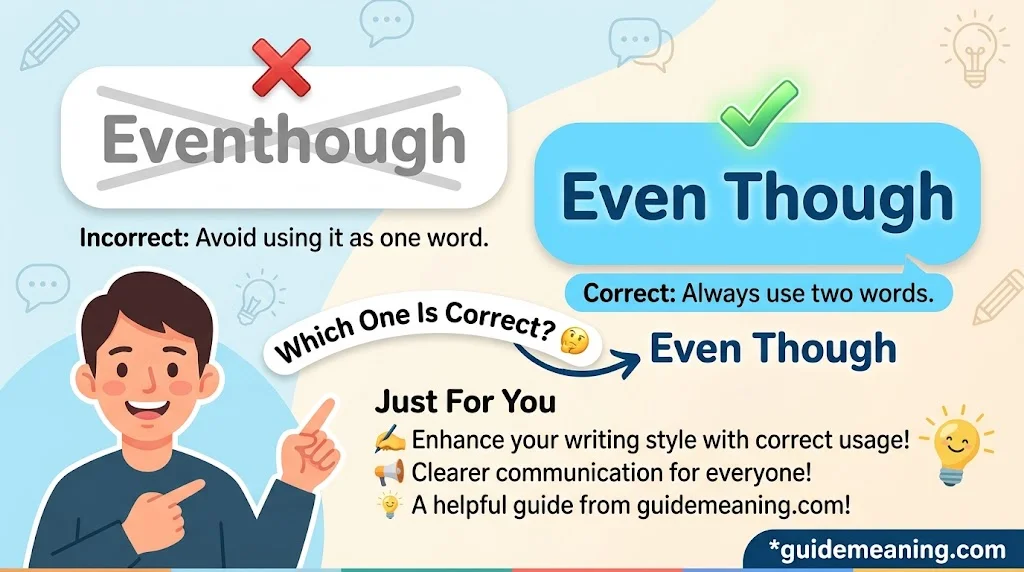

Eventhough vs. Even Though becomes easy when you know the meaning and the basic rule in English. Even though is the correct, grammatically accepted phrase and a conjunction that shows contrast, while eventhough is an incorrect spelling, not a real word, and not recognized in standard English. Many English learners and native speakers confuse these forms because eventhough looks harmless, sounds right, and feels natural when typing fast. I often notice this mistake while checking student work, emails, essays, captions, and business proposals. People may assume it is a style choice or believe both forms are correct, but that is not true in real usage. The truth is that eventhough is always incorrect, while even though remains the standard form.
The difference goes beyond spelling because it affects grammar, sentence structure, clarity, credibility, and correctness in formal communication. A single spelling mistake may look minor, but clear writing supports professional authority and polished writing. When a sentence looks clean and natural, readers can follow your meaning without a tiny doubt. The history and psychology behind this confusion are less important than understanding why the two-word form feels natural to fluent speakers. The brain can join familiar words quickly, so even though may become eventhough without thinking twice. This tricky pair can create an error in everyday usage, even among confident writers. Grammar rules make the correct form clear: always write two words, never one.
A useful guide is to master one memory trick: picture even and though as two separate words. This helps English learners avoid the single-word version and use the proper phrase naturally. My practical fixes include noticing the form while reading, checking your writing, and using examples, tables, and practical tips to strengthen your skills. Keep this quick takeaway in mind: even though shows contrast, while eventhough is a spelling error. Once you understand this rule, repeated mistakes become easier to prevent, your writing becomes more confident, and your clarity improves. The alternatives and memory tricks can reinforce the essential point. This guide breaks the issue down in plain English without unnecessary grammar jargon, helping you apply the rule naturally and clear this up in your own writing.
Let’s dive in!
Quick Answer:
Even though is correct. Eventhough is not the standard English spelling.
| Form | Correct? | Explanation |
| even though | ✅ Yes | Standard English phrase |
| eventhough | ❌ No | Nonstandard spelling of even though |
| even though in formal writing | ✅ Yes | Appropriate |
| even though in casual writing | ✅ Yes | Common and natural |
| eventhough in formal writing | ❌ No | Should be corrected |
Even though means roughly “despite the fact that” or “although.” Cambridge Dictionary defines it as an expression used to introduce a fact that contrasts with another part of the sentence.
For example:
Even though it was raining, we went for a walk.
The rain might normally discourage someone from going outside. Nevertheless, the people went for a walk. That’s the contrast even though creates.
The incorrect version would be:
Eventhough it was raining, we went for a walk. ❌
The correction is simple:
Even though it was raining, we went for a walk. ✅
What Does “Even Though” Mean?
Even though is a subordinating conjunction used to connect contrasting ideas.
It commonly introduces a situation that might lead you to expect one result. The main clause then gives you a different or surprising result.
Consider this sentence:
Even though Maya was tired, she finished her assignment.
The sentence contains two ideas:
- Maya was tired.
- Maya finished her assignment.
Being tired might make you expect Maya to stop working. Instead, she completed the assignment.
That’s the heart of even though: one fact doesn’t prevent the other result . from happening.
Cambridge describes the phrase as meaning “despite the fact that)
You can therefore think of the structure like this:
Unexpected condition → expected obstacle → contrasting result
For example:
Even though the restaurant was crowded, we found a table.
The restaurant’s crowded condition creates an expectation that finding a table might be difficult. The main clause tells you what actually happened.
Common meanings of “Even Though”
Depending on context, even though can express:
- Contrast
- Concession
- An unexpected result
- A fact that doesn’t change the outcome
- A stronger form of contrast than plain “though” or “although”
Here are a few examples:
- Even though he was nervous, he gave the speech.
- Even though the car is old, it runs well.
- She went to work even though she felt sick.
- Even though I studied for hours, the test was difficult.
- They enjoyed the trip even though the weather was poor.
The phrase doesn’t necessarily mean that the first condition caused the second. Instead, it highlights the fact that the first condition didn’t stop the second situation from being true.
Is “Eventhough” a Word?
In standard English, eventhough isn’t the accepted spelling of this conjunction.
When writers use eventhough, they normally intend to write even though. The problem usually comes from treating a frequently spoken phrase as though it were a single written word.
For example:
Eventhough I was busy, I answered the phone. ❌
The standard version is:
Even though I was busy, I answered the phone. ✅
This isn’t a case where two spellings carry slightly different meanings. There is no standard grammatical distinction such as:
- eventhough = informal
- even though = formal
Instead, even though is the standard form.
Some informal or user-generated sources may display eventhough as an alternative form. That doesn’t make it the standard spelling expected in edited English. Wiktionary, for example, lists it as an alternative form, while major learner-dictionary sources define and use even though as the standard phrase.
Why Does “Eventhough” Look Right?
There’s a simple reason.
When people speak naturally, the words in even though often flow together. Spoken language doesn’t always provide the clear word boundaries that writing does.
Think about phrases such as:
- a lot
- at least
- of course
- even though
When you hear them quickly, the spaces between words can become less noticeable.
That can create a spelling trap. Your ear hears one smooth sound pattern, while standard writing requires two separate words.
Why Is “Even Though” Written as Two Words?
The phrase contains two separate words with distinct grammatical roles.
Even adds emphasis. Though introduces the contrasting or concessive clause.
Together, they form the conjunction even though.
Compare it with other common constructions:
- even if
- even when
- even after
- even before
- even so
English doesn’t automatically combine frequently adjacent words into one word.
For that reason, familiarity shouldn’t be confused with compound-word formation. A phrase can appear together thousands of times while remaining two words.
A Useful Memory Trick
When you’re unsure, mentally separate the phrase:
even + though
If the sentence means something like “despite the fact that,” write even though as two words.
For example:
Even though I was exhausted, I kept working.
You can mentally replace it with:
Despite the fact that I was exhausted, I kept working.
The meaning remains essentially the same.
How to Use “Even Though” in a Sentence
The most common structure is:
Even though + subject + verb, main clause
For example:
Even though the test was difficult, Sarah passed it.
The first part is a dependent clause:
Even though the test was difficult
The second part is the main clause:
Sarah passed it.
You can also reverse the order:
Main clause + even though + subject + verb
For example:
Sarah passed the test even though it was difficult.
Both sentences are grammatically correct.
Beginning With “Even Though”
When the even though clause comes first, a comma normally separates it from the main clause.
Even though I was tired, I finished the report.
Even though the store was busy, we received quick service.
Even though he had little experience, he handled the task well.
Cambridge’s grammar guidance similarly explains that when a though/although/even though clause comes first, a comma normally follows it.
Using “Even Though” After the Main Clause
When the main clause comes first, you generally don’t need a comma before even though.
I finished the report even though I was tired.
We received quick service even though the store was busy.
He handled the task well even though he had little experience.
This is one of the easiest punctuation patterns to remember.
| Sentence position | Example | Comma? |
| Even though clause first | Even though I was tired, I worked. | Usually yes |
| Main clause first | I worked even though I was tired. | Usually no |
Even Though vs. Though
Though and even though have closely related meanings. Both can introduce a contrast.
Compare these sentences:
Though it was expensive, I bought it.
Even though it was expensive, I bought it.
Both are correct.
The difference is mainly one of emphasis. Even though can make the contrast feel stronger or more pronounced. Cambridge specifically notes that even though is similar to although but creates a stronger contrast.
Consider the difference in tone:
Though he was tired, he continued working.
This states the contrast.
Even though he was exhausted, he continued working.
This gives the obstacle more emphasis.
A Note About “Though”
Though has another useful role that even though doesn’t normally have.
In conversational English, though can appear at the end of a clause with a meaning similar to “however” or “nevertheless.”
For example:
It’s expensive. I like it, though.
You can’t naturally replace the final though with even though:
It’s expensive. I like it, even though. ❌
Cambridge specifically distinguishes this sentence-final use of though from even though.
Even Though vs. Although
Even though and although often perform the same grammatical job.
Compare:
Although it was raining, we went outside.
Even though it was raining, we went outside.
Both sentences express a contrast.
However, even though generally puts more emphasis on the unexpected nature of the result. Cambridge identifies both as subordinating conjunctions and notes that even though creates a stronger contrast.
Quick Comparison
| Expression | Basic meaning | Strength |
| although | despite the fact that | Neutral contrast |
| though | despite the fact that | Neutral and often conversational |
| even though | despite the fact that | Stronger contrast |
For example:
Although she was nervous, she spoke clearly.
Even though she was extremely nervous, she spoke clearly.
The second sentence draws more attention to the surprising contrast.
Even Though vs. Even If
This distinction is more important because the two phrases can look similar while expressing different ideas.
“Even Though” Refers to a Fact or Existing Situation
Use even though when the condition is presented as real or known.
Even though it was raining, we went hiking.
The sentence presents the rain as an actual condition.
“Even If” Refers to a Possibility or Condition
Use even if when you’re discussing a possibility, assumption, or hypothetical situation.
Even if it rains tomorrow, we’ll go hiking.
Here, the rain hasn’t necessarily happened. It’s a possibility.
Compare Them Side by Side
| Phrase | Typical idea | Example |
| even though | Known or actual fact | Even though it rained, we went out. |
| even if | Possible or hypothetical situation | Even if it rains, we’ll go out. |
This distinction becomes particularly useful in conditional sentences.
Even though he was tired, he drove home.
This tells us he was tired.
Even if he is tired, he’ll drive home.
This presents tiredness as a possible condition.
Even Though vs. Despite and In Spite Of
These expressions can communicate a similar contrast. However, they don’t normally take the same grammatical structure.
Even Though + Clause
Even though she was tired, she continued working.
Despite + Noun or -ing Form
Despite her tiredness, she continued working.
Despite being tired, she continued working.
In Spite Of + Noun or -ing Form
In spite of her tiredness, she continued working.
In spite of being tired, she continued working.
The important point is that even though normally introduces a clause containing a subject and verb.
| Structure | Example |
| even though + clause | Even though she was tired, she worked. |
| despite + noun/-ing | Despite her tiredness, she worked. |
| in spite of + noun/-ing | In spite of being tired, she worked. |
A common mistake is to combine these patterns incorrectly:
Despite she was tired, she worked. ❌
Use:
Even though she was tired, she worked. ✅
Or:
Despite being tired, she worked. ✅
Common Mistakes With “Even Though”
A few errors appear repeatedly in everyday writing.
Writing “Eventhough”
This is the main spelling problem.
Eventhough the room was small, it was comfortable. ❌
Even though the room was small, it was comfortable. ✅
Remember: two words.
Using “Even Though” and “But” Together
Because even though already introduces a contrast, adding but in the same basic construction creates a faulty sentence.
Incorrect:
Even though it was raining, but we went outside. ❌
Correct:
Even though it was raining, we went outside. ✅
You can also write:
It was raining, but we went outside. ✅
The two structures perform different grammatical jobs. Cambridge explains that but is a coordinating conjunction, while although/though/even though introduce subordinate clauses.
Incorrect Comma Placement
Don’t automatically put a comma before even though.
Incorrect:
I went home, even though I wasn’t tired. ⚠️
In ordinary usage, the comma isn’t normally needed there.
Better:
I went home even though I wasn’t tired. ✅
When the dependent clause comes first, however, the comma is normally appropriate:
Even though I wasn’t tired, I went home. ✅
Confusing “Even Though” With “Even If”
Don’t use even though for an imagined condition simply because the sentence contains a contrast.
Compare:
Even though the forecast predicted rain, we went outside.
The forecast’s prediction is a known fact.
But:
Even if it rains, we’ll go outside.
The rain itself is presented as a possibility.
Can You Use “Even Though” and “Still” Together?
Yes.
Still can reinforce the unexpected result that follows the concessive clause.
For example:
Even though the task was difficult, she still completed it.
The word still emphasizes that the result happened despite the obstacle.
Another example:
Even though he had little time, he still helped us.
This is grammatically natural because still doesn’t duplicate the grammatical function of even though. Instead, it adds emphasis to the main clause.
However, don’t confuse still with but in the same construction.
Even though the task was difficult, she still completed it. ✅
Even though the task was difficult, but she completed it. ❌
Can “Even Though” Start a Sentence?
Yes. There’s nothing wrong with beginning a sentence with even though.
For example:
Even though the deadline was close, the team remained calm.
Even though I disagreed with him, I understood his point.
Even though the product was expensive, customers continued buying it.
The important thing is that the even though clause usually needs a main clause to complete the thought.
For example:
Even though I was tired. ❌
This doesn’t express a complete idea.
Instead:
Even though I was tired, I kept working. ✅
The first clause establishes the contrast. The second clause supplies the main result.
“Even Though” in Formal and Informal Writing
One useful feature of even though is its versatility.
You can use it naturally in:
- Casual conversations
- Emails
- Blog posts
- Business communication
- Essays
- Reports
- Academic writing
- Explanatory articles
- Narrative writing
For example, an email might say:
Even though the meeting ran late, we completed the main agenda.
An academic discussion might say:
Even though the sample size was limited, the results revealed a consistent pattern.
A casual conversation might sound like this:
Even though I’m tired, I don’t want to go to bed yet.
The phrase doesn’t belong exclusively to formal or informal English. Context determines the overall tone.
Case Study: Why the Difference Matters
Imagine you’re writing a professional email to a client.
Your original sentence says:
Eventhough we received your request late, we completed the changes today.
The meaning is understandable. However, the spelling error can distract the reader from your message.
Correct it to:
Even though we received your request late, we completed the changes today.
Nothing about the meaning changes. The correction simply brings the sentence into line with standard English spelling.
Now compare another situation:
Even though the instructions were unclear, the team completed the project.
Here, the phrase does more than connect two facts. It tells the reader how those facts relate.
Unclear instructions create an obstacle.
Completing the project is the unexpected result.
That relationship is exactly why even though works so well.
Eventhough vs. Even Though Examples
The quickest way to make the distinction stick is to see the forms side by side.
| Incorrect | Correct |
| Eventhough it was cold, we went outside. | Even though it was cold, we went outside. |
| I went eventhough I was tired. | I went even though I was tired. |
| Eventhough she apologized, he remained upset. | Even though she apologized, he remained upset. |
| We continued eventhough the road was difficult. | We continued even though the road was difficult. |
| Eventhough the price was high, they bought it. | Even though the price was high, they bought it. |
More Correct Examples
Everyday life:
Even though I was hungry, I waited for everyone else.
Workplace writing:
Even though the meeting started late, we covered every major issue.
Academic writing:
Even though the study had limitations, it produced useful findings.
Travel:
Even though the flight was delayed, we arrived before midnight.
Personal experience:
Even though I had never used the software before, I learned it quickly.
Business:
Even though demand increased, the company maintained its regular delivery schedule.
Each sentence uses even though as two separate words.
How to Remember “Even Though”
The easiest rule is also the most reliable:
Always write “even though” as two words.
If you’re proofreading your work and see eventhough, stop and separate it.
A useful mental test is to substitute although.
For example:
Even though she was tired, she continued working.
You can replace it with:
Although she was tired, she continued working.
If the meaning still makes sense, you’re almost certainly dealing with the conjunction even though.
A Simple Memory Formula
Think:
even + though = two words
Not:
eventhough = one word
This is a small rule, but it eliminates one of the most common spelling errors involving the phrase.
Eventhough vs. Even Though: Quick Comparison
| Feature | Even Though | Eventhough |
| Standard English | ✅ Yes | ❌ No |
| Spelling | Two words | One word |
| Grammatical conjunction | ✅ Yes | ❌ No |
| Expresses contrast | ✅ Yes | Intended meaning |
| Means “despite the fact that” | ✅ Yes | Intended meaning |
| Suitable for academic writing | ✅ Yes | ❌ No |
| Suitable for professional writing | ✅ Yes | ❌ No |
| Standard spelling in edited English | ✅ Yes | ❌ No |
| Recommended form | Use it | Avoid it |
FAQs:
Is “eventhough” correct in English?
No. Eventhough is an incorrect spelling in standard English. The correct form is even though, written as two separate words.
What does “even though” mean?
Even though is a conjunction that introduces a contrast. It shows that one fact is true despite another fact or situation.
Is “even though” one word or two words?
Even though is always written as two words. Writing it as eventhough is a spelling error.
Why do people write “eventhough”?
People often write eventhough because the phrase sounds natural when spoken quickly. Familiar words can also appear connected when typing fast.
Can I use “even though” in formal writing?
Yes. Even though is appropriate in emails, essays, business proposals, academic writing, and other formal contexts.
Is “even though” the same as “although”?
They can have similar meanings because both can express contrast. However, even though often adds stronger emphasis to the contrast.
How can I remember the correct spelling?
Remember this simple trick: even and though are always separate. Write even though, never eventhough.
Conclusion:
The difference between Eventhough vs. Even Though is straightforward once you remember the basic spelling rule. Even though is the correct two-word phrase used to express contrast, while eventhough is not accepted as a standard English word. Keeping the two words separate will help you maintain clear, polished, and professional writing.