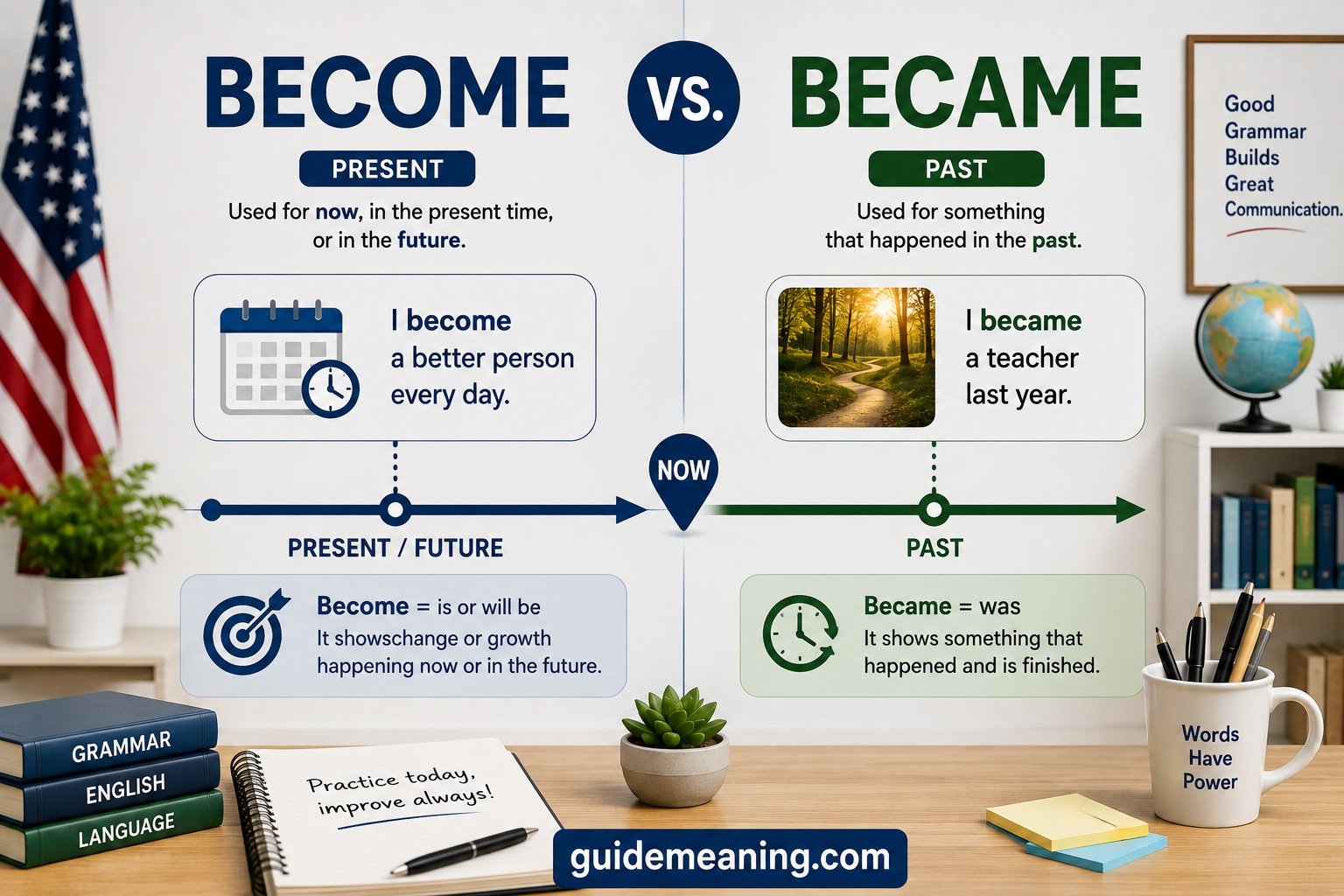

Become vs Became can seem confusing because these English verbs have similar forms, but they serve completely different roles depending on time and tense. The key difference is simple: become works for the present and after certain helping verbs, while became describes a completed past change. For example, “I become happy every day” describes a repeated situation, while “I became tired yesterday after work” points to a past event. Becomes is also important because it fits a singular subject in the present.
When English learners or native speakers are typing quickly, writing quickly, or speaking casually, this grammar issue can cause confusion. A useful memory trick is to connect became with the past and become with the present, future, or a helping-verb structure. Once you understand this simple rule, you can avoid common mistakes, choose the correct word more confidently, and improve your clarity in English writing.
The same idea helps when you write an email, school essay, or social media post, because checking the time and structure of each sentence makes the choice more straightforward. From my experience explaining verb forms, this approach makes the grammar feel less like a chore and more like a natural part of everyday conversation.
Let’s dive in!
Quick Answer:
Become vs Became mainly differs in tense. Use became for a completed change in the past, while become is used as the base form, after certain helping verbs, and in future or infinitive constructions.
TL;DR:
• Become is the base form of the verb.
• Became is the simple past form.
• Become is also the past participle.
• Use became for completed past changes.
• Use has become or have become for present perfect.
What Does “Become” Mean?
The verb become describes a change from one condition, role, or state to another. It can refer to becoming something physically, emotionally, professionally, or socially.
For American English learners, the key is understanding how the word fits into the sentence rather than memorizing one meaning.
The Basic Meaning
To become something means to begin to be that thing or enter a new state.
For example:
- I want to become a teacher.
- She hopes to become more confident.
- They will become parents next year.
- People often become tired after long trips.
The word can describe both real changes and future possibilities.
Become as an Infinitive
You’ll often see become after “to.”
Examples include:
- He wants to become a doctor.
- She plans to become a writer.
- They hope to become better speakers.
Here, became would be incorrect because the infinitive requires the base form.
What Does “Became” Mean?
Became is the simple past form of become. It describes a change that happened before the present moment.
This makes it especially useful when telling stories or describing completed events.
Past Changes
Consider these examples:
- She became a doctor in 2022.
- The weather became colder last night.
- He became interested in photography during college.
- The small business became successful after several years.
Each example describes a change that occurred in the past.
The exact date doesn’t always need to appear. Context can make the past time clear.
Become and Became Side by Side
Compare these sentences:
She wants to become a lawyer.
This describes a goal that hasn’t happened yet.
She became a lawyer in 2021.
This describes a completed change in the past.
The basic meaning stays similar. However, the tense changes the timing.
Become vs Became: The Main Grammar Difference
The easiest way to understand the difference is to look at the verb forms.
| Verb Form | Grammatical Role | Example |
| become | Base form | I want to become a nurse. |
| became | Simple past | She became a nurse last year. |
| become | Past participle | She has become a nurse. |
| becomes | Present, third-person singular | He becomes nervous easily. |
| becoming | Present participle | She is becoming more confident. |
This pattern is unusual because become appears as both the base form and past participle. Cambridge identifies the principal forms as become, became, and become.
The Easy Formula
Think of the verb like this:
become → became → become
The middle form is the simple past.
The final form is the past participle.
That small pattern prevents many common grammar mistakes.
When Should You Use “Become”?
Use become when the sentence requires the base form or past participle. It commonly appears with infinitives, modal verbs, and perfect tenses.
For many American English learners, these structures are more useful than trying to label every sentence by tense.
Common Structures
You can use become after:
- to
- will
- can
- may
- might
- should
- has
- have
- had
Examples:
- I want to become stronger.
- She will become a manager.
- He may become famous.
- They have become close friends.
- We had become accustomed to the routine.
Notice that became doesn’t follow these helping verbs in standard English.
When Should You Use “Became”?
Use became when you’re describing a completed change in the simple past.
It usually works without a helping verb.
Examples From Everyday English
- My brother became a firefighter.
- The room became quiet.
- She became interested in art.
- The situation became difficult.
- They became friends during college.
These sentences describe changes that took place previously.
Time Words Can Help
Certain words strongly suggest a past situation.
For example:
- yesterday
- last year
- last night
- in 2019
- when I was young
- several years ago
- after college
So if you write, “She ___ a teacher in 2020,” the correct choice is became.
How “Has Become” and “Have Become” Work
One of the biggest sources of confusion is the phrase has become.
Many learners mistakenly write “has became.” That construction is incorrect because “has” requires the past participle.
Has Become
Use has become with singular third-person subjects.
Examples:
- She has become more confident.
- He has become a respected leader.
- The city has become more expensive.
- Technology has become part of daily life.
Have Become
Use have become with I, you, we, and they.
Examples:
- I have become more patient.
- You have become a better writer.
- We have become close friends.
- They have become successful entrepreneurs.
The important rule is simple:
has/have + become
Not:
has/have + became
Common Mistakes With Become and Became
These mistakes often happen because both words describe transformation. However, the grammar around them determines which form works.
Mistake: “Has Became”
Incorrect:
She has became more confident.
Correct:
She has become more confident.
The helping verb has requires the past participle.
Mistake: “Will Became”
Incorrect:
He will became a doctor.
Correct:
He will become a doctor.
After will, use the base form.
Mistake: “To Became”
Incorrect:
She wants to became a teacher.
Correct:
She wants to become a teacher.
After to in an infinitive, use the base form.
Mistake: Using Became for Present Habits
Incorrect:
He became nervous whenever he speaks publicly.
Correct:
He becomes nervous whenever he speaks publicly.
The second sentence describes a repeated present situation.
Become, Became, and Becomes Compared
A third form often creates confusion: becomes.
It looks similar, but it serves a different purpose.
Present-Tense “Becomes”
Use becomes with he, she, or it when describing a present or repeated situation.
Examples:
- She becomes nervous before exams.
- He becomes quiet when he’s tired.
- The weather becomes colder in December.
By contrast:
- She became nervous yesterday.
- She will become nervous if the situation continues.
The subject and time both matter.
Read More: In Process vs In Progress: Simple Guide to the Difference 2026
Become vs Became in American English
In the United States, these forms follow the same standard English grammar rules used elsewhere. However, American speakers use them constantly in everyday situations.
The words appear in education, professional communication, casual conversation, and storytelling.
Everyday American Examples
| Situation | Correct Form | Example |
| Future career | become | I want to become an engineer. |
| Past career change | became | She became an engineer in 2020. |
| Present habit | becomes | He becomes quiet during meetings. |
| Present result | become | They have become close friends. |
| Future possibility | become | You will become more confident. |
This makes the distinction practical rather than merely academic.
If you can identify when the change happens, choosing the correct form becomes much easier.
How Become and Became Express Change
Both forms share the same central idea: transformation.
The difference is the position of that transformation in time.
A Simple Timeline
Think of the forms this way:
Past: She became a teacher.
Present result: She has become an experienced teacher.
Future: She will become a school principal.
The person may be moving through one long journey. However, each verb form places the change at a different point.
Why This Matters
Verb tense helps readers understand when something happened.
Without the correct tense, your sentence may sound confusing or unnatural. Therefore, tense isn’t just a grammar rule. It helps organize your meaning.
Become vs Became in Questions
Questions can make this difference even clearer.
Questions With “Did”
After did, use the base form become.
Correct:
When did she become a doctor?
Not:
When did she became a doctor?
The reason is that did already carries the past tense.
This rule applies to many English verbs, not only become.
Questions About the Present
For present situations, you might use become or becomes, depending on the sentence.
Examples:
How do people become successful?
Why does he become nervous so easily?
The auxiliary verb controls the form that follows it.
Become vs Became in Conditional Sentences
Conditional sentences can make learners hesitate because they often discuss imagined situations.
Real or Possible Situations
For future possibilities, use become.
If you keep practicing, you will become better.
If she studies medicine, she may become a doctor.
General Truths
For general conditions, become can also appear.
People become more confident when they practice regularly.
The sentence describes a general pattern rather than one completed past event.
Past Situations
For completed past events, use became.
After years of training, she became a skilled athlete.
The change already happened, so the simple past fits naturally.
The History Behind “Become” and “Became”
Unlike a symbolic concept, this pair has a linguistic history. The two forms developed from the same irregular English verb.
The verb become has Germanic roots and has been part of English for centuries. Its unusual form reflects older patterns in English rather than a modern grammar invention.
From Older English to Modern English
English has changed greatly since its earliest stages. Many verbs once followed patterns that no longer feel familiar today.
Become retained an irregular pattern:
become → became → become
That pattern survived even as other parts of English grammar changed.
Why Isn’t It “Becomed”?
Regular verbs usually form the past with -ed, such as:
- walk → walked
- work → worked
- change → changed
However, become is irregular.
English inherited many irregular verbs from earlier Germanic language patterns. That’s why learners need to memorize forms like became instead of simply adding -ed.
The Psychological Idea of “Becoming”
Although become and became are grammar terms, the idea behind them is also common in everyday American culture.
People often describe life as a process of becoming something new.
Someone may say they’re becoming more confident, becoming a parent, or becoming a better leader. These expressions focus attention on growth and change.
Common Associations
• Become often suggests possibility, growth, or transformation.
• Became often suggests achievement, transition, or completed change.
• Becoming can suggest an ongoing personal journey.
These meanings aren’t special symbolic definitions. Instead, they come from how language frames change.
Modern Usage in Social Media and Everyday Writing
People use these forms frequently in captions, comments, messages, and personal posts.
Social media often emphasizes personal growth, making become especially common.
For example:
“Trying to become the best version of myself.”
Someone describing a completed experience might write:
“I became more confident after leaving college.”
Why Casual Writing Can Cause Errors
Fast typing often leads people to skip grammar checks.
However, the same basic rules still apply online. A short message may be informal, but has became and will became remain incorrect in standard English.
Simple Tricks to Remember the Difference
You don’t need to memorize complicated grammar terminology.
Instead, connect each form with a simple clue.
Use “Became” for Completed Past Change
Ask yourself:
Did this change already happen?
If yes, became may be correct.
He became a teacher last year.
Use “Become” After Helping Verbs
Look for words such as:
- will
- can
- may
- might
- should
- has
- have
- had
Then check the structure.
She will become successful.
She has become successful.
This quick check can prevent many mistakes.
FAQs:
What is the difference between become and became?
Become is the present or base form of the verb, while became is the simple past form. For example, “I want to become a teacher” refers to the present or future, while “I became a teacher last year” refers to the past.
Is became the past tense of become?
Yes. Became is the simple past tense of become. The three main forms are become – became – become.
When should I use become?
Use become for the base or present form and after helping verbs such as “will,” “can,” “may,” and “have” in the appropriate structure. For example, “She will become successful.”
When should I use became?
Use became when describing a completed change or situation in the past. For example, “He became tired after work.”
Is “I became happy every day” correct?
Usually, no, if you mean something that happens regularly. In that case, “I become happy every day” is grammatically possible, although the natural wording depends on the intended meaning. Became normally points to a past event.
Is “I become tired yesterday” correct?
No. Because yesterday clearly refers to the past, you should use became: “I became tired yesterday.”
How can I remember become vs became?
A simple memory trick is to connect became with the past. If the change already happened, use became. For the present, future, or after many helping verbs, use become.
Conclusion:
Understanding become vs became is easier once you focus on time and tense. Remember that became describes a completed change in the past, while become works as the base form and appears in present, future, and helping-verb structures. With a little practice, you’ll be able to choose the correct form naturally in conversation, school writing, emails, and everyday sentences.