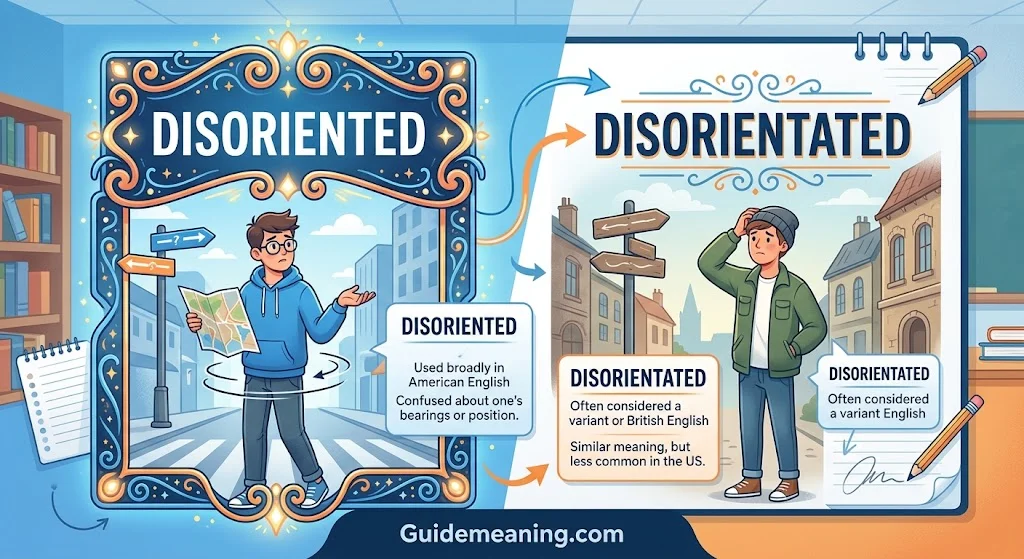

Disoriented vs Disorientated can confuse people, but both forms describe a state of confusion and differ mainly by regional English preference. Disoriented is more common in American English, while disorientated appears more often in British English. Both words can describe someone who feels lost, puzzled, confused, or unable to think clearly. The difference mainly comes from regional habits, grammar, etymology, and usage frequency rather than meaning. Trusted dictionaries and real examples from formal writing, books, and news articles recognize both forms as legitimate. The related verbs disorient and disorientate and the noun disorientation also help explain this variation.
The distinction becomes easier when you consider context, style, and audience preference. You might feel disoriented while walking through a new city, playing a video game, or losing your sense of direction. More serious situations such as a concussion or certain diseases can also cause disorientation. Writers may choose either form based on regional usage or stylistic reasons, while learners can remember that disoriented is usually the safer choice for a US audience. Understanding the word’s French root, meaning “turn from the east,” also gives useful insight into its linguistic history.
Quick Answer:
Disoriented vs Disorientated have essentially the same meaning: confused, lost, or unsure of your surroundings or direction. In American English, disoriented is the preferred form, while disorientated is especially common in British English.
TL;DR:
• Disoriented is the preferred form in American English.
• Disorientated is especially common in British English.
• Both forms describe confusion or loss of direction.
• Neither word is inherently wrong when used in the right variety.
• The difference is mainly regional, not a difference in meaning.
• For U.S. readers, choose disoriented in most situations.
What Does Disoriented Mean?
The word disoriented describes a person who has lost their bearings. It can involve physical direction, mental clarity, or a sense of place. Merriam-Webster defines it as losing one’s sense of time, place, or identity.
Common Uses of Disoriented
In everyday American English, the word can describe several situations:
• Getting lost in an unfamiliar neighborhood
• Waking suddenly and not knowing where you are
• Feeling confused after a major change
• Losing track of what happened during an event
• Struggling to understand a confusing situation
For example, you might say, “I felt disoriented when I walked out of the subway.”
The word can also describe a figurative experience. Someone facing a sudden job change might feel disoriented because their familiar routine has disappeared.
What Does Disorientated Mean?
Disorientated carries essentially the same meaning. It is the past tense or past participle of disorientate, a verb that means to make someone confused about their location or direction. Cambridge labels disorientate as mainly British.
Examples of Disorientated
You might encounter sentences such as:
• “The unfamiliar streets left her completely disorientated.”
• “He felt disorientated after waking in the dark.”
• “The sudden change left the team disorientated.”
• “The fog made the hikers disorientated.”
These sentences sound perfectly understandable to American readers. However, many Americans would naturally replace disorientated with disoriented.
Oxford also lists disorientated as meaning unable to recognize where you are or where you should go. It also includes the broader sense of feeling confused and unable to think clearly.
Is Disoriented or Disorientated More Common in America?
For a general U.S. audience, disoriented is the better choice. American dictionaries and current American usage strongly support the shorter form.
Merriam-Webster lists disorient as the verb and disoriented as its past tense and past participle. Its recent examples also show the word being used naturally in American news and general writing.
American Preference
Consider these examples:
| Context | Preferred U.S. Form | Less Typical U.S. Form | Meaning |
| Getting lost | disoriented | disorientated | Unsure of direction |
| Waking suddenly | disoriented | disorientated | Temporarily confused |
| New surroundings | disoriented | disorientated | Unsure of where you are |
| Major life change | disoriented | disorientated | Mentally unsettled |
| Confusing information | disoriented | disorientated | Unclear about what to think |
The longer version isn’t necessarily incorrect. It simply sounds more British to many American readers.
Why Americans Prefer Disoriented
English often develops different regional preferences without changing the underlying meaning.
For example, American English has many shorter forms that differ from British preferences. Disoriented fits comfortably into that American pattern.
Therefore, if your audience is primarily in the United States, disoriented will usually sound more natural.
Is Disorientated Correct English?
Yes. Disorientated is a legitimate English word. It isn’t automatically a spelling error or grammatical mistake.
Cambridge explicitly includes disorientated and describes it as the past form of disorientate. Oxford also recognizes it and lists disoriented as an alternative.
Correctness Depends on Context
The better question isn’t always, “Which one is correct?”
Instead, ask, “Which form fits my audience?”
For British readers, disorientated can sound completely ordinary. For American readers, disoriented usually feels more natural.
That distinction matters in international writing. A word can be correct while still sounding unusual to a particular group of readers.
Disoriented vs Disorientated in British English
British English generally uses disorientated more often than American English does. However, British speakers and writers also use disoriented.
Cambridge describes disorientated as mainly UK and lists disoriented as another form. This means the British preference isn’t an absolute rule.
A Regional Difference, Not a Meaning Difference
The distinction is similar to many other differences between English varieties.
The words may look different, but the idea remains the same. Neither form automatically signals a different emotional state.
For example:
“The traveler became disoriented in the unfamiliar city.”
And:
“The traveler became disorientated in the unfamiliar city.”
Both sentences communicate the same basic idea.
The first simply sounds more typical in American English.
What Is the Difference Between Disorient and Disorientate?
The underlying difference involves the verb forms used in different varieties of English.
Disorient is the main verb used in American English. Disorientate is especially associated with British English. Their meanings overlap closely.
The Verb Forms
In American English:
disorient → disoriented → disorienting
In British English, you may see:
disorientate → disorientated → disorientating
Both systems work grammatically within their respective varieties.
However, American readers will generally find the first pattern more familiar.
Where Did the Word Disorient Come From?
The history of disorient explains why the word is connected to direction in the first place.
The English verb appeared in the 1650s from French désorienter, meaning to cause someone to lose their bearings. The French word was built from dés- and orienter. Merriam-Webster gives the first known English use as 1655.
The Connection to East
The deeper story leads to the word orient.
Orient originally referred to the east, the direction where the sun rises. It came through French from Latin orientem, connected with the rising sun.
To orient yourself originally involved establishing your direction, especially by reference to the east.
So, at its root, disorient carries an old idea of losing your bearings.
From Physical Direction to Mental Confusion
Over time, the meaning expanded beyond geography.
People could lose their bearings physically, but they could also lose their mental bearings. Eventually, the word became useful for situations involving uncertainty, confusion, and unfamiliar ideas.
That shift is why someone can be disoriented in a forest or disoriented by unexpected information.
How Did Disorientated Develop?
The longer disorientate form belongs to the same word family. It developed alongside the broader family of words connected with orient, orientation, and orientate.
The important point is that the extra -at- doesn’t create a new meaning.
Same Core Idea
Both forms ultimately describe a loss of orientation.
The difference developed through English usage rather than through a completely separate definition. Today, dictionaries continue to recognize both forms, while noting their regional preferences.
This is why treating disorientated as simply “wrong” can be misleading.
It’s better understood as a regional variant.
Read More: How Long vs How Much Time: A Simple Guide for 2026
Can Disoriented and Disorientated Be Used Interchangeably?
In most ordinary sentences, yes. You can generally replace one with the other without changing the basic meaning.
However, regional style still matters. A sentence written for American readers will usually sound smoother with disoriented.
Examples Side by Side
Consider these pairs:
American: “She felt disoriented after waking up.”
British: “She felt disorientated after waking up.”
American: “The unfamiliar building left him disoriented.”
British: “The unfamiliar building left him disorientated.”
The meaning stays essentially unchanged.
Therefore, choose according to audience rather than trying to create a hidden distinction.
Disoriented vs Disorientated in Everyday American Writing
For Americans, disoriented works naturally in conversation, journalism, fiction, education, and professional writing.
It can describe physical confusion or a more abstract sense of uncertainty. Merriam-Webster also lists confused as a synonym of disorient.
Common American Examples
Here are some natural uses:
• “I was completely disoriented after the long flight.”
• “The dark room left me briefly disoriented.”
• “He looked disoriented when he entered the wrong building.”
• “The sudden change in plans left everyone disoriented.”
• “The strange layout can make visitors feel disoriented.”
Notice how the word works in both physical and figurative settings.
That flexibility is one reason it remains useful in modern American English.
Why Do People Confuse These Two Words?
The confusion usually comes from regional English rather than grammar.
An American reader may encounter disorientated and assume the writer added unnecessary letters. A British reader may find disorientated completely ordinary.
The Extra Syllable Can Feel Unfamiliar
American English tends to favor disoriented.
British English has traditionally used disorientated more frequently, although the shorter form is also established there. Grammar references have documented this regional split for years.
This creates a familiar language problem: a word can sound “wrong” simply because it isn’t the version you grew up hearing.
Don’t Invent a Grammatical Difference
One common mistake is assuming that one form is an adjective while the other must be a verb.
That isn’t the real distinction.
Both forms can function as participles and adjectives. The main difference is regional usage and the verb form behind them. Cambridge specifically identifies disorientated as the past form of disorientate.
What Are the Best Alternatives to Disoriented?
Sometimes you may want a simpler or more precise word.
The best alternative depends on what kind of confusion you’re describing.
Useful Alternatives
• Confused — when someone doesn’t understand what is happening
• Lost — when someone can’t find their way
• Bewildered — when something is deeply puzzling
• Perplexed — when someone can’t understand a problem
• Uncertain — when someone lacks confidence about what to do
• Unsettled — when someone feels emotionally disturbed or unsure
For example, “I was lost” is more specific about location.
Meanwhile, “I was confused” may focus more on understanding than direction.
Does Disoriented Have a Figurative Meaning?
Yes. Modern English uses disoriented far beyond physical navigation.
Someone doesn’t need to be literally lost to feel disoriented. Major changes can disrupt familiar expectations and make a person unsure about what comes next.
Figurative Examples
A new college student may feel disoriented during the first week.
Likewise, someone starting a completely different career may feel disoriented by unfamiliar routines.
A sudden change in plans can also leave a group disoriented.
In each case, the person hasn’t necessarily lost physical direction. Instead, their usual sense of how things work has been disrupted.
How Has the Meaning Changed Over Time?
The word’s history shows a gradual movement from physical direction toward broader mental uncertainty.
Originally, the concept was strongly tied to orientation and the east. Later, disorient came to mean losing one’s bearings more generally.
A Simple Historical Timeline
Before modern English: Orient developed from words associated with the rising sun and east.
1650s: English disorient emerged from French désorienter.
18th–19th centuries: The language increasingly used orientation-related terms for mental and abstract situations.
Modern English: Disoriented commonly describes physical, mental, and situational confusion.
This evolution explains why the word feels natural in expressions that have nothing to do with a compass.
When Should You Use Disoriented?
If you’re writing for Americans, disoriented should usually be your first choice.
It’s concise, familiar, and standard in American English.
Choose Disoriented When:
• Your audience is primarily American
• You’re writing everyday American English
• You want the most familiar form
• You’re describing confusion or lost direction
• You’re writing for a broad U.S. audience
For example:
“The unfamiliar airport left me disoriented.”
That’s a completely natural American sentence.
When Should You Use Disorientated?
Use disorientated when you’re following British English conventions or preserving someone’s regional voice.
It’s also appropriate when quoting or closely reflecting British writing.
Choose Disorientated When:
• Your audience is primarily British
• You’re following British editorial conventions
• You’re intentionally preserving regional language
• You’re discussing British English usage
• The wording needs to match an existing British text
The important thing is consistency.
If the rest of your writing follows American English, switching suddenly to disorientated may sound unusual.
FAQs:
Is “disoriented” or “disorientated” correct?
Both disoriented and disorientated are correct. They have the same basic meaning and describe someone who feels confused, lost, or unable to think clearly.
Is “disoriented” more common in American English?
Yes. Disoriented is the more common form in American English. If you’re writing for a US audience, this form will usually sound more natural.
Do British people say “disorientated”?
Yes. Disorientated is commonly used in British English. However, British speakers and writers can also use disoriented.
Do “disoriented” and “disorientated” have the same meaning?
Yes. In most contexts, both words describe the same feeling of confusion, loss of direction, or mental uncertainty. The main difference is regional preference.
Which form should I use in formal writing?
Either form can work in formal writing. Choose disoriented for an American audience and disorientated if you’re following British English. Most importantly, remain consistent throughout your writing.
What is the difference between “disorient” and “disorientate”?
Disorient and disorientate are related verbs that mean to make someone confused or cause them to lose their sense of direction. Their corresponding adjective forms are disoriented and disorientated.
Can “disoriented” describe mental confusion?
Yes. Disoriented can describe someone who feels mentally unclear, confused, or unsure about their surroundings. For example, someone might feel disoriented after waking up suddenly in an unfamiliar place.
Conclusion:
Disoriented and disorientated are both correct words with essentially the same meaning. The main distinction comes from regional usage: American English generally prefers disoriented, while British English often uses disorientated. When choosing between them, consider your audience and keep your writing consistent.



1 thought on “Disoriented vs Disorientated: Which Word Is Correct? 2026”