
English has many words that share similar meanings but serve different purposes. Acumen, acuity, and acuteness are three good examples. All three relate to sharpness, keen perception, or mental ability, yet each word carries a slightly different meaning.
Choosing the right word depends on what you want to describe. If someone makes smart business decisions, you might praise their acumen. When a person sees fine details clearly, acuity is often the better choice. If you’re describing the sharpness of someone’s mind or the intensity of pain, acuteness may fit more naturally.
These distinctions matter in professional writing, academic discussions, everyday conversations, and medical contexts. Although the words sometimes overlap, replacing one with another can make a sentence sound awkward or change its meaning.
This guide explains acumen vs. acuity vs. acuteness, including their definitions, common phrases, sentence examples, and practical differences. By the end, you’ll know when to use each word with confidence.
Let’s dive in!
Quick Answer:
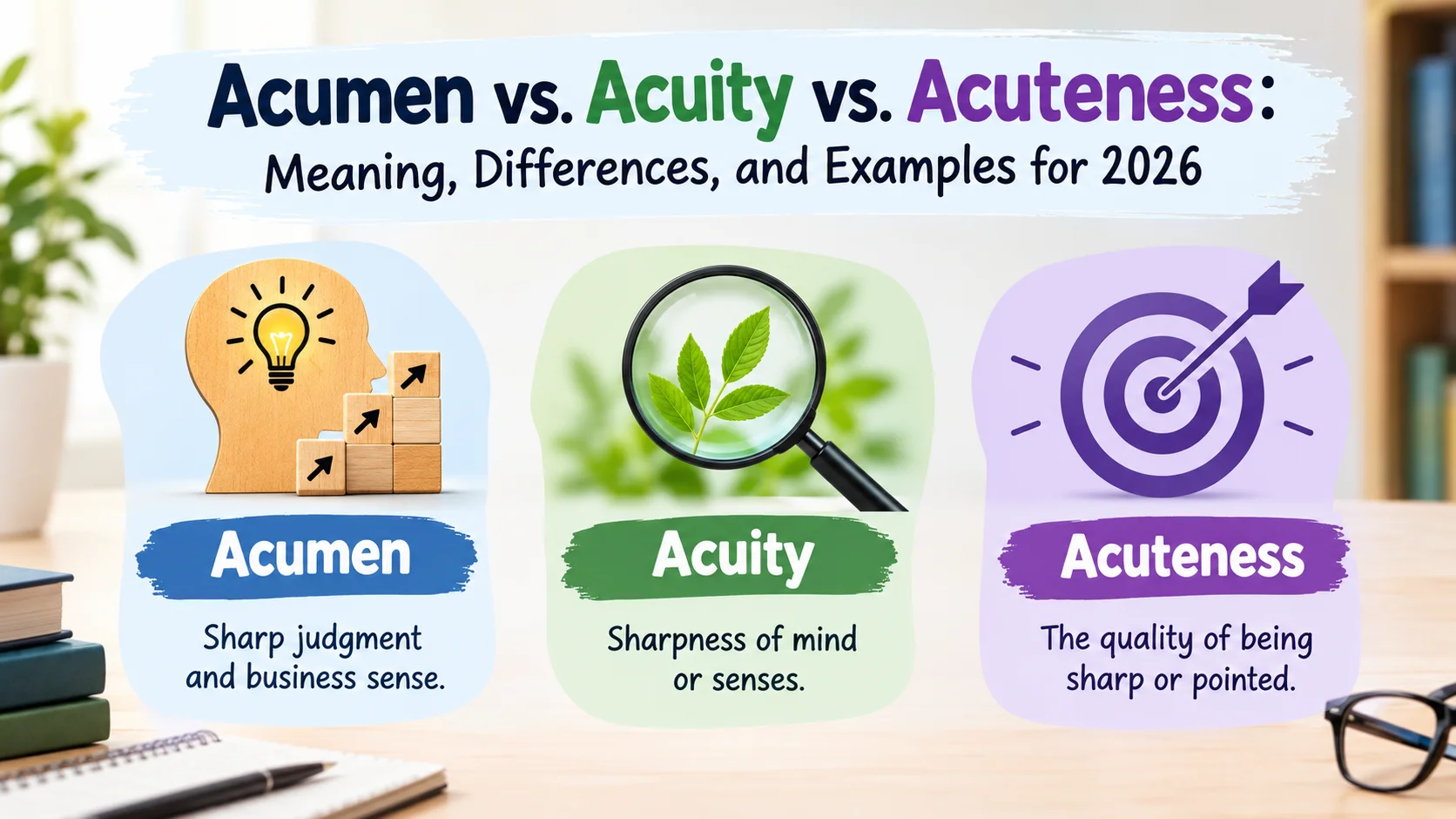
Acumen refers to the ability to understand situations and make sound judgments. Acuity describes sharpness or precision in perception, including vision and mental awareness. Acuteness refers to the quality or degree of being sharp, keen, intense, or severe.
Here is the simplest way to remember the difference:
- Acumen: Good judgment and practical insight.
- Acuity: Sharp perception or the ability to notice and understand things clearly.
- Acuteness: The quality of being sharp, keen, sensitive, or intense.
Consider these examples:
- Her business acumen helped the company avoid a costly investment. This describes sound commercial judgment.
- The doctor tested his visual acuity. This refers to the clarity of his vision.
- The acuteness of her pain made it difficult to walk. This describes the pain’s intensity.
The three words can overlap when describing mental sharpness. However, their usual meanings and common expressions make them easier to distinguish.
Comparison Overview
The easiest way to understand acumen vs. acuity vs. acuteness is to compare what each word emphasizes. One focuses on judgment, another on perception, and the third describes sharpness or intensity.
| Feature | Acumen | Acuity | Acuteness |
| Main meaning | Ability to make sound judgments | Ability to perceive clearly and accurately | Quality or degree of being sharp, keen, or intense |
| Primary focus | Practical insight and discernment | Precision of perception | Sharpness, sensitivity, or severity |
| Common context | Business, finance, leadership, politics | Vision, hearing, mental awareness | Intellect, perception, pain, serious problems |
| Common expression | Business acumen | Visual acuity | Acuteness of pain |
| Example | His financial acumen impressed the investors. | Her visual acuity remained excellent. | The acuteness of the pain concerned the doctor. |
| Typical emphasis | Making good decisions | Noticing or understanding accurately | Describing how keen or intense something is |
These distinctions reflect standard dictionary usage. Cambridge defines acumen in terms of making correct judgments, acuity as the ability to perceive or think clearly, and acuteness as sharpness or severity.
One useful detail stands out: acuity and acuteness overlap more directly than acumen and acuteness. Both can describe mental sharpness, but acuteness also appears naturally in expressions about pain and serious problems.
What Does Acumen Mean?
Acumen is the ability to understand situations, recognize important details, and make sound judgments. It often describes someone who can assess complicated circumstances and identify a sensible course of action.
The word commonly appears in professional settings. For example, a business owner might demonstrate acumen by recognizing a promising opportunity, evaluating financial risks, and deciding when to invest.
However, acumen isn’t limited to business. People can show political, financial, strategic, social, or legal acumen. The particular field changes, but the central idea remains the same: good judgment supported by insight and understanding.
Definition of Acumen
Acumen is a noun that describes a person’s ability to make accurate judgments in a particular area. It often suggests more than basic knowledge because it involves applying what you know to real situations.
Consider someone who understands financial reports. That person has financial knowledge. If they can also interpret the numbers, identify hidden risks, and make sound investment decisions, they demonstrate financial acumen.
The difference is subtle but important. Knowledge helps you understand information, while acumen helps you use that information wisely.
Acumen is also generally a formal word. You’ll encounter it in business articles, professional profiles, academic writing, and discussions about leadership.
Examples of Acumen in Sentences
Here are several examples showing how to use acumen naturally.
- Business: Her business acumen helped the company expand without taking unnecessary risks.
- Finance: His financial acumen allowed him to identify weaknesses in the investment proposal.
- Politics: The candidate demonstrated political acumen during the difficult negotiations.
- Leadership: Effective leaders need strategic acumen as well as strong communication skills.
- Negotiation: Maria’s negotiating acumen helped both parties reach a fair agreement.
- Everyday life: His social acumen helped him recognize when his friend needed support.
Each sentence describes the ability to understand a situation and respond intelligently. The word doesn’t simply mean that someone is clever; it highlights their judgment within a particular context.
Common Phrases With Acumen
Some expressions appear more naturally than others. These are among the most useful combinations.
| Phrase | Meaning | Example |
| Business acumen | Understanding business decisions and opportunities | Her business acumen helped the startup grow. |
| Financial acumen | Skill in understanding financial matters | Financial acumen is useful when evaluating investments. |
| Political acumen | Ability to understand political situations | His political acumen helped him build support. |
| Strategic acumen | Insight into long-term plans and decisions | The team relied on her strategic acumen. |
| Commercial acumen | Understanding markets, customers, and commercial risks | Commercial acumen helped the retailer adapt to changing demand. |
| Legal acumen | Skill in understanding legal issues and making sound legal judgments | The case required considerable legal acumen. |
Notice that acumen usually refers to a capability rather than a single action. Someone may demonstrate acumen through one decision, but the word often describes a broader ability.
When Should You Use Acumen?
Use acumen when you want to emphasize someone’s ability to make good judgments. It works especially well when a situation requires insight, experience, or an understanding of complex factors.
For example:
- The manager showed business acumen by reducing costs without sacrificing product quality.
- Her political acumen helped her anticipate objections before the meeting.
- He used his financial acumen to compare the risks of several investment options.
In each sentence, the person does more than notice something. They understand its significance and use that understanding to make a decision.
Avoid using acumen when you simply mean sharp eyesight or intense pain. Those meanings generally call for different words.
What Does Acuity Mean?
Acuity describes the ability to perceive, hear, or think clearly and accurately. It emphasizes sharpness and precision rather than practical judgment alone.
The word appears frequently in medical discussions about vision. Visual acuity, for example, refers to the clarity or sharpness of a person’s vision. However, acuity also applies to hearing, mental awareness, and the ability to recognize subtle details.
definition in the Cambridge English Dictionary
Imagine two people looking at a detailed map. One can distinguish tiny street names and small landmarks more clearly than the other. You could describe the first person’s visual acuity as particularly good.
Now imagine a manager who quickly notices a subtle change in customer behavior. The phrase mental acuity may describe the manager’s sharp awareness.
Definition of Acuity
Acuity is a noun that refers to the ability to perceive or think clearly and accurately. It often describes how effectively someone detects details, processes information, or distinguishes between similar things.
Its meaning depends on context. In healthcare, acuity can describe the severity or urgency of a patient’s condition, as in high-acuity care. In discussions about perception, it often means sharpness or precision.
These uses share a focus on how clearly something can be perceived or assessed. However, the medical meaning involving urgency differs from the ordinary sense of mental or sensory sharpness.
Examples of Acuity in Sentences
The following examples show the different ways writers use acuity.
- Vision: The eye examination measured her visual acuity.
- Hearing: The specialist evaluated his auditory acuity.
- Thinking: Regular mental challenges can help people practice skills that require mental acuity.
- Observation: Her acuity allowed her to notice a small inconsistency in the report.
- Politics: The journalist admired the analyst’s political acuity.
- Healthcare: The emergency department assessed patients according to the urgency and acuity of their conditions.
The final example illustrates an important distinction. In healthcare, acuity may refer to how seriously ill a patient is or how urgently the patient needs care. It doesn’t always mean that the patient has particularly sharp perception.
Common Phrases With Acuity
| Phrase | Meaning | Example |
| Visual acuity | Clarity or sharpness of vision | The optometrist checked his visual acuity. |
| Auditory acuity | Sharpness of hearing | The assessment focused on auditory acuity. |
| Mental acuity | Sharpness and clarity of thought | The puzzle challenged her mental acuity. |
| Sensory acuity | Ability to detect sensory details | The exercise tested sensory acuity. |
| Political acuity | Ability to understand political situations and subtleties | Her political acuity impressed the observers. |
| Clinical acuity | Degree of illness severity or care needs in a clinical setting | Nurses monitored patients with different levels of clinical acuity. |
Some expressions, such as political acuity and mental acuity, overlap with acumen. The distinction lies in emphasis. Acuity highlights clear perception or understanding, while acumen more strongly highlights sound judgment.
When Should You Use Acuity?
Choose acuity when sharp perception, accuracy, or clarity is central to your meaning.
For example, visual acuity is the established expression for the sharpness of vision. Replacing it with visual acumen would sound unnatural because acumen generally concerns judgment rather than eyesight.
You might also use mental acuity to describe someone’s ability to think clearly and recognize details. However, if the sentence specifically praises a person’s skill in making difficult decisions, acumen may be more precise.
The right choice depends on the quality you want to emphasize: perceiving clearly or judging wisely.
What Does Acuteness Mean?
Acuteness is the quality or degree of being acute, meaning sharp, keen, intense, or severe. It can describe a person’s intellect, the sensitivity of their perception, the intensity of pain, or the seriousness of a problem.
Unlike acumen, which usually emphasizes judgment, acuteness has a broader descriptive range. Unlike acuity, which often emphasizes perceptual precision, acuteness can describe both sharpness and intensity.
Definition of Acuteness
Acuteness is an abstract noun formed from the adjective acute and the suffix -ness. It describes the quality or state of being acute.
The adjective acute has several related meanings. It can mean sharp or perceptive, intense or severe, and urgent in certain medical contexts. Acuteness carries some of those meanings into noun form.
Consider these examples:
- The acuteness of her intellect impressed the research team.
- The doctor asked about the acuteness of the pain.
- The acuteness of the housing shortage demanded immediate attention.
The first sentence concerns mental sharpness. The second describes intensity. The third highlights the seriousness of a problem.
This flexibility makes acuteness useful when you want to describe the degree or quality of something rather than someone’s general ability to make decisions.
Examples of Acuteness in Sentences
Here are examples from several contexts.
- Intellect: The acuteness of his reasoning helped him identify a flaw in the argument.
- Understanding: Her acuteness of understanding became clear during the discussion.
- Perception: The detective’s acuteness of perception helped uncover a small inconsistency.
- Pain: The patient described the acuteness of the pain after the injury.
- Crisis: The acuteness of the crisis forced the organization to act quickly.
- Problem-solving: The acuteness of her analysis revealed weaknesses in the proposed plan.
These examples demonstrate why context matters. In the first three sentences, acuteness describes mental or perceptual sharpness. In the next two, it emphasizes intensity or severity.
Common Phrases With Acuteness
| Phrase | Meaning | Example |
| Acuteness of mind | Sharpness of thought | The debate revealed the acuteness of her mind. |
| Acuteness of perception | Ability to notice subtle details | His acuteness of perception helped him spot the error. |
| Acuteness of understanding | Depth and sharpness of comprehension | The essay demonstrated the acuteness of her understanding. |
| Acuteness of pain | Intensity or severity of pain | The nurse asked about the acuteness of the pain. |
| Acuteness of a crisis | Seriousness or urgency of a crisis | The report emphasized the acuteness of the crisis. |
Some phrases sound more formal than everyday alternatives. For example, how severe the pain was may sound more natural in casual conversation than the acuteness of the pain. Both can communicate the intended idea, but the first is simpler.
When Should You Use Acuteness?
Use acuteness when you want to describe how sharp, keen, intense, or severe something is.
It works well in formal writing, literary descriptions, analytical discussions, and medical contexts. However, the word may sound unnecessarily elaborate in ordinary conversation.
Compare these sentences:
- The acuteness of her observation impressed the team.
- Her observation was remarkably sharp.
Both express a similar idea, but the second is more direct. The first may suit a formal discussion or a style that emphasizes abstract qualities.
For pain and serious problems, acuteness can be especially useful when you want to emphasize intensity or urgency. It doesn’t automatically indicate a particular diagnosis or explain the cause of a symptom.
Read More: On a Call or In a Call: Which Phrase Is Correct? Just for You
Main Differences Between Acumen vs. Acuity vs. Acuteness
Although these three words share a connection to sharpness, they emphasize different qualities. Understanding those differences will help you choose the most accurate word for your sentence.
Difference in Meaning
The central difference is what each word describes.
Acumen focuses on judgment. It describes the ability to assess a situation, recognize opportunities, and make sensible decisions.
Acuity focuses on perception. It describes the ability to see, hear, or think clearly and recognize details accurately.
Acuteness focuses on a quality or degree. It describes how sharp, keen, sensitive, intense, or severe something is.
Consider a manager reviewing a company’s declining sales. The manager uses acuity to notice an unusual pattern in customer behavior. They use acumen to decide how the company should respond. The acuteness of their analysis describes how sharp and perceptive that analysis is.
The three qualities can work together, but they aren’t identical.
Difference in Usage and Context
The words also differ in their common settings.
| Context | Most suitable word | Example |
| Business decisions | Acumen | Her business acumen helped the company enter a new market. |
| Investment judgment | Acumen | His financial acumen helped him assess the risks. |
| Clear eyesight | Acuity | The test measured his visual acuity. |
| Sharp thinking | Acuity | The discussion tested her mental acuity. |
| Keen understanding | Acuteness | The acuteness of his understanding impressed the panel. |
| Pain intensity | Acuteness | The patient explained the acuteness of the pain. |
| Seriousness of a crisis | Acuteness | The acuteness of the crisis required immediate attention. |
These are common patterns, not rigid rules. For example, acumen and acuity can both describe political insight. The difference depends on whether you want to emphasize judgment or sharp perception.
Difference in Connotation
A word’s connotation is the extra meaning or feeling it carries beyond its basic definition.
Acumen often suggests practical intelligence. It can imply that someone understands a particular field well enough to make effective decisions.
Acuity suggests sharpness and precision. It often draws attention to someone’s ability to perceive details or think clearly.
Acuteness emphasizes the quality or degree of a characteristic. Depending on the context, it can suggest impressive intellectual sharpness or something unpleasantly intense.
Compare these examples:
- Her business acumen helped the company survive a difficult year.
- Her mental acuity helped her recognize the problem.
- The acuteness of her analysis exposed several hidden weaknesses.
The first sentence emphasizes practical judgment. The second highlights mental sharpness. The third describes the precision and depth of an analysis.
Can Acumen, Acuity, and Acuteness Be Used Interchangeably?
Sometimes, yes. However, the words aren’t interchangeable in every situation.
Both acumen and acuity can describe mental ability. Likewise, acuity and acuteness can describe sharp perception or intellect.
Consider the following examples:
- Natural: The surgeon demonstrated exceptional visual acuity.
- Awkward: The surgeon demonstrated exceptional visual acumen.
The second sentence doesn’t communicate the intended meaning as naturally. Visual acuity is the established expression for clarity of vision.
Now compare these examples:
- Her political acumen helped her negotiate a difficult agreement.
- Her political acuity helped her recognize subtle shifts in public opinion.
Both sentences work. The first emphasizes judgment during negotiations, while the second highlights her ability to detect changes.
Finally, consider acuteness of pain. This expression emphasizes intensity or severity. Replacing acuteness with acumen would change the meaning completely.
The safest approach is to consider the quality you’re describing before choosing a synonym.
Acumen vs. Acuity
The comparison between acumen and acuity is especially important because both words can describe intelligence, insight, and mental sharpness.
The key difference is judgment versus clear perception.
Key Difference Between Acumen and Acuity
Acumen describes the ability to make sound judgments in a particular area. Acuity describes the ability to perceive or think clearly and accurately.
Imagine a financial analyst examining a company’s annual report. The analyst notices a small but important change in operating costs. That observation demonstrates mental acuity.
The analyst then realizes the company faces a serious cash-flow risk and recommends a sensible response. That decision demonstrates financial acumen.
In simple terms, acuity helps someone recognize important details, while acumen helps them make good judgments using those details.
Acumen vs. Acuity Examples
Example one: Business
- Her business acumen helped her negotiate a profitable contract.
- Her mental acuity helped her spot a discrepancy in the contract.
The first sentence emphasizes business judgment. The second focuses on recognizing a detail.
Example two: Politics
- His political acumen helped him build support for the proposal.
- His political acuity helped him detect a shift in public opinion.
The first describes strategic judgment. The second emphasizes his ability to recognize subtle changes.
Example three: Finance
- The investor’s financial acumen helped her choose a suitable investment.
- The investor’s mental acuity helped her identify an error in the financial report.
Both qualities can support good decisions, but they describe different parts of the process.
Acuity vs. Acuteness
Acuity and acuteness share a closer relationship because both can describe sharpness, perception, and mental ability.
However, acuity usually emphasizes the ability to perceive clearly, while acuteness emphasizes a quality or degree of sharpness or intensity.
Key Difference Between Acuity and Acuteness
Acuity commonly describes a person’s ability to see, hear, or think accurately. It also appears in clinical settings to describe the seriousness of a patient’s condition.
Acuteness often describes the sharpness of an intellectual quality or the intensity of an experience. It can refer to perception, understanding, pain, or a serious problem.
For example, mental acuity emphasizes the ability to think clearly. Meanwhile, acuteness of understanding emphasizes how keenly someone understands a subject.
The difference can be subtle. In some contexts, both expressions communicate almost the same idea.
Acuity vs. Acuteness Examples
Consider these paired examples:
| Acuity | Acuteness |
| The examination measured her visual acuity. | The acuteness of his pain concerned the medical team. |
| His mental acuity helped him follow the complex discussion. | The acuteness of her understanding impressed the audience. |
| Her sensory acuity helped her detect small changes. | The acuteness of his perception helped him notice the inconsistency. |
The first pair illustrates an important distinction. Visual acuity is a standard term, while acuteness of pain emphasizes intensity.
The other pairs show that the words can overlap when describing mental sharpness. The choice often depends on which expression sounds more natural in the particular sentence.
Acumen vs. Acuteness
Acumen and acuteness both relate to sharpness of mind, but they emphasize different aspects of intellectual ability.
Acumen focuses on sound judgment, while acuteness describes the quality of being keen or perceptive.
Key Difference Between Acumen and Acuteness
Someone with strong acumen can understand a situation and make a sensible decision. Someone who demonstrates acuteness may notice subtle distinctions or understand complicated ideas with remarkable sharpness.
For instance, a business owner might show commercial acumen by recognizing that a new product won’t generate enough profit. An analyst might demonstrate acuteness by identifying a subtle flaw in the assumptions behind the product’s financial forecast.
Both abilities are valuable, but they aren’t the same.
Acumen vs. Acuteness Examples
Business decisions
- Her commercial acumen helped her avoid a risky expansion.
- The acuteness of her analysis revealed weaknesses in the expansion plan.
Intellectual ability
- His scientific acumen helped him make sound research decisions.
- The acuteness of his intellect helped him understand a difficult theory.
Understanding people
- Her social acumen helped her handle the disagreement diplomatically.
- The acuteness of her perception helped her recognize the tension in the room.
These examples demonstrate how the words complement each other. Acumen describes an ability to judge well, while acuteness describes the sharpness of a quality or perception.
Common Mistakes When Using Acumen, Acuity, and Acuteness
Even experienced writers sometimes confuse these words. Their meanings overlap enough to create uncertainty, especially when describing intelligence.
Here are the most common mistakes to avoid.
Using Acumen to Describe Eyesight
Acumen usually refers to judgment and insight rather than physical vision.
- Incorrect for the intended meaning: The optometrist tested her visual acumen.
- Correct: The optometrist tested her visual acuity.
Use visual acuity when discussing the sharpness or clarity of someone’s vision.
Assuming Acuity Only Applies to Vision
Although visual acuity is a familiar expression, acuity also describes hearing and mental sharpness.
For example, mental acuity refers to the ability to think clearly and accurately. Similarly, political acuity can describe someone’s ability to recognize subtle political developments.
Don’t limit the word to eyesight alone.
Treating Acuteness as an Exact Synonym for Intelligence
Acuteness can describe intellectual sharpness, but it has other meanings too.
For example, the acuteness of the pain refers to the pain’s intensity, not someone’s intelligence. Likewise, the acuteness of the crisis emphasizes its seriousness.
Always consider the surrounding words before deciding what acuteness means.
Confusing Judgment With Perception
Recognizing a problem and deciding how to solve it are related but different abilities.
- Acuity helped her recognize the error.
- Acumen helped her decide how to correct it.
This distinction is useful in business writing, academic discussions, and everyday communication.
Choosing a Word Only Because It Sounds Sophisticated
Longer or less common words don’t automatically improve your writing. Sometimes, a simple alternative communicates the idea more clearly.
For example, her judgment was excellent may be more natural than her acumen was exceptional in a casual conversation.
Choose the word that expresses your intended meaning rather than the one that sounds most impressive.
How to Choose the Right Word
When you’re unsure whether to use acumen, acuity, or acuteness, ask yourself one question: What exactly am I trying to describe?
Use the following guide to make the decision easier.
Choose acumen for judgment and insight.
Use it when someone understands a situation and makes a sound decision.
Example: Her financial acumen helped her manage the company’s budget.
Choose acuity for sharp perception.
Use it when someone sees, hears, or thinks clearly and accurately.
Example: The test measured his visual acuity.
Choose acuteness for sharpness or intensity.
Use it when describing how keen, sensitive, severe, or intense something is.
Example: The acuteness of the pain required immediate assessment.
Here’s another way to check your choice. Replace the word with a simple phrase and see whether the sentence keeps its meaning.
- If you mean good judgment, choose acumen.
- If you mean clear perception, choose acuity.
- If you mean the quality or degree of being sharp or intense, choose acuteness.
Remember that context still matters. These are practical guidelines rather than strict rules that cover every possible use.
FAQs:
What Is the Main Difference Between Acumen and Acuity?
Acumen refers to the ability to make sound judgments, while acuity refers to the ability to perceive or think clearly and accurately. Business acumen helps someone make good commercial decisions, whereas visual acuity describes the clarity of vision.
Are Acumen and Acuity Synonyms?
They can overlap when describing mental sharpness or insight. However, acumen generally emphasizes judgment and decision-making, while acuity emphasizes clear perception and precision.
For example, financial acumen describes sound financial judgment. Mental acuity describes sharp thinking.
What Is the Difference Between Acuity and Acuteness?
Acuity usually describes the ability to perceive or think clearly. Acuteness describes the quality or degree of being sharp, keen, or intense.
Is Acuteness a Synonym for Acumen?
Sometimes, particularly when discussing intellectual sharpness or keen understanding. However, the words aren’t interchangeable in every context.
What Does Business Acumen Mean?
Business acumen is the ability to understand business situations and make sound commercial decisions. It includes recognizing opportunities, assessing risks, understanding customers, and considering how decisions affect business performance.
What Does Visual Acuity Mean?
Visual acuity refers to the clarity or sharpness of vision. Eye care professionals assess it to determine how clearly someone can distinguish visual details.
Which Word Describes the Severity of Pain?
Acuteness can describe the intensity or severity of pain. For example, the acuteness of the pain surprised the patient emphasizes how intense the pain felt.
Conclusion:
Understanding acumen vs. acuity vs. acuteness becomes much easier when you focus on what each word describes. Acumen refers to sound judgment, practical insight, and the ability to make good decisions. Acuity describes sharp perception or the ability to see, hear, or think clearly. Acuteness refers to the quality or degree of being sharp, keen, intense, or severe.
Although the words sometimes overlap, their common expressions offer useful clues. Business acumen concerns judgment, visual acuity concerns eyesight, and the acuteness of pain concerns intensity. The next time you’re choosing between these words, think about the meaning you want to convey. That small check will help you write more clearly, naturally, and accurately.




1 thought on “Acumen vs. Acuity vs. Acuteness: Meaning, Differences, and Examples for 2026”