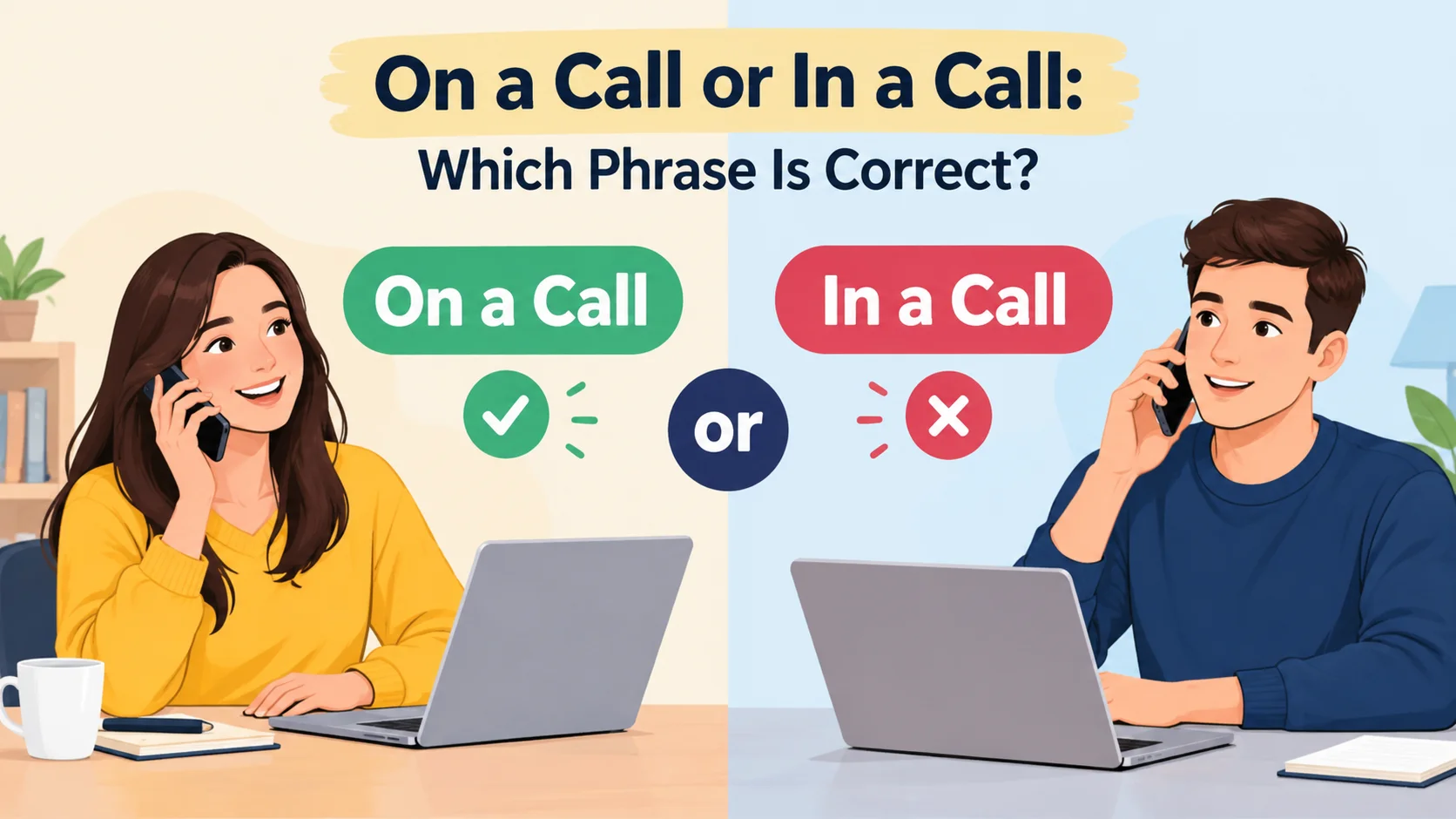

When typing a message or telling a friend about your availability, you may wonder which preposition sounds right. This common confusion affects English learners and native speakers alike. Although the choice may appear minor, prepositions help convey the exact meaning of a situation. They explain when, where, and how something happens. Think of English prepositions as a small puzzle in the language. The right choice can clarify your message and improve communication. Understanding On a Call or In a Call helps you clear up confusion once and for all. You can then speak confidently when telling friends or coworkers that you’re not available, without second-guessing yourself.
In daily conversations, casual conversations, and professional communication, correct usage depends on what you want to express. When you’re engaged in a phone conversation, participating in a call, or actively speaking, on a call is the common way to describe your involvement. The phrase I’m on a call sounds natural and is widely used in standard English. For example, you might use it while attending a Zoom call, joining a Microsoft Teams meeting, or speaking with a client during a work meeting, online meeting, conference call, or business call. It explains why you’re currently talking to another person and can’t talk to someone else. On the other hand, I’m in a call appears less often in general conversation, although it may fit specific situations in certain workplace or software contexts. Both expressions can be grammatically correct, but they don’t always sound equally natural.
So, which phrase is correct? The short answer is that on a call usually works best in modern spoken English, business English, and everyday communication. The different meanings of on and in explain this grammar difference. English speakers use on with common forms of communication, including on the phone, on a call, and on a video call. Meanwhile, in often describes being inside a situation, activity, place, or event. That’s why in a meeting sounds perfectly natural. Understanding this small distinction helps you communicate clearly and sound more fluent. This guide helps you discover the meaning, usage, and differences through real-life examples, clear examples, and common examples. Use these practical tips to avoid common mistakes, recognize common grammar mistakes, and choose the right phrase every time. For natural communication, focus on how people use each expression rather than relying on direct rules alone. Keep your writing easy to read, use active voice, and integrate primary keywords, secondary keywords, and long-tail keywords naturally into SEO-optimized, human-written content.
Let’s dive in!
Quick Answer
Both “on a call” and “in a call” can be correct, but “on a call” is generally more natural in everyday American English.
- On a call: Use this expression when someone is speaking on the phone or participating in a call. Example: “I’m on a call with my manager.”
- In a call: Use this expression when the context emphasizes participation in a particular call or an ongoing call session. Example: “I’m in a call with the support team.”
- On the call: Use this phrase when referring to a specific call, especially a scheduled conference call. Example: “Three managers are on the call.”
- In the call: Use this expression when referring to participation within a particular call, although “on the call” often sounds more natural in ordinary conversation.
If you’re unsure which expression to choose, “I’m on a call” is a reliable option for everyday conversations and professional communication.
Comparison Overview
The following table highlights the main differences between “on a call” and “in a call.”
| Feature | On a Call | In a Call |
| Main emphasis | Being engaged in a call | Being involved in a particular call or session |
| Everyday American English | Very common | Less common in general conversation |
| Phone conversations | Natural and widely used | Possible, depending on context |
| Online meetings | Common and natural | Possible in specific contexts |
| Workplace communication | Common for explaining unavailability | Sometimes used to describe participation |
| Example | I’m on a call with Sarah. | I’m in a call with the technical team. |
| Referring to a specific conference call | I’m on the call. | I’m in the call. |
| General recommendation | Best default for everyday use | Choose when the context supports it |
The important distinction is that English doesn’t use prepositions randomly. Expressions such as “on a call” become established through common usage, while “in a call” can emphasize a different relationship with the activity.
However, neither expression should be judged by grammar alone. The surrounding sentence and the situation also influence which one sounds most natural.
Main Differences Between “On a Call” or “In a Call”
The main difference between “on a call” and “in a call” lies in how speakers describe their involvement in a conversation. The first is an established everyday expression, while the second can emphasize participation in a particular call session.
Consider these examples:
- On a call: “Sorry, I can’t talk right now. I’m on a call.”
- In a call: “I’m in a call with the support team, so I’ll message you afterward.”
Both sentences communicate that someone is occupied with a call. However, the first sounds more conventional in everyday American English.
Meaning and Emphasis
The phrase “on a call” commonly describes the activity someone is doing. It tells the listener that the person is engaged in a phone conversation or participating in a call.
By comparison, “in a call” can frame the call as an ongoing event in which someone is participating. This distinction becomes more noticeable when the speaker refers to a specific meeting or session.
For example:
- “She’s on a call with her client.” This emphasizes her current activity.
- “She’s in the call with her client.” This emphasizes her participation in that particular call.
The meanings overlap, so you shouldn’t treat this distinction as an absolute grammatical rule. In many situations, context matters more than the preposition itself.
Which Phrase Sounds More Natural?
In ordinary American English, “on a call” is usually the more natural choice when you want to explain that you’re busy talking to someone.
For example, imagine your coworker asks why you haven’t answered their message. You might respond:
“I’m on a call right now. I’ll get back to you in a few minutes.”
This sounds natural because you’re explaining your current activity and why you can’t respond immediately.
Now imagine discussing a scheduled online meeting. You might say:
“Everyone is on the call except Daniel.”
Here, “on the call” refers to a particular meeting with known participants.
Although “in a call” can work in some settings, it isn’t automatically the better option whenever you discuss a specific session. In many cases, “on the call” remains the more idiomatic expression.
What Does “On a Call” Mean?
“On a call” means participating in a phone conversation or another type of call. People commonly use this phrase when explaining their availability, describing their current activity, or discussing professional communication.
The expression works for personal phone conversations, business calls, conference calls, and many virtual meetings.
For example:
- I’m on a call with my brother.
- She is on a call with her supervisor.
- The customer service representative is on a call.
- He can’t join us because he’s on a call.
- I’ll contact you when I’m off the call.
Notice that speakers use “on a call” even when the conversation happens through a computer rather than a traditional telephone.
That’s because modern English uses call for several forms of real-time communication, including internet-based voice and video conversations.
When to Use “On a Call”
You can use “on a call” in several common situations.
When you’re talking on the phone
This is one of the most familiar uses of the phrase.
- I’m on a call with my parents.
- She’s on a call with the bank.
- He was on a call when I arrived.
When you’re participating in a business conversation
The phrase works naturally when discussing clients, colleagues, customers, or supervisors.
- Our manager is on a call with the client.
- I’ll be on a call until 3 p.m.
- She’s on a call discussing the new project.
When explaining why you’re unavailable
If someone contacts you while you’re busy, this expression offers a simple explanation.
- I’m on a call right now. Can I call you back?
- Sorry, I missed your message because I was on a call.
- He’s on a call, so please leave him a message.
When discussing online meetings
You can also use the phrase for voice or video meetings on platforms such as Zoom and Microsoft Teams.
- I’m on a Zoom call with my team.
- We’re on a call with the marketing department.
- She’ll join the discussion after her current call ends.
In all these examples, “on a call” communicates the situation without making the sentence sound unnecessarily formal.
What Does “In a Call” Mean?
“In a call” describes someone participating in or being occupied with a call. The expression is understandable and can be grammatically correct, but its naturalness depends on the sentence and the communication setting.
For example:
- I’m in a call with the technical support team.
- She was in a call when I tried to reach her.
- He’s currently in a call with the project manager.
These sentences communicate that the people are participating in ongoing conversations. However, many American English speakers would naturally choose “on a call” in the first two situations.
The phrase “in a call” may appear more often in particular workplace environments, software interfaces, or contexts where people describe participation in a specific session. Local team habits can also influence the wording.
When to Use “In a Call”
Use this expression when it fits the context and sounds natural to your intended audience.
When discussing participation in a particular session
For example:
- She’s in a call with the engineering team.
- Two new employees are in a call with their trainer.
These sentences are understandable, although “on a call” or “on the call” may sound more idiomatic in many situations.
When describing an ongoing communication session
You might encounter “in a call” in workplace messages or technical discussions.
For example:
- The application shows that the user is in a call.
- I was in a call when the connection dropped.
In technical settings, the wording may reflect a system’s terminology rather than the most common conversational expression.
When your workplace uses this expression consistently
Some teams develop their own communication habits. If colleagues regularly say “in a call,” the expression may be familiar within that environment.
Still, if you’re writing for a broad American audience, “on a call” is generally the safer choice.
“On the Call” vs. “In the Call”: Does the Article Change the Meaning?
Adding “the” changes how a listener understands the noun call. The indefinite article “a” introduces a call, while “the” usually refers to a particular call that the speaker and listener can identify.
Compare these sentences:
- I’m on a call.
- I’m on the call.
- I’m in a call.
- I’m in the call.
Although the sentences look similar, they don’t always communicate exactly the same thing.
“On a Call” vs. “On the Call”
“On a call” refers to a call without identifying it as a particular, already-known conversation.
Example:
“I’m on a call with a supplier.”
The listener learns that you’re talking with a supplier. The sentence doesn’t necessarily refer to a previously discussed meeting.
“On the call” usually refers to a specific call.
Example:
“I’m on the call we scheduled for 10 a.m.”
The speaker identifies a particular meeting that both people can recognize.
More examples include:
- There are five people on the call.
- I’ll explain the issue when we’re on the call.
- Sarah was on the call with the regional manager.
The article helps establish whether you’re discussing a call generally or referring to an identifiable one.
“In a Call” vs. “In the Call”
“In a call” refers to participation in a call without necessarily identifying one specific session.
Example:
“I’m in a call with a customer.”
“In the call” points toward a particular call.
Example:
“I’m in the call that the IT department organized.”
Both sentences are understandable. However, when referring to conference calls, many speakers prefer “on the call” to “in the call.”
For example, these alternatives often sound more natural:
- Less conventional in many contexts: “Everyone is in the call.”
- More conventional: “Everyone is on the call.”
The key takeaway is simple: use “the” when referring to a specific call, but don’t assume that “in” becomes the best preposition simply because the call is specific.
Read More: Timber or Timbre: Differences, Pronunciation, and Examples
“On a Call” vs. “In a Call” in Phone Conversations
When discussing an ordinary phone conversation, “on a call” is generally the preferred expression.
Imagine calling a friend who can’t answer because they’re already speaking with someone. They might text you:
“I’m on a call. I’ll ring you back shortly.”
This sounds natural and communicates the situation immediately.
You could also say, “I’m in a call,” and people would probably understand your meaning. However, it may sound less familiar to many American English speakers.
Consider these everyday examples:
| Situation | Natural example |
| Talking to a friend | I’m on a call with Jake. |
| Speaking to a bank | She’s on a call with the bank. |
| Missing someone’s call | Sorry, I was on a call. |
| Explaining a delay | He’s on a call right now. |
| Returning a call later | I’ll call you when I’m off the phone. |
Notice that “on the phone” is another natural alternative when you want to emphasize the phone conversation itself.
For example, “She’s on the phone with her doctor” sounds perfectly natural. You don’t need to force “in a call” into every situation involving a phone.
“On a Call” vs. “In a Call” in Online Meetings
Online meetings introduce more situations where these expressions can overlap. People now use the word call for voice chats, video conferences, interviews, and virtual team discussions.
However, “on a call” remains a common expression for participating in these activities.
For example:
- I’m on a Zoom call with my team.
- She’s on a Microsoft Teams call.
- We’re on a video call with the client.
- He’s on a conference call with the regional office.
“In a call” may also appear in workplace conversation or technical interfaces.
For example:
- The application indicates that I’m in a call.
- She’s in a call with the development team.
The second set of examples is understandable, but many speakers would choose “on a call” in ordinary conversation.
What About Zoom and Microsoft Teams?
Different platforms and organizations may use different labels for call status. A software interface might describe someone as being “in a meeting,” “in a call,” or “on a call.”
These labels don’t establish a universal rule for everyday English. Software terminology often reflects a product’s design choices, while natural conversation follows broader patterns of usage.
When speaking casually, you can say:
“I’m on a call right now. I’ll join the meeting afterward.”
If the event is specifically a scheduled meeting rather than an informal call, you can also say:
“I’m in a meeting right now.”
Both are natural. Choose the expression that accurately describes the activity.
“On a Call” vs. “In a Meeting”
One reason this topic confuses English learners is that people often say “on a call” but “in a meeting.”
For example:
- I’m on a call with the client.
- I’m in a meeting with the client.
Both sentences sound natural in American English. So why do the prepositions differ?
English contains many established word combinations called collocations. These are words that speakers commonly use together. Their patterns don’t always follow one simple rule that applies everywhere.
Consider these examples:
| Natural expression | Example sentence |
| On a call | I’m on a call with my supervisor. |
| In a meeting | She’s in a meeting until noon. |
| On the phone | He’s on the phone right now. |
| In a conversation | We’re in a conversation about the new policy. |
| At a meeting | I’ll see you at the meeting. |
| On a video call | They’re on a video call with the client. |
Each expression has its own common usage pattern.
“In a meeting” emphasizes participation in a meeting as an event. “On a call” is the conventional expression for being engaged in a call.
However, the categories can overlap. A virtual meeting may involve a call, and someone can naturally describe the same event using either expression, depending on the intended emphasis.
The best approach is to learn common combinations as complete phrases instead of trying to apply one preposition to every situation.
“On a Call” vs. “On Call”: An Important Difference
Don’t confuse “on a call” with “on call.” The expressions look nearly identical, but they communicate different things.
On a call means that someone is currently participating in a call.
Example:
“I’m on a call with the customer.”
The person is already engaged in a conversation.
On call means that someone is available to respond when needed, often as part of a job or scheduled duty.
Example:
“The doctor is on call tonight.”
The doctor may need to respond to emergencies, but that doesn’t mean the doctor is currently speaking on the phone.
Here are more examples:
- “The technician is on a call.” The technician is participating in a call.
- “The technician is on call.” The technician is available for work-related requests.
- “I’m on a call with my manager.” I’m speaking with my manager.
- “I’m on call this weekend.” I may need to respond to work issues.
This distinction matters in healthcare, IT support, emergency services, and other jobs that require staff availability outside regular working hours.
A single article can change the meaning significantly. Pay attention to it when writing professional messages.
Common Mistakes to Avoid When Using “On a Call” or “In a Call”
Even advanced English speakers occasionally choose expressions that sound awkward in a particular context. These common mistakes are easy to fix.
Assuming “In a Call” Is Always Wrong
“In a call” isn’t automatically ungrammatical. The expression can work in appropriate contexts, especially when describing participation in a call session.
However, it isn’t always the most idiomatic choice.
Instead of insisting that one phrase is correct and the other is incorrect, consider the full sentence and your audience.
Using “In a Call” in Every Situation
If you want to tell someone you’re busy talking on the phone, “I’m on a call” is generally the more natural choice.
Less conventional in many everyday contexts: “I’m in a call, so I can’t talk.”
More natural: “I’m on a call, so I can’t talk.”
The second version sounds familiar and direct.
Confusing “On the Call” With “In the Call”
When referring to a particular conference call, “on the call” is often the better option.
For example:
- Less conventional in many contexts: “Everyone is in the call.”
- More natural: “Everyone is on the call.”
However, context still matters. Don’t treat the second expression as a rule that makes every use of “in the call” incorrect.
Using Unnecessarily Complicated Sentences
You don’t need formal or elaborate wording to explain that you’re busy.
Instead of saying, “I am currently engaged in an ongoing telephonic communication session,” simply write:
“I’m on a call right now.”
Clear writing usually works better than language that sounds complicated for its own sake.
Practical Examples: How to Use Each Phrase Naturally
The easiest way to understand these expressions is to see how they work in realistic situations.
Examples With “On a Call”
- “I’m on a call with my boss.” — You’re speaking with your boss.
- “She’s on a call right now.” — She’s currently participating in a call.
- “He was on a call when I arrived.” — His call was already underway.
- “We’re on a call with the client.” — Your team is participating in a client conversation.
- “I’ll message you after my call.” — You’ll contact the person when the call ends.
- “Can you wait? I’m on a call.” — You’re asking someone to wait because you’re busy.
- “The manager is on a conference call.” — The manager is participating in a conference call.
Examples With “In a Call”
- “I’m in a call with the support team.” — You’re participating in an ongoing call.
- “She was in a call when I messaged her.” — She was occupied with a call.
- “The system shows that he’s in a call.” — The system identifies his current status.
- “Two employees are in a call with the trainer.” — The employees are participating in a session.
These sentences are understandable. However, in many everyday American English situations, “on a call” would sound more conventional.
Examples With “On the Call” and “In the Call”
- “I’ll explain everything on the call.” — You’ll explain it during a specific call.
- “Everyone is on the call except Mark.” — Mark is the only expected participant who hasn’t joined.
- “I heard the announcement on the call.” — You heard it during that call.
- “She joined the call late.” — She entered the meeting after it began.
- “He’s in the call now.” — He’s participating in the particular call, although “on the call” may sound more natural to many speakers.
These examples show why the article and preposition should be considered together.
A Workplace Case Study: Choosing the Right Phrase
Imagine that Maya works remotely for a software company. Her colleague, Daniel, sends her a message asking whether she can review a document.
Maya is speaking with a customer at that moment.
She could respond:
“I’m on a call with a customer. I’ll review the document in 20 minutes.”
This message works well because it explains her current activity and gives Daniel a clear expectation.
Now imagine Maya has joined a scheduled team conference. Daniel wants to know whether she has joined the meeting.
She could write:
“I’m on the call now.”
This response confirms that she’s participating in the particular conference.
What if Maya’s communication software displays a status saying that she’s “in a call”? She can still use that wording when discussing the software’s status or following her team’s terminology.
The lesson is practical: choose language that fits both the situation and the communication setting. A phrase can be understandable without being the most natural choice for every audience.
Which Phrase Should You Use: “On a Call” or “In a Call”?
If you want a simple rule for everyday American English, use “on a call” when describing a phone conversation or your participation in a call.
Choose “in a call” when it fits your context, especially when discussing a particular call session or following established terminology within a workplace or software environment.
Here’s a quick guide:
- Talking on the phone? Say, “I’m on a call.”
- Participating in a client conversation? Say, “I’m on a call with the client.”
- Referring to a scheduled conference? Say, “I’m on the call.”
- Describing your availability for emergency work? Say, “I’m on call.”
- Talking about a regular meeting? Say, “I’m in a meeting.”
- Describing a software status? Use the wording that fits the system or context, while recognizing that “in a call” and “on a call” aren’t equally common in every setting.
When writing for a broad audience, familiar expressions are usually your best bet. There’s no need to overthink a simple message when a common phrase communicates your meaning clearly.
FAQs:
1. Is it correct to say “on a call” or “in a call”?
Both expressions can be correct, but “on a call” is more common in everyday and professional English. Use it when you’re talking on the phone or participating in an online meeting.
2. Why do people say “I’m on a call”?
People use this phrase to explain that they’re currently speaking with someone by phone or through an online communication platform. It also helps explain why they cannot answer another call or have a conversation.
3. Can I say “I’m in a call” during a meeting?
Yes, you may hear this expression in certain workplace or software contexts. However, “I’m on a call” generally sounds more natural when you’re discussing a phone conversation or an online meeting.
4. What is the difference between “on a call” and “in a meeting”?
“On a call” usually refers to participating in a phone or online conversation. “In a meeting” describes attending or participating in a meeting. Both expressions are natural, but they emphasize different activities.
5. Should I use “on a call” in business English?
Yes. “On a call” is widely used in business English, especially when communicating with coworkers, clients, or managers. For example, you can say, “I’m on a call with a client right now.”
6. Is “on a video call” grammatically correct?
Yes, “on a video call” is grammatically correct and sounds natural. You can use it when speaking with someone through Zoom, Microsoft Teams, or another video communication platform.
7. Which phrase should English learners use in daily conversations?
English learners should generally choose “on a call” because it’s widely understood and sounds natural in most situations. For example, you can say, “I’m on a call right now. Can I call you back later?”
Conclusion:
Understanding On a Call or In a Call can make your English sound clearer and more natural. Although both expressions appear in English, “on a call” is the usual choice for phone conversations, online meetings, and professional communication. Meanwhile, “in a meeting” is a natural way to describe participating in a meeting. Learning these small differences helps you avoid common grammar mistakes and communicate confidently. When you’re unsure which phrase to use, choose “on a call” for everyday conversations and most workplace situations.



1 thought on “On a Call or In a Call: Which Phrase Is Correct? Just for You”