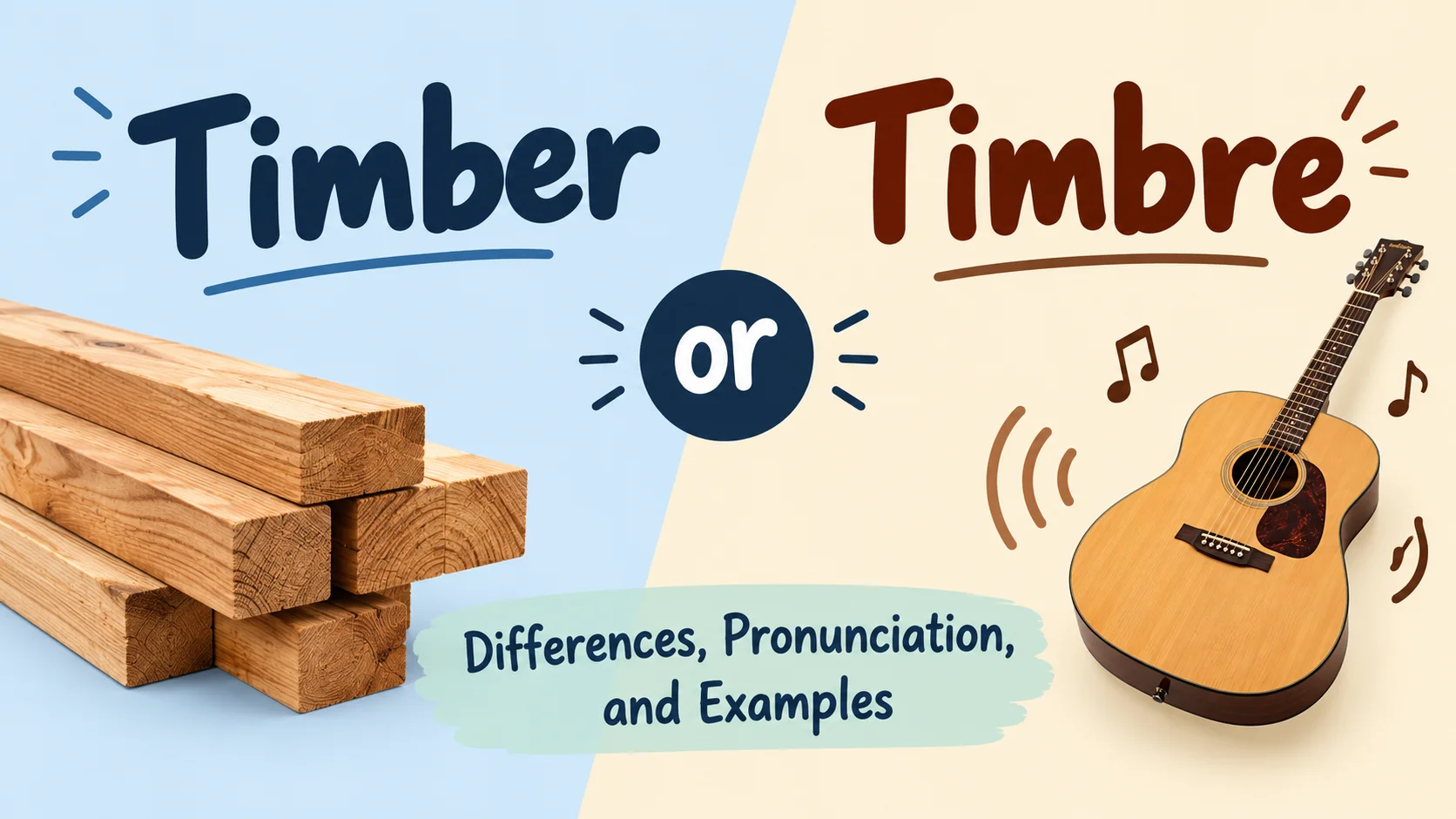

Timber or Timbre can confuse English learners because these similar-sounding words have different meanings, uses, and spellings in everyday communication. Timber refers to wood from forests and trees used for building, construction, carpentry, and other practical purposes, while timbre describes the distinctive quality of a sound, voice, or musical instrument. For example, workers use sturdy local timber to build a house, while a singer may have a rich, warm timbre. Although the words sound alike, understanding their context helps students, writers, builders, musicians, and native speakers choose the correct word and avoid spelling mistakes.
The quality of a sound, also called its musical tone or timbre, helps you recognize a voice or instrument, even when it produces the same note as another sound. A violin may create a rich, haunting tone, while a singer’s voice has its own unique character. This distinctive quality is instrumental in creating aural landscapes that give music its beauty and complexity. To improve clarity and understanding, remember this simple rule: use timber when talking about trees, wood, building materials, or physical structures, and use timbre when describing sound. These practical tips and rich examples make the difference easier to understand, even when the words feel like a tongue twister.
A helpful guide, deep-dive explanation, or comparison table can make learning English vocabulary easier. Helpful tables can show each word’s meaning, purpose, and example, while simple reminders help you remember forever which spelling fits each situation. Focus on what the sentence describes rather than how the words sound. When discussing buildings, houses, or carpentry, choose timber; when discussing the distinctive quality of music or a voice, choose timbre. Knowing their meanings, context, and correct usage helps you use both words correctly, avoid mixed-up words, and communicate with confidence.
Let’s dive in!
Quick Answer
Timber refers to wood used for building or to trees grown for their wood. Timbre refers to the distinctive quality of a sound, especially the sound produced by a voice or musical instrument.
Although their spellings differ by just one letter, their meanings have nothing directly in common.
- Timber: The builders ordered more timber to finish the wooden roof.
- Timbre: The singer’s warm timbre made her voice instantly recognizable.
Remember this simple distinction: timber is about wood, while timbre is about sound.
Comparison Overview
The table below highlights the main differences between timber and timbre.
| Feature | Timber | Timbre |
| Part of speech | Noun | Noun |
| Main meaning | Wood used for building or trees grown for wood | The distinctive quality or character of a sound |
| Common context | Construction, forestry, carpentry, and building materials | Music, singing, speech, and sound production |
| American English pronunciation | Commonly /ˈtɪmbər/ | Commonly /ˈtæmbər/; pronunciation can vary |
| Related terms | Lumber, wood, wooden beams | Tone color, sound quality, tonal character |
| Example | The carpenter measured the timber carefully. | The instrument has a bright timbre. |
| Memory clue | Think of trees and wooden structures. | Think of voices and musical instruments. |
Both words function as nouns, but they belong to different subject areas. You will usually encounter timber in discussions about wood and construction. Meanwhile, timbre appears in music, audio production, and descriptions of voices.
Pronunciation also helps distinguish them in many varieties of American English. However, because pronunciations can vary, context remains the most reliable way to identify the intended word.
Main Differences Between Timber or Timbre
The main difference between timber and timbre comes down to what each word describes. Although their spellings are similar, they serve different purposes in everyday English.
Timber describes a material or natural resource, whereas timbre describes an audible quality. You might buy timber to build a house, but you might praise the timbre of a singer’s voice.
Here are the most important distinctions to remember:
- Meaning: Timber relates to wood; timbre relates to sound.
- Context: Timber commonly appears in construction and forestry; timbre appears in music and acoustics.
- Usage: You can cut, transport, measure, or treat timber. You can describe, recognize, or compare timbre.
- Examples: A wooden roof contains timber. A violin has a distinctive timbre.
- Related vocabulary: Timber connects with lumber and beams, while timbre connects with tone color and sound quality.
Timber Refers to Wood
The word timber describes trees grown for their wood or wood intended for construction. It can also refer to large wooden pieces used to support buildings, roofs, and other structures.
For example, a construction company might order timber to build a wooden frame. A forestry business might manage a forest to produce timber for commercial use.
Consider these examples:
- The builders used timber to construct the cabin.
- Workers inspected the wooden timbers supporting the roof.
- The company harvests timber from managed forests.
- The carpenter selected strong timber for the staircase.
- The old barn contains exposed oak timbers.
In each sentence, timber refers to wood or wooden structural materials. The word doesn’t describe the sound a person or instrument produces.
One regional detail matters here. In British English, timber commonly refers to prepared wood used for building. In American English, lumber often serves that purpose, although timber remains correct in relevant contexts.
Timbre Refers to Sound Quality
The word timbre describes the distinctive character of a sound. It helps explain why two voices or musical instruments can sound different even when they produce the same musical note.
Imagine a piano and a flute playing the same note at the same pitch. You can usually identify which instrument you’re hearing because each produces a different sound quality. That difference involves timbre.
Here are several examples:
- The singer’s timbre sounded warm and rich.
- The violin has a bright, expressive timbre.
- The recording captured the natural timbre of her voice.
- The two flutes produced notes with different timbres.
- The producer adjusted the synthesizer’s timbre to create a darker sound.
Notice that these sentences focus on the character of sound rather than its source material. You could describe a wooden violin’s timbre, but the word timbre would still refer to its sound.
This distinction becomes especially useful when writing music reviews, discussing vocal performances, or describing audio recordings.
Timber vs. Timbre: Side-by-Side Examples
Comparing the words in similar sentences makes their meanings easier to remember.
| Sentence | Correct word | Why it works |
| The carpenter ordered oak ___ for the floor. | Timber | The sentence concerns construction wood. |
| The singer’s warm ___ impressed the judges. | Timbre | The sentence describes vocal sound quality. |
| The builders replaced the damaged roof ___. | Timbers | The sentence refers to wooden support beams. |
| The violin’s distinctive ___ filled the room. | Timbre | The sentence describes the violin’s sound. |
| The company exports tropical ___. | Timber | The sentence concerns wood as a natural resource. |
| The recording preserved the singer’s natural ___. | Timbre | The sentence concerns the character of a voice. |
A quick way to solve these questions is to identify the subject first. If you’re discussing wood, buildings, or forestry, timber will usually fit. If you’re discussing voices, instruments, or sound, timbre is the appropriate choice.
What Does Timber Mean?
Timber is a noun that refers to trees grown for wood, wood prepared for construction, or large pieces of wood used in structures. Its meaning changes slightly depending on whether the discussion concerns forestry or building work.
For example, a forester might discuss the amount of timber available in a managed forest. A builder might discuss the timber needed to construct a roof. Both uses are correct.
The word also appears in discussions about traditional buildings, wooden ships, furniture production, and structural engineering.
Different Uses of Timber
Timber appears in several practical contexts. Understanding these uses helps you recognize the word in different types of writing.
Forestry: Timber can refer to trees cultivated or harvested for their wood. Forestry professionals manage timber resources for commercial and other purposes.
Construction: Timber can mean wood used to construct floors, roofs, walls, and structural frames. Its suitability depends on factors such as strength, moisture, species, and intended use.
Carpentry: Carpenters work with timber to make structural components, doors, furniture, and other wooden products.
Architecture: Timber plays an important role in traditional timber-framed buildings and modern wood construction.
Shipping: The word can describe substantial wooden structural components in older wooden ships.
For example, a report might state, “The restoration team replaced the rotten timber beams.” Here, the word identifies the physical material used to support the building.
Examples of Timber in Sentences
These examples show how timber works in everyday writing.
- The contractor purchased treated timber for the deck.
- Heavy timber beams supported the old warehouse.
- The forest supplies timber to several local mills.
- Moisture can damage untreated timber over time.
- The architect designed a house with exposed timber ceilings.
- Workers stacked the timber neatly beside the workshop.
Each sentence uses timber to describe wood or wooden materials. You can also use the plural timbers when referring to separate wooden pieces or beams.
Common Phrases With Timber
Several common expressions use timber in construction and forestry.
| Phrase | Meaning | Example |
| Timber frame | A structural framework made from wood | The cabin has a traditional timber frame. |
| Timber industry | Businesses involved in producing and supplying timber | The timber industry supports many rural jobs. |
| Timber forest | A forest managed or grown for wood production | The company manages a timber forest. |
| Roof timbers | Wooden structural pieces that support a roof | The inspector examined the roof timbers. |
| Timber merchant | A business or person who supplies timber | We bought the beams from a local timber merchant. |
| Timber treatment | A process that protects wood against decay or damage | Proper timber treatment can extend its service life. |
One additional use appears in a familiar warning: “Timber!” People traditionally shout this when a felled tree is about to fall.
The expression is different from the ordinary noun, although both share the same spelling. In this situation, timber functions as an exclamation rather than naming wood in a sentence.
What Does Timbre Mean?
Timbre is the distinctive quality that allows you to recognize and distinguish sounds. People often use the word when describing musical instruments, singing voices, and other complex sounds.
Think about two people saying the same word. They might speak at approximately the same pitch and loudness, yet their voices still sound different. Their vocal timbres help create those differences.
Timbre also matters when identifying musical instruments by ear. A trumpet and a clarinet can play the same note, but their sounds usually remain distinguishable.
The term appears in music theory, acoustics, audio engineering, and vocal analysis. Although it can sound technical, the underlying idea is straightforward: timbre describes what makes a sound recognizable beyond its pitch and loudness.
Examples of Timbre in Sentences
These examples demonstrate how writers use timbre when discussing sound.
- Her voice has a soft, warm timbre.
- The cello produces a deep, resonant timbre.
- The recording revealed the instrument’s natural timbre.
- The singer changed her vocal timbre during the performance.
- Each instrument contributed a different timbre to the arrangement.
- The audio engineer wanted to preserve the speaker’s original timbre.
The word often appears with descriptive adjectives such as warm, bright, dark, rich, thin, and resonant. These terms help readers imagine the character of a sound.
However, such descriptions aren’t strict scientific categories. A listener might describe the same voice as warm or bright depending on its characteristics and their perception.
How Timbre Works in Music and Sound
Timbre depends partly on the composition of a sound. Many musical sounds contain a fundamental frequency and additional frequency components called harmonics or, more generally, partials.
The relative strengths of these components help shape the sound’s character. The way a sound begins, changes, and fades also contributes to how listeners perceive it.
For example, a piano note begins with a sharp attack before gradually fading. A bowed violin note can sustain its sound and change character while the musician plays. Even when both instruments play the same pitch, their timbres remain different.
Timbre also helps distinguish individual voices. Two singers may perform the same melody with similar timing, yet their voices can have noticeably different qualities.
Audio producers work with timbre when shaping recordings. They might adjust equalization, filters, or synthesis settings to make a sound brighter, darker, softer, or more pronounced.
These details explain why timbre is useful when discussing sound. The word describes a quality that ordinary references to pitch or loudness cannot fully capture.
Timber or Timbre Pronunciation
Pronunciation is another useful part of the timber vs. timbre distinction. Both words contain similar consonants, but their commonly listed American English pronunciations differ in the first vowel.
| Word | IPA pronunciation | First vowel |
| Timber | /ˈtɪmbɚ/ | /ɪ/, as in ship |
| Timbre | /ˈtæmbɚ/ | /æ/, as in hat |
Both words have two syllables and stress the first syllable in these pronunciations. However, timbre can also be pronounced with the first vowel found in timber. This variation explains why some speakers pronounce the words alike.
Why Timber and Timbre Sound Similar
The words share several letters and have similar sound patterns. Their pronunciation overlap can make them difficult to distinguish during conversation.
The spelling difference becomes especially important when writing. Even if someone pronounces timbre like timber, the correct spelling still depends on the intended meaning.
For example:
- Correct: The singer’s timbre was smooth and distinctive.
- Correct: The builder selected strong timber for the roof.
- Incorrect: The singer’s timber was smooth and distinctive.
- Incorrect: The builder selected strong timbre for the roof.
The last two examples use the wrong word for the intended meaning.
When speaking, you can rely on context to communicate clearly. When writing, choose the spelling that matches what you’re describing rather than assuming both forms are interchangeable.
Read More: Who’s or Whose: Meaning, Differences, Examples, and Correct Usage
How to Remember Timber vs. Timbre
Remembering the difference between timber and timbre doesn’t require memorizing complicated definitions. A simple association with each word’s meaning can help you choose correctly.
Connect Timber With Trees
Think of trees, wooden beams, and building materials whenever you see timber.
You might picture a carpenter measuring a wooden plank or a builder assembling a timber frame. These images connect the word with physical materials.
Memory trick: Timber starts with the same letters as time, but think of trees instead when recalling its meaning.
For example, if you’re writing about wooden floors, a forest, or roof supports, timber is probably the word you need.
Connect Timbre With Music
Associate timbre with the sound of a trumpet, a piano, or a human voice.
You can imagine a singer performing a song or a violin playing a sustained note. The distinctive quality you hear is the instrument’s or singer’s timbre.
Memory trick: The unusual spelling of timbre can remind you of a specialized musical term.
For example, if you’re describing a singer’s rich voice or a flute’s airy sound, timbre fits the context.
Use a Simple Question
When you’re unsure which word belongs in a sentence, ask yourself:
- Am I describing wood or a wooden structure? Use timber.
- Am I describing the character of a sound? Use timbre.
This quick test works for most everyday situations. It also helps you proofread your writing without stopping to review lengthy definitions.
Common Mistakes When Using Timber and Timbre
Because the words look alike, writers sometimes confuse them in articles, school assignments, music reviews, and professional documents.
The good news is that the mistake is easy to correct once you understand the meanings.
Using Timber to Describe a Voice
A common mistake is using timber when discussing someone’s voice.
Incorrect: The singer’s timber was warm and expressive.
Correct: The singer’s timbre was warm and expressive.
The corrected sentence describes the distinctive quality of the singer’s sound. It doesn’t refer to wood or construction materials.
Using Timbre to Describe Wood
The opposite mistake happens when someone uses timbre to describe a building material.
Incorrect: The carpenter ordered enough timbre for the deck.
Correct: The carpenter ordered enough timber for the deck.
The sentence concerns wood used in construction, so timber is the correct choice.
Assuming Timbre Is Just Another Spelling of Timber
These words aren’t alternative spellings of the same word. Each has its own established meaning.
This distinction matters because some English words differ only by regional spelling conventions. For example, American color corresponds to British colour. However, timber and timbre express different concepts regardless of the variety of English.
Confusing Timbre With Pitch or Volume
Another mistake is assuming that timbre means how high, low, loud, or quiet a sound is.
These characteristics are related, but they aren’t identical.
- Pitch describes how high or low a sound seems.
- Volume describes how loud or quiet a sound is in everyday language.
- Timbre describes the sound’s distinctive character.
A singer can change pitch without completely changing their characteristic timbre. Likewise, turning up a recording’s volume doesn’t automatically give the voice a different timbre.
Forgetting Regional Differences in Timber
American English commonly uses lumber for prepared wood used in construction, while British English frequently uses timber for the same material.
For example, an American contractor might order lumber for a deck. A British builder might describe ordering timber for the same project.
This regional difference doesn’t change the distinction between timber and timbre. The latter remains the term for sound quality.
Timber or Timbre: Which Word Should You Use?
The correct choice depends on the meaning you want to communicate. Rather than focusing on the spelling alone, identify the subject of your sentence.
Use timber when writing about wood, forestry, construction, or wooden structural components. Use timbre when discussing the distinctive sound of a voice, instrument, or other sound source.
Consider these practical situations.
| Situation | Correct choice | Example |
| Describing a wooden building | Timber | The house features exposed timber beams. |
| Discussing a singer’s voice | Timbre | Her timbre gives the song a distinctive character. |
| Writing about forest resources | Timber | The region produces timber for construction. |
| Reviewing a violin performance | Timbre | The violin’s timbre was rich and expressive. |
| Discussing roof supports | Timber | The workers replaced the damaged timbers. |
| Describing a synthesizer sound | Timbre | The producer adjusted the synthesizer’s timbre. |
A Practical Editing Checklist
Before publishing an article, sending an email, or submitting an assignment, check these points:
- Does the sentence describe wood or a wooden structure? Choose timber.
- Does the sentence describe the quality of a sound? Choose timbre.
- Am I discussing pitch or loudness instead of timbre?
- Have I considered regional differences if the sentence concerns construction materials?
- Does the chosen word make sense when I read the sentence aloud?
This checklist is especially helpful when proofreading content that covers music, architecture, construction, or forestry.
Real-World Examples: Timber vs. Timbre in Context
Sometimes, seeing how the words appear in realistic situations makes the distinction easier to understand.
Example: A Construction Project
Imagine an architect designing a small wooden cabin. The contractor needs beams for the roof and wood for the interior structure.
The project report might say:
“The contractor selected durable timber for the roof and interior frame.”
Here, timber refers to the physical building material. Using timbre would change the meaning and make the sentence incorrect.
Example: A Music Review
Now imagine a reviewer describing a live performance by a vocalist accompanied by a piano.
The review might say:
“The singer’s warm timbre blended beautifully with the piano’s clear tone.”
In this example, timbre describes the distinctive quality of the singer’s voice. It helps the reviewer explain what made the performance sound appealing.
Example: An Audio Recording
Suppose an audio engineer records the same musical passage using a flute and a clarinet. Both instruments play the same notes, but the recordings sound noticeably different.
The engineer might explain:
“The two instruments produced different timbres despite playing the same melody.”
The word timbres refers to the different sound qualities. It doesn’t describe the instruments’ materials, even if their bodies contain wood.
These examples show that the surrounding subject usually provides enough information to select the correct spelling.
FAQs:
What is the difference between timber and timbre?
Timber means wood used for building and construction. Timbre describes the unique quality or character of a sound, such as a singer’s voice or a musical instrument.
Is timber related to music?
No, timber usually refers to wood from trees used for construction, carpentry, and other practical purposes. The word you need when discussing the quality of music is timbre.
What does timbre mean in music?
Timbre is the distinctive quality of a sound that helps you tell one voice or instrument from another. For example, a violin and a flute can play the same note but still sound different.
How do you use timber in a sentence?
You can use timber when talking about wood or building materials. For example: The workers used sturdy timber to build the house.
How do you use timbre in a sentence?
Use timbre when describing the character of a sound. For example: The singer’s warm timbre made the song sound beautiful.
Do timber and timbre have the same pronunciation?
In many English accents, timber and timbre have similar or nearly identical pronunciations. However, their meanings and uses are different, so context helps you choose the right spelling.
How can I remember the difference between timber and timbre?
Remember that timber relates to trees, wood, and construction. Timbre relates to tone, voices, and musical sounds. Connecting each word with its subject makes the difference easier to remember.
Conclusion:
Although timber and timbre look and sound similar, they serve different purposes in English. Use timber when referring to wood, trees, or construction materials. Choose timbre when describing the distinctive quality of a voice, instrument, or other sound. Remembering this simple distinction will help you avoid spelling mistakes and use both words correctly in writing and conversation.



1 thought on “Timber or Timbre: Differences, Pronunciation, and Examples”