
Many people mix up these words in emails, essays, social media posts, and professional writing. Although the difference may seem complicated at first glance, a few easy grammar rules can help you avoid common mistakes. In the English language, small details often make big differences in how you write and speak. Understanding this simple grammar rule can change the way you communicate. Even though who’s and whose are pronounced similarly, they have completely different meanings and are not interchangeable. The right trick makes mastering English easier and helps you remember the correct usage.
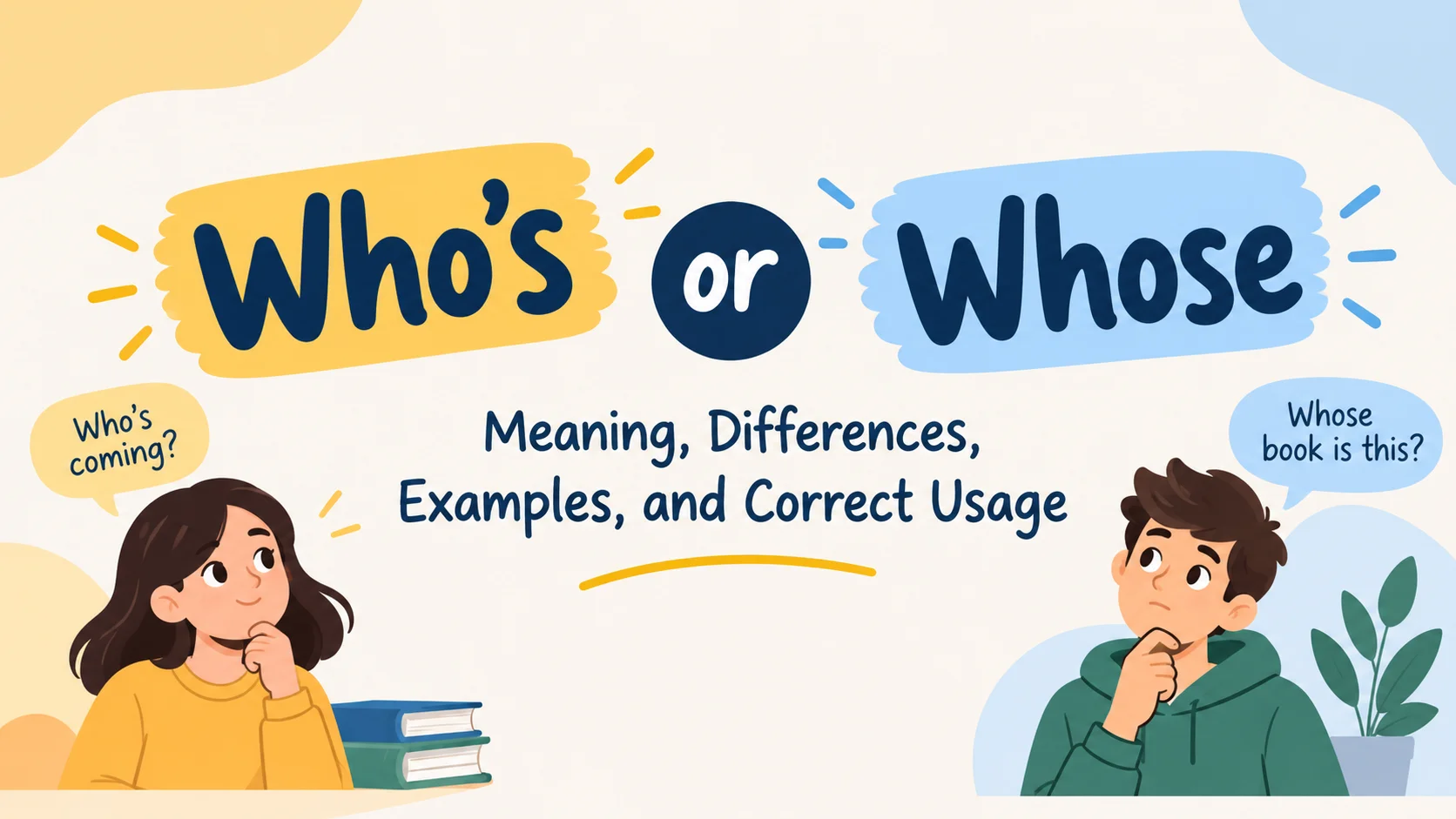
The simple rule is that who’s is a contraction of who is or who has, while whose is a possessive pronoun that shows ownership or relationship. For example, “Who’s coming to the meeting?” means “Who is coming to the meeting?” Similarly, “Who’s going to the store?” uses the contraction correctly. Try replacing who’s with who is or who has. If the sentence still makes sense, you have probably chosen the right word. However, whose asks to whom something belongs. “Whose book is this?” asks who owns the book, while “Whose backpack is on the chair?” asks who owns the backpack. Remember this simple tip: use whose when talking about ownership. This quick trick helps you understand the difference and make the correct choice.
In this grammar guide, students, ESL learners, and everyday writers can learn when to use who’s and when to use whose. Compare examples, practice with real-world sentences, and use memory tricks to understand the difference between who’s and whose. One twist that may catch you off guard is that who’s can mean either who is or who has, while whose points to ownership. To tackle this slippery slope without sliding off track, read each sentence carefully and ask what it means. If you are asking who someone is or what someone has, choose who’s. If you want to know who owns something, choose whose. With regular practice, you can write clearer, grammatically correct sentences and avoid common English grammar mistakes.
Let’s dive in!
Quick Answer:
Who’s is a contraction of who is or who has. Whose is a possessive form of who that expresses ownership, association, or a relationship.
Here’s the simplest way to remember the difference:
- Who’s = Who is or who has. Example: Who’s waiting outside?
- Whose = Belonging to whom. Example: Whose jacket is this?
Consider these two sentences:
- Who’s calling me? This means Who is calling me?
- Whose phone is ringing? This asks who owns the ringing phone.
You can also use who’s when who has fits the sentence.
For example: Who’s finished the assignment? means Who has finished the assignment?
Quick trick: Replace who’s with who is or who has. If the sentence still makes sense, who’s is correct. If neither replacement works and the sentence expresses possession or association, you probably need whose.
Comparison Overview
Although who’s and whose sound alike, their grammatical functions differ. Understanding those functions makes the distinction much easier.
| Feature | Who’s | Whose |
| Meaning | Who is or who has | Belonging to whom |
| Grammatical role | Contraction | Possessive determiner or pronoun |
| Uses an apostrophe | Yes | No |
| Expresses possession | No | Yes, or a related association |
| Common question | Who’s coming? | Whose bag is this? |
| Example with a statement | I know who’s responsible. | I know whose bag this is. |
| Replacement test | Who is / who has | Belonging to whom |
| Common mistake | Who’s book is this? | Whose coming tomorrow? |
The most important distinction is simple: who’s combines words, while whose expresses possession or association.
For instance, who’s can introduce a question about someone’s identity or describe what someone has done. On the other hand, whose identifies the person associated with a particular object, person, or characteristic.
Both forms are correct English. The right choice depends on the meaning you want to communicate.
What Does Who’s Mean?
The word who’s is a contraction formed by combining who with either is or has. The apostrophe marks the omitted letters.
Contractions appear frequently in everyday English because they make sentences sound natural and conversational. You’ll find them in dialogue, emails, text messages, articles, and even many forms of professional writing.
However, who’s never serves as the possessive form of who. If you want to ask who owns something, use whose instead.
Who’s as a Contraction of Who Is
The first meaning of who’s is who is. This usage appears when asking about someone’s identity, actions, condition, or current situation.
For example:
- Who’s at the door? — Who is at the door?
- Who’s responsible for this project? — Who is responsible for this project?
- Who’s your favorite author? — Who is your favorite author?
- Who’s coming to dinner tonight? — Who is coming to dinner tonight?
- Do you know who’s in charge? — Do you know who is in charge?
Notice that who’s works in both direct and indirect questions.
A direct question asks something explicitly, such as Who’s leading the meeting? An indirect question places the same question inside a larger sentence, as in I wonder who’s leading the meeting.
In both cases, who’s means who is.
You can also use it in statements that describe someone’s identity or condition.
For example:
- I know who’s ready for the trip.
- She understands who’s responsible for the decision.
- Everyone knows who’s in charge.
- Tell me who’s available this afternoon.
Remember: If replacing who’s with who is preserves the sentence’s meaning and grammar, the contraction is appropriate.
Who’s as a Contraction of Who Has
The second meaning of who’s is who has. This use often appears with the present perfect tense, which describes actions or experiences connected to the present.
Consider these examples:
- Who’s finished the report? — Who has finished the report?
- Who’s seen my keys? — Who has seen my keys?
- Who’s taken my notebook? — Who has taken my notebook?
- Who’s completed the application? — Who has completed the application?
- Who’s been to New York? — Who has been to New York?
In these sentences, who’s replaces who has rather than who is.
The following example shows why context matters:
Who’s been waiting outside?
Here, who’s means who has because been waiting forms part of the present perfect continuous construction.
Compare that with:
Who’s waiting outside?
This time, who’s means who is because waiting follows the verb is in the present continuous construction.
The difference becomes clear when you expand each contraction:
- Who has been waiting outside?
- Who is waiting outside?
Both sentences are grammatically correct, but they use different verb structures.
Who’s in Everyday Writing
In everyday communication, who’s often helps writers sound relaxed and natural.
For example, imagine you’re messaging a coworker before a meeting. You might write, Who’s joining us at three? That sounds direct and conversational.
In a more formal report, you could write, The manager identified who’s responsible for each department. The contraction remains grammatically acceptable, although a style guide or specific document may favor expanded forms.
Here are a few situations where who’s appears naturally:
- Conversations: Who’s picking us up?
- Work emails: Do you know who’s handling the request?
- School assignments: The teacher asked who’s completed the exercise.
- Social media: Who’s watching the game tonight?
- Personal messages: Guess who’s coming to visit!
The important point is that contractions don’t automatically make writing incorrect or unprofessional. Choose a style that suits your audience and purpose.
What Does Whose Mean?
Whose is a possessive form of who. It identifies the person or other entity associated with something.
Writers use it to ask about ownership, describe relationships, or connect information about someone or something. Unlike who’s, whose is not a contraction and does not contain an apostrophe.
For example:
- Whose shoes are these?
- Whose idea was that?
- I met a woman whose brother works overseas.
- The company hired an engineer whose experience impressed the team.
In the first two examples, whose asks about ownership or responsibility. In the remaining examples, it connects a person or organization with additional information.
Whose as a Possessive Determiner
When whose appears before a noun, it functions as a possessive determiner.
A possessive determiner identifies who something belongs to or which person has a particular relationship with something.
Examples include:
- Whose car is parked outside?
- Whose notebook did you borrow?
- Whose idea started the discussion?
- Whose responsibility is it to lock the door?
- Whose name appears on the document?
In each sentence, whose comes before a noun: car, notebook, idea, responsibility, or name.
It doesn’t always refer to legal ownership. Sometimes, it identifies authorship, responsibility, origin, or another kind of connection.
For example, Whose idea was it to organize the event? asks who proposed the idea. It doesn’t suggest that an idea is a physical object someone owns.
Similarly, Whose turn is it? asks who should act next.
Key point: Whose expresses a relationship between someone and something. That relationship can involve ownership, responsibility, authorship, or association.
Whose in Direct Questions
One of the most common uses of whose appears in direct questions about ownership.
These questions help identify the person associated with an object or situation.
Examples:
- Whose wallet is on the table?
- Whose keys did you find?
- Whose dog is barking?
- Whose turn is it to present?
- Whose handwriting is on this note?
The word can appear before a noun, as in Whose wallet is this? It can also appear without a following noun when the noun is understood from context.
For example:
Whose is this?
This question is grammatically correct when the speaker and listener understand what this refers to. The question asks who owns the item.
You could use the same structure while pointing toward a lost umbrella, a phone, or a notebook.
However, when you want to identify the person performing an action, who or who’s may be more appropriate.
Compare:
- Who’s carrying the bags? asks who is carrying them.
- Whose bags are these? asks who owns them.
The first question concerns an action. The second concerns ownership.
Whose in Relative Clauses
Another important use of whose appears in relative clauses. These clauses add information about a noun without requiring a separate sentence.
For example:
I met a student whose research focuses on climate change.
The main clause is I met a student. The relative clause, whose research focuses on climate change, tells readers more about that student.
Here are additional examples:
- The teacher whose class I attended explained the topic clearly.
- We visited a family whose home overlooks the lake.
- She hired a designer whose portfolio showed impressive creativity.
- I spoke with a manager whose team recently expanded.
- They adopted a dog whose previous owner had moved abroad.
In each example, whose connects a person or animal with something associated with them.
Importantly, whose isn’t limited to questions or physical ownership. It also introduces relative clauses in statements.
English can even use whose with organizations and things, particularly when describing their features or associated parts.
For example:
The company, whose headquarters are in Chicago, opened another office.
Here, whose headquarters identifies something associated with the company.
Likewise:
We visited a building whose windows overlooked the river.
This sentence connects the building with its windows. The usage is standard English and often helps writers avoid awkward phrasing.
Main Differences Between Who’s and Whose
The difference between who’s and whose becomes easier to understand when you examine their meaning, grammar, and position in a sentence.
Meaning and Grammatical Function
The central difference is that who’s replaces two words, while whose expresses possession or association.
Consider these examples:
| Sentence | Meaning | Correct word |
| Who’s calling? | Who is calling? | Who’s |
| Who’s finished the task? | Who has finished the task? | Who’s |
| Whose coat is this? | Who owns this coat? | Whose |
| I know whose coat this is. | I know who owns the coat. | Whose |
| She met a writer whose books sell well. | The books are associated with the writer. | Whose |
The apostrophe in who’s signals omitted letters. It doesn’t indicate ownership.
By contrast, whose can show possession without an apostrophe. This may seem unusual if you’re familiar with possessive nouns such as Sarah’s book or the dog’s collar.
However, English doesn’t form every possessive expression in the same way. The possessive form of who is whose, just as the possessive form of he is his.
Sentence Structure and Usage
The words also differ in how they fit into sentence structures.
Who’s usually appears where who is or who has would otherwise occur.
Examples:
- Who’s responsible for the schedule?
- I wonder who’s coming.
- Who’s taken my seat?
- She knows who’s been working late.
Whose often appears before a noun or within a relative clause.
Examples:
- Whose schedule are we following?
- Do you know whose seat this is?
- The employee whose desk is near the window is on vacation.
- We met an artist whose paintings were displayed downtown.
One helpful clue is the word that follows.
If you see whose directly before a noun, such as whose schedule or whose paintings, you’re likely looking at a possessive construction.
However, don’t rely on word order alone. Instead, examine the complete sentence and its intended meaning.
For instance, I know who’s responsible is correct because it means I know who is responsible. Meanwhile, I know whose responsibility it is is also correct because it identifies who has responsibility.
Apostrophes and Possession
A common source of confusion is the belief that apostrophes always show possession.
In English, apostrophes serve two major purposes:
- Contractions: They mark omitted letters, as in don’t, it’s, and who’s.
- Possessives: They mark possession in many nouns, as in Maria’s bag and the dog’s bowl.
These patterns explain why who’s doesn’t mean that something belongs to someone.
Compare the following examples:
- Who’s there? means Who is there?
- Whose bag is there? asks who owns the bag.
- The student’s bag is there. uses a possessive noun to show ownership.
The apostrophe performs different grammatical work in who’s and student’s. Understanding that difference prevents many common errors.
Formal and Informal Writing
Both who’s and whose are standard English forms. Neither is inherently informal or incorrect.
However, your writing context may affect whether you choose contractions.
In conversations, text messages, personal emails, and many blog posts, contractions often sound natural. In highly formal writing, some institutions prefer expanded forms such as who is and who has.
For example:
- Conversational: Do you know who’s attending?
- Expanded: Do you know who is attending?
Both sentences are grammatically correct.
By contrast, replacing whose with who’s doesn’t create a more formal or informal version. It changes the grammatical meaning and usually makes the sentence incorrect.
For example, Whose attending the meeting? is incorrect if you mean Who is attending the meeting?
The correct form is Who’s attending the meeting?
Read More: Based In or Based Out Of: Meaning, Differences, and Correct Usage
Who’s vs. Whose Examples in Sentences
Examples make grammar rules easier to apply because they show how words function in real contexts.
The following examples cover the most common uses of who’s and whose.
Examples of Who’s Meaning Who Is
- Who’s waiting at the bus stop? — Who is waiting at the bus stop?
- Who’s your new supervisor? — Who is your new supervisor?
- I know who’s responsible for the delay. — I know who is responsible.
- Can you tell me who’s available? — Can you tell me who is available?
- Who’s ready to begin the presentation? — Who is ready to begin?
In each sentence, who’s replaces who is without changing the intended meaning.
Examples of Who’s Meaning Who Has
- Who’s finished the assignment? — Who has finished the assignment?
- Who’s taken my umbrella? — Who has taken my umbrella?
- Do you know who’s visited the museum? — Do you know who has visited the museum?
- Who’s been working on this project? — Who has been working on this project?
- Who’s already submitted the application? — Who has already submitted the application?
These examples show why you must consider the verb structure. Sometimes who’s means who is, while in other sentences it means who has.
Examples of Whose Showing Ownership
- Whose laptop is on the desk? — Who owns the laptop?
- Whose shoes did you borrow? — Who owns the shoes?
- Whose keys are these? — Who do these keys belong to?
- Whose idea was it to start early? — Who suggested starting early?
- Do you know whose car is parked outside? — Do you know who owns the car?
Here, whose identifies ownership or the person associated with something.
Examples of Whose in Relative Clauses
- I met a woman whose son studies medicine. — The son is associated with the woman.
- He hired an assistant whose skills matched the role. — The skills belong to the assistant.
- We visited a school whose library recently reopened. — The library is associated with the school.
- She thanked the neighbor whose advice helped her. — The advice came from the neighbor.
- They bought a house whose garden faces the park. — The garden is part of the house.
These examples demonstrate that whose works in statements as well as questions.
Common Mistakes to Avoid When Using Who’s or Whose
Even experienced writers sometimes confuse these words because their pronunciation is identical in many varieties of English. Fortunately, a few common errors are easy to fix.
Using Who’s When You Mean Whose
One frequent mistake involves adding an apostrophe to a question about ownership.
Incorrect: Who’s book is lying on the table?
Correct: Whose book is lying on the table?
Why? The sentence asks who owns the book. It doesn’t mean Who is book or Who has book.
Another example:
Incorrect: Who’s jacket did you borrow?
Correct: Whose jacket did you borrow?
The possessive word whose identifies the owner of the jacket.
Whenever a noun follows the word and the sentence asks about ownership, check whether whose is the form you need.
Using Whose When You Mean Who’s
The opposite mistake occurs when writers omit the apostrophe from a contraction.
Incorrect: Whose coming to the party?
Correct: Who’s coming to the party?
The intended meaning is Who is coming to the party? Therefore, who’s is the correct choice.
Here are more examples:
| Incorrect sentence | Correct sentence | Reason |
| Whose at the door? | Who’s at the door? | Means who is |
| Whose going first? | Who’s going first? | Means who is |
| Whose finished the work? | Who’s finished the work? | Means who has |
| Who’s phone is ringing? | Whose phone is ringing? | Asks about ownership |
The key is to identify the intended meaning before choosing the spelling.
Forgetting the Who Is or Who Has Test
The replacement test is useful, but writers sometimes apply it too quickly.
For example:
Who’s been to this restaurant?
Replacing who’s with who is gives Who is been to this restaurant? That sentence is incorrect.
However, replacing it with who has gives Who has been to this restaurant? The sentence now makes sense.
This shows why you should test both possible expansions.
Use this process:
- Replace who’s with who is.
- Read the sentence carefully.
- If it doesn’t fit, try who has.
- If neither works, check whether the sentence expresses possession or association.
- Use whose when that possessive meaning is intended.
The test works best when you consider the entire sentence rather than just the word immediately following the contraction.
Confusing Whose With Who, Whom, and Whoever
These words are related, but they don’t perform identical functions.
| Word | Main function | Example |
| Who | Identifies a person performing an action or serving as the subject | Who called you? |
| Whom | Refers to a person functioning as an object in formal grammar | Whom did you invite? |
| Whose | Expresses possession or association | Whose bag is this? |
| Whoever | Refers to any person who meets a condition | Whoever arrives first can choose a seat. |
| Who’s | Contracts who is or who has | Who’s calling? |
In everyday American English, many speakers use who instead of whom in situations where traditional formal grammar favors whom. However, that variation doesn’t change the distinction between who’s and whose.
For example, Who’s calling? asks about a caller’s identity. Whose phone is ringing? asks who owns the phone.
Keeping each word’s function in mind makes these choices easier.
Easy Ways to Remember the Difference Between Who’s and Whose
You don’t need to memorize every example in this article. A few practical techniques can help you choose the right word while writing.
Use the Apostrophe Test
Remember that the apostrophe in who’s marks a contraction.
It tells you that the word contains missing letters. In this case, those letters belong to is or has.
For example:
- Who’s coming? → Who is coming?
- Who’s arrived? → Who has arrived?
- Whose coat is this? → Who owns this coat?
The last example doesn’t need a contraction. The word whose already expresses the intended relationship.
One important detail: the apostrophe doesn’t automatically make a word possessive. That’s why who’s and whose follow different rules.
Use the Replacement Test
When you’re uncertain, expand the contraction.
Consider this sentence:
I wonder who’s at the office.
Replace who’s with who is:
I wonder who is at the office.
The sentence remains correct, so who’s works.
Now consider:
I wonder whose office this is.
Replacing whose with who is would produce I wonder who is office this is, which doesn’t work.
The sentence expresses ownership or association, so whose is correct.
This method is particularly useful when proofreading articles, school assignments, business emails, and social media posts.
Use the Ownership Test
Ask yourself whether the sentence identifies an owner or describes a relationship.
If it does, whose is often the correct word.
For example:
- Whose wallet did you find?
- Whose idea was approved?
- The author whose article we discussed lives nearby.
- The student whose project won the award thanked her teacher.
None of these sentences uses whose as a contraction. Instead, each sentence connects someone with an object, idea, or relationship.
However, don’t assume every sentence containing a noun needs whose. The question Who’s carrying the wallet? is correct because it asks who is performing an action.
Read the Sentence Aloud With the Expanded Words
Reading aloud can reveal mistakes that aren’t obvious on the screen.
When you encounter who’s, say the complete phrase instead. Try both who is and who has when necessary.
For instance:
Who’s completed the work?
Reading it as Who has completed the work? reveals the intended meaning.
By contrast:
Whose work is complete?
This sentence asks about the work associated with someone. Expanding whose into who is doesn’t preserve the grammar.
This technique works well during final proofreading because it checks both meaning and sentence structure.
FAQs:
What is the main difference between who’s and whose?
Who’s is a contraction of “who is” or “who has.” Whose is used to show possession or ask who owns something. For example, “Who’s coming?” asks about a person, while “Whose bag is this?” asks about ownership.
Is who’s short for who is or who has?
Yes, who’s can mean either “who is” or “who has.” The correct meaning depends on the sentence. For example, “Who’s ready?” means “Who is ready?” while “Who’s finished the work?” can mean “Who has finished the work?”
How do you remember when to use who’s or whose?
Use a simple replacement trick. Replace who’s with “who is” or “who has.” If the sentence still makes sense, who’s is probably correct. If you’re asking about ownership, use whose.
Is whose a contraction?
No, whose is not a contraction. It is a word used to ask about ownership or show possession. For example, “Whose phone is ringing?” asks who owns the phone.
Can who’s and whose be used interchangeably?
No, who’s and whose have different grammatical purposes. Using one instead of the other can change a sentence’s meaning or make it grammatically incorrect. Remember that who’s means “who is” or “who has,” while whose relates to ownership.
Which sentence is correct: Who’s book is this or whose book is this?
“Whose book is this?” is correct because the question asks who owns the book. “Who’s book is this?” is incorrect because replacing who’s with “who is” or “who has” does not make sense in this sentence.
Why do people often confuse who’s and whose?
People often confuse these words because they sound alike when spoken. However, their meanings and grammatical purposes differ. Learning the replacement trick, reading examples, and practicing regularly can help you avoid this common English grammar mistake.
Conclusion:
Understanding who’s or whose becomes much easier when you remember one simple rule. Use who’s when you mean “who is” or “who has.” Use whose when asking about ownership or showing possession. Although these words sound alike, they cannot replace each other in every sentence.
When you’re unsure, replace who’s with “who is” or “who has” and check whether the sentence makes sense. With regular practice, you’ll choose the correct word more confidently and make your writing clearer, more professional, and grammatically correct.