
Waive vs. Wave: Understanding their meanings, spelling, and usage helps you choose the correct word in everyday conversations and formal writing.
Waive and wave sound similar, but their meanings and uses differ significantly. Waive means to give up a right, fee, privilege, or claim voluntarily. You might waive a late payment fee or waive your right to make a claim. The related noun, waiver, often appears in contracts, legal documents, and official paperwork. For example, an airline might waive baggage fees for certain passengers.
In contrast, wave describes a hand gesture, moving water, or a pattern of motion. It can also refer to a sudden increase, a widespread event, or a hairstyle with gentle curves. Although both words sound alike in American and British English, their meanings become clear when you consider the context. Remember this simple distinction: you waive something you give up, but you wave your hand to greet someone.
Let’s dive in!
Quick Answer:
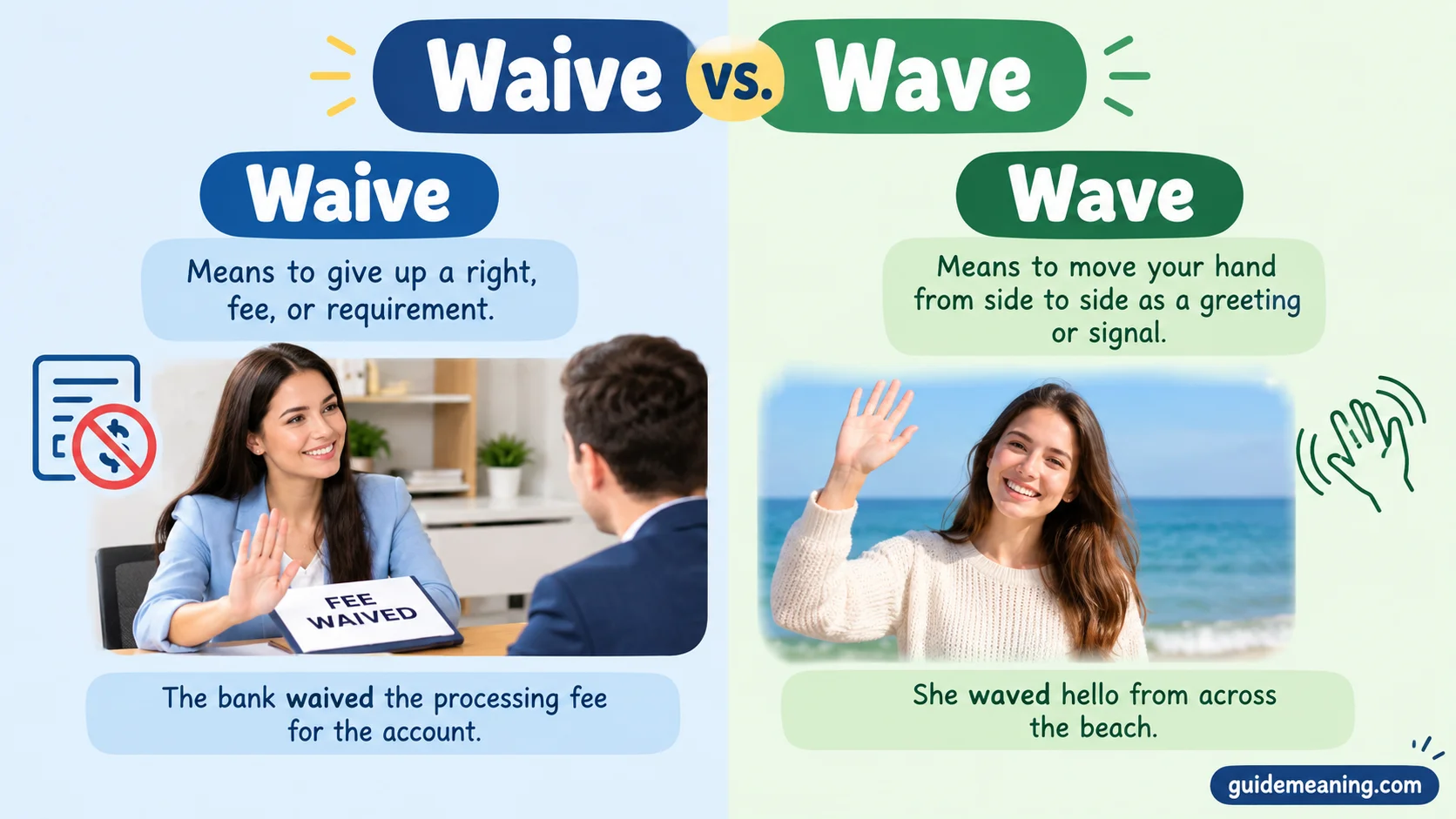
Waive means to voluntarily give up a right, claim, fee, or requirement, or to choose not to enforce something. Wave means to move your hand or another object back and forth, or it refers to a moving swell, such as an ocean wave.
Although these words share the same pronunciation, their meanings and grammatical uses differ.
| Word | Meaning | Part of Speech | Example |
| Waive | To give up a right or excuse a requirement | Verb | The university agreed to waive the application fee. |
| Wave | To make a gesture or describe a moving swell | Noun and verb | She waved goodbye to her friends. |
| Waived | The past tense of waive | Verb | The bank waived the late fee. |
| Waved | The past tense of wave | Verb | He waved at the driver. |
Easy way to remember: Waive means give up or excuse something. Wave means move, gesture, or describe a swell.
Comparison Overview
The easiest way to distinguish waive from wave is to examine what the sentence describes. If someone gives up a right or excuses a payment, use waive. If someone moves a hand, signals another person, or describes water in motion, use wave.
| Feature | Waive | Wave |
| Primary meaning | Give up or choose not to enforce something | Make a gesture or describe a moving swell |
| Part of speech | Verb | Noun and verb |
| Common contexts | Fees, rights, penalties, requirements | Greetings, oceans, flags, emotions, physical movement |
| Present tense | Waive | Wave |
| Past tense | Waived | Waved |
| Common expression | Waive a fee | Wave goodbye |
| Example | The company waived the penalty. | The child waved at her teacher. |
Both words belong to a group called homophones. Homophones sound alike but have different meanings and spellings. Other examples include right and write, pair and pear, and sea and see.
Because waive and wave sound identical, pronunciation alone won’t help you choose the correct spelling. You must consider the sentence’s meaning.
For example:
- Correct: The hotel agreed to waive the cancellation fee.
- Correct: The hotel manager waved to the arriving guests.
- Incorrect for the intended meaning: The hotel agreed to wave the cancellation fee.
- Incorrect for the intended meaning: The hotel manager waived to the arriving guests.
The context determines which word belongs in each sentence.
What Does Waive Mean?
The verb waive means to voluntarily relinquish a right, claim, privilege, or requirement. It can also mean choosing not to demand something that would otherwise be due.
People commonly use waive in financial, legal, educational, employment, and administrative situations. For instance, a company might waive a service fee, a university might waive an admission requirement, or a person might waive a contractual right.
When someone waives something, they generally choose not to exercise or enforce it. The exact effect depends on the circumstances, applicable rules, and any relevant agreement.
Common Uses of Waive
The word waive appears in several familiar situations. Understanding these uses helps you recognize when the spelling is appropriate.
Waive a fee: A business decides not to charge a payment that would normally apply.
Example: The bank agreed to waive the monthly maintenance fee.
Waive a penalty: An organization chooses not to impose a penalty under the applicable circumstances.
Example: The school waived the late registration penalty.
Waive a right: Someone voluntarily gives up a right or chooses not to exercise it.
Example: The participant signed an agreement to waive certain claims, subject to applicable law.
Waive a requirement: An authorized person or organization excuses a condition that would otherwise need to be met.
Example: The university may waive the prerequisite for applicants with equivalent experience.
Waive a claim: Someone relinquishes a claim or decides not to pursue it.
Example: The parties agreed to waive certain claims as part of their settlement.
Notice the pattern: every example involves giving something up, excusing an obligation, or choosing not to enforce a condition. None describes a physical gesture.
Waive a Fee or Charge
One of the most common uses of waive involves money. Businesses, banks, hotels, schools, and service providers sometimes waive fees under specific conditions.
For example, a bank may waive a monthly account fee if a customer meets certain eligibility requirements. A hotel might waive a cancellation fee after an unexpected emergency. A university could waive an application fee for qualifying applicants.
Consider this example:
“The airline agreed to waive the change fee after the flight schedule changed.”
The airline chose not to collect a fee that might otherwise have applied. Therefore, waive is the correct word.
You might also see these expressions:
- Waive an annual fee
- Waive a processing charge
- Waive a service fee
- Waive a cancellation penalty
- Waive a late payment fee
In each case, waive describes the decision not to require payment.
Waive a Right or Requirement
In legal and administrative settings, waive often refers to rights, claims, or conditions. The word can carry important consequences, so writers should use it carefully.
For example, a person might waive a right to a particular hearing or choose not to pursue a claim. An applicant might receive a waiver of an entrance requirement under an institution’s rules.
However, waiving a right does not automatically mean that every related right disappears. The consequences depend on the specific right, the wording involved, and the applicable law.
For everyday writing, the main distinction remains straightforward: waive means giving up or choosing not to enforce something, not moving your hand.
Waive in Sentences
Here are additional examples showing how waive works in different contexts.
- The company agreed to waive the delivery fee.
- The professor decided to waive the attendance requirement for the approved absence.
- The customer asked the bank to waive the overdraft fee.
- The organization may waive the membership charge for eligible applicants.
- The parties agreed to waive certain contractual claims.
- The school offered to waive the application fee for qualifying students.
- The manager had the authority to waive the usual processing charge.
Each sentence involves a fee, right, claim, or requirement. That connection provides a reliable clue when you’re choosing between waive and wave.
What Does Wave Mean?
The word wave can function as both a noun and a verb. As a verb, it describes moving your hand or another object back and forth, often to greet someone, attract attention, or give a signal.
As a noun, wave can refer to a moving swell of water, a hand gesture, or a sudden increase in something. It also appears in scientific terms such as sound wave and light wave.
Unlike waive, which focuses on giving something up or excusing an obligation, wave generally relates to movement, gestures, or patterns.
Wave as a Verb
When people use wave as a verb, they usually describe a visible movement or signal.
For example, you might wave to a neighbor, wave goodbye to a friend, or wave a flag during a celebration. A traffic officer might wave vehicles through an intersection, while a person in a crowd might wave to get someone’s attention.
Common examples include:
- She waved at her neighbor from the porch.
- He waved goodbye before boarding the train.
- The children waved their flags during the parade.
- The officer waved the cars through the checkpoint.
- I waved to my friend across the street.
- The passenger waved for the taxi to stop.
In each sentence, wave describes movement or signaling. No one is giving up a right, fee, or requirement.
Wave as a Noun
As a noun, wave has several meanings. The surrounding words usually reveal which meaning the writer intends.
An ocean wave: A moving ridge or swell of water.
Example: A powerful wave crashed against the rocky shore.
A greeting gesture: A movement of the hand used to greet someone or say goodbye.
Example: She gave her colleague a friendly wave.
A wave of emotion: A sudden or powerful feeling.
Example: A wave of relief washed over him after the results arrived.
A period of intense activity: A sudden increase in the number or intensity of events.
Example: The city experienced a wave of new business openings.
A scientific wave: A disturbance that transfers energy through a medium or through space, depending on the type of wave.
Example: Sound travels through air as a mechanical wave.
These meanings share a broad connection to movement, whether physical, emotional, or figurative. That connection makes wave easier to remember.
Wave in Everyday Expressions
Several common expressions use wave in ways that have little to do with ocean water.
| Expression | Meaning | Example |
| Wave goodbye | Make a farewell gesture | She waved goodbye to her family. |
| Wave hello | Greet someone with a gesture | He waved hello from across the room. |
| Wave someone over | Signal someone to approach | The host waved us over to the table. |
| A wave of relief | A sudden feeling of relief | A wave of relief followed the announcement. |
| Heat wave | A period of unusually hot weather | The heat wave lasted several days. |
| Wave of support | A sudden increase in public support | A wave of support followed the announcement. |
These expressions demonstrate why wave can describe both literal movement and figurative changes. The meaning shifts with the context, but it never becomes interchangeable with waive.
Main Differences Between Waive vs. Wave
Although waive and wave sound alike, their meanings are distinct. The most reliable way to choose between them is to identify the action or idea you want to express.
Waive concerns giving something up or choosing not to enforce a condition. Wave concerns movement, gestures, or a swell of activity or energy.
Waive vs. Wave: Differences in Meaning and Usage
Let’s compare the words in realistic situations.
| Situation | Correct word | Example sentence | Why it fits |
| A bank removes a charge | Waive | The bank waived the fee. | The bank chose not to collect payment. |
| A person greets a friend | Wave | She waved at her friend. | She made a greeting gesture. |
| A school excuses a condition | Waive | The school waived the prerequisite. | The school excused a requirement. |
| A child moves a flag | Wave | The child waved a flag. | The child moved an object. |
| Someone gives up a claim | Waive | He waived his claim. | He relinquished a claim. |
| Ocean water moves toward shore | Wave | A wave reached the beach. | The word describes moving water. |
The difference becomes clearer when you replace each word with a short explanation. If give up or excuse preserves the intended meaning, use waive. If gesture, move, or swell makes sense, use wave.
When Should You Use Waive?
Choose waive when the sentence involves a right, obligation, fee, penalty, or requirement.
Here are several examples:
- The company agreed to waive the additional service charge.
- The applicant requested a waiver of the usual requirement.
- The landlord decided to waive the late payment fee.
- The organization may waive certain conditions under its published policy.
- The parties agreed to waive specific claims in their settlement.
In each case, someone gives up something or chooses not to enforce it. The word doesn’t describe a physical action.
When Should You Use Wave?
Choose wave when describing a gesture, movement, swell, or sudden increase.
For example:
- She waved to the children from the window.
- The crowd began to wave its flags.
- A huge ocean wave struck the seawall.
- A wave of excitement spread through the audience.
- The driver waved the pedestrian across the road.
The word also appears in technical discussions of physics, sound, light, and other forms of wave motion.
How Context Changes the Meaning
Consider these two sentences:
- The manager agreed to waive the requirement.
- The manager began to wave toward the entrance.
Both sentences are grammatically correct, but they describe entirely different actions. In the first, the manager excuses a condition. In the second, the manager makes a gesture.
This distinction matters even more in professional writing. A spelling mistake in a casual message might cause a brief laugh, while the same mistake in a contract or business email could create confusion.
Waive vs. Wave Pronunciation
One reason writers confuse these words is their identical pronunciation in standard American English. Both are pronounced /weɪv/ in the International Phonetic Alphabet (IPA).
The word homophone describes two or more words that sound alike but differ in meaning or spelling. Waive and wave are common examples.
Why Waive and Wave Sound the Same
Both words contain the same spoken sounds, including the long vowel sound represented by /eɪ/. Their spelling differences don’t create a difference in standard pronunciation.
The extra letter i in waive doesn’t give it a separate spoken form. Consequently, you usually cannot identify the intended word by hearing it alone.
For example, if someone says, “The company will waive the fee,” you understand the intended word through the surrounding meaning. The same sound could appear in “The company will wave at the visitors,” although that sentence expresses a different action.
Writing tip: When you’re unsure about the spelling, read the entire sentence and identify what the subject is doing.
Waived vs. Waved: Which Spelling Is Correct?
Both waived and waved are correct English words. Neither spelling is inherently wrong; each is the past-tense form of a different verb.
Use waived when someone gave up a right, excused a requirement, or chose not to collect a fee. Use waved when someone made a gesture or moved something back and forth.
When to Use Waived
Waived is the simple past tense and past participle of waive.
Examples include:
- The bank waived the annual account fee.
- The committee waived the usual entry requirement.
- The customer asked whether the company had waived the penalty.
- The organization had waived certain conditions under its policy.
- The team waived the player under the league’s roster rules.
In these sentences, waived describes a decision or action involving a right, fee, condition, or roster status.
When to Use Waved
Waved is the simple past tense and past participle of wave.
Examples include:
- She waved goodbye to her family.
- The child waved a small flag.
- The officer waved the traffic through.
- He waved at his coworkers from across the parking lot.
- The crowd had waved banners throughout the celebration.
These examples describe gestures or physical movement.
Waived vs. Waved: Quick Comparison
| Present tense | Past tense | Example |
| Waive | Waived | The hotel waived the cancellation fee. |
| Wave | Waved | The guest waved to the receptionist. |
Remember that the endings follow ordinary English verb patterns. Both verbs add -d to form the past tense, but their base spellings remain different.
Waive vs. Wave in Common Phrases
Certain expressions make the difference between these words especially easy to understand. Learning them can help you avoid common spelling mistakes in emails, applications, and everyday conversations.
Waive a Fee vs. Wave a Fee
The correct expression is waive a fee when someone chooses not to collect a payment.
For example:
- Correct: The service provider agreed to waive the fee.
- Incorrect for the intended meaning: The service provider agreed to wave the fee.
The second sentence doesn’t express the intended financial meaning. Wave describes movement or a gesture, not the act of excusing a charge.
You might encounter waive a fee in these situations:
- A bank removes a qualifying account charge.
- A university excuses an application fee.
- A hotel chooses not to charge a cancellation fee.
- A service provider removes a penalty under its policy.
Always use waive when the intended action involves excusing payment.
Wave Goodbye vs. Waive Goodbye
The correct expression is wave goodbye. It describes making a gesture to someone who is leaving.
Examples:
- She waved goodbye to her parents.
- The children waved goodbye as the bus pulled away.
- He stood outside to wave goodbye to his guests.
By contrast, waive goodbye doesn’t express the intended meaning in standard English.
The distinction is simple: you can waive a fee or a right, but you wave goodbye to a person.
Waive a Right vs. Wave a Hand
These expressions provide another clear contrast.
Waive a right means to give up or choose not to exercise a right.
Example: The applicant decided to waive the right to request a particular review.
Wave a hand means to move your hand as a gesture or signal.
Example: She waved a hand to attract the waiter’s attention.
Although the phrases sound similar when spoken, their meanings have no direct overlap. The noun following the verb often gives you a useful clue.
Waive vs. Wave vs. Waver
The word waver sometimes adds to the confusion because it looks and sounds related to wave. However, waver has a separate meaning.
To waver means to hesitate, become uncertain, or fluctuate. People often use it when discussing confidence, decisions, determination, or stability.
For example, someone might waver before accepting a job offer. A person’s voice might waver when they’re nervous. A commitment might waver when circumstances become difficult.
Waive, Wave, and Waver Compared
| Word | Meaning | Example |
| Waive | Give up or excuse something | The company waived the charge. |
| Wave | Gesture, move, or describe a swell | She waved to her neighbor. |
| Waver | Hesitate or become unsteady | His confidence began to waver. |
Notice how the words perform different jobs.
- Waive: The manager waived the additional requirement.
- Wave: The manager waved to the waiting customers.
- Waver: The manager began to waver over the final decision.
One important point: waver isn’t the past tense of wave. The past tense of wave is waved, while the past tense of waver is wavered.
Waive vs. Wave in American English and Sports
The word waive also appears in professional sports, particularly when teams manage player rosters. This specialized use can seem confusing if you’re familiar with the word only through fees and legal rights.
In sports such as professional football, basketball, and hockey, waiving a player refers to a formal roster procedure governed by the relevant league’s rules. Depending on the league and circumstances, other teams may have an opportunity to claim the player.
For example:
“The team waived the player during the offseason.”
This sentence doesn’t mean the team waved at the player. Instead, it describes a roster-related transaction.
Sports terminology requires attention to context because a waiver can have specific procedural effects. Different leagues have different rules, so writers should consult the relevant league’s official documentation before describing what happens next.
Outside sports, waive commonly appears in business, education, law, and customer service. The core idea remains the same: the word describes a formal decision involving a right, condition, or status rather than a gesture.
Waive vs. Wave: Common Mistakes to Avoid
Even experienced writers sometimes confuse homophones. Because waive and wave sound identical, spelling errors can slip into emails, reports, and online content.
The best solution is to focus on meaning instead of pronunciation.
Common Waive vs. Wave Errors
| Incorrect usage | Correct usage | Explanation |
| The bank agreed to wave the fee. | The bank agreed to waive the fee. | The bank is excusing a charge. |
| She waived goodbye. | She waved goodbye. | She is making a farewell gesture. |
| He waved his right to appeal. | He waived his right to appeal. | He is giving up a right. |
| Please waive your hand. | Please wave your hand. | The sentence describes movement. |
| The company waved the penalty. | The company waived the penalty. | The company chose not to impose the penalty. |
| The child waived at her teacher. | The child waved at her teacher. | The child is greeting someone. |
Why These Mistakes Happen
Three factors explain why these errors are common.
Identical pronunciation: Both words sound the same, so spelling depends on meaning rather than sound.
Unfamiliar contexts: Writers who rarely encounter legal or financial language may not immediately recognize waive.
Fast typing: When people type quickly, they may choose the more familiar spelling without checking the sentence.
To avoid these errors, pause when the word appears in a phrase involving fees, rights, or gestures. Ask yourself what action the sentence describes.
A Practical Editing Checklist
Before publishing or sending your writing, check the following:
- Does the sentence describe giving up a right or excusing a condition? Use waive.
- Does the sentence describe greeting someone or moving an object? Use wave.
- Is the sentence about an earlier action? Check whether waived or waved fits.
- Does the sentence involve hesitation or uncertainty? You may need waver.
- Would replacing the word with a short definition preserve the sentence’s meaning?
This quick review can catch most waive vs. wave mistakes without slowing down your writing.
Easy Ways to Remember Waive vs. Wave
You don’t need to memorize complicated grammar rules to distinguish these words. A few practical memory aids will help you choose the right spelling.
Remember Waive as Give Up
Connect waive with fees, rights, claims, penalties, and requirements.
For example, a company might waive a fee. A person might waive a right. A school might waive an admission requirement.
Think of the phrase “waive what you owe or are required to do.” This isn’t a complete legal definition, but it provides a useful reminder for everyday writing.
Remember Wave as Movement
Connect wave with hands, flags, ocean water, and other kinds of movement.
You wave hello, wave goodbye, wave a flag, and watch waves roll toward the beach.
The letter combination wa doesn’t need a special memory trick. Focus on the familiar image of a hand moving back and forth.
Use the Sentence Substitution Test
When you’re uncertain, replace the word with a simpler phrase.
If the sentence still makes sense with give up, excuse, or choose not to enforce, use waive.
If it makes sense with gesture, move back and forth, or swell, use wave.
For example:
- “The company agreed to ___ the charge.”
Replacement: The company agreed to excuse the charge.
Correct answer: Waive. - “She stopped to ___ at her neighbor.”
Replacement: She stopped to gesture at her neighbor.
Correct answer: Wave.
This technique works because it tests meaning directly instead of relying on spelling or pronunciation.
FAQs:
What is the main difference between waive and wave?
Waive means to give up a right, fee, or privilege voluntarily. Wave refers to a hand gesture, moving water, or another type of movement. Their meanings depend on how you use them in a sentence.
Is waive or wave correct?
Both words are correct, but they have different meanings. Use waive when someone gives up a right or fee. Use wave when describing a greeting, water movement, or a similar action.
What does waive mean in simple words?
Waive means to choose not to use or enforce a right, claim, fee, or requirement. For example, a school might waive an application fee for eligible students.
What does wave mean in everyday English?
Wave commonly means moving your hand to greet someone or say goodbye. It can also describe moving water, a scientific disturbance, or a sudden increase in something.
What is an example of waive in a sentence?
The hotel agreed to waive the cancellation fee because of the unexpected emergency.
In this sentence, waive means the hotel chose not to charge the fee.
What is an example of wave in a sentence?
She smiled and waved goodbye as her friend boarded the train.
Here, waved describes moving her hand to say goodbye.
How can I remember the difference between waive and wave?
Remember that waive means to give something up, while wave means to move or signal. You might waive a fee but wave your hand. Connecting each word with a familiar action makes the distinction easier to remember.
Conclusion:
Understanding waive vs. wave becomes easier when you focus on what each word means. Waive means to voluntarily give up a right, fee, privilege, or claim. Wave describes a hand gesture, moving water, a scientific pattern, or a sudden occurrence. For example, a company might waive a service fee, while you wave goodbye to a friend. Although these words sound alike, their spelling and meanings serve different purposes. Remember that you waive something you give up, but you wave to greet someone. With regular practice and simple examples, you’ll find it easier to choose the correct word in everyday conversations, formal documents, and academic writing.