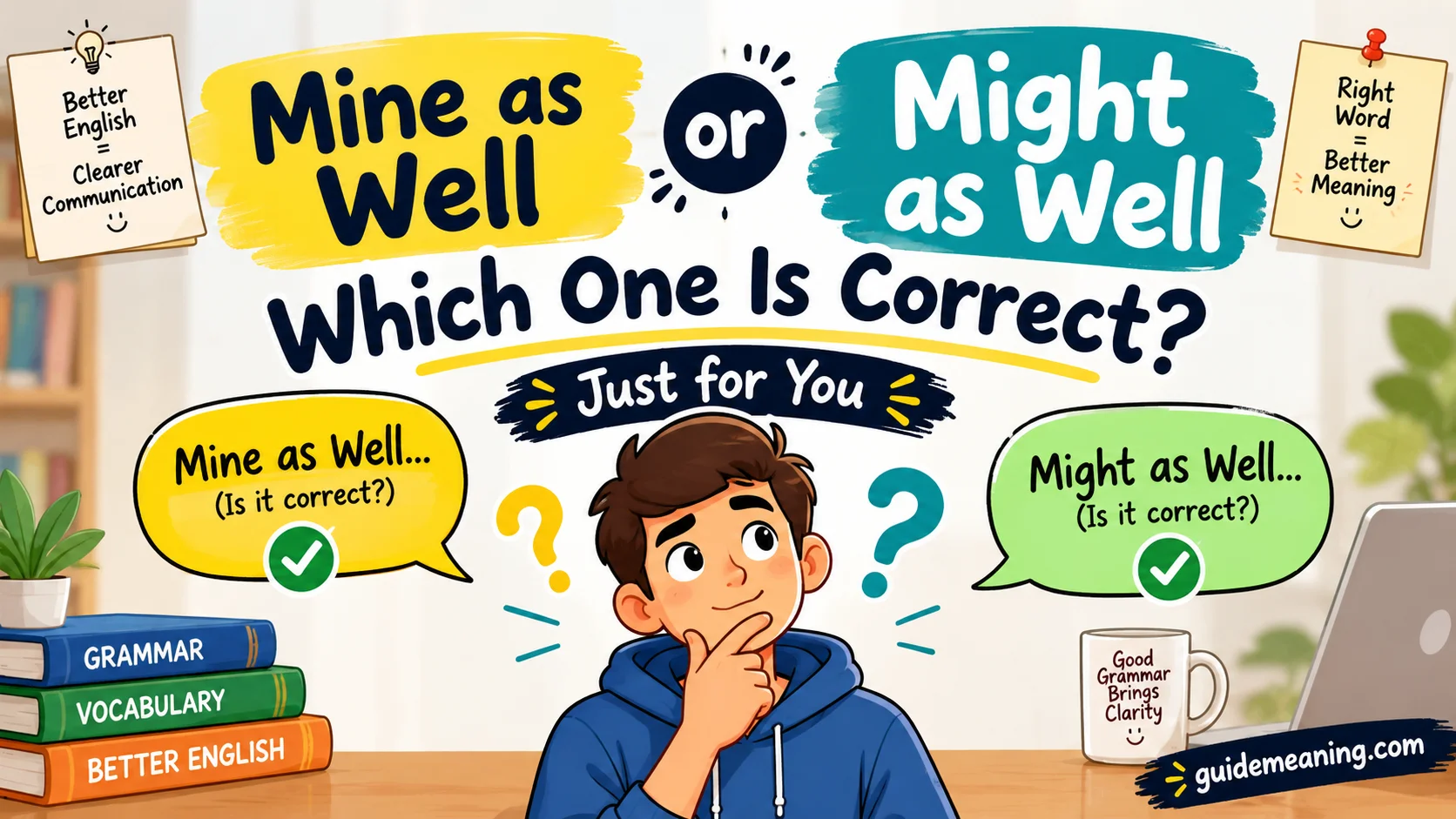

Mine as Well or Might as Well is easier to understand when you notice how English has tricky twins that sound alike but belong to different grammar neighborhoods. Might as well and mine as well are classic examples. In casual talk, fast English speech can cause a hearing mistake when spelling rules compete with what your brain thinks it hears. For English learners, the two phrases may seem very similar and have the same meaning, but mine as well is a common misspelling, spelling mistake, or spoken mistake caused by informal pronunciation, while might as well is the correct phrase in proper English. The difference between mine as well and might as well becomes clearer in standard English, where Might as well is the only correct phrase and a standard English idiom used in almost every situation where the expression fits.
Mine as well is a common mistake and wrong phrase in daily conversation, formal communication, writing, and exams, so the preferred form is “might as well.” The grammar rule and actual grammar rules show that the phrase can express an action that seems reasonable, useful, or worth doing under certain circumstances. As a practical guide, English learners should hear the phrase carefully, check the words they use in writing, and follow the rule to choose the standard expression. Real-life situations and easy examples make the distinction easier to remember.
In my experience, learners often recognize the correct expression after seeing it repeatedly in natural sentences, while practice exercises help the distinction become clearly understood. The article can explain these common mistakes through simple English, but the key point remains that might as well is grammatically correct, commonly accepted, and correctly used when it means that doing something is the reasonable or practical choice.
Let’s dive in!
Quick Answer:
“Might as well” is the correct expression when you mean that doing something makes sense because there’s no better option or little reason not to do it.
Correct: We’re already here, so we might as well stay.
Incorrect: We’re already here, so we mine as well stay.
Cambridge defines “may/might as well” as an expression used to suggest doing something, often when there’s nothing better to do. It also notes that “might as well” is more common than “may as well.”
However, “mine as well” isn’t always grammatically impossible. For example:
My shoes are wet. Mine as well.
Here, “mine” means “my shoes are wet too.” It has nothing to do with the idiom “might as well.” Scribbr also identifies this possessive use as a legitimate exception.
So, the easiest rule is:
If you mean “we may as well do it,” write “might as well.”
What Does “Might as Well” Mean?
“Might as well” is an idiomatic expression used when an action seems reasonable under the circumstances. Usually, the speaker sees no strong reason to avoid the action or no better alternative.
For example:
We’re already at the restaurant, so we might as well eat here.
The speaker isn’t necessarily saying the restaurant is fantastic. Instead, staying there makes sense because they’re already there.
That subtle distinction matters.
“Might as well” often carries a practical or slightly resigned tone. You’re choosing something because the circumstances point toward it.
Consider this situation:
You’ve driven 30 minutes to a store, only to discover that the item you wanted is sold out. Another store is five minutes away.
You might say:
We’re already out here. We might as well check the other store.
The phrase communicates practical reasoning. You aren’t celebrating the plan. You’re simply thinking, “Since we’re already here, why not?”
Cambridge describes the expression as a way to suggest what seems like the easiest or most logical course of action when there’s no better alternative.
Common meanings of “Might as Well”
Depending on context, “might as well” can suggest:
- There’s no reason not to.
- This is probably the easiest option.
- There’s nothing better to do.
- Given the circumstances, this makes sense.
- The alternatives aren’t any better.
- The outcome probably won’t change much.
- I’m accepting the situation, even if I’m not thrilled about it.
That last meaning gives the phrase some personality. Sometimes “might as well” sounds almost like a shrug in grammatical form.
Why Is “Might as Well” Correct?
The phrase “might as well” contains the modal verb “might.”
Modal verbs include words such as can, could, may, might, must, should, will, and would. They modify another verb and help express ideas such as possibility, necessity, intention, or judgment.
In this expression, “might” doesn’t simply express ordinary possibility.
Compare these sentences:
It might rain tonight.
Here, might expresses possibility.
Now compare:
It might as well rain tonight.
This has a different meaning. The speaker may be saying that the situation is effectively the same whether it rains or not, depending on context.
More commonly:
We might as well leave now.
This means leaving now seems like the sensible option.
Oxford’s learner dictionary similarly describes “may/might as well do something” as an expression used when something seems like the best thing to do in the current situation, even when the speaker may not particularly want to do it.
The Basic Structure
The standard pattern is:
Subject + might as well + base verb
For example:
- I might as well go.
- We might as well start.
- You might as well ask.
- They might as well stay.
- She might as well finish it.
Notice something important: the verb after “might” stays in its base form.
We might as well leave.
Not:
We might as well leaves.
And not:
We might as well leaving.
Because might is a modal verb, it takes the base form of the following verb. Oxford specifically notes this general modal-verb pattern.
Why Is “Mine as Well” Usually Incorrect?
The confusion starts with the word “mine.”
Mine is normally a possessive pronoun. It indicates that something belongs to the speaker.
For example:
That laptop is mine.
The red jacket is mine.
This seat is mine.
In those sentences, mine has a clear possessive function.
The problem appears when someone substitutes mine for might in the idiom:
We mine as well leave.
That sentence doesn’t express the intended idea. Mine cannot replace might in the fixed expression.
The correct sentence is:
We might as well leave.
This distinction becomes especially clear when you compare their grammatical roles:
| Word | Grammatical role | Example |
| might | Modal verb | We might leave. |
| mine | Possessive pronoun | The car is mine. |
| as well | Phrase meaning “also” or forming an idiomatic construction | I want to go as well. |
So, although “mine as well” and “might as well” can sound similar, their grammar is completely different.
When Can “Mine as Well” Actually Be Correct?
Here’s where things get interesting.
“Mine as well” can be correct when “mine” functions as a possessive pronoun. In that case, it usually means “mine too” or “the same thing is true of mine.”
For example:
My back hurts.
Mine as well.
The second speaker means:
My back hurts as well.
Here, mine stands for something already mentioned. The full version might be:
My back hurts, and mine does as well.
In casual conversation, speakers may shorten this to:
Mine as well.
Scribbr gives essentially this type of possessive use as the legitimate exception to the common misspelling.
Compare the Two Uses
We might as well leave.
Meaning: Leaving makes sense under the circumstances.
My hands are cold. Mine as well.
Meaning: My hands are cold too.
These sentences look similar on the page, but their grammar and meanings are worlds apart.
A Simple Test
Ask yourself:
Am I talking about doing something, or am I talking about something belonging to me?
If you’re talking about doing something, use:
might as well
If you’re saying something is mine too, then:
mine as well
can be correct.
“Might as Well” vs. “Mine as Well”: Key Differences
| Feature | Might as Well | Mine as Well |
| Standard idiom | Yes | No |
| Main grammatical role | Idiomatic modal construction | Possessive construction |
| Typical meaning | No strong reason not to do something | Something belongs to me too |
| Followed by a base verb | Yes | No |
| Example | We might as well go. | My phone is broken. Mine as well. |
| Commonly confused in speech | Yes | Yes |
| Can be correct? | Yes | Yes, but only in a different possessive meaning |
The crucial point is that “mine as well” isn’t a replacement for “might as well.”
It only works when mine genuinely refers to something belonging to the speaker.
When Should You Use “Might as Well”?
When There Is Little Reason Not to Do Something
This is probably the most common use.
Suppose your friend asks whether you want coffee. You already have the kettle boiling.
You might say:
I’m making coffee anyway. You might as well have one.
The phrase suggests that adding another cup makes practical sense.
It doesn’t necessarily mean coffee is the best possible choice. It simply means there’s little reason not to do it.
When the Situation Makes an Action Logical
Sometimes circumstances make the decision almost obvious.
The meeting starts in five minutes, so we might as well head upstairs.
The speaker isn’t necessarily excited about moving. It’s simply the logical next step.
When You Have No Better Option
Imagine your flight gets delayed for three hours.
You could sit around complaining. Or you could find a quiet restaurant and have dinner.
You might say:
We have three hours to kill. We might as well get something to eat.
The expression fits because the situation leaves you with plenty of time and no particularly attractive alternative.
When Making a Casual Suggestion
You can also use “might as well” to make a suggestion sound relaxed.
You’re already going to the store. You might as well pick up some milk.
This sounds less forceful than:
You should pick up some milk.
The first focuses on convenience. The second sounds more like advice or an obligation.
When Accepting an Unavoidable Situation
The phrase can also carry a resigned tone.
The rain isn’t stopping, so we might as well start walking.
The speaker may not want to walk in the rain. Still, waiting longer doesn’t seem useful.
That mild resignation is one reason “might as well” appears so often in everyday conversation.
Common Sentence Patterns With “Might as Well”
Learning the patterns makes the expression much easier to use naturally.
Subject + Might as Well + Base Verb
This is the simplest pattern.
I might as well stay.
We might as well leave.
You might as well try.
They might as well start.
Since + Situation + Might as Well
This pattern explains the reason behind the choice.
Since you’re already here, you might as well stay.
Since we’re waiting anyway, we might as well order dinner.
Since the store is closing soon, we might as well go now.
If + Situation + Might as Well
You can also frame the decision around a condition.
If we’re going to drive that far, we might as well stay overnight.
If you’re already cooking, you might as well make enough for everyone.
Might Just as Well
Adding “just” can make the expression stronger.
We might just as well take the train.
You might just as well tell her now.
Cambridge notes that “just” can strengthen “may as well” and “might as well.”
“Might as Well” in Questions and Suggestions
Although the phrase usually appears in statements, conversational English allows more flexible uses.
For example:
Might as well get started?
This can function as a casual suggestion, especially in conversation.
You might also answer a question with the phrase:
“Are you coming with us?”
“Sure. I might as well.”
That answer suggests that joining the group seems reasonable. The speaker doesn’t necessarily feel strongly about it.
Another example:
“Should we order dessert?”
“We might as well.”
The meaning is roughly:
Since we’re already here and there’s no strong reason not to, let’s do it.
That relaxed tone makes the expression common in informal American English.
“Might as Well” vs. “May as Well”
“May as well” is also correct.
Both expressions can suggest that something is the easiest or most logical choice under the circumstances. Cambridge states that both are fairly informal and notes that “might as well” is more common.
Compare:
We might as well leave now.
We may as well leave now.
Both sentences are grammatical.
In everyday American English, “might as well” often sounds more natural.
| Expression | Correct? | Common meaning | Everyday use |
| Might as well | ✅ | Logical or practical choice | Very common |
| May as well | ✅ | Logical or practical choice | Common |
| Mine as well | ❌ for this idiom | Not the intended meaning | Usually a mistake |
Don’t confuse “may as well” with “may also.”
These aren’t interchangeable.
You may also need an umbrella.
Here, also means something additional.
But:
You may as well take an umbrella.
Here, the speaker is suggesting the umbrella as a sensible choice.
Cambridge specifically warns that “may/might as well” doesn’t carry the same meaning as “may/might also.”
“Might as Well” vs. “Could as Well”
These expressions can overlap, but they aren’t identical.
“Might as well” emphasizes the practical choice.
We might as well take the bus.
This suggests that taking the bus makes sense given the circumstances.
“Could as well” can emphasize possibility or an available alternative.
We could take the bus.
That simply presents the bus as one option.
The difference is subtle but useful:
- Could = this is an available option.
- Might as well = this option seems reasonable given the situation.
That’s why replacing one with the other can slightly change the speaker’s attitude.
“Might as Well” vs. “Should”
These expressions sometimes overlap, but “might as well” doesn’t always mean “should.”
Compare:
You should call your mother.
This sounds like advice. It can imply that calling her is the right thing to do.
Now:
You might as well call your mother while you’re free.
This focuses more on convenience or timing.
The second sentence doesn’t necessarily suggest a moral duty. It simply says the circumstances make calling a sensible choice.
The Tone Difference
| Phrase | Typical tone |
| You should go. | Advice or recommendation |
| You could go. | Possibility |
| You might go. | Possibility |
| You might as well go. | Practical choice or mild resignation |
That distinction helps you choose the phrase that matches your intended tone.
“Might as Well” vs. “As Well as”
These phrases look related, but they perform different jobs.
Might as Well
Used to suggest an action:
We might as well order now.
As Well As
Used to connect two things or actions:
She speaks Spanish as well as French.
The first expression concerns a practical decision.
The second expresses addition or comparison.
| Expression | Function | Example |
| Might as well | Suggests a practical action | We might as well leave. |
| As well as | Adds or compares information | She sings as well as she dances. |
| As well | Means “also” | I want dessert as well. |
Mixing these patterns can create awkward sentences, especially when you’re writing quickly.
Common Mistakes With “Might as Well”
Writing “Mine as Well”
This is the most relevant mistake for this topic.
❌ We mine as well go.
✅ We might as well go.
If the sentence contains a verb immediately after the phrase, “might as well” is almost certainly what you need.
Using the Wrong Verb Form
Because might is a modal verb, use the base form afterward.
❌ We might as well going.
❌ We might as well goes.
✅ We might as well go.
Confusing “Might as Well” With “Might Also”
These expressions don’t mean the same thing.
She might also come.
This means her arrival is another possibility.
She might as well come.
This suggests that, given the circumstances, her coming would make sense.
That’s a substantial difference in meaning.
Confusing “Might as Well” With “Should”
The two can overlap in some situations. However, “might as well” often carries a softer or more resigned tone.
You should finish the report.
You might as well finish the report while you’re here.
The second sentence sounds more situational and less authoritative.
Why Does “Might as Well” Sound Like “Mine as Well”?
The confusion largely comes from connected speech.
When native speakers talk naturally, they don’t pronounce every word as carefully as they might when reading aloud. Sounds can become reduced, linked, or less distinct.
The phrase “might as well” can therefore sound quite compressed in rapid conversation. Wiktionary records pronunciations including a connected-speech form in which the phrase can sound substantially different from its careful pronunciation.
That’s why someone may hear:
“might as well”
and mentally interpret it as:
“mine as well”
The ear catches the overall sound rather than every individual consonant.
Think of It Like This
Spoken English is often more like a flowing stream than a row of separate bricks.
Words touch each other. Sounds influence neighboring sounds. Some consonants become less prominent.
That doesn’t change the spelling.
So when you’re unsure, rely on the meaning and grammatical structure, not only on what you hear.
Real-Life Examples of “Might as Well”
Everyday Conversation
We’re already dressed. We might as well go out.
At Work
Everyone’s here now. We might as well start the meeting.
While Traveling
The train doesn’t leave for an hour. We might as well grab some coffee.
During a Delay
The flight is delayed again. We might as well find something to eat.
While Shopping
We’re already at the mall. We might as well look for the shoes.
Making Plans
If you’re going tomorrow, I might as well come with you.
Accepting a Change of Plans
The beach is closed. We might as well visit the museum.
Each sentence has the same underlying idea:
The circumstances make the action reasonable.
Case Study: How Context Changes the Meaning
Consider this short conversation:
Alex: The movie doesn’t start for another hour.
Jordan: We’re already downtown. We might as well get dinner first.
Jordan isn’t saying dinner is mandatory.
Jordan is making a practical decision based on the circumstances.
Now change the conversation:
Alex: Are you coming to dinner?
Jordan: Sure. I might as well.
Here, the phrase expresses a fairly casual acceptance. Jordan doesn’t sound wildly enthusiastic. The decision simply seems reasonable.
Now consider the possessive version:
Alex: My laptop is overheating.
Jordan: Mine as well.
This has nothing to do with making a practical choice.
Here, mine means “my laptop.”
The context tells you which grammar applies.
Quick Comparison: “Mine as Well” or “Might as Well”?
| Sentence | Correct? | Why? |
| We might as well leave. | ✅ | “Might as well” expresses a practical choice. |
| We mine as well leave. | ❌ | “Mine” can’t replace the modal verb “might.” |
| My computer is slow. Mine as well. | ✅ | “Mine” means “my computer.” |
| You might as well try. | ✅ | The attempt seems reasonable. |
| You mine as well try. | ❌ | Incorrect spelling for the idiom. |
| My feet hurt. Mine as well. | ✅ | “Mine” means “my feet.” |
The context is the key.
How to Remember the Correct Phrase
Here’s an easy memory trick:
If you’re talking about an action, think “might.”
We might as well go.
I might as well try.
You might as well ask.
They might as well stay.
If you’re talking about ownership, “mine” can make sense.
That bag is mine.
My phone is broken. Mine as well.
Another useful test is to ask:
Can I replace the phrase with “there’s no reason not to”?
If yes, you probably need “might as well.”
For example:
We might as well start.
Meaning:
There’s no reason not to start.
But:
My car is old. Mine as well.
You can’t apply that substitution. Here, mine means something belonging to the speaker.
Facts About “Might as Well”
- “Might as well” is a standard English idiomatic expression.
- It commonly introduces a practical suggestion or choice.
- It often appears when there is no clearly better alternative.
- “Might as well” is more common than “may as well,” according to Cambridge Grammar.
- The phrase can express mild resignation, not just enthusiasm.
- A base-form verb normally follows the modal might.
- “Mine as well” is usually a misspelling when the intended meaning is the idiom.
- “Mine as well” can still be grammatical when mine functions as a possessive pronoun.
- “Might as well” and “may as well” can often substitute for each other.
- “Might as well” does not simply mean “might also.”
FAQs:
Is “mine as well” correct English?
No. “Mine as well” is generally a mistake. The standard phrase is “might as well.”
What does “might as well” mean?
“Might as well” means that doing something seems reasonable or practical, especially when there is little reason not to do it.
Why do people say “mine as well”?
People may say “mine as well” because “might as well” can sound similar when spoken quickly. This creates a common hearing or spelling mistake.
Is “might as well” a grammar rule?
Yes. “Might as well” is a standard English expression. It’s commonly used to suggest that an action is a sensible choice.
Can I use “might as well” in formal writing?
Yes. “Might as well” is grammatically correct and can appear in both everyday conversation and appropriate formal writing.
Can “mine as well” ever replace “might as well”?
No, not when you mean the standard expression. Use “might as well” instead.
How can I remember the correct phrase?
Remember that the expression uses might, not mine. Reading and practicing sentences with “might as well” can help make the correct form automatic.
Conclusion
“Might as well” is the correct standard English phrase, while “mine as well” is usually a mistake caused by similar pronunciation. Although the two forms can sound alike in fast speech, their written forms are not interchangeable. When you want to say that something is reasonable or practical to do, choose “might as well.” With a little practice, this common confusion becomes easy to avoid.