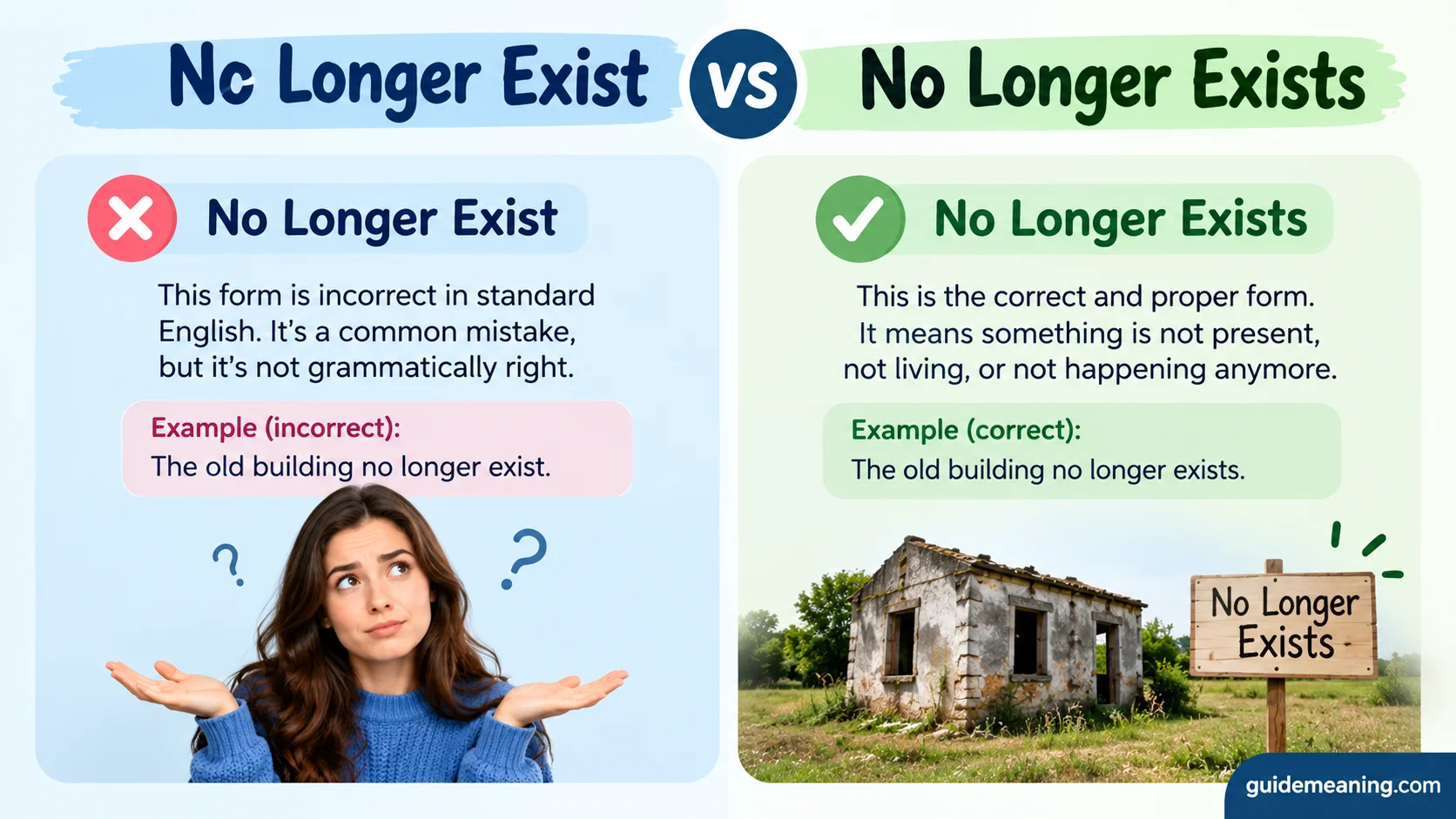

No Longer Exist vs. No Longer Exists becomes easier when you match the verb to its subject and follow a simple grammar rule. Grammar can feel like a tricky beast, even for native speakers, because complex rules and seemingly endless exceptions cause headaches. When choosing between these phrases, matching verbs with their subjects may seem easier said than done. The English language throws curveballs that make confident speakers second-guess themselves. However, the correct choice depends on the subject’s number. A single person or item, such as an old building, takes a singular verb form. Multiple people or items, including traditions, take a plural form. This simple rule helps writers use both phrases correctly.
The main difference between No Longer Exist and No Longer Exists is subject-verb agreement, not subject-verb tense. A singular subject takes No Longer Exists, while plural subjects take No Longer Exist. For example, “The old building no longer exists” describes one building, while “These traditions no longer exist” describes several traditions. Identifying the subject and selecting the right verb improves sentence structure, syntax, semantics, and pragmatics. Whether you write emails, business reports, website content, academic papers, or everyday conversations, proper usage helps convey ideas with clarity, accuracy, and precision. These standard English usage and writing rules also improve reader perception and create a reader-friendly flow. Learna Language explains both expressions through clear examples and practical explanations, helping learners, students, and English learners understand the correct grammar without confusion.
Think about old photos on your phone, a saved picture of a lost place, or a favorite spot that has been replaced by a modern shopping mall. You might pause for a quiet moment as something familiar disappears, leaving a memory behind. The same idea applies to old traditions, languages, and buildings that change over time. Context and subtle differences matter when using singular forms and plural expressions. A careful writer can understand the distinction by remembering singular subject singular verb and plural subject plural verb. If you mean one thing, choose “no longer exists.” If you mean many things, choose “no longer exist.” Instead of trying to memorize every example, focus on mastering the form and learning when and how to use each expression correctly. This builds confidence, prevents common mistakes, and helps you communicate naturally in real-life situations, writing, and speech.
Let’s dive in!
Quick Answer:
Both “no longer exist” and “no longer exists” are grammatically correct. The right choice depends on the subject of your sentence.
- No longer exists: Use this form with a singular third-person subject, such as he, she, it, or a singular noun.
- No longer exist: Use this form with plural subjects and the pronouns I, you, we, and they.
Here are a few quick examples:
- Correct: The old bookstore no longer exists.
- Correct: Those bookstores no longer exist.
- Correct: This rule no longer exists.
- Correct: These rules no longer exist.
- Correct: They no longer exist.
The easiest way to remember the rule is to identify the subject first. If you can replace the subject with it, use exists. If you can replace it with they, use exist. Remember that I and you also take exist, even when referring to one person.
Comparison Overview
The following table highlights the main differences between “no longer exist” and “no longer exists.”
| Feature | No Longer Exist | No Longer Exists |
| Grammatical form | Base verb | Third-person singular verb |
| Common subjects | I, you, we, they, plural nouns | He, she, it, singular nouns |
| Subject example | These products | This product |
| Example sentence | These products no longer exist. | This product no longer exists. |
| Meaning | Does not exist anymore | Does not exist anymore |
| Main grammar rule | Used with plural subjects and I/you/we/they | Used with singular third-person subjects |
Both expressions describe something that has stopped existing or is no longer present. Neither form is inherently more formal or more correct than the other.
The difference comes down to the subject. A singular subject such as the building takes exists, while a plural subject such as the buildings takes exist.
Main Differences Between “No Longer Exist” and “No Longer Exists”
The main difference between these expressions is verb agreement, not meaning. Both describe a situation in which something has ceased to exist, remain available, or be present. However, the grammatical subject determines which verb form belongs in the sentence.
Consider these examples:
- Singular: The local newspaper no longer exists.
- Plural: Local newspapers no longer exist.
- Singular: That online account no longer exists.
- Plural: Those online accounts no longer exist.
Notice how the verb changes when the subject changes from singular to plural. The phrase no longer stays exactly the same.
The Difference Between “Exist” and “Exists”
The verb exist means to be real, to be present, or to have a place in reality. It can describe physical objects, living things, organizations, ideas, relationships, and many other things.
In the simple present tense, English uses exist with most subjects. However, it adds -s when the subject is a third-person singular noun or pronoun.
| Subject | Correct Verb | Example |
| I | exist | I exist in this world. |
| You | exist | You exist for a reason. |
| He | exists | He exists in the story. |
| She | exists | She exists as a character in the novel. |
| It | exists | It exists in digital form. |
| We | exist | We exist within a larger system. |
| They | exist | They exist in several locations. |
| The building | exists | The building exists today. |
| The buildings | exist | The buildings exist today. |
Adding no longer doesn’t change this rule. You simply place the phrase before the verb.
For example, “The building exists” becomes “The building no longer exists.” Similarly, “The buildings exist” becomes “The buildings no longer exist.”
Why “No Longer” Doesn’t Change Subject–Verb Agreement
The phrase no longer means not anymore or not now, although something was previously true. It modifies the meaning of the sentence without changing the verb’s agreement requirements.
Compare these sentences:
- The restaurant exists.
- The restaurant no longer exists.
- The restaurants exist.
- The restaurants no longer exist.
The subjects determine whether you use exist or exists. The phrase no longer simply indicates that the previous state has ended.
This distinction matters because writers sometimes assume that adding extra words changes the grammatical structure. It doesn’t. The same subject–verb agreement rules apply whether the sentence is short or contains several descriptive phrases.
When to Use “No Longer Exists”
Use “no longer exists” when your subject is a singular third-person noun or pronoun. This construction works well when discussing one person, object, business, location, institution, rule, or concept.
For instance, if a company has permanently closed and ceased operating as a legal entity, you might write, “The company no longer exists.” The singular subject company requires exists.
Here are common situations where this form works naturally:
- A business that has ceased to exist.
- A building that has been demolished.
- A website that has been permanently removed.
- A rule that has been abolished.
- A tradition that people no longer practice.
- An organization that has dissolved.
However, be careful with the meaning. A business can stop operating without legally ceasing to exist. Likewise, a website can become unavailable temporarily without disappearing permanently. Grammar determines the verb form, but context determines whether the statement is factually accurate.
Examples of “No Longer Exists” With Singular Nouns
A singular noun refers to one person, place, thing, or concept. When it serves as the subject in a simple present-tense sentence, use exists.
Examples include:
- The old theater no longer exists.
- This website no longer exists.
- The original agreement no longer exists.
- That tradition no longer exists.
- The abandoned factory no longer exists.
- The previous version no longer exists.
- The local newspaper no longer exists.
- The ancient settlement no longer exists.
Each sentence refers to one subject. Therefore, the verb needs the third-person singular form.
You can also use this construction in professional writing. For example, “The previous policy no longer exists” is suitable when a company has replaced or formally withdrawn a policy. If the policy remains in effect but has changed, however, a more precise sentence might be “The previous policy is no longer in effect.”
Using “No Longer Exists” With Uncountable Nouns
Uncountable nouns refer to things that English doesn’t usually count as separate units. Examples include information, evidence, equipment, and infrastructure.
These nouns generally take singular verbs, even when they describe large quantities or many individual items.
Consider these examples:
- The evidence no longer exists.
- That information no longer exists in the database.
- The original infrastructure no longer exists.
- The old equipment no longer exists in its original form.
In each sentence, the noun functions grammatically as singular. Consequently, exists is the appropriate verb form.
Important distinction: Uncountable nouns don’t always behave the same way across related expressions. For example, information is uncountable, but pieces of information is plural. You would write “The information no longer exists” but “Those pieces of information no longer exist.”
This difference becomes especially useful in technical reports, academic writing, and discussions about digital records.
Using “No Longer Exists” With “It,” “He,” and “She”
The pronouns it, he, and she take third-person singular verbs in the simple present tense.
Examples:
- It no longer exists in its original form.
- He no longer exists as a character in the revised story.
- She no longer exists in the fictional universe described in the book.
These examples illustrate grammatical agreement, but the context matters. The phrase may describe a fictional character, a former identity, or something that has ceased to exist in a particular system.
For living people, avoid using no longer exists as a casual substitute for is no longer present. The former can imply that someone has died or ceased to exist. If you simply mean that someone left a place or organization, choose a more precise expression.
When to Use “No Longer Exist”
Use “no longer exist” with plural subjects and with the pronouns I, you, we, and they.
Plural nouns refer to more than one person, place, object, or concept. Since plural subjects generally take the base form of the verb in the simple present tense, exist is the correct choice.
For example, “The old factories no longer exist” is correct because factories is plural.
Common situations include discussions about discontinued products, demolished buildings, outdated traditions, dissolved organizations, and historical customs that have disappeared.
Examples of “No Longer Exist” With Plural Nouns
Here are examples showing how the base verb works with plural subjects:
- The old records no longer exist.
- Those stores no longer exist.
- Several restrictions no longer exist.
- These traditions no longer exist.
- The original files no longer exist.
- Many ancient settlements no longer exist.
- Those payment options no longer exist.
- The previous arrangements no longer exist.
The plural subject determines the verb form in each sentence.
This rule applies regardless of how far the subject appears from the verb. In a sentence such as “The documents stored in the old filing cabinet no longer exist,” the subject is documents. The phrase stored in the old filing cabinet provides extra information but doesn’t change the subject’s number.
Using “No Longer Exist” With “I,” “You,” “We,” and “They”
One common source of confusion is the assumption that exist always requires a plural subject. That’s incorrect.
The pronouns I and you take the base verb exist, even when they refer to one person. The same applies to we and they.
Examples:
- I no longer exist as a member of that online community.
- You no longer exist in the system as an active user.
- We no longer exist as an independent organization.
- They no longer exist in the current version of the game.
These sentences may sound unusual in certain contexts, but their verb forms are grammatically consistent. The surrounding context determines whether the meaning sounds natural.
For everyday situations, you might prefer more specific alternatives. For example, “You no longer have an active account” is clearer than “You no longer exist in the system” when discussing a canceled account.
Using “No Longer Exist” With Compound Subjects
A compound subject contains two or more subjects joined by a conjunction. When two separate subjects are joined by and, they generally take a plural verb.
Examples:
- The bookstore and the café no longer exist.
- The original rules and regulations no longer exist.
- The old website and its mobile application no longer exist.
- The two organizations no longer exist independently.
The final example highlights an important detail: meaning can influence how you phrase a sentence. If two organizations merge into one, they may no longer exist as separate entities even though the combined organization continues operating.
Not every compound subject automatically takes a plural verb. When two nouns express one combined idea or a single entity, the sentence may require singular agreement. For example, “The founder and CEO no longer exists as a separate role” can be appropriate if both titles refer to one position.
When the meaning becomes complicated, rewriting the sentence can improve clarity.
“No Longer Exist” vs. “No Longer Exists”: Examples Compared
Side-by-side examples make the difference easier to remember. Each pair below uses a similar meaning but changes the subject from singular to plural.
| Singular Subject | Plural Subject |
| The museum no longer exists. | The museums no longer exist. |
| This account no longer exists. | These accounts no longer exist. |
| The old rule no longer exists. | The old rules no longer exist. |
| That service no longer exists. | Those services no longer exist. |
| The historic building no longer exists. | The historic buildings no longer exist. |
| This product no longer exists. | These products no longer exist. |
| The original document no longer exists. | The original documents no longer exist. |
| The organization no longer exists. | The organizations no longer exist. |
The pattern remains consistent across different subjects. When you change a singular noun to its plural form, you usually change exists to exist.
Incorrect Examples and Their Corrections
Writers sometimes choose the wrong verb because they focus on the sentence’s meaning rather than its grammatical subject. Fortunately, the corrections are straightforward.
| Incorrect Sentence | Correct Sentence | Reason |
| The company no longer exist. | The company no longer exists. | Company is singular. |
| Those buildings no longer exists. | Those buildings no longer exist. | Buildings is plural. |
| This feature no longer exist. | This feature no longer exists. | Feature is singular. |
| The old traditions no longer exists. | The old traditions no longer exist. | Traditions is plural. |
| They no longer exists. | They no longer exist. | They takes the base verb. |
| It no longer exist. | It no longer exists. | It takes the third-person singular verb. |
The important lesson is simple: identify the subject before choosing the verb. Don’t let the length of a sentence or the words surrounding the subject distract you from the agreement rule.
How to Choose Between “No Longer Exist” and “No Longer Exists”
You don’t need to memorize dozens of examples to choose the correct expression. A few simple checks can help you make the right decision quickly.
Use the “It” or “They” Test
One of the easiest ways to identify the correct form is to replace the subject with it or they.
- If it works, use no longer exists.
- If they works, use no longer exist.
- If the subject is I, you, or we, use no longer exist.
For example, consider this sentence:
“The old computer system no longer exist.”
Replace the old computer system with it. You get “It no longer exist,” which sounds incorrect. The correct sentence is “The old computer system no longer exists.”
Now consider this sentence:
“The old computer systems no longer exists.”
Replace the old computer systems with they. You get “They no longer exists.” Again, the verb doesn’t agree with the subject. The correct sentence is “The old computer systems no longer exist.”
This quick test works in most everyday writing situations.
Find the Real Subject in Longer Sentences
Long sentences can make subject–verb agreement harder because additional nouns appear between the subject and the verb.
Consider this example:
“The collection of historical documents no longer exists.”
The subject is collection, not documents. Although documents is plural, the phrase of historical documents describes the collection. Since collection is singular, exists is correct.
Compare it with this sentence:
“The historical documents in the collection no longer exist.”
Here, the subject is documents. The phrase in the collection adds information but doesn’t change the subject’s plural form. Therefore, exist is correct.
Keep this distinction in mind whenever a sentence contains prepositional phrases such as of the records, in the building, or from the organization.
Common Mistakes to Avoid
Even experienced writers occasionally make subject–verb agreement errors. The following mistakes are worth watching for when proofreading your work.
- Using exist with a singular third-person subject: Write “The service no longer exists,” not “The service no longer exist.”
- Using exists with a plural subject: Write “The services no longer exist,” not “The services no longer exists.”
- Assuming no longer changes the verb: The phrase changes the meaning, not the agreement rule.
- Choosing the verb based on the nearest noun: Always identify the grammatical subject, even when other nouns appear closer to the verb.
- Confusing grammatical number with physical quantity: An uncountable noun such as equipment takes a singular verb, even when it refers to many items.
A useful proofreading habit is to read each sentence and ask, “Who or what no longer exists?” Once you’ve identified the subject, the correct verb usually becomes obvious.
“No Longer Exists” vs. “Doesn’t Exist Anymore”
Another common question concerns the difference between “no longer exists” and “doesn’t exist anymore.”
Both expressions communicate that something isn’t present or real anymore. However, they use different grammatical structures.
- No longer exists: The subject is followed by no longer and the appropriately inflected verb.
- Doesn’t exist anymore: The subject is followed by doesn’t, the base verb exist, and anymore.
Compare these examples:
| No Longer Exists/Exist | Doesn’t/Don’t Exist Anymore |
| The company no longer exists. | The company doesn’t exist anymore. |
| The companies no longer exist. | The companies don’t exist anymore. |
| This option no longer exists. | This option doesn’t exist anymore. |
| These options no longer exist. | These options don’t exist anymore. |
Notice that the verb after doesn’t remains exist, not exists. The auxiliary verb does already carries the third-person singular marking.
Therefore, “The company doesn’t exists anymore” is incorrect. The correct version is “The company doesn’t exist anymore.”
Both constructions are natural English. Choose the one that best fits your sentence and intended tone.
Other Alternatives to “No Longer Exists”
Sometimes, a different expression communicates your meaning more precisely. The best alternative depends on what has disappeared or changed.
| Alternative | Best Used For | Example |
| Has ceased to exist | Something that has ended completely | The organization has ceased to exist. |
| Is no longer around | Conversational references to people, places, or businesses | The old diner is no longer around. |
| Has been discontinued | Products, services, or features no longer offered | The software feature has been discontinued. |
| Has been abolished | Laws, rules, or formal systems that have been ended | The outdated regulation has been abolished. |
| Is no longer available | Products, services, or resources that cannot currently be accessed | The original model is no longer available. |
| Has disappeared | Something that has vanished or can no longer be found | The original record has disappeared. |
These alternatives aren’t always interchangeable. For instance, a product can be discontinued even though existing units remain in circulation. Similarly, a website might be unavailable because of a temporary technical problem rather than because it no longer exists.
Choose wording that reflects the actual situation instead of relying on a phrase that merely sounds similar.
FAQs:
What is the difference between “no longer exist” and “no longer exists”?
No longer exist is used with plural subjects, while no longer exists is used with singular subjects. For example, “These rules no longer exist” is correct, and “This rule no longer exists” is also correct.
Is “no longer exists” grammatically correct?
Yes, no longer exists is grammatically correct when the subject is singular. For example, “The old building no longer exists” correctly uses the singular verb exists.
Should I use “no longer exist” with plural subjects?
Yes, use no longer exist with plural subjects. For example, “These traditions no longer exist” is correct because the plural subject “traditions” takes the base form of the verb.
Is “no longer exist” correct for a singular subject?
No, not in a standard affirmative sentence with a singular subject. You should write “The problem no longer exists,” rather than “The problem no longer exist.”
What does “no longer exists” mean?
No longer exists means that something is not present, available, or in existence anymore. For example, “The old store no longer exists” means the store is no longer there or operating as it once did.
Can I use “no longer exist” when talking about people?
Yes, you can use no longer exist with plural subjects referring to people, depending on the context. For example, “Those communities no longer exist” means those communities are no longer present as they once were.
How can I remember when to use “exist” or “exists”?
Check whether the subject is singular or plural. Use exists with a singular subject, such as “The building exists,” and exist with a plural subject, such as “The buildings exist.” The same rule applies when you add “no longer.”
Conclusion:
Understanding No Longer Exist vs. No Longer Exists becomes simple when you focus on subject-verb agreement. Use no longer exists for a singular subject and no longer exist for a plural subject. Remember that the subject determines the correct verb form, even when the sentence includes extra details or longer phrases.
With regular practice, you can avoid common grammar mistakes and write more clearly. If you are preparing an academic paper, writing website content, or speaking in everyday conversations, this simple rule will help you choose the correct expression with confidence.